Beijing Launches Ice Hockey Program for Children

Students play in a ice hockey leauge held in Beijing on May 21, 2016. 749 students from 46 primary schools and middle schools in the city participated in the games. [Photo: qianlong.com]

 2016-06-07 20:10:49   From:  CRIENGLISH.com

Pupils in Beijing now have opportunities to play ice hockey.

Over 20 primary schools in the city have joined a program that aims to promote the sport and an athletic spirit among youngsters.

Initiated by the National Committee for the Wellbeing of the Youth and Beijing Ice Star Sports Management, the Thousands of Children on the Ice program will provide students with free professional ice hockey lessons and equipment.

The company said the program will use two of its existing rinks and another five that are expected to be put into operation later this year.

The program’s organizers hope the students can start to enjoy ice hockey games after playing it firsthand.

Ice hockey, known for its intense actions, is widely popular in North America and Europe.

But in China, the sport is still quite new. Relatively high costs of equipment and training have also prevented the sport’s growth here.

Ice hockey equipment cost 3,000 yuan (460 U.S. dollars) on average, while expenses for training can be as high as 100,000 yuan a year.

Beijing, as one of the host cities of the 2022 Winter Olympics, has been actively working to promote winter sports, including ice hockey, in recent years.

Thanks to these efforts, ice hockey has seen fast development here.

A total of 15 hockey clubs and 116 minor hockey teams have been set up in the city so far.

Source: Beijing Launches Ice Hockey Program for Children

DROP THE GLOVES: CANADA’S TOUGHEST HOCKEY LEAGUE

June 7, 2016    From: 

The LNAH has been called the toughest league in the world. Whereas the NHL averages around 0.3 fights per game, LNAH audiences are treated to more than four per game, with no shortage of bench-clearing brawls, fan fights, and, of course, poutine.

But the game is changing, and the pressure to reduce fighting in the LNAH has players wondering what that will mean for a league whose identity and brand revolved around violence for nearly two decades. The guys here make a few hundred dollars per game at most, and still it’s drawn over 200 former NHL players.

This VICE Sports documentary brings you behind-the-scenes with the Laval team as we follow some of the toughest players in the league during the playoffs, to discuss the pressure they feel to take their gloves off in the twilight of their hockey careers.

The All Blacks: Team for the corporate elite 

Dylan Cleaver on sport

Sport analysis and comment from Dylan Cleaver

Wednesday Jun 8, 2016    http://www.nzherald.co.nz/

Photo / Greg Bowker

The All Blacks have only rarely had to cultivate an image of being the team for all New Zealand.

Apart from a period during and post-1981, when they were the team for half of New Zealand, they’ve slotted unchallenged into that role.

Success will do that for you.

Sure, they’re never going to please everyone. There will always be a section of society that has a disdain for organised sport, particularly rugby, and the coverage it receives, but by and large New Zealanders take enormous pride in the fact the All Blacks consistently produce a team better than any other country can muster.

Success of your flagship team is about the best anti-blemish cream on the market, but there is a boil on the back of rugby here that needs lancing: the increasing creep of elitism into the game.

It is at that tingling, barely perceptible stage at the moment, but it threatens to burst to the surface.

It can be seen most obviously in Auckland, where New Zealand Rugby and toothless college sports bodies have allowed to run unchecked the domination of a few schools with chequebooks large enough to take the best players from low-decile schools.

It’s not the fact that these kids are often sold an unrealistic vision of a life of wealth in rugby that rankles most. Most damaging is the perpetuation of the idea that they should be grateful for being given the opportunity to escape less prestigious rugby environments.

One of the stated aims of NZ Rugby according to their latest AGM was to make rugby the game of choice for wider Auckland. By their own admission they have failed, but it is these schools and their born-to-rule old boys’ networks that are actively working against that aim – making it instead the game for narrower Auckland.

This creeping elitism can be also seen in pricing, where we’re asked to accept the idea that tickets to tests will be unaffordable to a large chunk of New Zealanders as if it is the most obvious thing in the world.

Said NZR chief executive Steve Tew to Fairfax a few days ago: “There’s no question when you get to the [Lions 2017] test matches the prices will be familiar to people having had a World Cup and Lions tour in the past. But we’ve got a number of games so there’ll be opportunity certainly for kids to come cheaply to watch the Super clubs.”

Tew has confirmed the fears of many: the All Blacks are only available to those who can pay the most, but never mind, there’s always the Blues!

Anybody who dares suggest that pricing the All Blacks for maximum return is not an ethos that sits well with the idea that they are a team for everyone is dismissed as having lost their “economic realities” faculties.

And maybe they have.

It is tough to keep producing the best team in the world and bloody expensive to provide the framework and infrastructure to enable that to happen, but I don’t believe people are naïve about this.

The rugby public grudgingly accepts that daylight tests are the Hanging Gardens of Babylon – a thing of great beauty and wonder that we’ll never see again. They painstakingly acknowledge that to watch the All Blacks live from the comfort of their couches, they will have to pay the broadcasters a monthly fee (which has just increased, again).

They might cringe when the front of the shirt – “it’s not a jersey, it’s a portal through which men pass” – is sold to an American insurer, just one more piece of crass commercialism that was captured inventively here by The Spinoff’s Calum Henderson, but understood it to be inevitable.

They have long accepted that the All Blacks’ mystique is available to the highest bidder, but they will surely baulk at the idea that All Blacks tests have become the domain of the corporate elite. “The team of the boardroom” does not quite have the same ring to it.

NZ Rugby is in the midst of a gilded age. The All Blacks are back-to-back world champions. They are led by a popular coach and are sprinkled with a seemingly neverending supply of stardust.

They can host a side that has played seven tests in New Zealand and lost all seven by a combined score of 284-46 and put the “Full House” signs out. They can point at those signs and say the market has spoken.

Eden Park is not sold out because they’re seduced by the allure of Wales, or the night-time time elements, or the extortionately priced food and beverage; they’re coming because the All Blacks are the hottest ticket in town.

And NZ Rugby are milking that for all its worth. They just need to remember, from time to time, that the bedrock of the sport here and what separates it from most of the other rugby playing nations is its egalitarian appeal. The All Blacks need to remain the face of that appeal.

Lose that and only time will tell what else you might lose in the process.

Source: The All Blacks: Team for the corporate elite – Sport – NZ Herald News

The Prime Minister announces changes in the senior ranks of the Public Service

OTTAWA, June 7, 2016 /CNW/ – The Prime Minister, Justin Trudeau, today announced the following changes in the senior ranks of the Public Service:

Serge Dupont, currently Deputy Clerk of the Privy Council and Associate Secretary to the Cabinet, will take on additional responsibilities as Deputy Minister of Intergovernmental Affairs, effective June 23, 2016.

Marta Morgan, currently Associate Deputy Minister of Finance, becomes Deputy Minister of Immigration, Refugees and Citizenship, effective June 27, 2016.

Manon Brassard, currently Assistant Deputy Minister, Compensation and Labour Relations, Treasury Board Secretariat, becomes President of the Economic Development Agency of Canada for the Regions of Quebec, effective June 27, 2016.

Stephen Lucas, currently Deputy Secretary to the Cabinet (Plans and Consultations and Intergovernmental Affairs), Privy Council Office, becomes Senior Associate Deputy Minister (Climate Change) of Environment and Climate Change, effective June 23, 2016.

Chantal Maheu, currently Assistant Secretary to the Cabinet (Priorities and Planning), Privy Council Office, becomes Deputy Secretary to the Cabinet (Plans and Consultations), Privy Council Office, effective September 6, 2016.

Ian McCowan, currently Deputy Secretary to the Cabinet (Legislation and House Planning and Machinery of Government), Privy Council Office, becomes Deputy Secretary to the Cabinet (Governance), Privy Council Office.  This change in title takes effect immediately.

The Prime Minister took the opportunity to congratulate Margaret Biggs, Senior Advisor to the Privy Council, Anita Biguzs, Deputy Minister of Immigration, Refugees and Citizenship, and Ward Elcock, Special Advisor to the Privy Council Office on the occasion of their retirements from the Public Service, following distinguished careers marked by dedication and excellence in serving Canadians.

Biographical notes attached.

This document is also available at http://pm.gc.ca


SERGE DUPONT

EDUCATION

International Diploma, Public Administration, École Nationale d’Administration, Paris
Master of Management Sciences, University of Waterloo
Bachelor of Management Sciences (Operational Research), University of Ottawa

PROFESSIONAL EXPERIENCE

Since May 2016
Deputy Clerk of the Privy Council and Associate Secretary to the Cabinet

2014 – 2016
Executive Director, International Monetary Fund (Constituency of Canada, Ireland and the Caribbean)

2010 – 2014
Deputy Minister of Natural Resources

2009 – 2010
Deputy Minister of Intergovernmental Affairs, Privy Council Office and Special Advisor to the Minister of Natural Resources on Nuclear Energy Policy

2008 – 2009
Associate Deputy Minister of Natural Resources

2005 – 2008
Director General and then Assistant Deputy Minister, Financial Sector Policy, Finance Canada

2001 – 2005
Director General, Tax Policy (Analysis), Finance Canada

1999 – 2001
Director General, Corporate Governance, Industry and Science Policy Sector, Industry Canada

1997 – 1999
Corporate Secretary, Industry Canada

1996 – 1997
Departmental Assistant, Office of the Minister, Finance Canada

1993 – 1996
Finance Counsellor, Canadian Embassy in Paris

1991 – 1993
Chief, Current Economic Conditions, International Trade and Finance Branch, Finance Canada

1990 – 1991
Senior Analyst, then Acting Chief, Strategic Planning, Sales Tax Division, Tax Policy Branch, Finance Canada

1986 – 1989
Analyst, Privatization Directorate, Office of Privatization and Regulatory Affairs

1983 – 1986
Analyst, Energy Policy Research Group, then Special Assistant to the Chair, Economic Council of Canada


MARTA MORGAN

EDUCATION

Master in Public Policy, Harvard University
Bachelor of Arts, Economics (Honours), McGill University

PROFESSIONAL EXPERIENCE

Since August  2014
Associate Deputy Minister of Finance

2012 – 2014
Associate Deputy Minister of Industry

2011 – 2012
Assistant Deputy Minister, Industry Sector, Industry Canada

2009 – 2011
Assistant Deputy Minister, Strategic Policy Sector, Industry Canada

2003 – 2009
Vice President, Trade and Competitiveness, Forest Products Association of Canada

2000 – 2001
Director General, Social Policy, Human Resources Development Canada

1997 – 2000
Director, Children’s Policy, Human Resources Development Canada

1993 – 1997
Various positions, Privy Council Office


MANON BRASSARD

EDUCATION

Bachelor of Law, Université Laval

PROFESSIONAL EXPERIENCE

Since February 2014
Assistant Deputy Minister, Compensation and Labour Relations, Treasury Board Secretariat

2013 – 2014
Assistant Deputy Minister, Programs, Agriculture and Agri-Food Canada

2010 – 2013
Assistant Deputy Minister, Corporate Services, Citizenship and Immigration Canada

2003 – 2010
Vice President, Operations, Economic Development Agency of Canada for the Regions of Quebec

2002 – 2003
Director General, Policy, Planning and Research, Immigration and Refugee Board

2001 – 2002
Director General, Office of the Implementation Act, Immigration and Refugee Board


STEPHEN LUCAS

EDUCATION

Ph.D. (Structural Geology and Tectonics), Brown University
Bachelor of Science with Honours (Geological Engineering), Queen’s University

PROFESSIONAL EXPERIENCE

Since July 2014
Deputy Secretary to the Cabinet (Plans and Consultations and Intergovernmental Affairs), Privy Council Office

2013 – 2014
Assistant Secretary to the Cabinet, Economic and Regional Development Policy, Privy Council Office

2009 – 2013
Assistant Deputy Minister, Science and Policy Integration, Natural Resources Canada

2007 – 2009
Assistant Deputy Minister, Minerals and Metals Sector, Natural Resources Canada

2003 – 2007
Director General, Health Products and Food Branch, Health Canada

2000 – 2003
Senior Director, Science, Innovation, Regional and Aboriginal Affairs, Natural Resources Canada

1998 – 2000
Director, Policy Planning and Coordination, Earth Sciences Sector, Natural Resources Canada

1988 – 1998
Research Scientist, then Subdivision Head, Geological Survey of Canada, Natural Resources Canada


CHANTAL MAHEU

EDUCATION

Master of Arts, Economics, Queen’s University
Bachelor of Business Administration, École des Hautes Études Commerciales

PROFESSIONAL EXPERIENCE

Since June 2014
Assistant Secretary to the Cabinet (Priorities and Planning), Privy Council Office

2011 – 2014
Director General, Federal-Provincial Relations and Social Policy, Finance Canada

2006 – 2011
Director General, Energy Policy, Natural Resources Canada

2004 – 2006
Director of Operations and Acting Assistant Secretary, Canada-United States Secretariat, Privy Council Office

2000 – 2004
Director, Health Care System Division, Health Canada

1997 – 2000
Acting Chief and Chief, Economic Development and Corporate Finance, Finance Canada


IAN MCCOWAN

EDUCATION

Master of Law, University of Cambridge, England
Bachelor of Laws, Queen’s University
Bachelor of Commerce, Queen’s University

PROFESSIONAL EXPERIENCE

Since March 2015
Deputy Secretary to the Cabinet (Legislation and House Planning and Machinery of Government), Privy Council Office

2012 – 2015
Assistant Secretary to the Cabinet (Communications and Consultations), Privy Council Office

2006 – 2012
Assistant Commissioner, Policy, Correctional Service of Canada

2001 – 2006
Director and General Counsel, Correctional Service Canada Legal Services, Justice Canada

1999 – 2001
Director and Senior Counsel, Parks Canada Agency Legal Services, Justice Canada

1993 – 1999
Counsel, Civil Litigation Section, Justice Canada


SOURCE Prime Minister’s Office

Source: The Prime Minister announces changes in the senior ranks of the Public Service

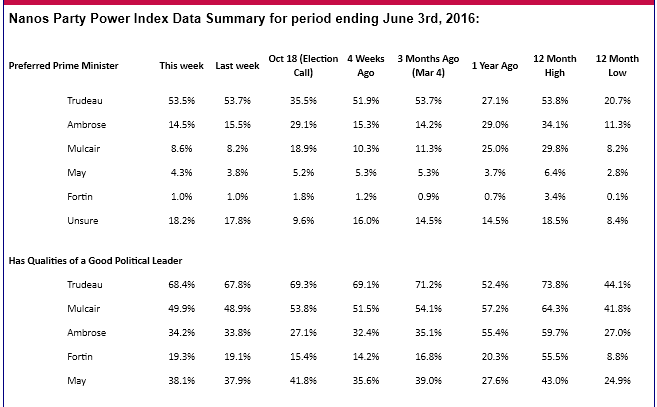
Seven in ten Canadians say Trudeau has qualities of a good political leader, Mulcair scores second highest (ending June 3, 2016)

Nanos Weekly Leadership Tracking

  • Preferred Prime Minister – The latest Nanos tracking has 53.5 per cent of Canadians preferring Trudeau as Prime Minister while 14.5 per cent preferred Ambrose, 8.6 per cent preferred Mulcair, 4.3 per cent preferred May and 18.2 per cent were unsure.
  • Qualities of a Good Political Leader – Asked a series of independent questions for each federal party leader almost seven of ten Canadians (68.4%) thought Trudeau had the qualities of a good political leader, one of two (49.9%) had similar views of Mulcair.  May was seen as a good political leader by 38.1 per cent of Canadians and Ambrose by 34.2 per cent of Canadians.

The team at Nanos in conjunction with Klipfolio have launched our new live political data portal where you run the numbers you want and can explore the trends and data you need.  This is part of our campaign, not only to provide the most reliable data to Canadians but to let them use it as they wish. We were the first to do nightly tracking and now we are the first research organization to post live public opinion data for Canadians.

We were the first to do nightly tracking and now we are the first research organization to post live public opinion data for Canadians. Here’s the link to check it out.

To view the detailed tracking visit our website.

Methodology

The views of 1,000 respondents are compiled into a party power brand index for each party that goes from 0 to 100, where 0 means that the party has no brand power and 100 means it has maximum brand power. A score above 50 is an indication of brand power for the party and its leader at this time.

The important factors in this weekly tracking include the direction of the brand strength or weakness and also the brand power of one federal party relative to another.

The data is based on random telephone interviews with 1,000 Canadians, using a four week rolling average of 250 respondents each week, 18 years of age and over. The random sample of 1,000 respondents may be weighted by age and gender using the latest census information for Canada, and the sample is geographically stratified to be representative of Canada.

The interviews are compiled into a four week rolling average of 1,000 interviews where each week, the oldest group of 250 interviews is dropped and a new group of 250 interviews is added. The current wave of tracking is based on a four-week rolling average of 1,000 Canadians (250 per week) ending June 3rd, 2016.

A random telephone survey of 1,000 Canadians is accurate 3.1 percentage points, plus or minus, 19 times out of 20.

All references or use of this data must cite “Nanos Party Power Index” as the source.

FireShot Screen Capture #305 - '' - _C__Users_apchernoff_Desktop_Seven%20in%20ten%20Canadians%20say%20Trudeau%20has%20qualities%20of%20a%20good%20poli