Statement by the Prime Minister of Canada on National Public Service Week 2016 

Ottawa, Ontario
12 June 2016

The Prime Minister, Justin Trudeau, today issued the following statement for National Public Service Week 2016:

“This National Public Service Week, I invite Canadians to join me in celebrating our federal Public Service.

“Every day, public servants work hard to strengthen the middle class and improve the lives of all Canadians. Their commitment ensures that we receive the services we need, no matter the pressures they face or the challenges before them.

“The theme of National Public Service Week, ‘Proudly Serving Canadians,’ could not be more apt. Since last November, my team and I have seen the passion and dedication of Canada’s public servants in every task and project that they undertake. Whether helping resettle more than 25,000 Syrian refugees into Canada, or assisting the thousands of Canadians affected by the devastating wildfires in Fort McMurray, Canada’s public servants make a real difference – day in and day out – in the lives of Canadians and people around the world.

“Our public servants understand that to remain focused on the people we serve, we must work together to make openness and transparency key values of our institutions. They understand the need to renew and modernize so that together we can – effectively and efficiently – meet the needs of Canadians today and into the future.

“Now is also the time to build and promote a welcoming and healthy federal Public Service environment in which public servants can access the support they need in times of personal crisis. A healthy workplace is a proud workplace – a dynamic, engaging, and appealing one to young Canadians looking for an exciting career that helps them make a real difference in the lives of others.

“To public servants, I say thank you for all that you do to help us tackle the real challenges that we face as a country. You serve a vital role in our democracy, and are a source of pride and a model to other countries and governments. It is truly a privilege to work with you every single day.

“I look forward to the great things we will achieve together for all Canadians.”

Source: Statement by the Prime Minister of Canada on National Public Service Week 2016 | Prime Minister of Canada

Kuzma: Benning bullish on fifth overall draft pick, but Canucks GM will listen to trade offers

VANCOUVER, BC – JANUARY 28: Pierre-Luc Dubois #18 of Team Orr skates up ice with the puck during the CHL/NHL Top Prospects Game January 28, 2016 at Pacific Coliseum in Vancouver, British Columbia, Canada. Photograph by: Jeff Vinnick , Vancouver Sun

BY BEN KUZMA JUNE 10, 2016

There are at least three forwards and three defencemen who could command interest when the Vancouver Canucks select fifth in the National Hockey League draft on June 24 in Buffalo.

There could be just as many trade offers to consider because the phone is ringing, and general manager Jim Benning and his staff are preparing for what is expected to be an active period before Auston Matthews is picked first overall.

The Canucks know they can land a foundation player — centre/winger Pierre-Luc Dubois, left winger Matthew Tkachuk or puck-moving defenceman Olli Juolevi, depending on what the Edmonton Oilers do with the fourth pick — but they could also make their club better now and in the future by moving the selection and getting a proven and young top-six player.

That’s plenty to ponder.

“Teams have been calling and enquiring about the fifth pick,” Benning said Thursday from the Canucks’ amateur scouting meetings in Whistler.

“We want to be prepared for any scenario that could come up at the draft. But depending on who’s there when we pick, we know we’re getting a good player. We’re not looking to move the pick, but I wouldn’t be doing my job if teams call and make offers for the pick and we didn’t consider the offers.

“We’re doing our due diligence. If we can move down and get a top-six player and a second-round pick, we have to keep our options open. I’m not saying we’re going to do anything, but we need to be prepared for any situation that may come up. But at the end of the day, if we go in and pick at No. 5, I’m real confident that we’re getting a piece that will help us win and be part of our future for a long time.”

The Canucks interviewed 70 players at the recent draft combine. Benning came away with a heightened level of satisfaction in how prospects conducted themselves, how articulate they were and how they were better prepared than even the previous year.

———————————————————-

Ben Kuzma tells Jeff Paterson about his recent chat with Canucks GM Jim Benning about the coming NHL Entry Draft. Listen here.

———————————————————-

That’s crucial. Playing the game is one thing, but being mentally mature and understanding the team concept at the pro level is crucial for impressionable players who dominate the junior ranks.

“It made me feel that we’re going to get a good player and a solid person,” added Benning, who noted that Tkachuk was really impressive in his interview with the Canucks.

Dubois and Tkachuk are of obvious interest as future first-liners because the Canucks need to formulate a succession plan for the eventual departure of Henrik and Daniel Sedin. It’s why a centre like the 6-foot-6 Logan Brown may pique their interest and why defencemen Mikhail Sergachev and Jake Bean merit some consideration.

The delicate dance of being more competitive now and retooling on the fly is easier said than done. The Canucks were active in the last draft at Florida when they showed interest in trading for Milan Lucic and then tried to land a second-round pick in 2015.

They thought they had one from San Jose in a possible Kevin Bieksa deal, but he wasn’t moved until the following week to Anaheim for a second-round pick in 2016. That pick was moved to Pittsburgh in the Brandon Sutter trade. The Canucks also tried to get a second-rounder for Eddie Lack, who was moved to Carolina at the last draft for third-round pick in 2015 and seventh-round pick in 2016.

The Canucks have first and third-round picks this year, but not a coveted second-round pick. They have identified their top 60 players for this draft and it’s imperative that the sixth through 30 picks are figured out in order of preference in case the round turns into the trade show.

The amateur meetings focus Thursday was also about making sure they’re all on the same page with what to do in the later rounds — especially the fifth, sixth and seventh where they could not only add depth, but find a diamond in the rough. In the fifth round, the Canucks selected Ben Hutton in 2012, Frank Corrado in 2011 and Bieksa in 2001. Joe Cannata was a sixth-round pick in 2009 and Jannik Hansen a ninth-rounder in 2004.

OF NOTE — The Canucks will hold pro-scouting meetings next week in advance of the buyout window and the plan for nine unrestricted free agents in the organization — including Dan Hamhuis — and which of seven restricted free agents to qualify. The Canucks expect to announce their training-camp location within the next two weeks.

bkuzma@postmedia.com

twitter.com/@benkuzma

Source: Kuzma: Benning bullish on fifth overall draft pick, but Canucks GM will listen to trade offers

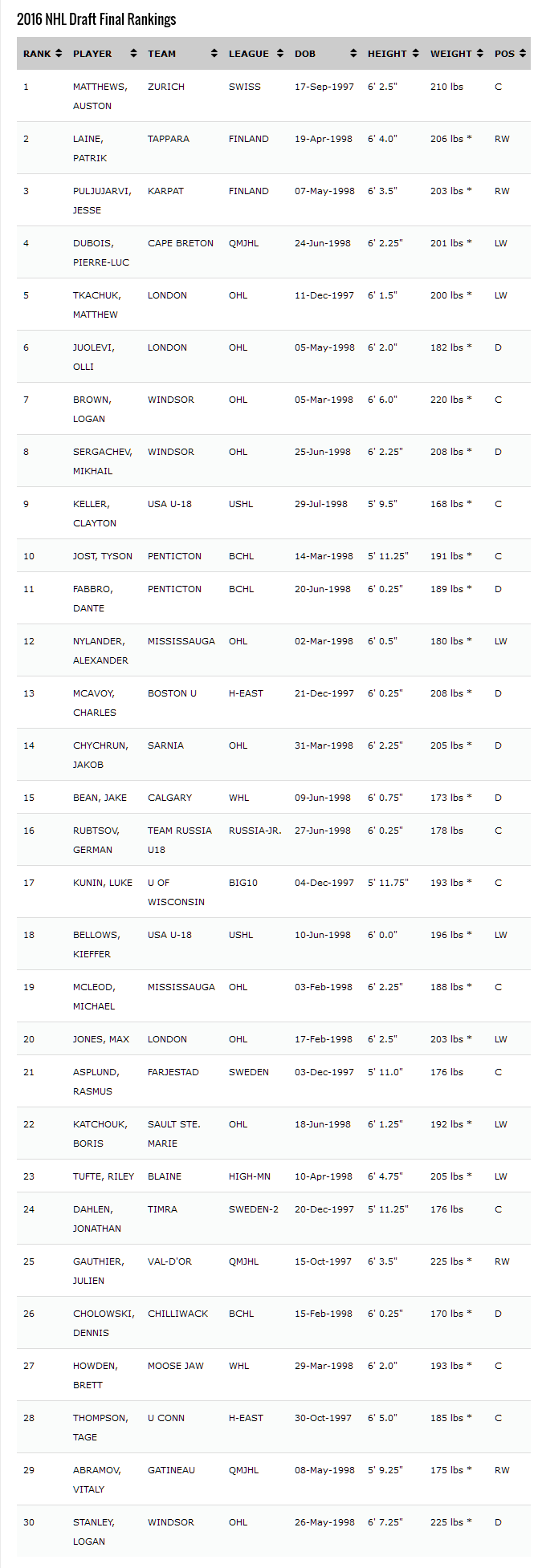
2016 NHL Draft Rankings: HockeyProspect.com Final Top 30

From living computers to nanorobots: how we’re taking DNA beyond genetics

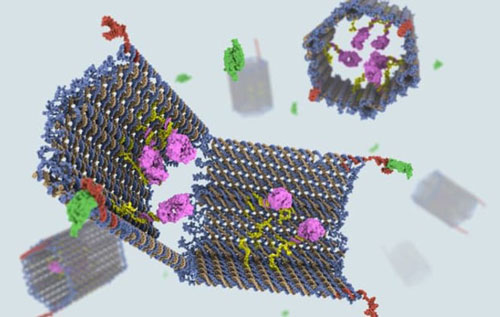
DNA barrel. (Image: Campbell Strong, Shawn Douglas, & Gaël McGill) Read more: From living computers to nanorobots: how we’re taking DNA beyond genetics

(Nanowerk News) DNA is one of the most amazing molecules in nature, providing a way to carry the instructions needed to create almost any lifeform on Earth in a microscopic package.

Now scientists are finding ways to push DNA even further, using it not just to store information but to create physical components in a range of biological machines.

Deoxyribonucleic acid or “DNA” carries the genetic information that we, and all living organisms, use to function. It typically comes in the form of the famous double-helix shape, made up of two single-stranded DNA molecules folded into a spiral. Each of these is made up of a series of four different types of molecular component: adenine (A), guanine (G), thymine (T), and cytosine (C).

Genes are made up from different sequences of these building block components, and the order in which they appear in a strand of DNA is what encodes genetic information. But by precisely designing different A,G,T and C sequences, scientists have recently been able to develop new ways of folding DNA into different origami shapes (Nature, “Folding DNA to create nanoscale shapes and patterns”), beyond the conventional double helix.

This approach has opened up new possibilities of using DNA beyond its genetic and biological purpose, turning it into a Lego-like material for building objects that are just a few billionths of a metre in diameter (nanoscale).

DNA-based materials are now being used for a variety of applications, ranging from templates for electronic nano-devices, to ways of precisely carrying drugs to diseased cells.

DNA-based nanothermometers

Designing electronic devices that are just nanometres in size opens up all sorts of possible applications but makes it harder to spot defects. As a way of dealing with this, researchers at the University of Montreal have used DNA to create ultrasensitive nanoscale thermometers (Nano Letters, “Programmable Quantitative DNA Nanothermometers”) that could help find minuscule hotspots in nanodevices (which would indicate a defect). They could also be used to monitor the temperature inside living cells.The nanothermometers are made using loops of DNA that act as switches, folding or unfolding in response to temperature changes. This movement can be detected by attaching optical probes to the DNA. The researchers now want to build these nanothermometers into larger DNA devices that can work inside the human body.

Biological nanorobots

Researchers at Harvard Medical School have used DNA to design and build a nanosized robot that acts as a drug delivery vehicle to target specific cells (Science, “A Logic-Gated Nanorobot for Targeted Transport of Molecular Payloads”).

The nanorobot comes in the form of an open barrel made of DNA, whose two halves are connected by a hinge held shut by special DNA handles. These handles can recognise combinations of specific proteins present on the surface of cells, including ones associated with diseases.

When the robot comes into contact with the right cells, it opens the container and delivers its cargo. When applied to a mixture of healthy and cancerous human blood cells, these robots showed the ability to target and kill half of the cancer cells, while the healthy cells were left unharmed. DNA barrel. Campbell Strong, Shawn Douglas, & Gaël McGill

Bio-computers in living animals

Because DNA structures can act as switches, moving from one position to another and back again, they can be used to perform the logical operations that make computer calculations possible. Researchers at Harvard and Bar-Ilan University in Israel have used this principle to build different nanoscale robots that can interact with each other, using their DNA switches to react to and produce different signals.

What’s more, the scientists implanted the robots into a living animal, in this instance a cockroach (Nature Nanotechnology, “Universal computing by DNA origami robots in a living animal”). This allowed them to develop a novel type of biological computer that can control the delivery of therapeutic molecules inside the cockroach by switching elements of their structure “on” or “off”. A trial of these DNA nanorobots is now scheduled to take place in humans.

Light-harvesting antennas

As well as creating minuscule machines, DNA can provide a way for us to copy natural processes at the nanoscale. For example, nature can capture energy from the sun using photosynthesis to convert light into chemical energy, which acts as fuel for plants and other organisms (and the animals that eat them).

Researchers at Arizona State University and the University of British Columbia have now built a three-arm DNA structure that can capture and transfer light that mimics this process (JACS, “A DNA-Directed Light-Harvesting/Reaction Center System”).

Photosynthesis occurs in living organisms thanks to tiny antennas made up of a large number of pigment molecules at specific orientations and distances from each other, which are able to absorb visible light.

The artificial DNA-based structures act as similar antennas, controlling the position of specific dye molecules that absorb the light energy and channel it to a reaction centre where it is converted into chemical energy.

This work could pave the way for devices capable of more efficiently using the most abundant source of energy we have at our disposal: sunlight.

So what’s next for DNA nanotechnology? It is hard to know but, with DNA, nature has given us a very versatile tool. It is now up to us to make the best use of it.

Source: By Matteo Palma, Queen Mary University of London
Source: From living computers to nanorobots: how we’re taking DNA beyond genetics