
The Grand Forks Sun, June 19, 1914
The Boundary Creek Times, June 19, 1903
The Phoenix Pioneer, June 19, 1909
The Boundary Creek Times, June 19, 1908
Source: https://open.library.ubc.ca/collections/bcnewspapers

Source: https://open.library.ubc.ca/collections/bcnewspapers

JUNE 18, 2016
For the first time this century, the Vancouver Canucks own a top-five pick at the NHL Draft.
Though general manager Jim Benning has been fielding calls and listening to offers on the pick, the club is comfortable at five and seems to be excited about adding a new top prospect to the pipeline.
Barring a Godfather offer – the sort that one ‘can’t refuse’ – the club isn’t eager to move down.
“We’ve got the fifth pick and we really like the players available at five,” Benning told Sportsnet this week. “We think it’s going to be a first line player as a forward or a first pair player as a defenceman.
“There are two forwards we really like and a defenceman, or a couple defencemen, who we really like and we’re getting one of those players,” Benning continued, while emphasizing that he didn’t expect to be able to move up in the draft order.
Assuming the Canucks use the fifth overall pick, the club will have some intriguing options. And there are a number of players they’re considering.
“There’s still some uncertainty as to who is going to be there and not, so we go through different scenarios,” said Canucks director of amateur scouting Judd Brackett.
“We’ve identified five or six different players that we’d be thrilled to get. We think they’re going to be fundamental, cornerstone pieces of our franchise going forward.”
Who are some of the players that could be available the Canucks are strongly considering? Here are four top contenders.
Matthew Tkachuk
The American-born power forward won the Memorial Cup with the London Knights this past season and scored the championship-winning overtime goal.
Tkachuk has the raw offensive instincts and the sort of physical strength and speed that generally appeals to NHL teams at the top of the draft.
He also managed a whopping 107 points in 57 games in the OHL regular season, before scoring better than a goal per game in the OHL playoffs in his draft season.
If any questions linger about Tkachuk’s suitability as a bluechip prospect – and talking to people in the industry, it seems most of those questions were answered by his playoff performance – it relates to his having spent the season with top-end linemates, including Christian Dvorak and top Toronto Maple Leafs prospect Mitch Marner.
The Canucks, it seems, aren’t concerned by the possibility that Tkachuk’s offensive totals were inflated by the players he skated with.
“We’ve watched him now for three years, he played on a good line (this year), the year before he played on a good line with the US Development Program,” Benning told Sportsnet. “In each instance, part of that line being good was because of him…
“I know he played on a good line this year, but the last three years he’s been on good lines, and a big part of those lines’ success has been his play.”
Pierre-Luc Dubois
The Canucks heavily scouted Dubois over the course of this season, with Benning even making a special trip to watch Dubois’ Cape Breton Screaming Eagles play live in the playoffs.
Dubois won’t turn 18 until draft day and he led all first-time draft eligible players in the QMJHL in scoring by a decent margin. He has a rare combination of size, speed and offensive skills and projects as the sort of two-way piece that can stick at centre in the NHL.
Just how rare is Dubois’ combination of size, speed and skill? You have to go back a decade – to Jakub Voracek in 2006 – to find a QMJHL prospect whose performance in their draft eligible season closely compares with Dubois’ height, relative youth and production.
Though there’s always a chance the Canucks might pass on Tkachuk or Dubois, at least one of whom will surely still be on the board by the time they pick, the smart money is on the club selecting whichever one of these two is left over.
Logan Brown
If there’s one forward who might change that calculus, it’s 6-foot-6 Logan Brown of the Windsor Spitfires.
The American-born son of former Canucks defenceman Jeff Brown, Logan is blessed with a massive frame and a solid offensive toolkit.
Among first-time draft-eligible skaters in the OHL, only Tkachuk, Alex DeBrincat and Alex Nylander manufactured a higher points per game rate. And none of those other players are 6-foot-6.
Brown stands out to the Canucks for a variety of reasons, all of which make sense. After all he’s a natural centre, he’s massive and he’s shown enormous improvement over the past 10 months.
“Over the course of last season, out of all the players in this draft, from the start of the season to the way he played in Grand Forks (at the U18 tournament), there was a huge jump in his progression,” Benning said of Brown.
“A 6-foot-6 guy who protects the puck and handles the puck like he can and make plays, that’s an attractive package. To say he’s a dark horse, I don’t know about that. He’s really improved, but he’s always been a skilled, talented player.”
Olli Juolevi
The Canucks are high on several defencemen in this draft – they’re believed to like Jake Bean, Jakob Chychrun and Charlie McAvoy in particular.
London Knights blueliner Juolevi has emerged as the consensus ‘best defenceman available’ and Benning has praised the Finn’s game in recent months, so we’ll use him as our example of what the Canucks would do if they decide to take a defenceman.
Before the floor fell out from under the Canucks in mid-February, the club seemed to be telegraphing their desire to select a defenceman in the first round.
Now that they’re picking in the top-five though, they can’t afford to consider positional need.
“When you’re at five, you have to look for best overall ability,” Brackett said.
“If it happens to coincide with a depth need or an organizational need that’s the cherry on top, but when you’re picking this high you just take the best available. You can’t be influenced by positional need at this point.”
Also consider that in May Benning said he wasn’t convinced that a true No. 1 defenceman existed in this draft class and it seems likely the club will use the fifth-overall pick on a forward.
That said, Benning did seem to moderate those comments in an extended discussion with Sportsnet this week.
“I think there’s a couple of defencemen that have a chance to grow into (a No. 1) in this year’s draft, and I think there’s some defencemen that have some special skills that will transform to the way that the game is being played now,” Benning said.
If the Canucks opt to hold the fifth-overall pick, expect them to take a forward. If they find a trading partner and move back in the first-round though, expect them to select a defenceman.
“In the course of the top 15 picks, there are five or six defencemen that we really like, who we think can be top-four defencemen in the NHL,” Benning said.
Source: NHL Draft Decisions: Vancouver Canucks – Sportsnet.ca
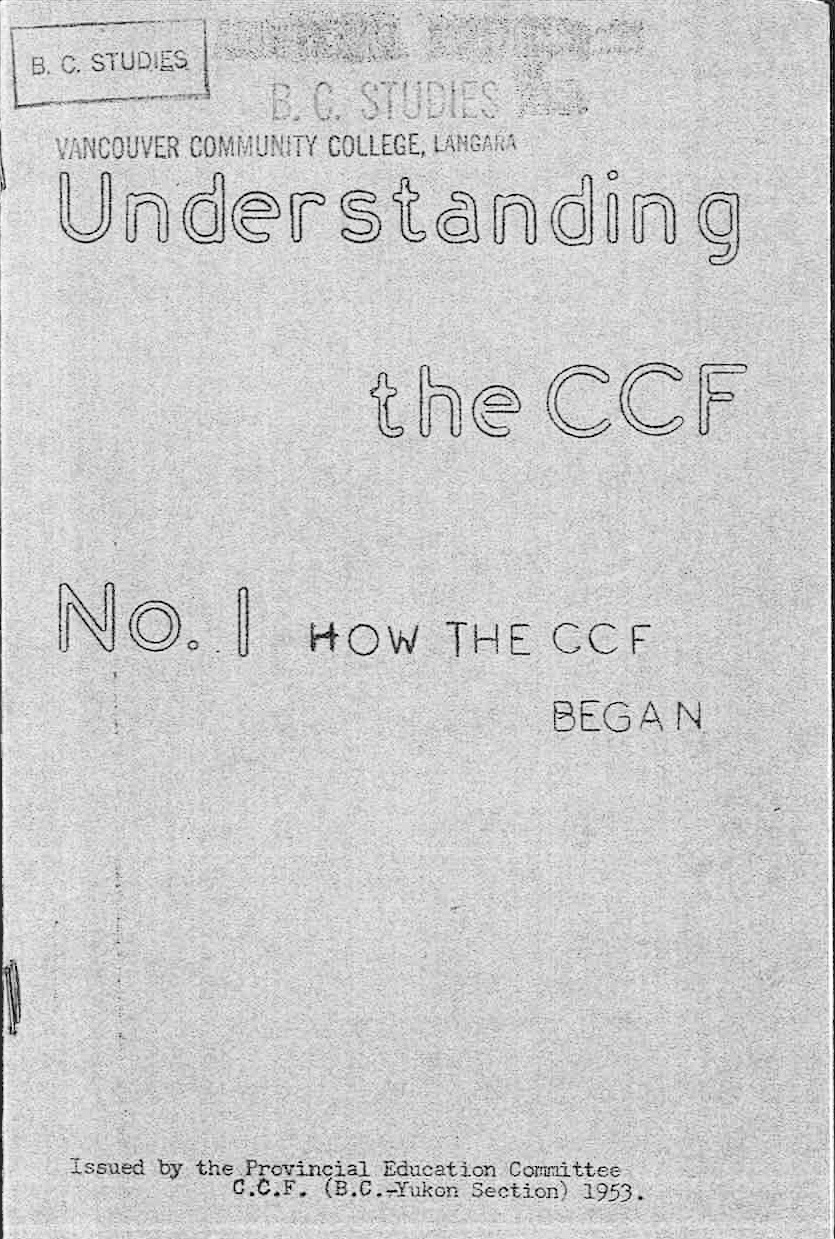
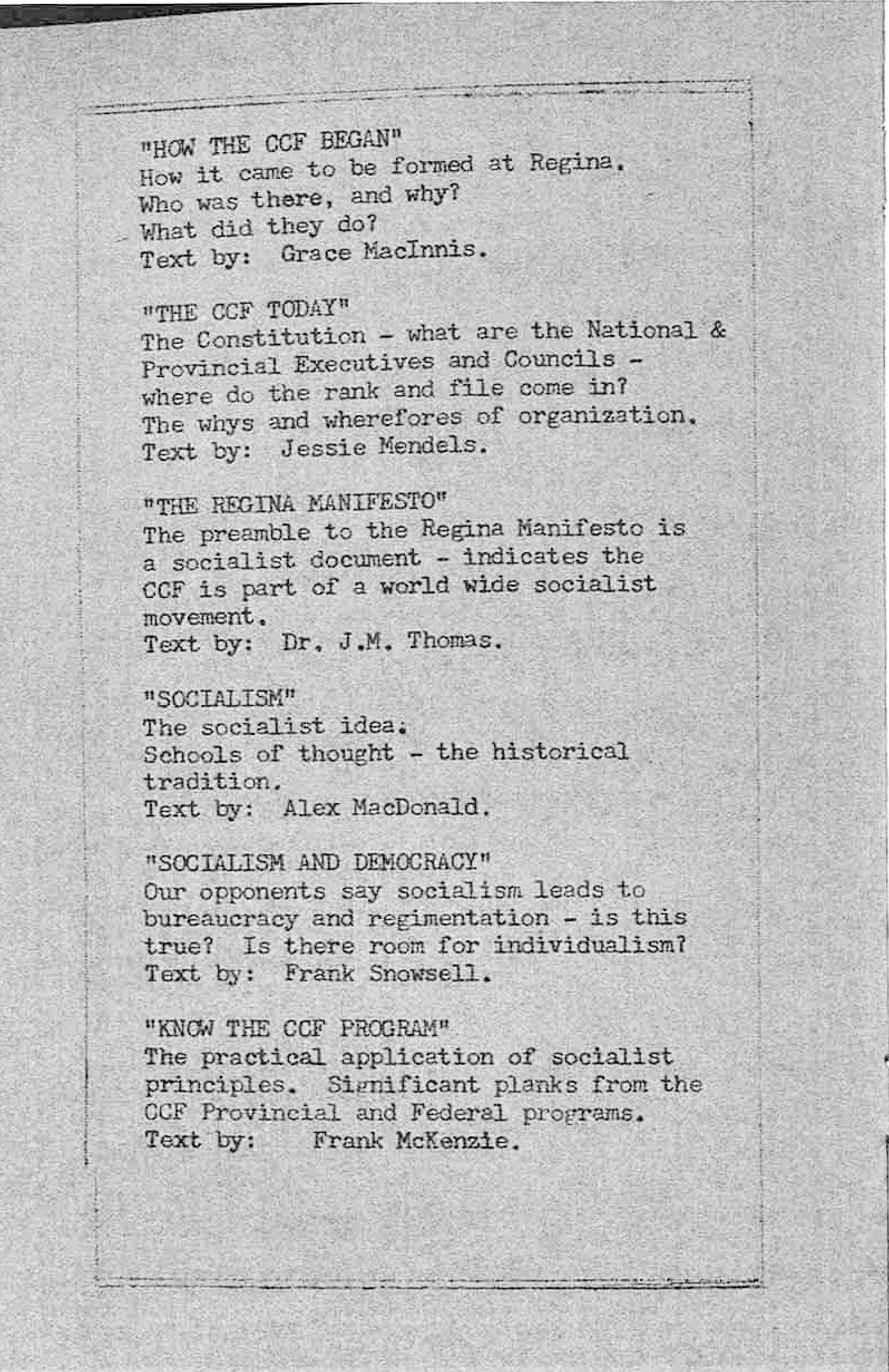
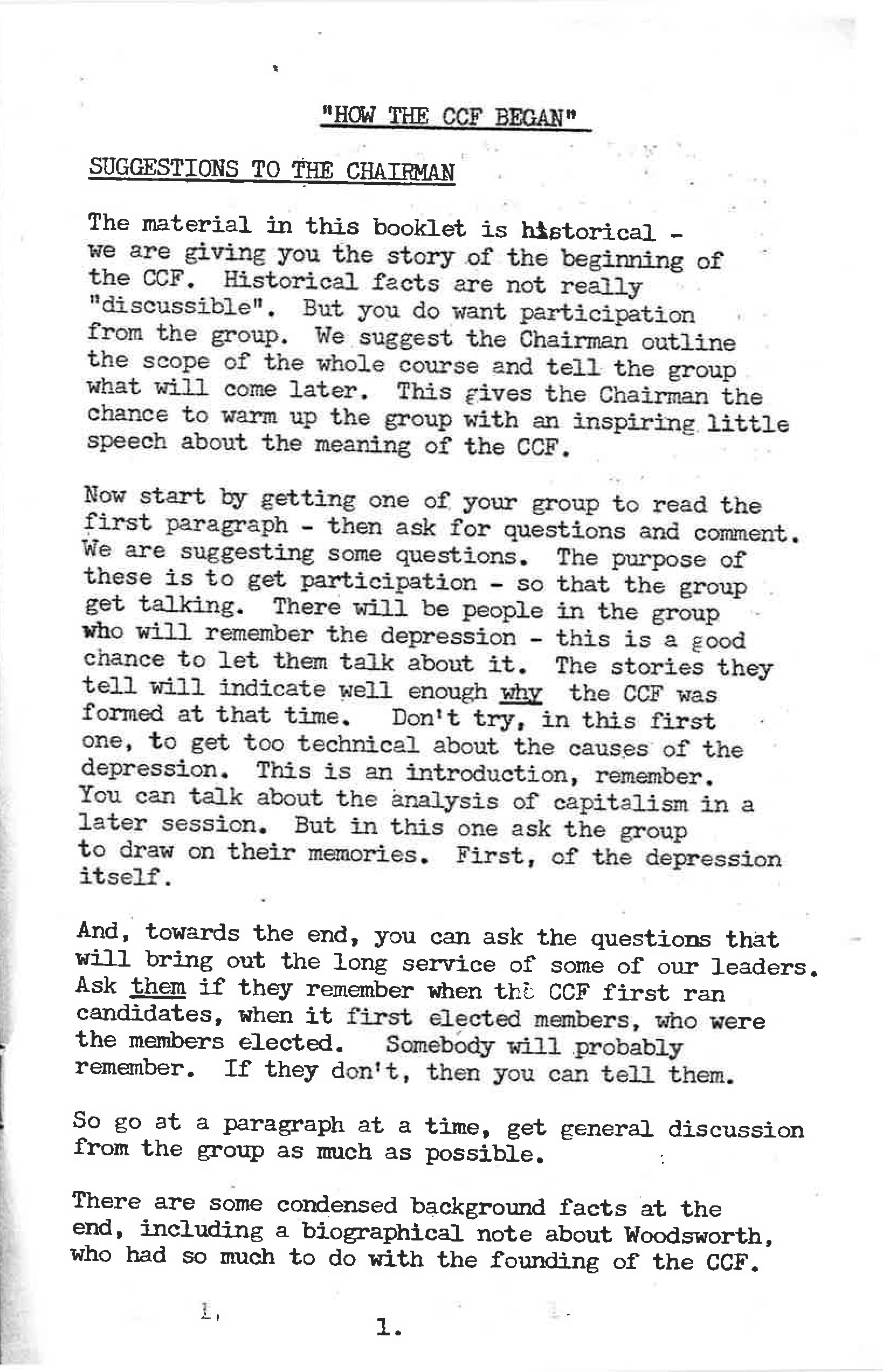
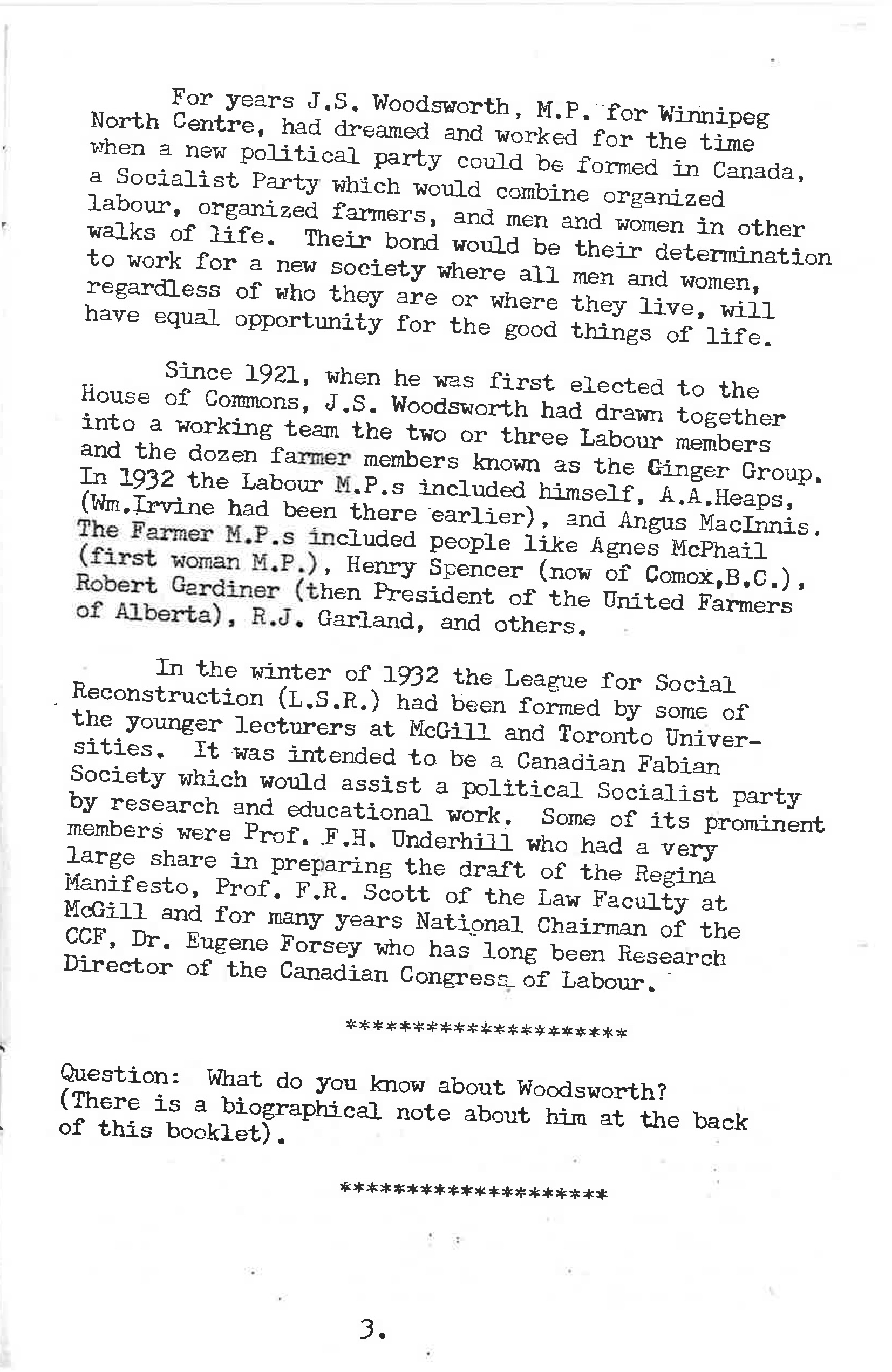
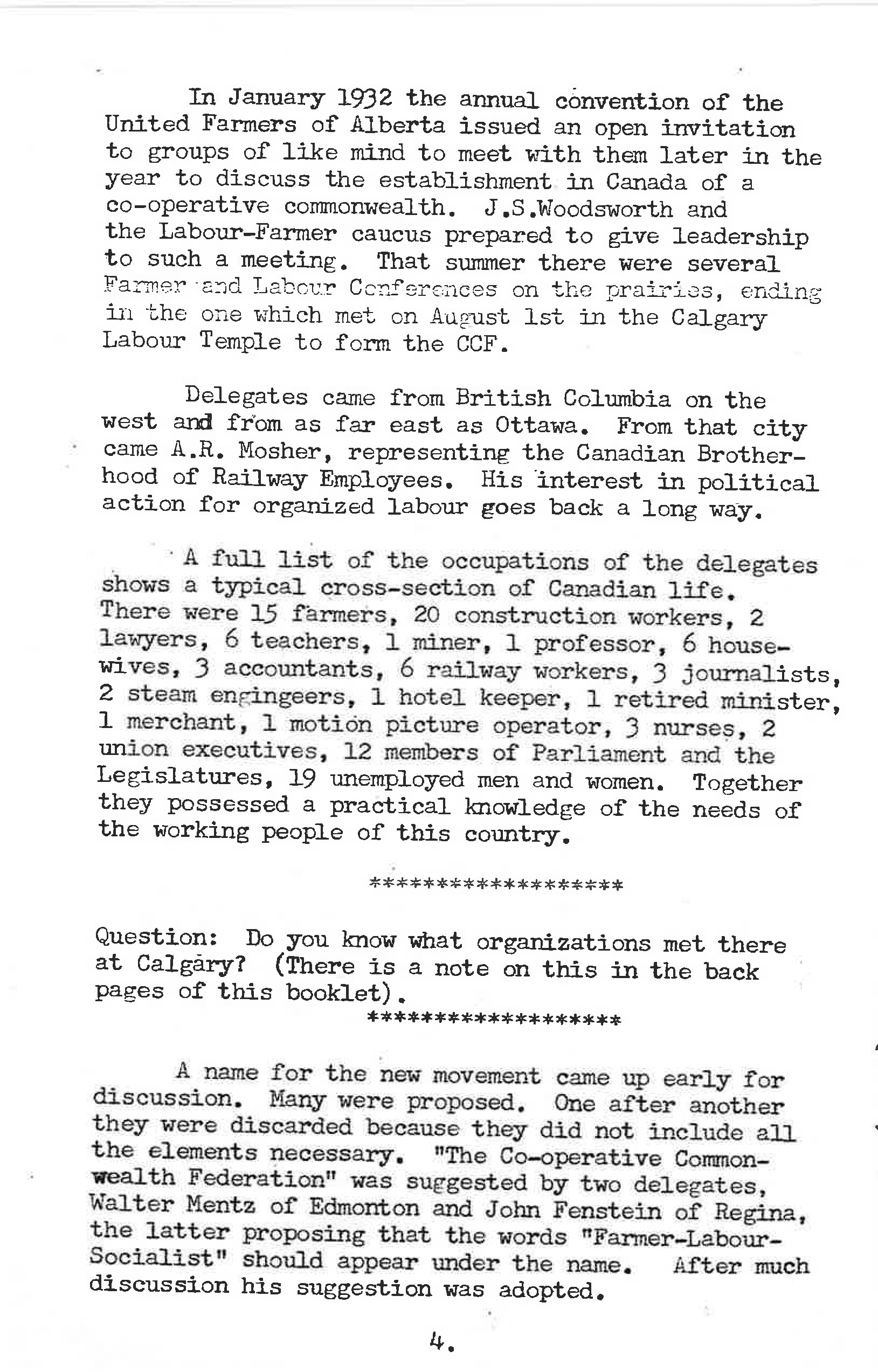
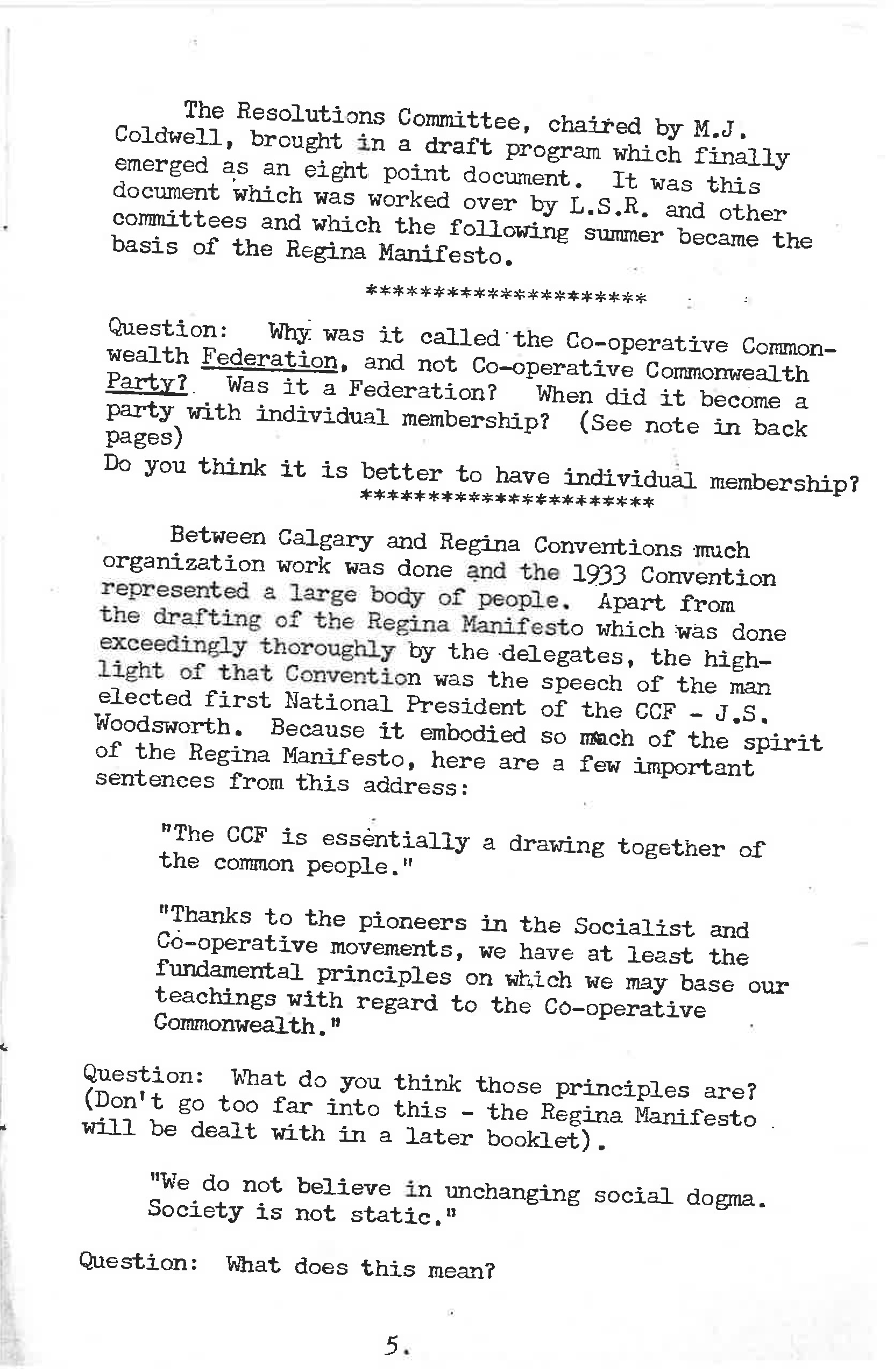
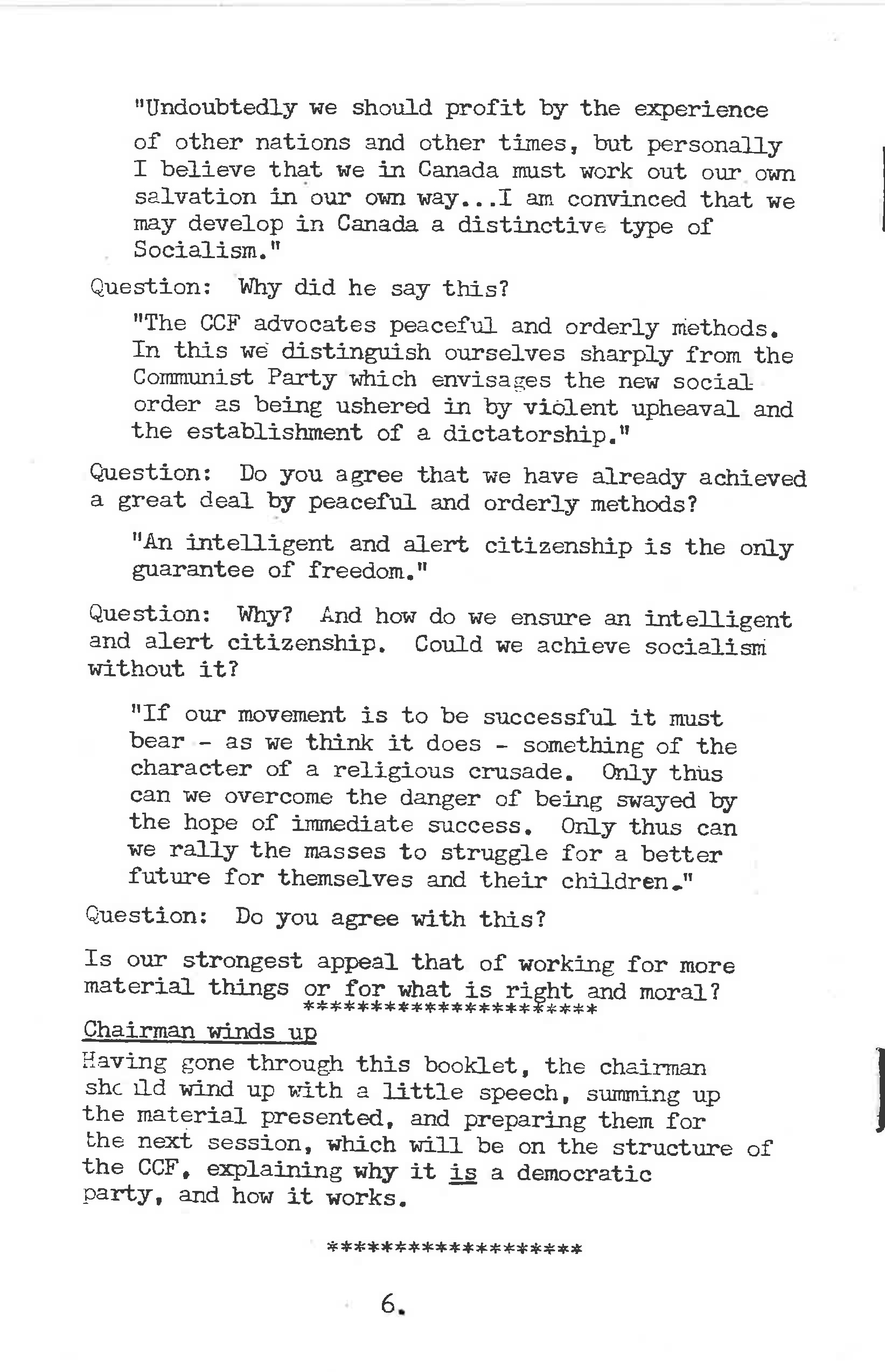
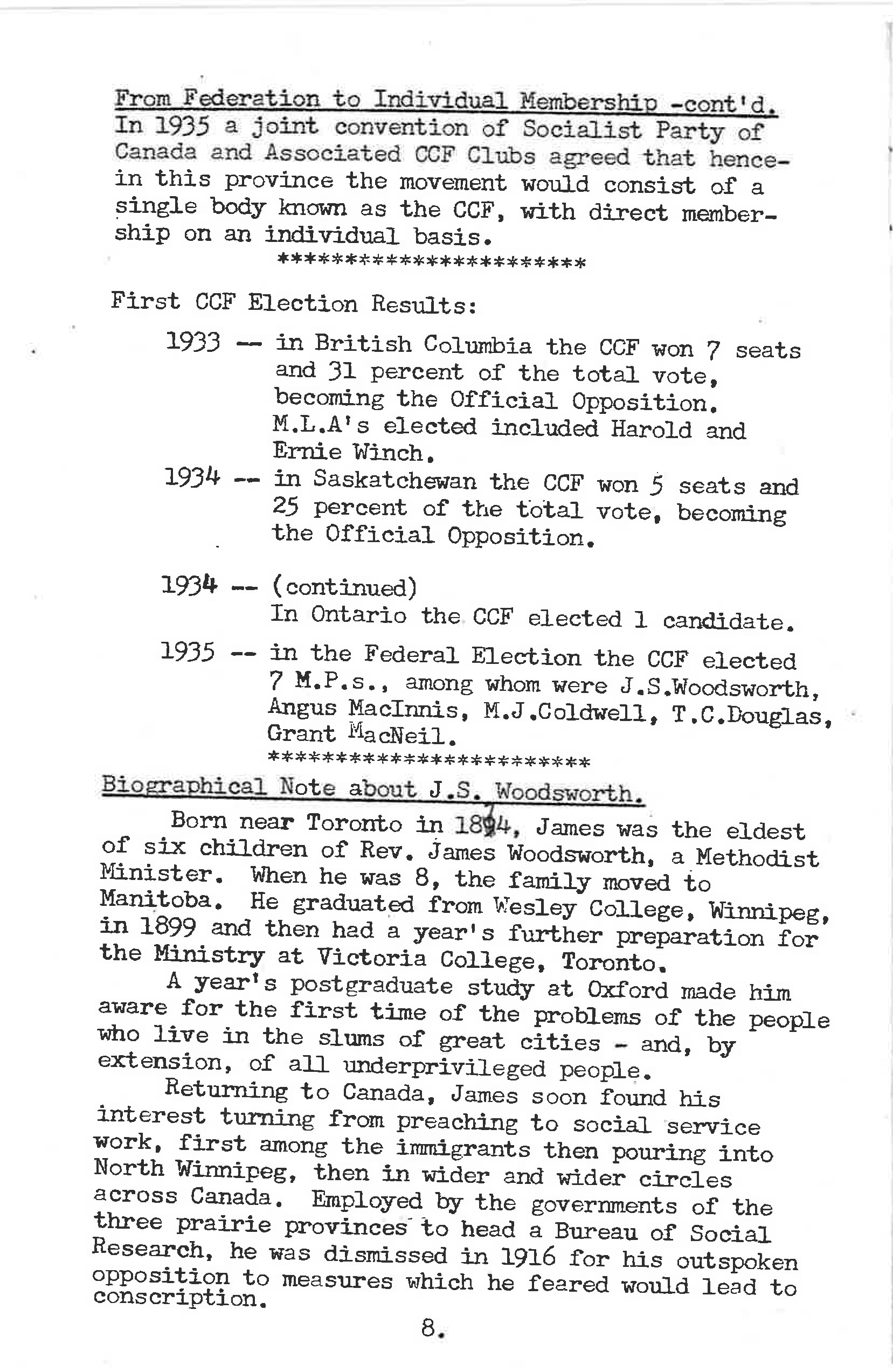
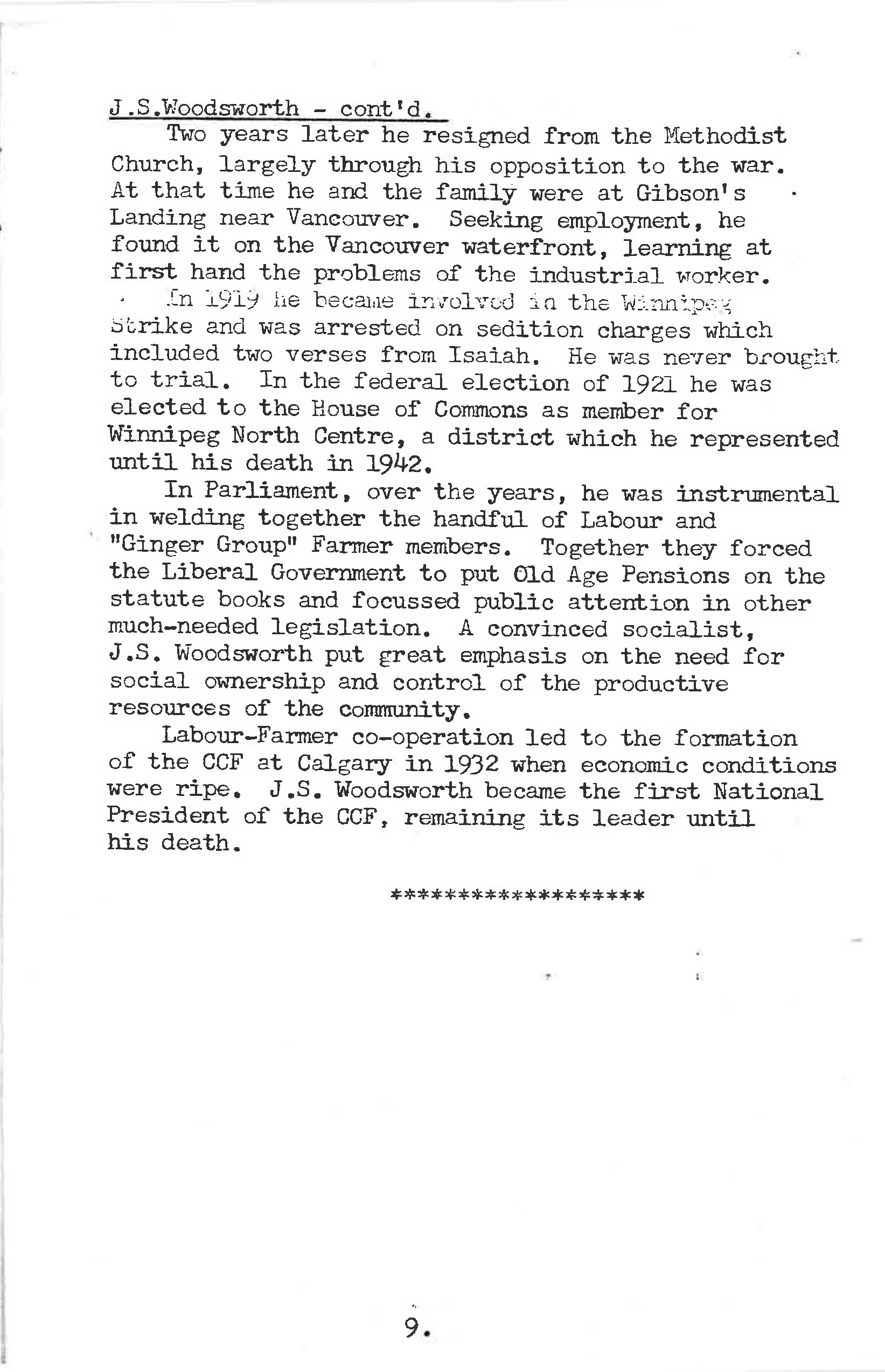
Understanding the CCF No.1: How the CCF began. Issued by the Provincial Education Committee C.C.F. (B.C.-Yukon Section) 1953.
Source: https://archive.org
The Co-operative Commonwealth Federation (CCF) (French: Fédération du Commonwealth Coopératif, from 1955 the Parti social démocratique du Canada) was a social-democratic[2] and democratic socialist[3] political party in Canada. The CCF was founded in 1932 in Calgary, Alberta, by a number of socialist, agrarian, co-operative, and labour groups,[4] and the League for Social Reconstruction. In 1944, the CCF formed the first social-democratic government in North America when it was elected to form the provincial government in Saskatchewan.[5] In 1961, the CCF was succeeded by the New Democratic Party (NDP). The full, but little used, name of the party was Co-operative Commonwealth Federation (Farmer-Labour-Socialist).[6]
Source: https://en.wikipedia.org/wiki/Co-operative_Commonwealth_Federation

Co-operative Commonwealth Federation 1932-1961



June 16, 2016
A growing number of business and financial sector voices with histories of strong opposition to expanding the Canada Pension Plan have suddenly accepted that our public, not-for-profit, pension system should grow. Their newfound support, however, comes with many caveats. Their strategy now focuses on ensuring any expansion of the CPP is overly narrow and extremely modest.
Various Chambers of Commerce, financial industry lobby groups, and the Canadian Life and Health Insurance Association argue that CPP expansion should: 1) not apply to low-income workers, 2) only apply to some middle-income workers and 3) not be the focus for new saving among higher-income earnings, who, in their view, are presumably better served by the for-profit private pension system. The small number of workers remaining who would be affected would only see a “modest” increase to CPP benefits.
These carve-outs would have significant consequences.
All workers currently participate on an equal basis in the CPP. Adding new exceptions for workers at certain income levels would make it more complicated and costly to operate the plan. More contributions would be used to pay administrative and compliance costs instead of being invested. A simple universal expansion of CPP is the more efficient solution.
Cutting low-income workers out of CPP expansion will also encourage employers to game the system. If new CPP contributions and benefits only applied on earnings above $27,500 as some are suggesting, employers would have yet another incentive to offer lower-wage, lower-hours jobs – keeping total earnings below this threshold would keep payroll costs down. This would lead to a new incentive to split full-time positions into precarious part-time positions. Canada’s governments should not be encouraging precarious employment by building these incentives into the CPP. Canadian workers deserve more good jobs and our governments should be fighting to keep them.
If Finance Ministers are concerned with the retirement prospects of low-income Canadians, CPP expansion should not be carved up. Low-income Canadians would see their retirement incomes rise like others under a bigger CPP. If Finance Ministers are concerned about the impact of the GIS clawback on these workers, they should address that particular mechanism rather than undermine the universal CPP.
Polling shows Canadians of all income levels, including low-income Canadians, strongly support CPP expansion. This federal government clearly campaigned on commitment to expand the CPP without reference to any new caveats.
As the salespeople for many for-profit private retirement products, Canada’s insurance industry has a long track record in lobbying against CPP reform. Canadians pay the highest mutual fund fees in the world in their RRSPs and these companies like it that way.
The insurance industry ran a massive campaign that tried to kill the CPP before it was born in the 1960s. The Canadian labour movement, on the other hand, was rightly skeptical that most workers would be able to achieve a pension plan at work, leading to our call for CPP benefits to be set at a much higher level. A middle ground was ultimately chosen, establishing a public pension plan with overly modest benefits. Political leaders at the time believed workplace pension plans would grow – enough to fill the gap left by the modest CPP. This hasn’t happened, and the basic benefit target of the CPP remains basically the same as when it was established.
Unions pushed for a doubling of CPP benefits in the 1980s,as the private pension system was not working for most Canadian workers. The insurance industry and other business groups successfully quashed CPP expansion, arguing that workplace pension coverage and private savings vehicles would grow and expand over coming decades.
These business groups were proven spectacularly wrong. Workplace pension coverage has been on a decline ever since. It’s no surprise we are facing a retirement crisis.
If we had listened to the insurance industry in the 1960s, we wouldn’t have a CPP today. If we hadn’t listened to them in the 1980s, Canadian baby boomers would be retiring with bigger CPP benefits today, instead of the justified anxiety of the retirement insecurity our failed system has left them with. The picture for their children looks even bleaker – unless something is done today.
Our Finance Ministers should reflect on this history next week as they weigh the latest, flawed advice from the insurance industry about CPP.
The labour movement’s message has been simple for the past 50 years: the CPP works very well in terms of coverage, benefit security and inflation protection. Its only flaw is that its benefits are too modest. It should be expanded for all Canadian workers. Relying too heavily on our private, for-profit retirement system has not and will not work for most Canadians.
Canadians are overwhelmingly behind the simple idea of setting aside a bit more today for a decent and secure retirement. Our Finance Ministers have an obligation to listen to Canadians, and universally expand the CPP.
Mark Hancock is national president of the Canadian Union of Public Employees. Representing over 635,000 members across the country, it is Canada’s largest union.

 Andrew Phillip Chernoff