Blood of King Albert I identified after 80 years

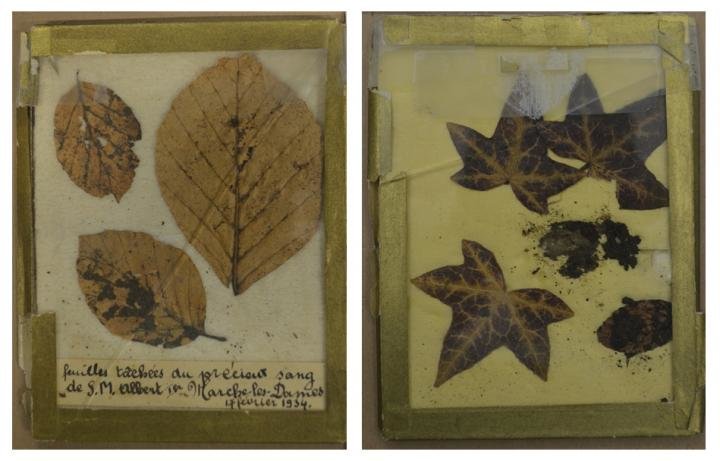
The relic of King Albert I of Belgium, bought at an auction by VTM journalist Reinout Goddyn: blood-stained tree leaves collected by people living near the forest at the foot of the rocks of Marche-les-Dames. The DNA analysis has confirmed that the blood really belonged to the monarch. Credit: Copyright KU Leuven – Maarten Larmuseau

July 22, 2016  KU Leuven

The death of King Albert I of Belgium in 1934 — officially a climbing accident — still fuels speculation. Forensic geneticists have now compared DNA from blood found on the scene in 1934 to that of two distant relatives. Their analysis confirms that the blood really is that of Albert I. This conclusion is at odds with several conspiracy theories about the king’s death.

On 17 February 1934, King Albert I — the third King of the Belgians — died after a fall from the rocks in Marche-les-Dames, in the Ardennes region of Belgium near Namur. Albert I was popular and world famous due to his role during the First World War. The fact that there were no witnesses to his death soon fuelled speculations about the king’s ‘real’ cause of death.

Conspiracy theories are circulating to this very day, ranging from a political murder to a crime of passion: the king is said to have been murdered elsewhere, his dead body allegedly never was in Marche-les-Dames, or his fall is believed to have been staged only later. Evidence for these theories, however, has never been found.

After the death of Albert I, Marche-les-Dames virtually became a place of pilgrimage, and relics turned up with the king’s trails of blood, said to have been collected during the night of 17 to 18 February by people living in the neighbourhood.

VTM journalist Reinout Goddyn, who works for the Flemish television programme Royalty, bought one of these relics: blood-stained tree leaves. He wanted to know if this could really be the blood of Albert I, given the conspiracy theories. In 2014, UGent Professor Dieter Deforce had already confirmed that the blood was definitely human.

Forensic geneticist Maarten Larmuseau and his colleagues from KU Leuven (University of Leuven, Belgium) continued the investigation and found two living relatives of Albert I: “King Simeon II of Saxe-Coburg and Gotha, the last tsar and former prime minister of Bulgaria who is related to Albert I on his father’s side, and Anna Maria Freifrau von Haxthausen, a German baroness who is related to Albert I on her mother’s side, were willing to cooperate. They gave up DNA samples that we compared with the DNA of the trails of blood. We found that the blood is indeed that of Albert I.”

This confirmation has historical importance. “80 years after the fact, everyone involved has passed away, and most material is gone; we will probably never be able to dismiss all speculations concerning this ‘cold case’. This study was one of the last possibilities to gather additional data. The authenticity of the trails of blood confirms the official account of the death of Albert I. The story that the dead body of the king has never been in Marche-les-Dames or was only placed there at night has now become very improbable. Furthermore, the results show that conducting a perfect legal investigation at the time was impossible right from the start, because souvenir hunters had disturbed the scene.”

This type of genetic family-tree research confronts researchers with quite a few ethical questions, adds bioethicist Pascal Borry from the KU Leuven Interfaculty Centre for Biomedical Ethics and Law: “We have to take into account the consequences of this study for living relatives. After all, in addition to the actual identification, a genetic profile can reveal quite a bit of sensitive information, in the context of a kinship analysis or in terms of hereditary conditions. This particular case concerns someone who’s deceased and has obviously never given permission for a genetic profile.”

“We only focused on the identification of the trails of blood and deliberately avoided deducing unexpected results from the DNA,” Larmuseau continues. “The latter was the most difficult aspect of this study. We also want to protect the privacy of everyone involved and of living relatives, and avoid commercialization of the genetic information, following international guidelines for biomedical research. Therefore, the genetic profiles have not been published, but they were double-checked by independent experts. The DNA samples of our study have been destroyed. What is left of the relic will be entrusted to an institution for cultural heritage or a scientific institution.”

Story Source:

The above post is reprinted from materials provided by KU Leuven. Note: Materials may be edited for content and length.


Journal Reference:

  1. Maarten H.D. Larmuseau, Bram Bekaert, Maarten Baumers, Tom Wenseleers, Pieter Deforce, Pascal Borry, and Ronny Decorte. Biohistorical materials and contemporary privacy concerns — The forensic case of King Albert I. Forensic Science International: Genetics, 2016 DOI: 10.1016/j.fsigen.2016.07.008


Source: Blood of King Albert I identified after 80 years — ScienceDaily
People are mad about this photo of a London, Ont., officer using his cell phone while driving — but it’s legal

Hala Ghonaim, Postmedia Network  Published: July 19, 2016      Updated: July 20, 2016

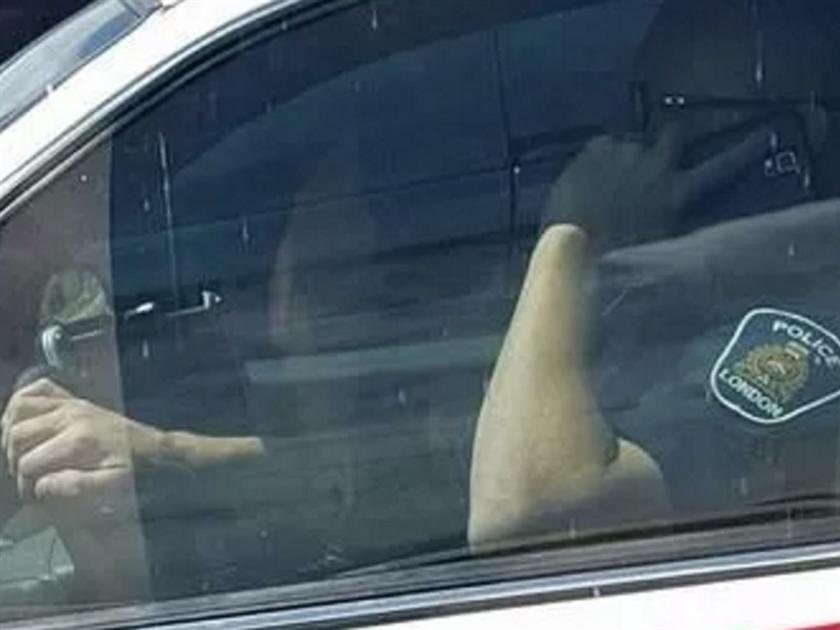
This London police officer was spotted on the phone while behind the wheel of his cruiser Sunday at Wonderland Road and Oxford Street. in London, Ont.

Londons finest talking on his cell phone while driving!

He was in his car, with one hand on the wheel, the other holding a cellphone to his ear, a London police badge on his shoulder.

It’s an image that went viral on social media Sunday, gathering more than 3,500 shares on Facebook, after getting posted online.

“Nobody will ever take distracted driving seriously if the public continue to see this,” said Natasha Anseeuw, who was passing through London at the time of the incident.

She noticed the officer on his cellphone at about 1 p.m. Sunday at the intersection of Wonderland Road and Oxford Street.

A passenger in her car snapped the photo, saving Anseeuw $500 to $1,000 in fines if she had pulled out her own cellphone.

If convicted of distracted driving, a driver may be fined as much as $1,000 fine and get up to three demerit points. Drivers who endanger others because of any distraction, including eating on the road, may face a $2,000 fine, six demerit points, a jail term of six months, and a two-year licence suspension, under the Highway Traffic Act.

However, the same doesn’t apply to the officer in the photo.

“There is an exemption for law enforcement officers when it comes to hand-held devices in relation to using them while on duty,” Const. Sandasha Bough reminded Londoners in a reply to concerned citizens who reached out to police regarding the online post.

Police officers aren’t the only ones who are given the green light. Several government officials, park wardens, conservation officers, and emergency workers also are exempt from the hands-free cellphone law.

London police are allowed to use hand-held devices during rare circumstances, such as connecting with officers regarding description information of a child during an Amber Alert, said Bough.

“Yes, we’re trying to multi-task and we do it on a daily basis,” she said. “But we still encourage our (officers) to pull off the roadway and park their vehicles.”

Bough said London police have not contacted the officer in the photo to determine the urgency of the phone call.

Regardless of the exemption, Anseeuw isn’t convinced.

“People learn from example. Monkey see, monkey do,” she said.

Source: People are mad about this photo of a London, Ont., officer using his cell phone while driving — but it’s legal

Soy-based protein boosts hunger hormone and stimulates appetite

July 18, 2016

Researchers have discovered a protein that stimulates secretion of ghrelin, an appetite-stimulating hormone produced in the stomach. When fed to mice, the protein, called soy-ghretropin, increased blood levels of ghrelin and boosted their appetite.

The findings, which are published in FEBS Letters, suggest that soy-ghretropin may be developed for elderly people or anorexic patients whose ghrelin levels and food intake are reduced.

Additional Material:

Source: Wiley: Soy-based protein boosts hunger hormone and stimulates appetite

Scientists Agree that Cranberry Benefits May Extend to the Gut, Heart, Immune System and Brain

Investigations show that unique compounds in cranberry juice, dried cranberries and various cranberry extracts hold great potential for the entire body.

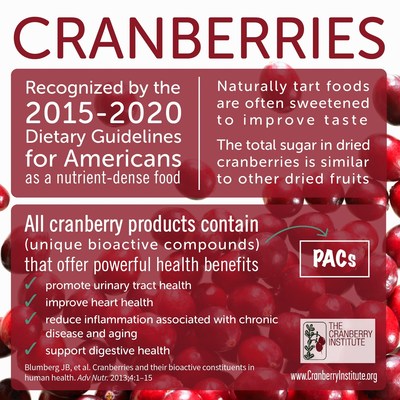
CARVER, Mass., July 19, 2016 /PRNewswire/ — While decades of cranberry research has found that regular consumption of cranberry products promotes urinary tract health, leading scientists studying the bioactive components of fruits and other foods reported that cranberries possess whole body health benefits.

In a July 2016 Advances in Nutrition supplement, Impact of Cranberries on Gut Microbiota and Cardiometabolic Health: Proceedings of the Cranberry Health Research Conference 2015, a team of international researchers reviewed the complex, synergistic actions of compounds that are uniquely cranberry. Their discussion led them to conclude that this berry may be more than just a tart and tangy fruit.

“It has been established that cranberries rank high among the berry fruits that are rich in health-promoting polyphenols,” notes lead author, Jeffrey Blumberg, PhD, of the Jean Mayer USDA Human Nutrition Research Center on Aging at Tufts University in Boston, MA.

“But now, recent investigations have shown that the cranberry polyphenols may interact with other bioactive compounds in cranberries that could protect the gut microbiota, and provide antioxidant and anti-inflammatory functions that benefit the cardiovascular system, metabolism and immune function.”

Recognition of the important role gut microorganisms play in human health has gained attention of scientists, reaching all the way up to the White House with the National Microbiome Initiative.

Emerging evidence has found that the gut microbiome may impact the health of the immune system and brain, as well as how the body balances energy and uses carbohydrates and fat.

Preliminary investigations with cranberries, some of which were performed in animal models, have revealed that cranberry bioactives show promise in helping to strengthen the gut defense system and protect against infection.

The effect of cranberry products on cardiovascular health and glucose management was also explained in the review. Authors of the paper described promising links between cranberry products and blood pressure, blood flow and blood lipids.

One study identified a potential benefit for glucose management with low-calorie cranberry juice and unsweetened dried cranberries for people living with type 2 diabetes. Benefits for heart health and diabetes management have been attributed to the antioxidant and anti-inflammatory effects of the polyphenols in cranberries.

Given the wide range of ways to consume cranberries – juice, fresh, sauce, dried, or as an extract in beverages or supplements – additional human studies will help determine all the ways that cranberries may influence health.

The scientific community and the cranberry industry agree – the impressive potential that cranberry bioactives may have on public health is worthy of further exploration.

“The bioactives in cranberry juice, dried cranberries and a variety of other cranberry sources have been shown to promote an array of beneficial health effects,” explains Dr. Blumberg.

“Given the complex nature and diversity of compounds found in berry fruits and how they interact with each other, I believe we have only scratched the surface when it comes to identifying the potential power of the cranberry.”

To read the proceedings in their entirety, the Advances in Nutrition supplement can be accessed here: Impact of Cranberries on Gut Microbiota and Cardiometabolic Health: Proceedings of the Cranberry Health Research Conference 2015.

Source: Scientists Agree that Cranberry Benefits May Extend to the Gut, Heart, Immune System and Brain

Tiny microbe turns tropical butterfly into male killer, scientists discover

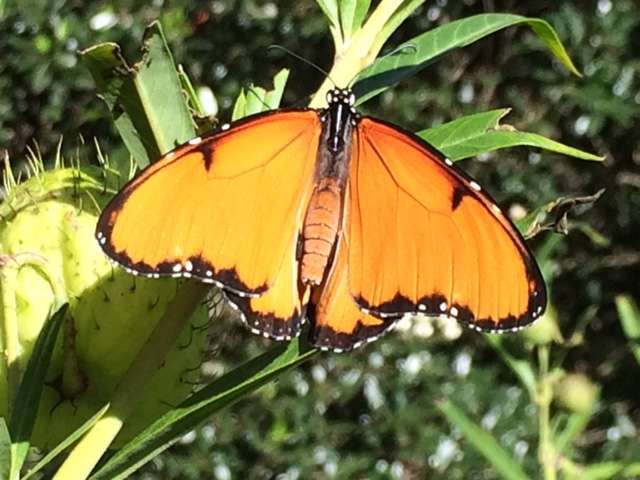
Tiny microbe turns tropical butterfly into male killer. Credit: University of Exeter

A scientist from the University of Exeter has helped to identify a male-killing microbe in a tropical butterfly called the African Queen, which leads to the death of all sons when a mother is infected.

In most of Africa this microbe, called Spiroplasma, infects African Queen butterflies but has no effect on their offspring. However, in a narrow zone around Nairobi in Kenya, where two sub species of butterfly live and breed, the scientists noted that the microbe infection caused all their sons to die. In fact the male eggs never hatch and are often consumed by their hungry sisters.

The authors of the paper, published in the Royal Society journal Proceedings of the Royal Society B, believe that the phenomenon, which takes place where two sub species meet, is the first step in the transition of the two sub-species into two true, non-interbreeding, species.

Professor Richard Ffrench-Constant, from the Centre for Ecology and Conservation at the University of Exeter’s Cornwall campus, and a team of British, Kenyan and German scientists, have found that the chromosomes of the females in which male-killing occurs have changed dramatically with a non sex chromosome fusing with a sex chromosome to form a new chromosome called ‘neo W’.

Professor Ffrench-Constant, Professor of Molecular Natural History, said: “We tend to think of coming about due to environmental changes but here its clearly the microbe that is driving these two sub species apart.

“Whilst we don’t understand the precise molecular mechanisms behind this chromosomal merger, this means that no males are made in the hybrid zone, and that mating success in the zone is effectively zero, thereby creating a barrier with a new species on either side.”

This paper represents the culmination of 13 years of field work in which the sex and colour pattern of butterflies around Nairobi was painstakingly recorded by a team led by Dr Ian Gordon based in Nairobi. The breakthrough came when female butterflies from the all- female zone were sent to Germany to have their chromosomes examined and where Professor Walther Traut from the University of Lübbek discovered that two of the chromosomes had fused.

Dr David Smith, formerly from the Natural History Museum at Eton College, first author on the paper, said: “The neo-W effectively acts as a genetic sink for all males, and butterfly populations around Nairobi are nearly all female. Our results demonstrate how a complex interplay between sex, , male-killing and chromosomes has set up a genetic ‘sink’ that keeps two subspecies apart.”

Professor Walther Traut, from the University of Lübbek, said: “This is like a smoking gun for the way in which species become distinct. It is rare that we can find the molecular basis for how species develop.”

Professor Ffrench-Constant added: “It appears that the butterfly’s susceptibility to the male-killing microbe is driving the separation of the two butterflies into two true . These tiny microbes are therefore having a major effect on sex and death in this fascinating butterfly.”

More information: A neo-W chromosome in a tropical butterfly links colour pattern, male-killing and speciation by David A. S. Smith, Ian J. Gordon, Walther Traut, Jeremy Herren,Steve Collins, Dino J. Martins, Kennedy Saitot, Piera Ireri and Richard Ffrench-Constant is published in Proceedings of the Royal Society B: rspb.royalsocietypublishing.org/lookup/doi/10.1098/rspb.2016.0821

Source: Tiny microbe turns tropical butterfly into male killer, scientists discover