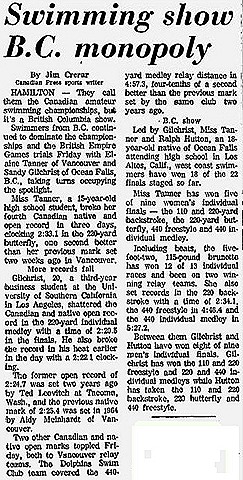
The Spokesman-Review – Jan 18, 1965


The Spokesman-Review – Jan 18, 1965
http://www.bcpsea.bc.ca June 9, 2014
VANCOUVER – “Further to our announcement last night, we’re pleased to provide some details of the tentative framework agreement reached with the K-12 Presidents’ Council representing support staff unions in the public education sector, with the Canadian Union of Public Employees (CUPE) having the largest membership,” said Michael Marchbank, Public Administrator of the BC Public School Employers’ Association (BCPSEA).
“As the unions are speaking with their members and we are communicating with our members,we will only touch on the key highlights at this time,” said Marchbank. “This Agreement sets the framework for school districts and their support staff unions to conclude local bargaining, which we expect to wrap up with ratifications in the fall.”
The proposed agreement is for a five-year term from July 1, 2014 to June 30, 2019 and includes wage increases consistent with the pattern of agreements concluded in the broad public sector under the Economic Stability Mandate. In acknowledgment that support staff have been caught up in the BC Teachers’ Federation (BCTF) strike action, they will also receive an Employee Support Grant to recognize lost wages for employees not crossing lawful picket lines established by the BCTF.
The parties have also agreed to standardize extended health benefit plans for the majority of support staff, which will provide enhanced benefits for employees while at the same time providing efficiencies for the employer. Other key areas of the tentative agreement include increased hours for education assistants, who provide vital support for the learning needs of students in our classrooms, and a commitment to a job evaluation plan to help address recruitment and retention issues.
“This is now the fourth provincial Framework Agreement negotiated between BCPSEA and the K-12 Presidents’ Council since 2006, covering approximately 34,000 employees” said Marchbank. “This success provides ample evidence that the bargaining system works — when the parties come to the table with reasonable expectations and a flexible, solution-oriented approach, negotiated agreements can be concluded that meet the interests of both employers and employees and provide important stability for all stakeholders in our public education system.”
Provincial Framework Agreement between BCPSEA and Support Staff Unions:
By: Ken Gallinger Ethically speaking columnist, Published on Fri Jun 13 2014
Many American states permit employees in unionized worksites to opt out of dues. It’s not legal in Canada. But after Michigan passed such a law, some conservative politicians began promoting the idea here. The argument made by proponents is “the right of employees to decide for themselves whether or not to join a union.” Is it ethical to refuse to pay dues if you work in a job covered by a union contract?
There are two viable ways of paying for services we enjoy. On the one hand, there are a limited number of services (roads, police, hospitals etc.) that we all pay for, whether we use them or not. These are provided by government, and deemed to some degree essential.
The vast majority of services on which we depend, however, are to some extent user-pay — i.e., if you use the service, you pay some of the cost. Included on the long list of services we fund on a per-use (or per-season, etc.) basis are things like provincial parks, museums, public transit, theatre tickets, etc. Almost all of these enjoy some public subsidization, because we are still, essentially, a socialist country. But users pay some per-pop cost, and in recent years the percentage has generally shifted away from subsidies, and towards higher user fees. Even in education, parents report a never-ending chorus of gimme from schools their kids attend.
Proponents of so-called “Right to Work” legislation (a euphemism gone malignant if there ever was one) argue, on the one hand, that union membership/dues should be a discretionary, user-pay arrangement; those who choose to support unions would be free to do so, but others equally free to opt out. Where their logic goes weirdly off track, however, is on the question of whether those who opt out of dues would also relinquish the benefits won by unions, not only on that particular worksite, but across society. Well, no, they wouldn’t in fact; they would continue to receive all the benefits of union negotiations, advocacy and so on — either without paying a cent, or in return for a paltry fee-for-service. That’s why Rick Unger, writing in Forbes, said this would be better described as “Right to Freeload” legislation.
The question is not whether everyone in society should be legally required to pay union dues; I’ve never paid dues in my life — but I’ve also never enjoyed the protections that workers in unionized environments take for granted. If I had a dispute with my employer, I was completely, 100 per cent on my own.
The real question is: could it ever be OK to accept work in a context where employees enjoy salary levels, pension plans, working conditions and other benefits that have been won, over many years, by unions, and still not support the unions that won those benefits?
The obvious answer is “no.”
Unless we create a society where worker’s rights, pensions and other benefits are universally protected by government — and we’re all prepared to pay for that protection the same way we pay for cops and hospitals — unions remain the only effective vehicle by which those benefits are won and protected. And ethically speaking, if you dance the jig, you pay the piper.

 Andrew Phillip Chernoff