Six world powers adopt nuclear deal with Iran

europa

From http://eeas.europa.eu/

Brussels, 14/07/2015
150714_01

Joint statement by EU High Representative Federica Mogherini and Iranian Foreign Minister Javad Zarif Vienna, 14 July 2015

14/07/2015

Today is an historic day.

It is a great honour for us to announce that we have reached an agreement on the Iranian nuclear issue.

With courage, political will, mutual respect and leadership, we delivered on what the world was hoping for: a shared commitment to peace and to join hands in order to make our world safer. This is an historic day also because we are creating the conditions for building trust and opening a new chapter in our relationship.

This achievement is the result of a collective effort.

No one ever thought it would be easy. Historic decisions never are. But despite all twists and turns of the talks, and the number of extensions, hope and determination enabled us to overcome all the difficult moments. We have always been aware we had a responsibility to our generation and the future ones.

Thanks to the constructive engagement of all parties, and the dedication and ability of our teams, we have successfully concluded negotiations and resolved a dispute that lasted more than 10 years.

Many people brought these difficult negotiations forward during the last decade and we would like to thank all of them – as we would like to thank the International Atomic Energy Agency for its critical contribution and close cooperation as well as the Austrian government for the support and hospitality.

We, the EU High Representative for Foreign and Security policy and the Foreign Minister of the Islamic Republic of Iran, together with the Foreign Ministers of the People´s Republic of China, France, Germany, the Russian Federation, the United Kingdom and the United States of America met here in Vienna, following several months of intensive work, at various levels and in different formats, to negotiate the text of the Joint Comprehensive Plan of Action (JCPOA), based on the key parameters agreed in Lausanne on 2 April.

We have today agreed on the final text of this Joint Comprehensive Plan of Action

The E3/EU+3 and the Islamic Republic of Iran welcome this historic Joint Comprehensive Plan of Action (JCPOA), which will ensure that Iran’s nuclear programme will be exclusively peaceful, and mark a fundamental shift in their approach to this issue. They anticipate that full implementation of this Joint Comprehensive Plan of Action will positively contribute to regional and international peace and security. Iran reaffirms that under no circumstances will Iran ever seek, develop or acquire any nuclear weapons.

The Joint Comprehensive Plan of Action includes Iran’s own long-term plan with agreed limitations on Iran’s nuclear program, and will produce the comprehensive lifting of all UN Security Council sanctions as well as multilateral and national sanctions related to Iran’s nuclear programme, including steps on access in areas of trade, technology, finance, and energy.

The Joint Comprehensive Plan of Action comprises of a main text, and five technical annexes – on nuclear, sanctions, civil nuclear energy cooperation, a joint commission, and implementation. These documents are detailed and specific: that is important because all sides wanted clarity so as to ensure the full and effective implementation of the agreement.

The Joint Comprehensive Plan of Action is a balanced deal that respects the interests of all sides. It is also complex, detailed and technical: we cannot fully summarise the agreement now. But the full main text and all its annexes will be made public still today and will be presented within the next few days by the E3+3 to the Security Council for endorsement.

We know that this agreement will be subject to intense scrutiny. But what we are announcing today is not only a deal but a good deal. And a good deal for all sides – and the wider international community.

This agreement opens new possibilities and a way forward to end a crisis that has lasted for more than 10 years. We are committed to make sure this Joint Comprehensive Plan of Action is fully implemented, counting also on the contribution of the International Atomic Energy Agency.

We call on the world community to support the implementation of this historic effort.

This is the conclusion of our negotiations, but this is not the end of our common work. We will keep doing this important task together.

Resources squandered on UK war machine could save 100s of millions from starvation

Daniel Jakopovich 11 July 2015. Posted in http://stopwar.org.uk/

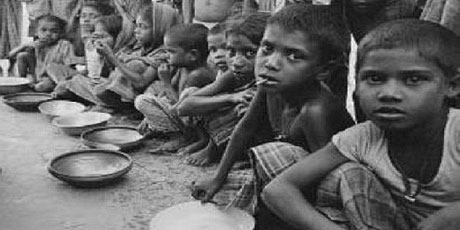
Look at what could be done with the £37 billion Britain spends annually on its military and foreign wars.

hunger_africa_460_2


The UK government has committed itself to a 2 per cent of GDP military spending target for the next five years on the basis of demands for more foreign military interventions.

In each of the last 100 years Britain has been involved in military conflict somewhere on Earth. It is a habitual invader of other countries. Intense Anglo-American imperialist violence has played a key role in creating the current vicious and expanding cycle of conflict in the Middle East, North Africa and other parts of the Third World.

The wars in Afghanistan, Iraq, Libya and elsewhere have been a colossal waste of resources and of lives. A million people (as well as millions of animals) have been killed in the Second Iraq War and, according to a recent study, as many as 2 million people may have died as a result of the global terroristic “war on terror”.

Apart from continuing to cause extreme and mass suffering, these conflicts create immense bitterness against the West, Britain and the US in particular. More than a decade of savage war has shown that violence only breeds more violence and that hatred and bombing cannot bring peace. More interventions will only add fuel to this inferno of hatred and inhumanity.

War constitutes the sunset of civilisation. It should be obvious that money should instead be used to generously invest in re-building these wretched, war-stricken countries, to invest in education and human development, and to build bridges instead of creating more enemies for the West.

Britain’s military spending is already much higher than that of other European countries. Furthermore, the political elite is planning to squander £100 billion of public money on the new generation of Trident nuclear weapons. Military spending increased by 19 per cent in real terms between 1998 and 2008. More than 37 billion pounds are spent each year on the military and on foreign wars (the full figure is much higher and includes the increasing budget given to the security services, the cost of healthcare for veterans, etc.).

A recent report stated that the global cost of war last year alone was US$14 trillion. By comparison, the Food and Agriculture Organization of the UN claims that $30 billion a year would be sufficient to eradicate world hunger, which affects hundreds of millions of people. Professor Jean Ziegler (the UN’s former Special Rapporteur on the Right to Food) stated that around 36 million people are dying as a result of hunger and malnutrition every year. According to these figures, around half of the UK annual military budget would be sufficient to save the lives of tens of millions of starving people each year. The resources squandered on the UK military budget could therefore save the lives of hundreds of millions of people in the space of a single decade. We are living under an evil, grotesquely anti-human system.

Increased military spending is particularly wrong at a time when the Conservative government is implementing severe cuts in the budgets for healthcare, education and welfare. These are core public services which are essential for creating and sustaining civilised public life.

Instead of enriching private military corporations and the rest of the military establishment, resources should be channelled towards improving the education system, building a greener economy, housing the homeless, feeding the poor, and providing the best possible medical care for Britain’s population. Hundreds of thousands of people are facing homelessness in Britain, each year tens of thousands of people die of hypothermia because they cannot afford heating, thousands of people are facing long delays for cancer treatment and thousands of poor children are left to suffer and die each year due to a lack of funds for potentially life-saving cancer treatment. Real existential threats which affect a large segment of the British population are being callously disregarded while the causes and the extent of the terrorist threat are being intentionally misrepresented. One report found that more US citizens die each year due to being crushed by their own furniture than have died as a result of Islamist terrorism since 9/11. Besides, it is the brutal and cynical Anglo-American policy of permanent war and imperialist control which is fomenting extremism and violence. True human security is being sacrificed at the altar of the militarist Moloch. What are we actually defending when we’re shutting down hospitals and fire stations?

The peace movement needs to continually reveal the links between the British establishment’s commitment to perpetual war abroad and permanent structural violence at home. As Tony Benn wrote in 2005: “The Stop the War movement might even be regarded as a Start the Peace movement dedicated to challenging the capitalist concept of globalisation involving exploitation and bloodshed by offering a perspective of internationalism, cooperation and solidarity”.

Militarism and neoliberal austerity are inextricably linked, which is why the anti-war and anti-austerity movements have to work closely together. It is not possible to truly challenge either without challenging both at the same time. Stop the War Coalition is committed to maintaining its vital role in this united struggle for peace and social justice.

Daniel Jakopovich is a writer and a national organiser of the Stop the War Coalition.

Things you can do:

Petition in your workplace/college against the increase in the military budget
Join Stop the War
Get involved in your local Stop the War group or set one up
•Get your trade union branch/trades council/community group to affiliate to Stop the War

Source: Stop the War Coalition

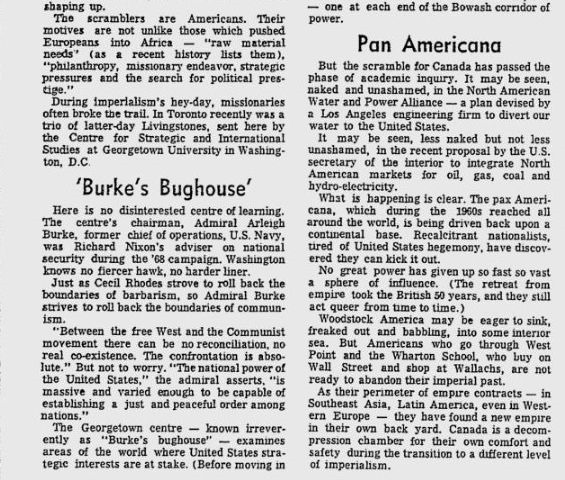
Back To The Future: Canada’s Future From The Past

The Vancouver Sun, Monday January 5,1970

From Google News Archive Search

Canada_The New Africa1                                                              Canada_The New Africa2Canada_The New Africa3

What are your thoughts some 45 years later regarding the opinions expressed by James Eayrs?

Feel free to let me know and add to the discussion of this article.