A Russian ‘Lady Cop’: Part Two · Global Voices

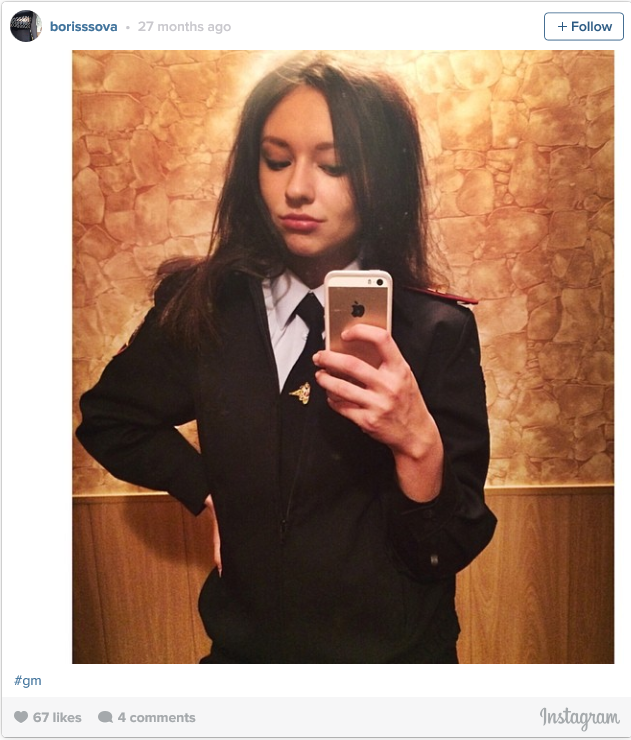
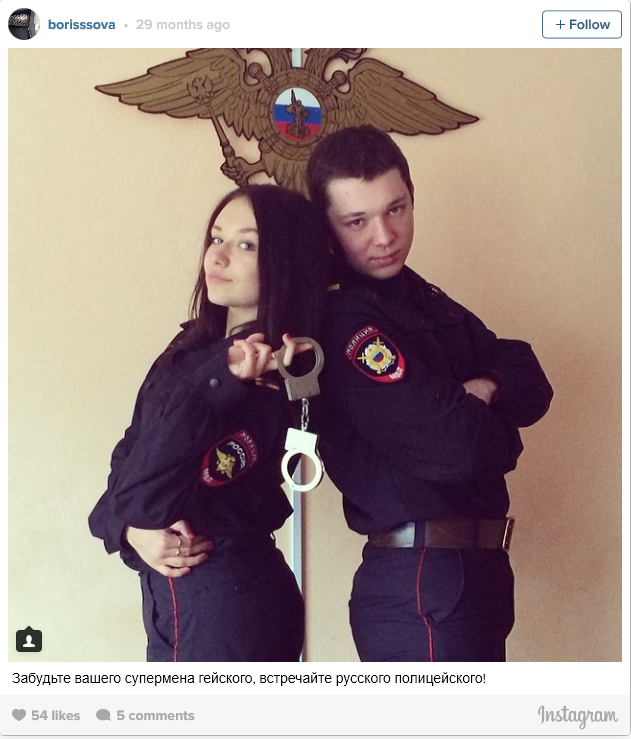
Photo: Instagram, edited by Kevin Rothrock.

Three years ago, Olga Borisova decided to join the St. Petersburg police force. Eighteen years old and, by her own description, a petite, fashionable young woman, she wasn’t your average cadet.

After a little more than a year, she quit, and has since become an active member of the Russian democratic opposition.

Earlier this month, Borisova wrote for the website Batenka.ru about her experiences as a police officer.

RuNet Echo is publishing her text, translated into English, in three parts. This is the first installment. You can read her full story here in Russian.

“Remember, you don’t have holidays. Holidays aren’t for the police.”

They gave me a uniform, and I stopped coming to work dressed in new Reeboks and a pink jacket. My dad drove me to the warehouse where I was issued my uniform. I’d never have been able to carry back home all those things myself. It was all on iron hangers that were ice-cold to the touch.

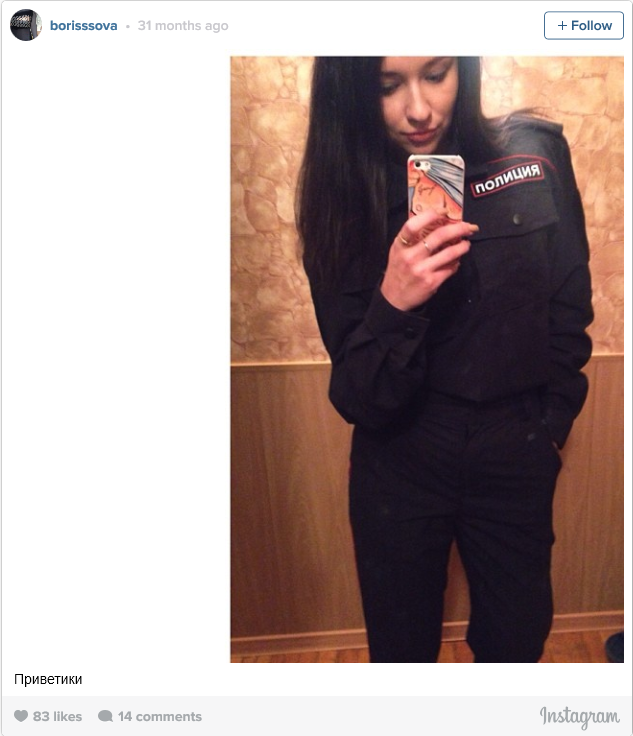
There was a parade uniform, a winter uniform, and a summer uniform. Dark blue. My favorite color. I ended up having to buy a lot myself at the commissary. (They didn’t make an extra small for police officers.) I brought it all home. I tried on the “vole”—the patrol-guard uniform: a dark-blue shirt, pants, and ankle boots. I took a picture of myself, posted it on Instagram, and wrote, “Hiya.”
FireShot Capture 2 - A Russian ‘Lad__ - https___globalvoices.org_2016_07_23

“VODKA AND ORANGE JUICE, WELCOME TO THE FORCE, YOUS,” the section commander told me. When someone got their first paycheck, they had to buy everyone drinks.

They called the two-story patrol-guard building “base.” On the first floor, there was just a watchman. On the second, there were offices and a large hall, where we presented our reports about completed assignments. There was also a rec room with a green leather couch and a refrigerator. People brought oatmeal and purée from home. The main thing people did there was drink and have all kinds of parties.

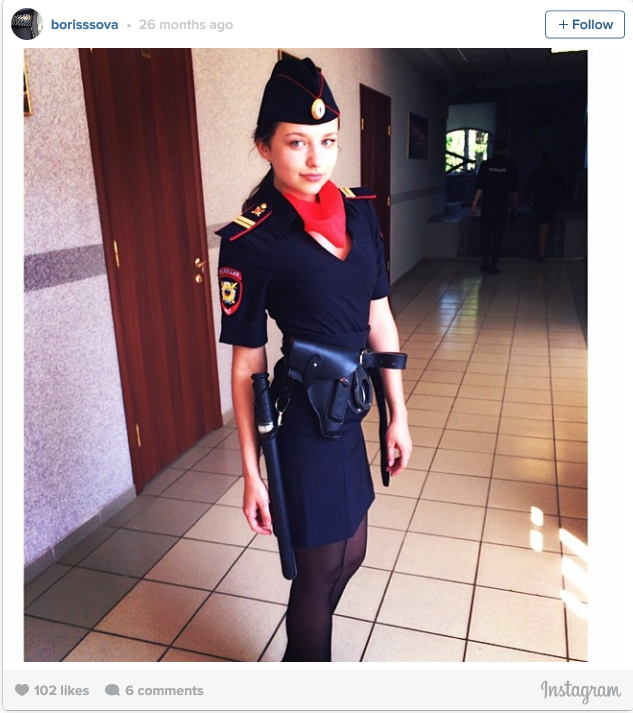
Sergeant Valya used to go around in denim miniskirts and she drank a lot. She was something of an assistant manager there. She gave me my pair of handcuffs, my rubber stick, and my service book. The stick attaches to the belt on your waist, but the stick was so long that it looked pretty ridiculous on someone my height. It almost dragged on the ground. I had to go to the commissary myself and buy one a little shorter.
FireShot Capture 3 - A Russian ‘Lad__ - https___globalvoices.org_2016_07_23

So I became a junior sergeant. There were two gold bars on my uniform’s shoulder straps. The police academy admits cadets every three months, so you just start working, if you’ve finished basic training, but admission isn’t yet underway.

When you’re just starting out, you’re very shy. A representative of law enforcement should, I thought, display a certain severity. But I didn’t have it.

“Police Junior Sergeant Borisova, your documents,” my partner Andrei would say, teaching me how to address people. “Now your turn. You’ll get it.” I imagined that I was playing some role.

“OLYA, YOU’RE A COP. YOU’RE A COP,” I told myself, and maybe thanks to some experience in theater, it worked.

“You are committing an administrative offense,” I said as confidently as possible, moving on to the next happy group of people drinking beer in the subway.

You’ve got to grasp that you have the right to demand things legally; you have the right to detain people. Now you are a representative of the authorities. Time passes and you get used to it. You start to feel more confident. You feel a duty to “maintain order” not just at work, but in your private life, too.

I wasn’t afraid to walk around outside at night: I knew all the “boys in blue” who were working the various beats, and I knew that at any moment I could call them. I knew that I wouldn’t be without protection.

I think the moment you put on the uniform and feel the authority, that’s when the “professional deformation” starts. They can make you work overtime, and you get used to the idea that you have to do it. You can be standing outside at your post in the rain, feeling like a stray dog, but you keep working, putting up with all of it, because that’s what you’ve got to do.

Patrol officers go down into the subway to warm up.

“I swear to endure the hardships associated with law-enforcement service, to be an honorable, brave, and vigilant member of the force, and to safeguard all state and official secrets.” You knew where you were going.

If you work the day shift, you report to your unit at 7:30 a.m., and change into your cop uniform. Then everyone goes together to headquarters, arriving by 8 a.m., where you retrieve your service weapon. The captain then reads out a summary of the previous night’s patrols, while you take notes in your service book. Overnight, somebody stole a bike, so you write down the color, the bike’s model and series, the full name of the person who filed the police report, and the case number. Then everyone is dismissed, and you head for your station, or your beat. You can take lunch whenever. When you take lunch, you jump on the radio and tell the other on-duty officers. Every police station is linked to its own routes and there are clear boundaries.

Finally, you make it to your precinct. There it is—your territory where you’ve been charged with maintaining the public order.

Then some drunk in custody, or better yet a minor brought into the station because he was caught smoking in school, walks up and says, “Cops are shit. You should all be burned.”

I can’t even count how many times I heard people tell me, “Hey you, bitch, you got nothing better to do?”

If you work “on the ground” (meaning, if you’re working outside), you represent the police and are its very face. From talking to you, people will form their opinions about law enforcement. And I liked being an exception for some people. I was never rude to people in police custody, even when they said to my face that I should be set on fire for being a cop.

Sometimes, you stand outside in the rain for 14 hours, and then you go inside a store to get warm, because you’ve lost feeling in your hands and your nose from the cold. You’re ready to curse everything to hell, but then somebody smiles at you, and thanks you for helping them with directions to some place. And things become easier again.

We would go into the subway to warm up, rubbing the blood back into our feet, while sitting on the stairs, like a bunch of bums. I didn’t have any children waiting for me back home, but those who did explained that their mom or their dad had the same kind of work.

On New Year’s, May Day, International Women’s Day, yes and even the Day of the Police, I was working at the station. In moments like that, you remember why you took the job. You remember what it’s all for. And it’s not the uniform, or the ability to make “lawful demands” of people. It sounds corny, but the truth is that I was there because it brought me pleasure to help people.

I drank a lot of Nescafe “3-in-1” coffees and ate a lot of muffins. There was a little store that had pastries just outside my precinct, which was tucked away in a typical Petersburg courtyard.

Nearby there was a subway station that was a big thoroughfare for people—especially non-locals. In the middle of the day, guys would often come around and park somewhere around the corner and start “earning some dough.” They’d check the documents of anybody who didn’t look Slavic. If they saw anything that looked fake, they put the person in the back of their patrol car.

“No sweat, buddy. Now you’re going home. Where ya from? Tajikistan? Wanna go home? No? Well what are we gonna do, then? You got any suggestions?”

Later, one of these “cops” told me, “My little Marina has a bday coming up, and I’ve got to get her something, but payday isn’t anytime soon.” They thought Andrei, my older partner, who never took any bribes, was simply no good at the job.

You’ve probably never seen how cops cry.

With every day on the force, I came to realize that there was even less justice within the police than there is on the streets. I saw how they abuse both the honest and the dishonest cops simply “because they could.” It was a display of intoxicating power. It’s the opposite of how they lure you in, and smile so you’ll stay. There aren’t enough staff, they say. “There’s a shortage.” Someone is on vacation leave. Another person is taking sick time. Somebody’s on maternity leave.

The head of my unit was a 27-year-old senior lieutenant who we called “Sweetie.” He had this nickname on Vkontakte and among the staff sergeants, who all hated him. I heard a story about how, just a few months after his son was born, he burst into a bordello completely drunk, and lost all his documents in the mess. Afterwards, Sweetie started to “jerk me off”—that’s a term in the police. It means he started criticizing everything I did.

Once, after a station inspection, he ripped into me about the loose stitching on my service book. (Issuing stitched service books, incidentally, is the sergeant major’s job.) He claimed that I undid the threading myself. Then he left, and I went out back with a colleague and started crying, not understanding why he was yelling at me.
FireShot Capture 4 - A Russian ‘Lad__ - https___globalvoices.org_2016_07_23

After one of these encounters, I called the senior lieutenant a piece of shit in the presence of his assistant. Naturally, he reported me. And that evening I got a phone call from a not-very-sober senior lieutenant, who was trying to understand why he was a piece of shit. I told him that I didn’t understand why he behaved the way he did. “You’re not supposed to understand anything,” he answered. “You’re supposed to take orders.”

“Why have you detained so few people?”

“Because there’s no quota system in Russia.”

For an answer like that, they’ll cite you for a broken locker in the next inspection, and the next thing you know a report is sitting on the senior lieutenant’s desk. A couple of reports like that, and it’s “goodbye, duty to the Motherland.” Because there’s no quota system in Russia.

Other than the usual arrests, like detaining somebody in the subway for walking around with an open can of beer, there was one time I took part in a controlled purchase. It was a methadone prostitute named Katya with a decent sense of humor. We moved in and detained her just as she dug out the “stash.” Then she decided to “phone a friend” [and snitch on her supplier]. She didn’t do any time, and a couple of months later her kidneys gave out and she died.

There was also one time when we rescued an elderly sick woman who’d fallen out of her walker and lost consciousness inside her locked apartment.

And there was another time when we responded to a fire alarm, cordoning off a building. They evacuated the burning building, and it was our job to make sure that nobody got past the police tape. Don’t let anybody in, where it’s dangerous. I saw a woman begging to be let across. She was nearly blind, and she kept crying, “My dog is still in there. I need to go back for her.” She started writhing around hysterically, and begging on her knees. We needed to calm her down, so I decided to find out what kind of dog it was. It turns out it was a dachshund—a brown one. So I went inside behind the tape and Tanya the scared dachshund lept into my arms, and I returned her to her owner.

There was one time we couldn’t save a man. He’d taken out a big loan for his business, and then he couldn’t pay it back. He wrote a note and went out onto the stairwell balcony, hopping the fence. We tried to talk him down “from below” with a megaphone. I wasn’t there, but I followed it on the radio. I listened to a conversation between two on-duty officers:

“So what’s going on over there?”

“We’re talking.”

“Got it.”

Twenty minutes later, I heard this:

“Now what’s going on?”

“He jumped.”

His wife is still paying off his debts. In the police report, his suicide was recorded as “fell from a great height.”

This text was translated from Russian by RuNet Echo’s Kevin Rothrock. Read the first installment here, and stay tuned for the final part of Borisova’s story.

Creative Commons License     Written by Olga Borisova  

Source: A Russian ‘Lady Cop’: Part Two · Global Voices

Trail B.C. Regional Airport Gets Terminal Building Funding Of $1,180,935

July 23, 2016       By Andrew Phillip Chernoff

The Government of British Columbia is providing more than $8 million in funding this year to support infrastructure improvements at 23 community and regional airports in B.C., including the Trail, B.C. regional airport, which is receivig funding of $1,180,935 for a terminal building.

The provincial government made the announcement on July 22, in a press release:

“Across B.C., airports serve as a vital transportation link and a lifeline for the many smaller communities they serve,” said Minister of Transportation and Infrastructure Todd Stone.

“Providing funding support for smaller and regional airports through our B.C. Air Access Program supports the continued growth of local, regional and provincial economies by keeping people and cargo moving.”

Through the program, the ministry cost-shares with public airports on projects such as lighting and navigational systems, terminal building expansion or upgrades, and runway improvements. These types of projects will allow airports to improve safety, accommodate larger aircraft and more frequent flights, and further support the continuing growth of local and provincial economies.

The ministry is investing $24 million over three years for the B.C. Air Access Program.

The program also encourages funding partnerships with the federal government, local and regional governments and agencies, and the private sector. Last year, the program provided just over $6 million toward improvements at 10 regional airports throughout the province.

B.C. on the Move is government’s 10-year plan for the improvement of the province’s transportation network. The actions prioritized in B.C. on the Move will enhance safety, grow the economy, maintain and replace aging infrastructure, and support trade for B.C.’s expanding resource sectors through Canada’s Asia-Pacific Gateway.

Over the next three years, the Ministry of Transportation and Infrastructure will invest almost $2.7 billion to improve British Columbia’s transportation network.

The BC economy’s unbalanced and inequitable growth : Policy Note

Jul 22, 2016     By

Skyrocketing property transfer tax revenues have been in the news the past few days, but the bigger story, well-documented in a recent Huffington Post article, is how dependent the entire BC economy is on the unsustainable and socially damaging housing market.

It is instructive to reread the 2012 BC Jobs Plan to see how far the economy has diverged from what was intended.

The core of the Jobs Plan was natural resource development, with more efficient regulatory processes and the pursuit of new markets in Asia. It was, at its core, all about LNG, mining and other resource sectors.

Though well masked by the housing bubble, there clearly is the need for a new economic development strategy in BC.

However Statistics Canada data clearly shows that didn’t take place.

There has been growth in the BC economy over the last four years, but over one quarter of the total growth in BC’s gross domestic product (the standard measure of total output in the economy) has been in real estate services. And real estate services combined with residential construction has accounted for over one third of the entire growth in the economy over the last four years.

Resource industries have made no significant contribution to the growth of the BC economy. Output in agriculture, forestry and fishing has been flat, and in mining and energy there has been a decline in output since the Jobs Plan went into effect.

What we are witnessing is not just unsustainable, but also unbalanced growth. The table below, showing unemployment rates by region in the province, clearly indicates the disparity between regions benefiting from the housing boom and the rest of the province:

  • Unemployment rates in the south coastal region over the last four years have fallen to very low levels, but have increased everywhere else.
  • In the Northeast the rate of unemployment is as high or higher than what Alberta is experiencing.

Unemployment Rates by Region
(Statistics Canada Labour Force Survey)

June 2013 June 2014 June 2015 June 2016
Vancouver Island / Coast 6.3 6.6 6 5.1
Lower Mainland 6.6 5.8 6 5.3
Thompson-Okanagan 6.5 5.7 4.9 7
Kootenay 5.8 6.7 7.3 7.5
Cariboo 5.6 7.1 7.9 7.8
North Coast / Nechako 7 9.8 7.5 8.1
Northeast 4.8 5.9 6.1 9.2

In addition to being regionally imbalanced, the growth we are experiencing in British Columbia is, by any measure, extraordinarily inequitable:

  • People who own homes are doing very well. They are realizing more in capital gains than they or other workers (except perhaps those in real estate and other housing related industries) could ever hope to earn in labour income.
  • Those who do not own homes—particularly those who live in Vancouver, Victoria or other urban centres with rapidly rising costs of housing—are seeing their real disposable income after housing costs sharply decline.

It truly is not what governments of any political stripe would want for the population as a whole.

Though well masked by the housing bubble, there clearly is the need for a new economic development strategy in BC.

It is not just that the bubble will eventually burst, it is that growth from the bubble is leaving too many regions and people behind.

Source: The BC economy’s unbalanced and inequitable growth : Policy Note

A Russian ‘Lady Cop’: Part One · Global Voices

Photo: Instagram, edited by Kevin Rothrock.

Three years ago, Olga Borisova decided to join the St. Petersburg police force. Eighteen years old and, by her own description, a petite, fashionable young woman, she wasn’t your average cadet.

After a little more than a year, she quit, and has since become an active member of the Russian democratic opposition.

Earlier this month, Borisova wrote for the website Batenka.ru about her experiences as a police officer.

RuNet Echo is publishing her text, translated into English, in three parts. This is the first installment. You can read her full story here in Russian.

“It only gets worse from here.” I heard this phrase often from my colleague, Lieutenant Antonov, and at that moment I had no reason not to believe him.

I came to work for the police’s patrol-guard service when I was 18 years old.

Before that, I worked in retail, and I’d become bored with it. In the summer of 2013, my mom suggested that I go to a friend who worked for a security firm that responded to alarms. The work would have been pretty boring. The firm was basically a private security company, but the officers had official status. I told her that I didn’t want to sit in an office.

“But if not an office, then where?” flashed through my head.

So I went down to the local police department and I said, “Hi, I want to work for you.”

They brought me to the personnel department, to an office where a woman was sitting. She was a police major, and the deputy head of the station. I sat down in the chair opposite her. The police major said they were only hiring for their police squad.

“What’s a squad?” I asked her. So she explained, clearly expecting me to refuse. The patrol-guard service. Patrol work.

“Sounds good,” I said.

I’ve heard all kinds of things about cops. Friends used to tell me, “Cops are faggots,” but remarks like that didn’t interest me.

What interested me was having my own opinion.

After Captain Tatiana Alexandrovna accepted my job application, I started to gather my documents.

In order to become a police officer, it’s not required to have a higher education; they’ll take you at the sergeant level, too, with a high-school diploma.

I spent two months gathering all the papers I needed.

In addition to a copy of my passport and records from past schools and employers, I needed a certificate from the superintendant of my apartment building, showing that I was a responsible tenant who didn’t throw loud parties. And I needed certificates showing that I didn’t have tuberculosis, that I didn’t take drugs, and that I wasn’t nuts. And there were certificates required to show that I wasn’t pregnant, and that I didn’t have AIDS, syphilis, or hepatitis. There were just five clinics I could go to for these documents.

The next step was to see a psychologist. My psychologist turned out to be a blonde in a dress and high heels.

She asked, “But you’re such a small, fragile thing. And you’re going into the patrol-guard service?”

“It’s fine,” I told her.

“It’s a dirty job. Bums, alcoholics, and drug addicts. You’re not afraid?”

“No.”

She gave me a long written exam. I only remember that I had to invent my own animal. I had to draw a picture of it and name it. I came up with a guy who had the body of a fish and the head of a tiger. I named him “Tigerfish.” This would actually make for a cool art exhibit: animals imagined by beginner Russian cops.

“Wait for a call,” she told me, and I waited a month. Then I called her myself.

“Listen, Olya…” the voice on the other line started telling me. “There’s been a bit of a force majeure with the woman who received your documents.”

It turned out that all my personal files had been lost. A little later, I found out that the psychologist had actually “taken sick leave” (read: she’d gone on a bender). They basically had to hunt her down, when the lie came out. And I had to gather my documents all over again.

The last step before I was sent for training was the military-medical commission. This meeting took place in a separate building on the outskirts of St. Petersburg.

I don’t know why, but when you give your passport to the registry staff, they draw a little cross on the last page. A little tag.

There were dozens of doctors. The lines were crazy. While I was standing in one of them, I found out that a cop is supposed to be at least 165 centimeters [5 feet, 5 inches]  tall. But I am only 162 centimeters [5 feet, 4 inches].What was I supposed to do?

In these situations, the local police department can submit a written request to accept a particular officer, saying they need them. The department wrote one for me.

FireShot Capture 1 - A Russian ‘Lad__ - https___globalvoices.org_2016_07_22

A psychiatrist is the one who sends you to training, which can last three months, or it can last six months. I was sent for three months; they decided that I was alright in the head.

While you’re in training, you wear your “civvies,” meaning that you wear your own clothes, because you haven’t yet formally joined the police force.

Working at your precinct alongside official police staff, you earn about 13,000 rubles [$200] [per month].

How did the veteran cops see me? The ones who’d been on the force for as long as I’d been alive? “Here comes some chick with fake eyelashes and a firm ass.”

How did I see myself? I was inspired by the TV show “Dexter.” I imagined that I was Debra Morgan, a slender but brutal girl. “That’s what it means to be a detective.”

When the cops asked me why I’d decided to “ruin my life in order to fight drug addicts and alcoholics, instead of taking part in the fun myself,” I told them about justice and the protection of the citizenry.I talked about security, and helping people.

The veteran cops thought, “Well, what can this chick do?” and they’d give me a fatherly pat on the shoulder. “Naive kid,” they’d say.

Naturally, when I showed up to train with the team, which was 80 percent men, I immediately became the testing grounds for all their pickup lines.

Back then, during the mornings, police sergeant Valera picked me up (right outside my home!) in a police van—during his work hours. He’d have hot coffee with him, straight from McDonald’s.

In the evenings, I’d often get a ride from staff sergeant Anton in his personal car. About six months later, Anton went on a bender, and he was dismissed dishonorably.

Three months passed quickly.

This text was translated from Russian by RuNet Echo’s Kevin Rothrock. Stay tuned for the remaining installments of Borisova’s story, coming over the next two days.