Buyers Have Upper Hand In Liquefied Natural Gas Market

(MENAFN – Gulf Times) Next year, on a remote island off Australia’s western coast, the world’s most expensive liquefied natural gas export terminal will start shipping cargoes into a market that has changed vastly since 2009, when the project was approved.

Chevron’s 54bn Gorgon LNG facility, initially budgeted at 31bn, was supposed to have begun operations in 2014. Labour disputes have delayed it, and lower LNG prices have potentially reduced its profitability. LNG producers no longer have the bargaining power they once did.

Weakening demand in Asia combined with an increase in LNG supply is giving the world’s biggest buyers not only cheaper gas but also more say on how contracts are designed.

“The buyers have the upper hand,” says Neil Beveridge, an analyst at Sanford C Bernstein.

LNG suppliers have historically been able to lock customers into 20-year contracts, with clauses that restrict the resale of gas. In Japan, the world’s largest LNG market, two of the country’s largest utilities have teamed up to gain leverage and demand more flexibility. Jera, a joint venture of Tokyo Electric Power and Chubu Electric Power, says it will no longer sign contracts that give producers control over the destination of the product.

If buyers succeed in negotiating better terms, the LNG market could become more like the one for crude oil, where producers, suppliers, and traders all compete for profits through constant buying and selling. That would require a fully functioning spot market, where supplies are traded for immediate delivery, a development that’s still a decade away, Beveridge says.

By then, Australia could be the world’s top LNG exporter. For the first time in eight years, exports from Qatar shrank in 2014. Qatar still provides about a third of the world’s LNG, but customers are also lining up for new supplies from Australia and the US.

Gorgon will join three other LNG megaprojects that have been completed recently along Australia’s east coast and will tap the country’s vast gas deposits.

In the US five LNG projects under construction will export cheap natural gas unlocked by the shale boom. The first will begin exports in 2016. Over the next decade the US is likely to become a net exporter of natural gas and compete with Australia to be the world’s leading LNG supplier.After these projects come online, it may be a while before any others are built.

“LNG is the last of those sectors where we’re seeing a wave of new projects hit the market,” says Daniel Hynes, a commodity strategist at Australia & New Zealand Banking Group.

“It’s coming at a time when demand is weakening across the board. It’s clearly a tough market.”

Source: It’s a buyer’s market as new supplies flow from US, Australia | MENAFN.COM
‘Apocalyptic’ Storm Front Looms Menacingly Over Sydney, Australia [Photos, Videos]

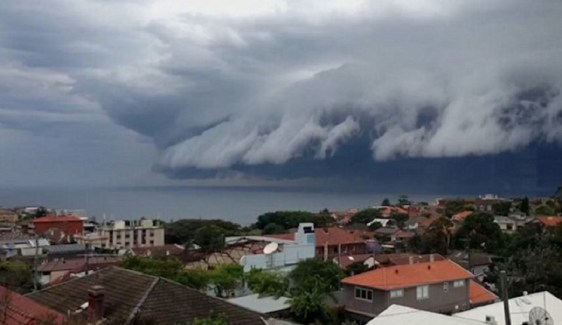
Photos and videos have gone viral on social media showing stunning sights of ominously dark and massive storm shelf clouds rolling across the Australian coast towards Sydney, giving warning of thunderstorms about to break loose over the city.

Even as the Bureau of Meteorology predicted gloom and doom, with warnings of severe storms, large hailstones and heavy rainfall in Sydney, Hunter region and the South and Central coastal regions, massive “tsunami” walls of black shelf clouds — also known as “arcus clouds” — hung over beaches, and loomed menacingly over the city on afternoon Friday.

As the “cloud tsunami” gathered, thousands of brave residents of the city took to the streets snapping photos. Thousands also took to social media, posting breathtaking photos and videos of dark and foreboding thunderheads rolling slowly across the sky and over beaches, spreading darkness over the city.

Source: ‘Apocalyptic’ Storm Front Looms Menacingly Over Sydney, Australia [Photos, Videos]

Study: Diamonds May Be More Common Than Thought | Geology | Sci-News.com

“Diamonds may not be as rare as once believed, but this finding won’t mean deep discounts at local jewelry stores,” said study authors Prof. Dimitri Sverjensky and Dr Fang Huang, both from the Johns Hopkins University.

“For one thing, the prevalence of diamonds near the Earth’s surface still depends on relatively rare volcanic magma eruptions that raise them from the depths where they form.”

“For another, the diamonds being considered in studies are not necessarily the stuff of engagement rings, unless the recipient is equipped with a microscope. Most are only a few microns across and are not visible to the unaided eye.”

Using a chemical model, the team found that diamonds could be born in a natural chemical reaction that is simpler than the two main processes that up to now have been understood to produce diamonds.

Specifically, the model shows that diamonds can form with an increase in acidity during interaction between water and rock.

“We show that diamonds could form due to a drop in pH during water–rock interactions,” the scientists wrote in the paper. “We use a recent theoretical model of deep fluids that includes ions, to show that fluid can react irreversibly with eclogite at 1,652 degrees Fahrenheit (900 degrees Celsius) and 5.0 GPa, generating diamond and secondary minerals due to a decrease in pH at almost constant oxygen fugacity.”

The common understanding up to now has been that diamonds are formed in the movement of fluid by the oxidation of methane or the chemical reduction of carbon dioxide.

“The new study showed that water could produce diamonds as its pH falls naturally – that is, as it becomes more acidic – while moving from one type of rock to another,” Prof. Sverjensky said.

“The more people look, the more they’re finding diamonds in different rock types now. I think everybody would agree there’s more and more environments of diamond formation being discovered,” he added.

“Overall, our results constitute a new quantitative theory of diamond formation as a consequence of the reaction of deep fluids with the rock types that they encounter during migration,” the scientists concluded.

Source: Study: Diamonds May Be More Common Than Thought | Geology | Sci-News.com

Temporary election work helps Canada gain 44,000 jobs in October | CTV News

Canada’s labour force received a boost of 44,000 net jobs last month thanks to a surge in temporary public-administration work likely generated by the federal election.

Source: Temporary election work helps Canada gain 44,000 jobs in October | CTV News