Consumer spending seen as key to economic growth

Policymaker says next five years will be crucial economic transformation period

China’s consumption will be a decisive factor in achieving the country’s next five-year economic growth targets, as its contribution to GDP will continue to increase, a senior policymaker said on Monday.

The driving power of investment, which was a major factor in preventing an economic hard landing in the wake of the 2008 global financial tsunami, will be relatively weakened, said Yang Weimin, deputy director of the Office of the Central Leading Group on Financial and Economic Affairs.

Net exports, meanwhile, “will be no worse than the current situation, but too fast growth is unlikely in the coming years”, Yang said on the sidelines of a news conference that introduced proposals related to socioeconomic development during the 13th Five-Year Plan (2016-20).

It stressed that the next five years will be a key period of transformation for the country’s economic growth model, marking the end of the high-speed growth driven by exports seen in the past 30 years, according to experts.

Completion of the entire transformation process may require more time, they said.

Zhang Xiaoqiang, vice-chairman of the China Center for International Economic Exchanges, said that process will last for at least three to five years, or even longer, during which period economic growth may face persistent slowdown pressure as the new driving force cannot be formed very soon.

“Difficulties will exist during the transformation, while the GDP growth rate should be no less than 6.5 percent on average in the next five years to achieve the goal of moderate prosperity,” he said.

To avoid a sudden economic cooling, investment should continue to play an important role, but inefficient and repetitive construction should be banned, said Yang.

“Fiscal reform under the next five-year plan is to reallocate rights and responsibilities among the central and local governments. The future model will encourage local government investment and lower local debt risks in order to ensure local governments’ stable fiscal income,” he added.

The National Bureau of Statistics indicated that consumption accounted for 60 percent of economic growth in the first half of this year, up from 51.6 percent in 2014 and 48.2 percent in 2013.

The contribution from gross capital formation declined to 35.7 percent in the first six months of 2015, down from 46.7 percent in 2014 and 54.2 percent in 2013.

Source: Consumer spending seen as key to economic growth[1]- Chinadaily.com.cn

OECD cuts global economic outlook for 2016 amid China slowdown

The OECD has slashed its global economic outlook for 2016, reflecting subdued trade growth amid China’s economic slowdown.

The organization now expects the global economy to grow 3.3 percent next year, downgraded from 3.6 percent in its September forecast, as other emerging markets have weakened further, and to expand 3.6 percent in 2017.

“A more significant slowdown in Chinese domestic demand could hit financial market confidence and the growth prospects of many economies, including the advanced economies,” the Paris-based organization said Monday in its economic outlook report.

The OECD also lowered its growth outlook for Japan, saying it now expects the economy to expand 1.0 percent in 2016, compared with an earlier projection of 1.2 percent, dampened by a sharp slowdown in external demand and sluggish private consumption.

Growth in the world’s third-largest economy is expected to decelerate further in 2017 to 0.5 percent, following the scheduled consumption tax hike in April that year, though the economy will be supported by rising real wages, the OECD said.

“The outlook for Japan remains softer than in other advanced economies, despite an anticipated upturn in real wage growth,” reflecting weak external demand, especially in Asia, and strong fiscal headwinds particularly from the planned tax hike, it said.

Slowing demand in Asian countries has resulted in a “marked contraction in Japan’s exports and industrial production,” the OECD said.

The government is scheduled to release gross domestic product data for the July-September period on Nov. 16. After contracting an annualized real 1.2 percent in the April-June period, sluggish exports and production are raising concern that the economy may have shrunk again.

The organization called for additional measures aimed at fiscal consolidation, after the Abe administration announced a revamped fiscal strategy relying on stronger economic growth.

The OECD warned that even with the planned consumption tax hike, Japan is “not on track” to achieve a primary surplus by fiscal 2020, calling for further increases in the consumption tax rate and broadening of the personal and corporate income tax bases.

Growth in China is now projected at 6.5 percent in 2016 and 6.2 percent in the following year as its economy faces sluggish manufacturing investment amid excess capacity.

The OECD expects growth in the United States to remain relatively solid at 2.5 percent in 2016, led by strong household consumption and a moderate upturn in private-sector investment.

But it warned that the normalization of accommodative policy will pose challenges for emerging markets, with the Federal Reserve appearing poised to raise interest rates as early as December.

“With globally integrated financial markets, it may be difficult for them to respond to any interest rate increases in the United States and to any associated depreciation of their currencies or capital outflows,” the report said.

The OECD is projecting the eurozone to grow 1.8 percent in 2016, supported by sustained monetary stimulus as well as lower oil prices, while a high level of private debt will remain a drag on consumption and investment in many countries.

Among emerging markets, recession has emerged in Brazil and Russia, which is likely to continue next year amid weakening prices for oil and other commodities, the OECD said.

Source: OECD cuts global economic outlook for 2016 amid China slowdown | The Japan Times

Expectations Sub-indice in Canada hits one year high, sentiment up in every region except energy-rich Prairie provinces (released November 9, 2015)

 image

Bloomberg Nanos Weekly Consumer Confidence Tracking

Consumer sentiment in Canada continues to trend upward in the post election period according to the Bloomberg Nanos Canadian Consumer Confidence Index.  The main index, sub-indices and each individual variable realized upward pressure this week in the Nanos tracking for Bloomberg.

“Consumer sentiment was up this week in every region of the country in Canada except the energy-rich Prairie provinces”, said Nanos Research Group Chairman Nik Nanos.

“The prospect of a fiscal stimulus and recent economic news–including upticks in the labor market and upside momentum in Canada’s non-energy exports–have been adding to the improvement in household expectations. Household attitudes toward spending are lagging, however, and less likely to improve until there are signs of wage growth”, said Robert Lawrie of Bloomberg Economics.

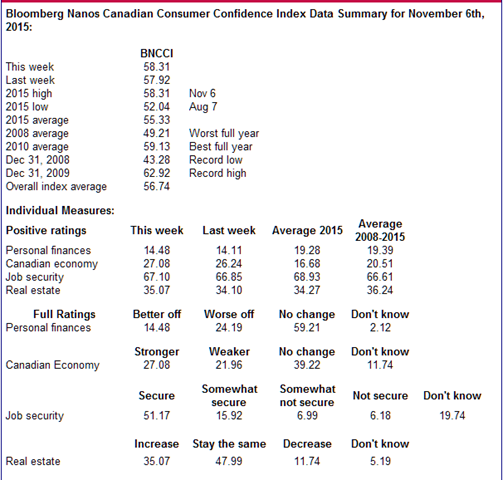
The BNCCI, a composite of a weekly measure of financial health and economic expectations, registered at 58.31 compared with last week’s 57.92. The twelve month high stands at 58.31.

The Bloomberg Nanos Pocketbook Index is based on survey responses to questions on personal finances and job security. This sub-indice was at 59.50 this week compared to 59.31 the previous week. The Bloomberg Nanos Expectations Index, based on surveys for the outlook for the economy and real estate prices, was at 57.11 this week (compared to 56.53 last week).

The average for the BNCCI since 2008 has been 56.74 with a low of 43.28 in December 2008 and a high of 62.92 in December 2009. The index has averaged 55.33 this year.

To view the weekly tracking visit our website

Methodology

The BNCCI is produced by the Nanos Research Corporation, headquartered in Canada,  which operates in Canada and the United States.  The data is based on random telephone interviews with 1,000 Canadian consumers (land- and cell-lines), using a four week rolling average of 250 respondents each week, 18 years of age and over. The random sample of 1,000 respondents may be weighted by age and gender using the latest census information for Canada and the sample is geographically stratified to be representative of Canada. The interviews are compiled into a four week rolling average of 1,000 interviews where each week, the oldest group of 250 interviews is dropped and a new group of 250 interviews is added. The views of 1,000 respondents are compiled into a diffusion index from 0 to 100. A score of 50 on the diffusion index indicates that positive and negative views are a wash while scores above 50 suggest net positive views, while those below 50 suggest net negative views in terms of the economic mood of Canadians.

A random telephone survey of 1,000 consumers in Canada is accurate 3.1 percentage points, plus or minus, 19 times out of 20.

All references or use of this data must cite Bloomberg Nanos as the source.

image

CANUCKS BANTER: All-Time Canuck 10 Or More Goal Games

CANUCKS BANTER     By Andrew Chernoff    November 9, 2015
image

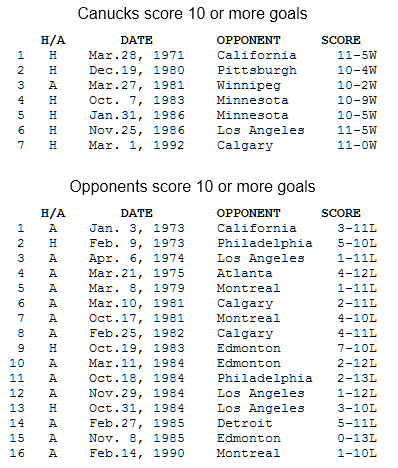
On March 28, 1971, the Canucks made history, defeating the California Golden Seals 11-5. It marked the first time in their history that the Canucks hit double digits in a game. Two years later, the Seals returned the favour, becoming the first team to hit double digits against the Canucks.

In total, the Canucks have been involved in 23 games where one of the teams scored ten or more goals. Not surprisingly, most of these games came during the high-scoring 1980’s. There have been no double-digit games between 1992-93 and 2009-10.  Canuck Library

NOTE: My research into double-digit games between 2010-11 and 2014-15 involving the Canucks has not indicated any. The current 2015-16 season has none.