Trudeau government facing bigger baseline deficits amid weaker economy

OTTAWA – The new Trudeau government will have to contend with bigger-than-expected baseline deficits in the coming years as it starts rolling out the large spending plans that helped it win power, the federal budget watchdog says.

The parliamentary budget office downgraded its economic projections for Canada on Tuesday, blaming the gloomier forecast on weaker growth, low commodity prices and shrinking revenues.

“It is worse than what we had expected, but it is not a disaster,” assistant parliamentary budget officer Mostafa Askari said Tuesday of Canada’s economic outlook.

“It’s a pause in the economic growth and as a result we have seen some deterioration in the fiscal picture for the government.”

The updated figures released by the budget office suggest it will be tougher for the Liberals to fulfil their election promise to balance the books by 2019-20, a goal they have said will follow three years of deficits.

But even those annual shortfalls are on track to grow bigger than expected, the report said.

For example, the Liberals pledged to run deficits of no more than $10 billion in each of the next two years by basing their forecasts on calculations made by the parliamentary budget office in July.

The budget office crunched those July numbers by updating government projections from April’s budget by recalculating them using downgraded Bank of Canada growth forecasts.

The latest PBO numbers, however, suggest the government’s fiscal starting point will be billions of dollars lower in those two years — by $3 billion in 2016-17 and by $4.7 billion in 2017-18. The result could mean deficits of nearly $13 billion in 2016-17 and more than $14 billion in 2017-18.

The Liberals have also said they would run a $5.7-billion shortfall in 2018-19 before delivering a $1-billion surplus in 2019-20 — but those projections are based on a combination of April’s Finance Department forecasts and the party’s own predictions.

The government has yet to say whether it will release a fiscal update before it tables its first budget since winning last month’s election.

The budget office said its predictions Tuesday do not take into account the fiscal impact of any measures in the Liberal government’s election platform.

The report Tuesday also updated the budget office’s own fiscal projections from April.

Back in April, the budget office said Ottawa would run a $1.1-billion surplus in 2015-16, break even in 2016-17 and post a $2.6-billion deficit in 2017-18. The spring forecast also projected shortfalls of $2.8 billion in 2018-19 and $2.5 billion in 2019-20.

The office is now forecasting a $1.2-billion surplus in 2015-16, but says it will be followed by four straight deficits that are on average $2.4 billion lower per year than its April projection.

It expects shortfalls of $3 billion in 2016-17, $4.7 billion in 2017-18, $5 billion in 2018-19 and $4.6 billion in 2019-20.

Source: Trudeau government facing bigger baseline deficits amid weaker economy: PBO | National Newswatch
A national child care system… because “it’s 2015” – Broadbent Institute

The best line of the Trudeau government’s first day— widely reported and praised in the international media—was the new PM’s.

In response to a reporter’s question about why he’d chosen to create a gender-parity cabinet, he rather matter of factly observed “because it’s 2015”.  This ostensibly simple statement summed up a complexity of attitudes, beliefs and even world views in three words. For those feminists who remain doggedly optimistic after a decade nasty enough to slay the optimism of Anne of Green Gables, it raised hopes that the first day’s lustre could foreshadow more significant changes to come.

Mr. Trudeau’s observation aptly fits another feminist “ask”— one that’s been a pillar of the feminist agenda for 45 years. This is the kind of solid universal publicly-funded early childhood education and child care (ECEC) system that many other countries have; one well-designed so it simultaneously advances women’s equality, supports young families across the income spectrum and is good for children.

Feminists are but one of the constituencies who passionately believe that 45 years after the report of the Royal Commission on the Status of Women, the answer to why a coherent national child care system of high quality services is needed is simply “because it’s 2015”.

“Because it’s 2015” stands in for a host of no-brainer rationales. Child care is still the ramp to women’s equality in employment.  Economic research shows how child care helps stimulate the economy through mothers’ paid work. Child care helps “generation squeeze” mothers and fathers balance work and family and make ends meet. Without child care, it’s impossible to help families out of poverty or help newcomers settle. And substantial research has accumulated that shows that if it’s high quality and inclusive, early childhood education and  care provides a terrific environment in which young children thrive whether they’re middle class or low income, abled or disabled, francophone, Anglophone or Indigenous.

Most women with children —more than 77% with three to five year olds—are employed or  engaged in studying, language learning and other activities. Yet a crucial piece of the social infrastructure needed to support them is still missing in Canada in 2015. And many families who don’t “need” child care choose to have their children participate in early childhood programs for socialization and learning as children do from about age two and a half in many other countries.

Now that the dust from the election has settled and the new government gets down to work, it’s timely to review campaign commitments to child care. The Liberal platform stated:

“We will develop a child care framework that meets the needs of Canadian families, wherever they live”, and “we will meet with provinces, territories, and Indigenous communities to begin work on a new National Early Learning and Child Care Framework, to deliver affordable, high-quality, flexible, and fully inclusive child care for Canadian families. This work will begin in the first 100 days of a Liberal government and will be funded through our investments in social infrastructure. The framework we design together will be administered in collaboration with, and in respect of, provincial jurisdictions”.

The platform also made an explicit commitment to “research, evidence-based policy, and best practices in the delivery of early learning and child care”. As one of the world’s child care laggards, Canada is in a position to learn a great deal not only from our own experience but by using evidence  from other countries about best (and worst) ECEC policies and practices. The body of research and analysis could be important because there is now substantial evidence about the best ways to move forward on the universal, high quality, publicly funded and managed early childhood education and care system long sought in Canada.

In a video outlining directions on child care developed by the Liberal Party for last November’s ChildCare2020 conference, Mr. Trudeau declared that: “As a country, we need to prioritize access to child care for every family that needs it. It must be affordable, available, and of the highest quality possible. When we’re talking about our kids’ development, we can’t cut corners”. And on CBC Radio’s The House last spring: “We’re committed to making sure parents have affordable, quality early learning for their kids, there’s no question about it,” concluding with “I think there is a need for national leadership to make sure that early learning and child care happens”.

The child care platform is one of three components in a “Greater Economic Security for Middle Class Families” package. In addition to child care, it includes a new geared-to-income Canada Child Benefit which amalgamates the existing Canada Child Tax Benefit (CCTB) with the Harper government’s Universal Child Care Benefit (UCCB) cheques, and Flexible Work, including more flexible parental leave benefits. The funding for child care, however, which is part of the Social Infrastructure Fund, is not earmarked specifically for child care. Thus, the new government’s commitment to a national child care program—while it includes many of the key elements needed to make it work—still leaves important pieces to be fleshed out.

The 2015 federal election was the first in which child care was a major election issue and the first in which three of four political parties—for which 70% of Canadians voted— made commitments to a national child care program. Noting that it had primarily been the NDP championing child care in the campaign, the Toronto Star’s endorsement of Mr. Trudeau observed, “If he wins power, [a national child care program] ought to be on his agenda”. The Star noted that “a national child care program is something that is long overdue” and that it would be firmly within the Liberal Party’s tradition if revived, as “Paul Martin’s government first proposed such a national plan more than a decade ago”.

In 2015, it’s dreadfully evident that our patchwork, marketized child care situation fails just about everyone and that young Canadian families live in one of the few wealthy countries that fails to  support them well. While not a simple task, taking on the challenge of beginning to create a real evidence-based national child care program in 100 days when the new federal government meets with the provinces would be consistent with creating the gender-parity, diverse and talented cabinet revealed yesterday.

And it would be absolutely appropriate if for no other reason than simply…”because it’s 2015”.

Martha Friendly is Director of the Childcare Resource and Research Unit.

Source: A national child care system… because “it’s 2015” – Broadbent Institute

Kitchen utensils can spread bacteria between foods, UGA study finds

Griffin, Ga. – In a recent study funded by the U.S. Food and Drug Administration, University of Georgia researchers found that produce that contained bacteria would contaminate other produce items through the continued use of knives or graters–the bacteria would latch on to the utensils commonly found in consumers’ homes and spread to the next item.

Unfortunately, many consumers are unaware that utensils and other surfaces at home can contribute to the spread of bacteria, said the study’s lead author Marilyn Erickson, an associate professor in the College of Agricultural and Environmental Sciences’ department of food science and technology.

“Just knowing that utensils may lead to cross-contamination is important,” Erickson said. “With that knowledge, consumers are then more likely to make sure they wash them in between uses.”

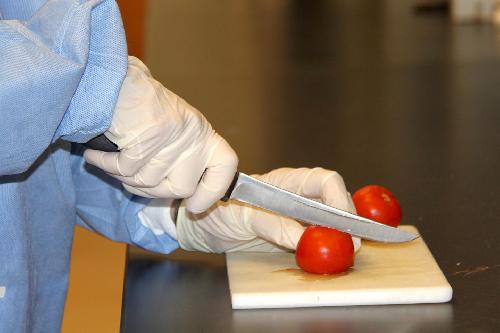
picMarilyn Erickson cuts into a tomato to test the chances of cross-contamination in home kitchens. An associate professor, she conducts her research at the University of Georgia Center for Food Safety in Griffin. Credit: Sharon Dowdy/University of Georgia
Erickson has been researching produce for the past 10 years. Her past work has mainly focused on the fate of bacteria on produce when it’s introduced to plants in the field during farming.

In 2013, she was co-author on a study looking at the transfer of norovirus and hepatitis A between produce and common kitchen utensils–finding that cutting and grating increased the number of contaminated produce items when that utensil had first been used to process a contaminated item.

This study, published in Food Microbiology, is similar in that it considers the influence that knives and graters have on the transfer of pathogenic bacteria to and from produce items. She urges consumers to realize that these germs can spread in their kitchens as well.

Researchers have known that poor hygiene and improper food preparation practices in a consumer’s home can lead to foodborne illnesses, but considering what practices in the kitchen are more likely to lead to contamination has not been examined extensively.

“The FDA was interested in getting more accurate numbers as to what level of cross-contamination could occur in the kitchen using standard practices,” Erickson said.

In her recent study, Erickson contaminated many types of fruits and vegetables in her lab–adding certain pathogens that often can be found on these foods, such as salmonella and E. coli.

Using a knife, Erickson would cut into things like tomatoes or cantaloupe and other types of produce to see how easily the bacteria could spread when the knife was continuously used without being cleaned. Because they “were looking at what would be the worst-case scenario,” she said, Erickson and study co-authors did not wash between cutting these different produce items.

Researchers also grated produce, like carrots, to see how easily the pathogens spread to graters. They found that both knives and graters can cause additional cross-contamination in the kitchen and that the pathogens were spread from produce to produce if they hadn’t washed the utensils.

“A lot of the broken up material and particles from the contaminated produce remained on the graters,” said Erickson, who conducts her research at the UGA Center for Food Safety in Griffin. “Then if you were to shred another carrot or something else immediately after that, it gets contaminated, too.”

The study also found that certain fruits and vegetables spread pathogens to knives to different degrees.

“For items like tomatoes, we tended to have a higher contamination of the knives than when we cut strawberries,” Erickson said. “We don’t have a specific answer as to why there are differences between the different produce groups. But we do know that once a pathogen gets on the food, it’s difficult to remove.”

Knives and graters aren’t the only utensils in the kitchen consumers should be worried about. Erickson has also helped study the role brushes and peelers have on the transfer of dangerous kitchen bacteria.

In concurrent studies, Erickson found that scrubbing or peeling produce items–like melons, carrots and celery–did not eliminate contamination on the produce item but led to contamination of the brush or peeler. Even when placed under running water, the utensils still became contaminated; however, the ability to cross-contaminate later produce items depended on the brush type and the pathogenic agent.

These studies combined give researchers a better idea as to how common cross-contamination is in the kitchen–even when just using standard practices.

Erickson explained there is a small chance of buying fruits and vegetables contaminated with bacteria, but the problem can occur–whether the product is store-bought or locally grown.

source: University of Georgia

Source: Kitchen utensils can spread bacteria between foods, UGA study finds | Science Codex

Trudeau popularity as Prime Minister keeps surging (ending November 6, 2015)

Nanos Weekly Leadership Tracking

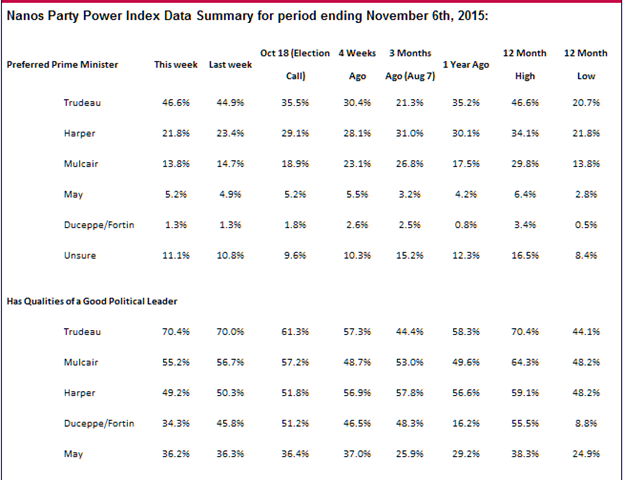
  • Preferred Prime Minister – Nanos tracking as to who Canadians would prefer as Prime Minister has Trudeau still climbing on this measure and is currently at 46.6%, followed by former Conservative leader Harper at 21.8%, Mulcair at 13.8%, May at 5.2%, and 11.1% were unsure.  Readers should note that Interim Conservative Leader Ambrose was added to the Nanos tracking this week.
  • Qualities of a Good Political Leader – Seven of ten Canadians thought Trudeau had the qualities of a good political leader a record high for Trudeau, or any leader in the Nanos tracking while 55.2% of Canadians thought similarly of Mulcair.  Harper was at 49.2% of Canadians and May at 36.2%.  This is based on a series of independent questions for each party leader.

The team at Nanos in conjunction with Klipfolio have launched our new live political data portal where you run the numbers you want and can explore the trends and data you need.  This is part of our campaign, not only to provide the most reliable data to Canadians but to let them use it as they wish. We were the first to do nightly tracking and now we are the first research organization to post live public opinion data for Canadians.

We were the first to do nightly tracking and now we are the first research organization to post live public opinion data for Canadians. Here’s the link to check it out 

To view the detailed tracking visit our website.

Methodology

The views of 1,000 respondents are compiled into a party power brand index for each party that goes from 0 to 100, where 0 means that the party has no brand power and 100 means it has maximum brand power. A score above 50 is an indication of brand power for the party and its leader at this time.

The important factors in this weekly tracking include the direction of the brand strength or weakness and also the brand power of one federal party relative to another.

The data is based on random telephone interviews with 1,000 Canadians, using a four week rolling average of 250 respondents each week, 18 years of age and over. The random sample of 1,000 respondents may be weighted by age and gender using the latest census information for Canada, and the sample is geographically stratified to be representative of Canada. 

The interviews are compiled into a four week rolling average of 1,000 interviews where each week, the oldest group of 250 interviews is dropped and a new group of 250 interviews is added. Note: the current wave of tracking is based on the final weekend of the election writ period ending October 18th as well as the three week period ending November 6th. As we move forward the tracking will revert to a four-week rolling average of 1,000 Canadians (250 per week).

A random telephone survey of 1,000 Canadians is accurate 3.1 percentage points, plus or minus, 19 times out of 20.

All references or use of this data must cite “Nanos Party Power Index” as the source.


image