First solar powered public bus operates in Tibet

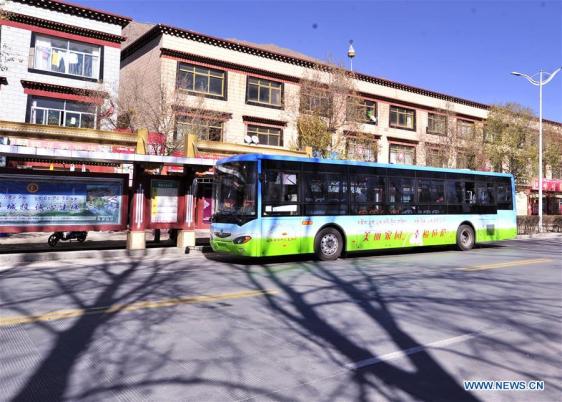
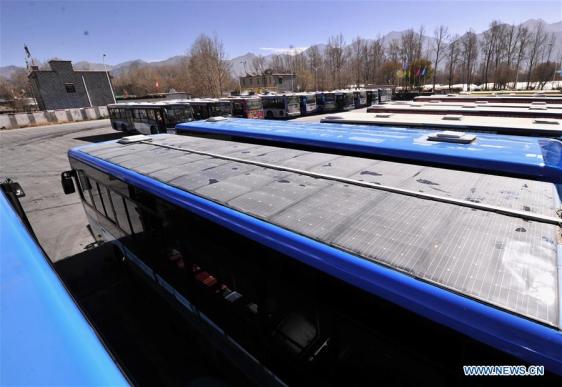
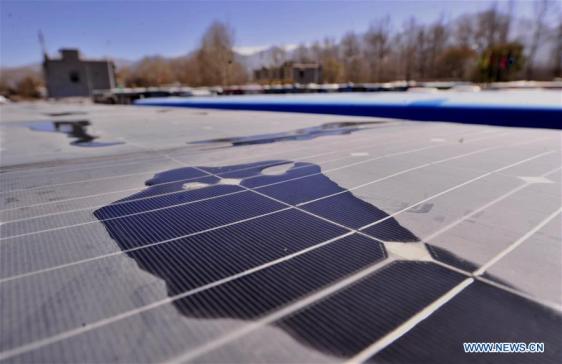
This photo taken on Nov 23, 2015 shows the solar bus in Lhasa, capital of Southwest China’s Tibet autonomous region. The first solar powered bus in Tibet was put in operation recently. [Photo/Xinhua]

chinadaily.com.cn  2015-11-24

A brand new solar powered bus, which looks just like an ordinary public bus to the naked eye, officially hit the road of Lhasa, the capital city of the Tibet autonomous region in November.

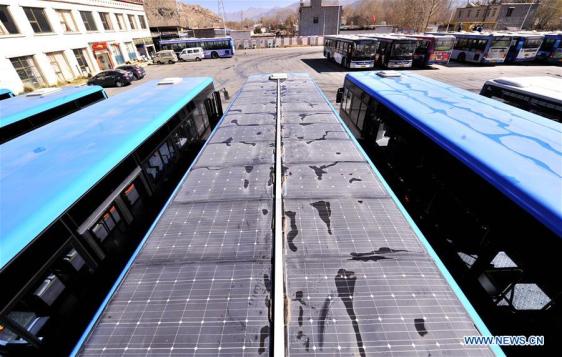
“Compared to the oil powered buses, the biggest distinction is that the roof of the new bus is comprised of photovoltaic (PV) panels totaling about 20 square meters,” said China Tibet Online, citing one employee from the local bus company. “Through the PV panels, electricity is converted from solar power, to support the engine of the bus.”

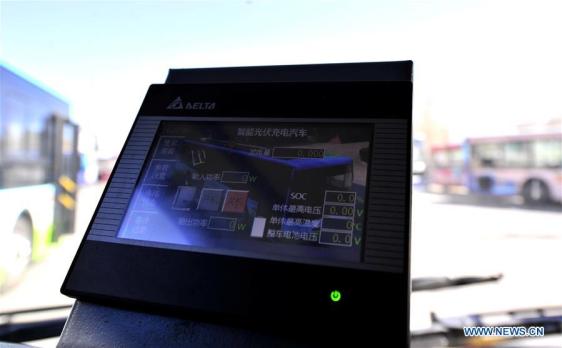
Drivers can monitor the charging status on the dashboard located at the driver’s cab at any time.

According to the report, technicians estimate that as long as there is enough sunshine, it is not necessary for the bus to be charged, whether it is parked or in motion. The effectiveness of charging is determined by how intense the sunlight is and to what extent the bus is exposed to the sun.

“As Lhasa enters the winter season, sun exposure will be reduced, sunlight intensity will weaken. That is, simply relying on solar power will not be enough, therefore we can switch to power charging mode to ensure smooth operations,” the employee said.
https://andrewphillipchernoff.ca/wp-content/uploads/2015/11/b083fe955b6c17be4b2e06.jpg

First solar powered public bus operates in Tibet

First solar powered public bus operates in Tibet

First solar powered public bus operates in Tibet

Source: First solar powered public bus operates in Tibet[1]- Chinadaily.com.cn

Solar Leading Enters PV-based LED Streetlight Market

Chinese solar power hardware manufacturer Solar Leading has entered the new photovoltaic (PV) street light product market, which is designed with the aim of providing longer lifetime and low energy consumption lights to cities and companies, reported IHS Electronics 360.

Under the new brand name of Senior LED, Solar Leading’s LED lighting business arm, it aims to profit from the street light market where many Solar Leading’s PV-based streetlights can enable year round of illumination.

The streetlights are able to illuminate and operate 365 days, due to its intelligent control system and light output that can be adjusted automatically based on battery power. Components including the battery, LEDs, and PV panels are all independent of each other in this system, and can be swapped if the occasion rises.

PV LED panels are fully adjustable and can take maximum advantage of solar radiation compared to other solar streetlights that have panels that are positioned at a fixed angle based on latitude.

The solar company plans to initially release the streetlight sin Asia, Latin America and Middle East, but has future plans to introduce the products to U.S. and other European markets.

Source: Solar Leading Enters PV-based LED Streetlight Market – LEDinside

Sharp surges third day after reports banks may forgive loans

Nov 24, 2015

[TOKYO] Sharp climbed a third day in Tokyo after reports the debt-strapped display maker’s main lenders were considering forgiving loans to facilitate an investment by a government-backed investment fund.

The shares surged 14 per cent to close at 150 yen, bringing their three-day gain to 25 per cent, the most since May 2013. The stock briefly soared on Tuesday by as much as 36 per cent, the most since 1974, with trading volume more than eight times the three-month average.

Mizuho Financial Group and Mitsubishi UFJ Financial Group may forgive loans to secure an investment from Innovation Network Corporation of Japan, Kyodo reported without attribution Friday.

Sharp has endured more than 1.2 trillion yen (S$138.3 billion) in losses over the past four financial years after lower-cost South Korean and Chinese rivals undercut its core business making liquid crystal-display televisions. The company remains dependent on its main lenders for survival, even after the banks accepted shares in the company in exchange for debt.

“Individual investors are buying Sharp to get short-term profit,” said Yasuaki Kogure, chief investment officer at SBI Asset Management Co. “Even if banks forgive loans, it won’t be a fundamental solution.” Sharp’s years of losses has seen many institutional investors abandon the stock. All but one of the 14 analysts tracked by Bloomberg recommend selling the shares, with the other rating being a neutral.

The maker of displays for mobile phones, tablets and televisions is considering selling a stake in the LCD operation to the government-backed INCJ or to Foxconn Technology Group unit Hon Hai Precision Industry, people with knowledge of discussions within the companies have said.

Sharp said Oct 30 its sales dropped 3.6 per cent in the fiscal first half to 1.279 trillion yen as revenue from LCD TVs, tablets and solar batteries all decreased.

Japan’s Rating & Investment Information has a B-rating on Sharp, six levels below investment grade. The ratings company evaluated the company at AA as recently as May 2009.

Foxconn, assembler of Apple Inc.’s iPhone, has signed a letter of intent to buy a stake in Sharp’s liquid-crystal display business in a deal that would give the Taiwan-based company management control, people familiar with the plan said in September.

Sharp President Kozo Takahashi is struggling under rising debt and has announced plans to sell the company’s headquarters, withdraw from the TV business in North America and cut back in solar panel manufacturing.

Source: Sharp surges third day after reports banks may forgive loans, Technology – THE BUSINESS TIMES

Canada to announce plan to resettle 25,000 Syrian refugees

Prime Minister Justin Trudeau will announce Tuesday his plan to resettle 25,000 Syrian refugees and he says all 10 of Canada’s provincial premiers support bringing that many in.

Trudeau hasn’t backed down from a pledge to bring 25,000 Syrian refugees to Canada by Dec. 31 despite pushback by some following the deadly attacks in Paris.

Details of how the refugees will be brought over and where they will be housed are expected to be announced Tuesday.

“Everyone agrees that Canada must do more and must welcome 25,000 refugees,” Trudeau said after meeting with provincial leaders late Monday.

Tuesday’s announcement is sure to raise alarm in the U.S. where many Republican governors have said they don’t want any Syrian refugees.

Trudeau said robust security screening continues to be a high priority.

Quebec Premier Phillipe Couillard said accepting refugees and immigrants is part of Canadian tradition.

“There was no one sitting at the table that is not interested in seeing refugees come,” Ontario Premier Kathleen Wynne said.

Immigration Minister John McCallum said he spoke to Canada’s big city mayors about how they can help resettle the refugees.

Canada has long prided itself on opening its doors wider than any nation to asylum seekers. In times of crisis in decades past, Canada resettled refugees quickly and in large numbers. It airlifted more than 5,000 people from Kosovo in the late 1990s, more than 5,000 from Uganda in 1972 and resettled 60,000 Vietnamese in 1979-80. More than 1.2 million refugees have arrived in Canada since World War II.

Former Conservative Canadian Prime Minister Stephen Harper, who lost the Oct. 19 election to Trudeau, had declined to resettle more Syrian refugees, despite the image of a drowned 3-year-old boy washed up on a Turkish beach focusing global attention on the refugee crisis stemming from the civil war. The boy had relatives in Canada and the refugee crisis became a major campaign issue.

Brad Wall, the Conservative premier of Saskatchewan province, said he has problems with the deadline of Dec. 31 for security reasons, but believes Canada should welcome the refugees.

More than 4 million Syrians have fled their country since the conflict began in 2011.

Source: Canada to announce plan to resettle 25,000 Syrian refugees | Fox News