Chinese shares turn positive after rout

Mainland Chinese shares reversed early losses on Tuesday, following Monday’s suspension of trading, which led to a global equities sell-off.

The Shanghai Composite was up 0.7% at 3,321.87 after opening more than 3% lower, while the Hang Seng also changed direction to head up 0.1% to 21,342.09.

Trading in Shanghai was suspended early on Monday after it triggered a new circuit breaker mechanism.

The 7% fall spooked global markets.

Overnight, US benchmark indexes lost up to 2% as concerns grew that the dive in the Chinese stocks was the start of another volatile period after last summer’s dramatic market rout.

The addition of escalating tensions in the Middle East on oil prices also dented investors’ confidence.

Oil prices were flat after rising as much as 4% on the brewing dispute between Saudi Arabia and Iran.

South Korean shares also headed higher after a senior finance ministry official told Reuters that the government would take action to stabilise the market if needed, following Monday’s steep plunge.

The Kospi was up 0.2% to 1,922.62 points.

Asia’s biggest market – Japan’s Nikkei 225 index was down 0.4% to 18,369.77, while Australia’s S&P/ASX 200 lost 0.9% to 5,222.90.

Analysts said investors were waiting to see if Beijing could stem the latest selling in Chinese stocks and whether more measures would be introduced.

The circuit breaker rule that suspended trading nationwide for the first time on Monday was created after sharp falls last summer and was meant to curb market volatility in China.

Source: Chinese shares turn positive after rout – BBC News

Global stock markets dive on China worries

Wall Street has continued the rout on global share markets, with the Dow Jones, S&P 500 closing down more than 1.5% and Nasdaq down 2%.

It followed sharp falls in China, where trading on the main stock markets was halted early after indexes tumbled 7%.

A survey indicating China’s manufacturing sector contracted again last month was blamed for the falls.

Other Asian markets also fell, while in Europe, the FTSE 100 closed down 2.6% and Germany’s Dax index dropped 4.3%.

Meanwhile, news that Saudi Arabia had broken off diplomatic ties with Iran sent oil and gold prices higher.

On Wall Street, all 10 major S&P sectors were lower, led by the 2.4% fall in the technology sector. Bank stocks were also hard hit, with JP Morgan down 3.65%.

“Those are violent New Year fireworks,” said Andre Bakhos, managing director at Janlyn Capital. “That’s quite a way to start the day off.”

China weakness

Earlier on Monday, trading on China’s Shanghai and Shenzhen stock exchanges was halted for the first time under new “circuit breaker” rules, which are designed to curb market volatility.

The share price falls came after more signs of trouble in the world’s second-largest economy.

The Caixin/Markit purchasing managers’ index slipped to 48.2 in December, marking the 10th consecutive month of shrinking factory activity in the sector. A reading below 50 indicated contraction.

Some analysts also attributed the decline in share prices to the imminent end of a six-month lockup period on share sales by major institutional investors, a policy implemented to shore up indexes. Big shareholders may start dumping shares once the ban is lifted on Friday.

Huang Cengdong, an analyst for Sinolink Securities in Shanghai, said: “The market will not improve because there will be heavy selling in the near future.”

Monday’s sell-off in China had a knock-on across the region. Japan’s Nikkei 225 tumbled 3.1% and Hong Kong’s Hang Seng retreated 2.6%.

Analysis: Karishma Vaswani, Asia business correspondent

There’s nothing like the herd mentality to get things started for the new year. Retail investors in the Chinese stock market are often driven by sentiment and tend to follow the crowd.

When they hear of some bad news from brokers or their friends, and other people start selling, they start selling too.

Falling prices attract more people to dump their stocks, and although shares are still above their lows, authorities will be keen to avoid the kind of share market crash we saw last summer.

Read Karishma’s full analysis here.

“Welcome to 2016, though you’d be forgiven for thinking the markets were back in August 2015 with China causing some early New Year issues,” said Spreadex analyst Connor Campbell.

And Alastair McCaig, market analyst at IG, said: “Anyone hitting the trading floor expecting a calm and quiet start to 2016 was given a rude surprise as Asian chaos affected European markets.”

Markets were also rattled by growing tensions between Middle East powerhouses Saudi Arabia and Iran over the execution of Shia cleric Nimr al-Nimr.

The execution in Saudi Arabia led to protests in Tehran. Saudi has cut diplomatic ties with Iran and given diplomats 48 hours to leave.

Iran’s supreme leader has warned Saudi Arabia it would face “quick consequences” for the execution.

‘Supply glut’

Fearing further upheaval in the already volatile Middle East, the US has urged regional leaders to try to ease tensions.

The price of Brent crude jumped more than 3% at the start of the day on the back of heightened tensions, but then fell back sharply after US stock markets opened. In late afternoon trading, Brent was down 1% at $36.96 a barrel, while US crude was down 1.4% at $36.52.

Analysts said the underlying trend of oversupply would continue to weigh on prices over the longer term.

“Unless we see a convincing drop in oil output from these two nations, and the broader oil-producing community, the supply glut issue will persist, which means oil prices would remain under pressure for a longer period,” said Bernard Aw at IG Markets in Singapore.

Oil prices are down by two-thirds since mid-2014, with analysts estimating that producers are pumping between 0.5 million and two million barrels of oil every day in excess of demand.

Worries about the impact of Middle East tensions were underlined in the gold price, which rose more than 1% on Monday to $1,070.20 an ounce.

Gold is frequently seen as an alternative investment during times of geopolitical and financial uncertainties. The gold price lost 10% last year.

Another traditional haven is the Swiss franc, which gained about 0.8% against both the dollar and the euro in early trading on Monday.

Source: Global stock markets dive on China worries – BBC News

Chemists Develop Fully Recyclable Polymer

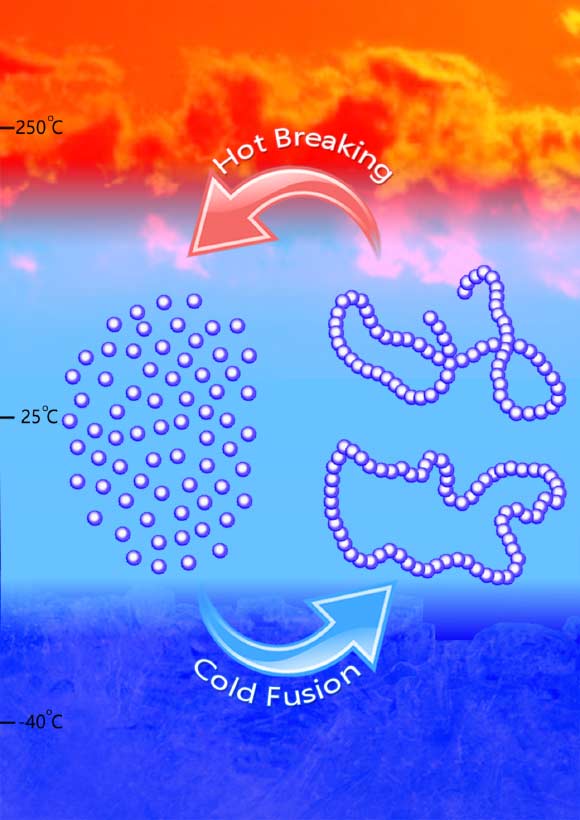
A graphical illustration of the polymer synthesis process: monomers are cooled in order to polymerize; to cycle back, heat is applied. Image credit: Jing Tang / Chen lab.

“More than 200 pounds of synthetic polymers are consumed per person each year – plastics probably the most in terms of production volume. And most of these polymers are not biorenewable,” said Prof. Eugene Chen of CSU’s Department of Chemistry.

“The big drive now is to produce biorenewable and biodegradable polymers or plastics. That is, however, only one part of the solution, as biodegradable polymers are not necessarily recyclable, in terms of feedstock recycling.”

Writing in the journal Nature Chemistry, Prof. Chen and his colleague, Miao Hong, describe synthesizing a polymer that, when reheated for about an hour, converts back to its original molecular state, ready for reuse.

Their starting feedstock was gamma-butyrolactone (GBL), a monomer that scientists had declared non-polymerizable.

Prof. Chen and Ms Hong used both metal-based and metal-free catalysts to synthesize the polymer, called poly(GBL).

They employed specifically designed reaction conditions, including low temperature, to make the poly(GBL), and heat between 428 – 572 degrees Fahrenheit (220 – 300 degrees Celsius) to convert the polymer back into the original monomer, GBL, demonstrating the thermal recyclability of the polymer.

“This work established relationships between the poly(GBL) structure and its thermal and dynamic mechanical properties, and it demonstrated the complete thermal recyclability of poly(GBL) back into its monomer, which thereby opens up unique opportunities for discovering new sustainable (renewable and recyclable) biomaterials based on the ROP (ring-opening polymerization) of other five-membered lactones,” Prof. Chen and Ms Hong said.

Their discovery has promising market potential, and a provisional patent has been filed with the help of CSU Ventures.

_____

Miao Hong & Eugene Y.-X. Chen. 2016. Completely recyclable biopolymers with linear and cyclic topologies via ring-opening polymerization of γ-butyrolactone. Nature Chemistry 8, 42-49; doi: 10.1038/nchem.2391

Source: Chemists Develop Fully Recyclable Polymer | Chemistry | Sci-News.com

Large and increasing methane emissions from northern lakes

Methane is increasing in the atmosphere, but many sources are poorly understood. Lakes at high northern latitudes are such a source. However, this may change with a new study published in Nature Geoscience. By compiling previously reported measurements made at a total of 733 northern water bodies – from small ponds formed by beavers to large lakes formed by permafrost thaw or ice-sheets – researchers are able to more accurately estimate emissions over large scales.

“The release of methane from northern lakes and ponds needs to be taken seriously. These waters are significant, contemporary sources because they cover large parts of the landscape. They are also likely to emit even more methane in the future”, says Martin Wik, PhD student at the Department of Geological Sciences and Bolin Centre for Climate Research, Stockholm University, who led the study.

With climate warming, particularly at high northern latitudes, longer ice-free seasons in combination with permafrost thaw is likely to fuel methane release from lakes, potentially causing their emissions to increase 20-50 precent before the end of this century. Such a change would likely generate a positive feedback on future warming, causing emissions to increase even further.

“This means that efforts to reduce human induced warming are even more urgent in order to minimize this type of feedback of natural greenhouse gas emissions. In a sense, every reduction in emissions from fossil fuels is a double victory”, says David Bastviken, Professor at Tema Environmental Change, Linköping University.

source: Stockholm University

Source: Large and increasing methane emissions from northern lakes | Science Codex

Worldwide electricity production vulnerable to climate and water resource change

Climate change impacts and associated changes in water resources could lead to reductions in electricity production capacity for more than 60% of the power plants worldwide from 2040-2069, according to a new study published today in the journal Nature Climate Change. Yet adaptation measures focused on making power plants more efficient and flexible could mitigate much of the decline.

“Hydropower plants and thermoelectric power plants–which are nuclear, fossil-, and biomass-fueled plants converting heat to electricity–both rely on freshwater from rivers and streams,” explains Michelle Van Vliet, a researcher at the International Institute for Applied Systems Analysis (IIASA) in Austria and Wageningen University in the Netherlands, who led the study. “These power-generating technologies strongly depend on water availability, and water temperature for cooling plays in addition a critical role for thermoelectric power generation.”

Together, hydropower and thermoelectric power currently contribute to 98% of electricity production worldwide.

Model projections show that climate change will impact water resources availability and will increase water temperatures in many regions of the world. A previous study by the researchers showed that reduced summer water availability and higher water temperatures associated with climate change could result in significant reductions in thermoelectric power supply in Europe and the United States.

This new study expands the research to a global level, using data from 24,515 hydropower and 1,427 thermoelectric power plants worldwide.

“This is the first study of its kind to examine the linkages between climate change, water resources, and electricity production on a global scale. We clearly show that power plants are not only causing climate change, but they might also be affected in major ways by climate,” says IIASA Energy Program Director Keywan Riahi, a study co-author.

“In particular the United States, southern South America, southern Africa, central and southern Europe, Southeast Asia and southern Australia are vulnerable regions, because declines in mean annual streamflow are projected combined with strong increases in water temperature under changing climate. This reduces the potential for both hydropower and thermoelectric power generation in these regions,” says Van Vliet.

The study also explored the potential impact of adaptation measures such as technological developments that increase power plant efficiency, switching from coal to more efficient gas-fired plants, or switching from freshwater cooling to air cooling or to seawater cooling systems for power plants on the coasts.

“We show that technological developments with increases in power plant efficiencies and changes in cooling system types would reduce the vulnerability to water constraints in most regions. Improved cross-sectoral water management during drought periods is of course also important,” says Van Vliet. “In order to sustain water and energy security in the next decades, the electricity focus will need to increase their focus on climate change adaptation in addition to mitigation.”

Source: International Institute for Applied Systems Analysis

Source: Worldwide electricity production vulnerable to climate and water resource change | Science Codex