USGS Researchers Reveal First-Ever Digital Geologic Map of Alaska

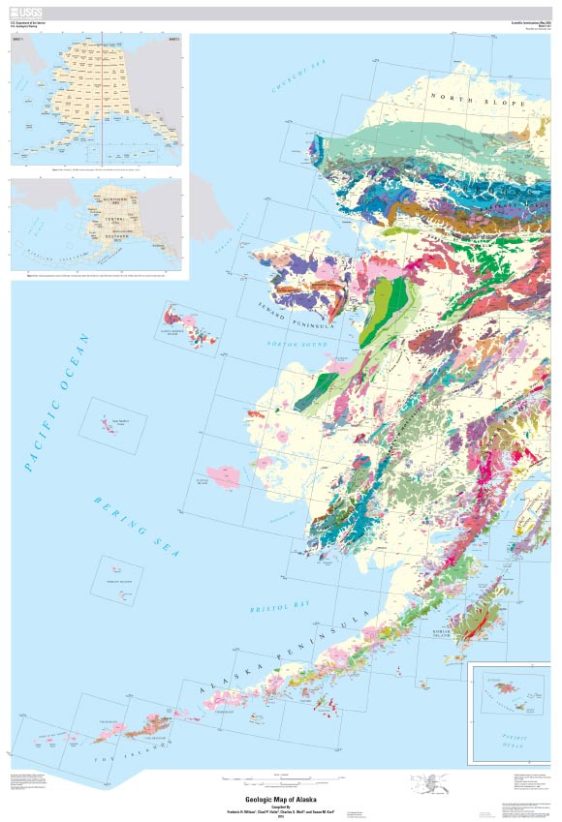
This map (Part 1 – the western part of Alaska and the Aleutian Islands, and Part 2 – the eastern part of Alaska and the list of map units) is a completely new compilation, carrying the distinction of being the first 100% digital statewide geologic map of Alaska.

More than 750 references were used in creating the map, some as old as 1908 and others as new as 2015.

“This new map and associated digital databases are the result of compilation and interpretation of published and unpublished 1:250,000-scale and limited 1:500,000- to 1:63,360-scale maps,” the USGS researchers explained.

The map gives visual context to the abundant mineral and energy resources found throughout Alaska in a beautifully detailed and accessible format.

“Covering the entire state of Alaska, it reflects more than a century of work by a host of geologists and almost two decades of compilation work,” the scientists said.
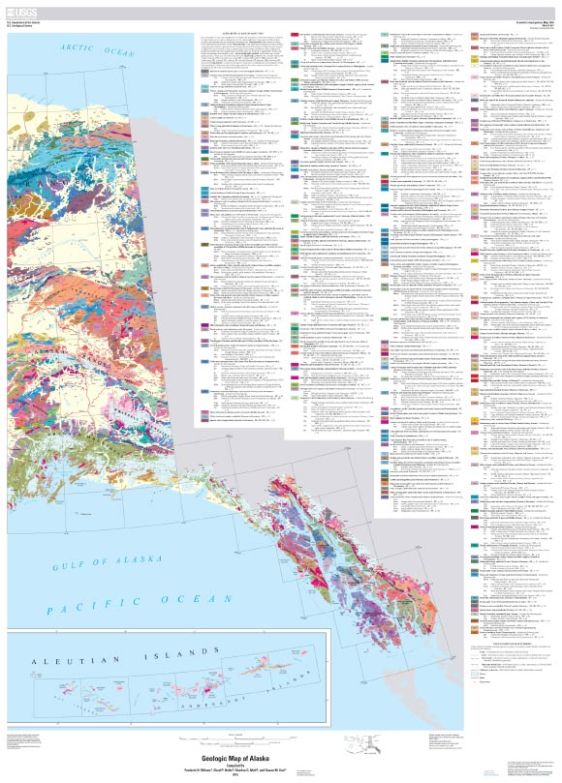
Geologic map of Alaska, part 2: generalized geologic map of the eastern part of Alaska. Image credit: U.S. Geological Survey / U.S. Department of the Interior.

Geologic map of Alaska, part 2: generalized geologic map of the eastern part of Alaska. Image credit: U.S. Geological Survey / U.S. Department of the Interior.

“I am pleased that Alaska now has a state-wide digital map detailing surface geologic features of this vast region of the United States that is difficult to access,” said USGS Director Suzette Kimball.

“This geologic map provides important information for the mineral and energy industries for exploration and remediation strategies. It will enable resource managers and land management agencies to evaluate resources and land use, and to prepare for natural hazards, such as earthquakes.”

“The data contained in this digital map will be invaluable. It is a great resource and especially enhances the capacity for science-informed decision making for natural and cultural resources, interpretive programs, and visitor safety,” added National Park Service Director Jonathan B. Jarvis.

“A better understanding of Alaska’s geology is vital to our state’s future,” said Sen. Lisa Murkowski, R-Alaska. “This new map makes a real contribution to our state, from the scientific work it embodies to the responsible resource production it may facilitate. Projects like this one underscore the important mission of the USGS, and I’m thankful to them for completing it.”

“This map is the continuation of a long line of USGS maps of Alaska, reflecting ever increasing knowledge of the geology of the state,” said USGS research geologist Dr Frederic Wilson, who is the lead author of the new map.

_____

Wilson, F.H. et al. 2015. Geologic map of Alaska: U.S. Geological Survey Scientific Investigations Map 3340, pamphlet 196 p., 2 sheets, scale 1:1,584,000; doi: 10.3133/sim3340

Source: USGS Researchers Reveal First-Ever Digital Geologic Map of Alaska | Geology | Sci-News.com
Sugar-sweetened drinks linked to increased visceral fat

DALLAS, Jan. 11, 2016–Drinking sugar-sweetened beverages every day was associated with an increase in a particular type of body fat that may affect diabetes and heart disease risk, according to new research in the American Heart Association’s journal Circulation.

Data from the Framingham Heart Study — federally supported, ongoing research that has advanced the understanding of cardiovascular disease — showed that among middle-aged adults, there was a direct correlation between greater sweetened beverage consumption and increased visceral fat.

Visceral fat or “deep” fat wraps around a number of important internal organs such as the liver, pancreas and intestines. Visceral fat affects how our hormones function and is thought to play a larger role in insulin resistance – which may boost Type 2 diabetes and heart disease risk.

Researchers looked at both sugar-sweetened beverage and diet soda consumption. The researchers did not observe this association with diet soda, which is often promoted as low in calories and sugar.

“There is evidence linking sugar-sweetened beverages with cardiovascular disease and type 2 diabetes,” said Caroline S. Fox, M.D., M.P.H, lead study author and a former investigator with the Framingham Heart Study of the National Heart, Lung, and Blood Institute. She is currently a special volunteer with the National Institutes of Health (NIH). “Our message to consumers is to follow the current dietary guidelines and to be mindful of how much sugar-sweetened beverages they drink. To policy makers, this study adds another piece of evidence to the growing body of research suggesting sugar-sweetened beverages may be harmful to our health.”

A total of 1,003 study participants, average age 45 and nearly half women, answered food questionnaires and underwent CT scans at the start and the end of the study to measure body fat changes.

They were ranked into four categories: non-drinkers; occasional drinkers (sugar-sweetened beverages once a month or less than once a week); frequent drinkers (once a week or less than once a day); and those who drank at least one sugar sweetened beverage daily.

Over a six-year follow-up period, independent of the participants’ age, gender, physical activity, body mass index and other factors, they found visceral fat volume increased by:


  • 658 centimeters cubed for non-drinkers;
  • 649 centimeters cubed for occasional drinkers;
  • 707 centimeters cubed for frequent drinkers; and
  • 852 centimeters cubed for those who drank one beverage daily.While the exact biological mechanism is unknown, Jiantao Ma, M.D., Ph.D., post-doctoral fellow at the NIH and co-leader of the study, said that it’s possible that added sugars may contribute to insulin resistance, a hormonal imbalance that increases the risk for Type 2 diabetes and heart disease.Sugar-sweetened beverages are the largest contributor of added sugar intake in the United States. Sucrose or high fructose corn syrup are two of the most common sugars found in these popular drinks, which include caffeinated and de-caffeinated soda, carbonated and non-carbonated drinks with added sugar, fruit juice, and lemonade.

    Daily consumption of added sugar, such as those found in sugar-sweetened beverages and processed foods, is high; in 2001 to 2004, the usual intake of added sugars for Americans was 22.2 teaspoons per day or an extra 355 calories. Growing evidence revealing the health risks associated with drinking sweetened beverages led the American Heart Association to provide added sugar recommendations in 2009; for most women, no more than 100 calories per day of added sugars, such as those found in sweetened beverages, and for most men, a limit of 150 calories per day.

    “Our findings are in line with current dietary guidelines that suggest limiting the consumption of sugar-sweetened beverages,” Ma said.

    Source: American Heart Association


Source: Sugar-sweetened drinks linked to increased visceral fat | Science Codex

Polymer puts new medical solutions within reach

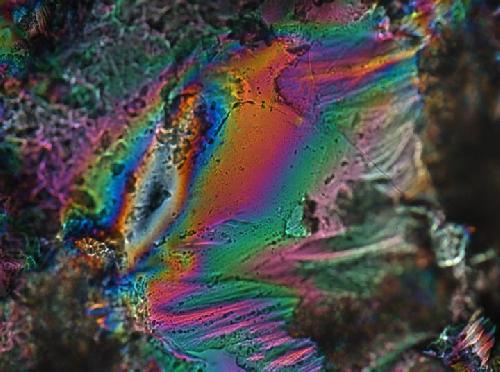
The liquid crystalline hydrogel in a dry state. Credit: Patrick Mather

Researchers, particularly those in the medical field, have been searching for a way to combine the properties of liquid crystallinity with those of hydrogels.

Liquid crystals are characterized as having the fluidity of liquid but some of the order of a crystal so they can be oriented to have structure. They are not water-loving, in that they will dissolve in water, making them less than ideal candidates for use inside the body.

Hydrogels, however, are water-loving but they lack the order to orient them into specific shapes.

Combining the properties of liquid crystals and hydrogels in just the right proportions creates the potential for new materials that have the same mechanical properties as soft tissues in the body. A material that is water-loving and has structure opens up the door the possibility for artificial blood vessels that are mechanically stealth so they wouldn’t be viewed as a foreign body.

Professor Pat Mather has developed a process that can create this type of a polymer.

The paper “A hydrogel-forming liquid crystalline elastomer exhibiting soft shape memory” authored by Mather and graduate student Amir Torbati G’14, now a post-doc at UC Denver, was featured on the cover the Journal of Polymer Science B: Polymer Physics.

“It is a balancing act of not having too many water-loving groups in the polymer and balancing that with other chemicals in the polymer that promote structure.” said Mather.

Whatever the hydrogels do to make the liquid crystals water-loving destroys the order of crystallinity, so historically creating a material like this has been a challenge but Mather’s process opens to the door to new medical applications that were previously out of reach.

source: Syracuse University

Source: Polymer puts new medical solutions within reach | Science Codex

Satellites dissect Nepal quake

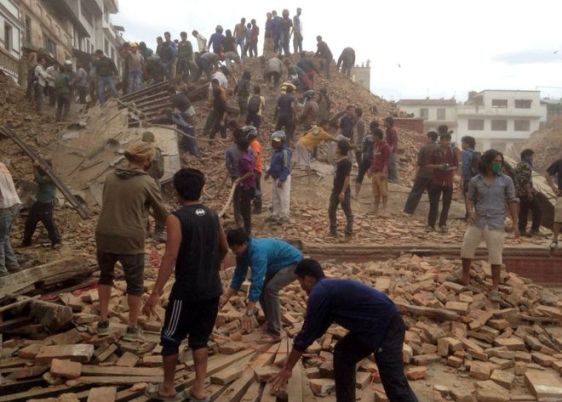
The deep anatomy of last year’s devastating quake in Nepal is revealed in a new analysis by scientists.

Satellite data is used to show where and how the rocks ruptured under the country, leading to the loss of more 8,800 lives.

The Magnitude 7.8 tremor occurred at a point where the main fault takes a deep dip just south of the high Himalayas.

This “ramp” structure, as the group calls it, probably also plays a key role in building the famous peaks.

As tectonic forces drive the Indian subcontinent under Central Asia, rocks ride up the ramp, adding a few millimetres a year to the height of the snow and ice-capped mountains.

John Elliott from Oxford University, UK, and colleagues report their assessment of the 25 April quake in the journal Nature Geoscience.

They examined images from Europe’s Sentinel-1a radar satellite and other spacecraft to map the buckling of the ground.

These pictures enabled the team to infer what was going on deep beneath the surface.


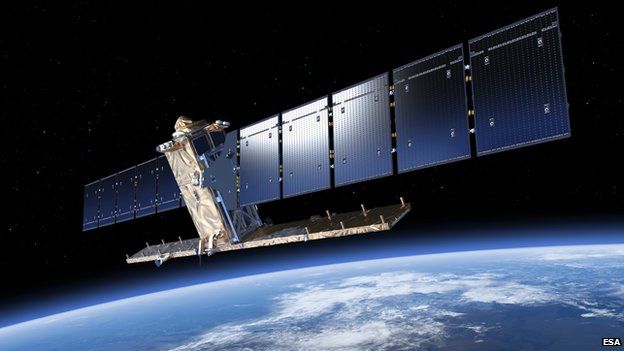
Sentinel-1a

Sentinel-1a is among a fleet of new orbiting sensors being launched by the European Union.

The researchers trace the quake activity to a locality some 10-15km down.

It was spread across what they term a “hinge point”, where the main fault in the region transitions from being relatively horizontal to being sharply angled into the Earth.

This geometry has a number of consequences, the scientists say.

First, it neatly explains why the surface surrounding the capital Kathmandu rose up by about a metre during the quake, and dropped by roughly 60cm in the more mountainous terrain to the north.

And, secondly, it also provides a good model for how the Himalayas gain height over time.

The team proposes a cycle of slumping on the occasion of major quakes and mountain-building in quiescent periods, with the increase in elevation dominating over the long term. The high Himalayas currently gain on average about 4mm per annum.

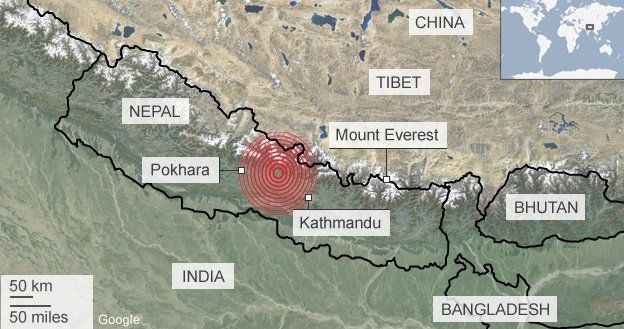
Nepal earthquake map

The quake initiated beneath the Gorkha region of central Nepal

Last April’s tremor occurred in what scientists refer to as a seismic gap – a segment of the fault that has not experienced any significant strain-releasing activity in a long while.

The 2015 shock brought relief only to the far eastern sector of this gap, meaning the potential for future large quakes is still present to the west.

And there is potential also to the south.

The latest analysis demonstrates that the main fault did not rupture all the way to the surface on 25 April. It stopped abruptly some 11km under Kathmandu.

“There is still half of the fault – that’s going south of Kathmandu, from a depth of 11km up to the surface – that hasn’t yet broken,” Dr Elliott told BBC News.

“Our hypothesis is that the abrupt stop is because the main fault has been damaged and it was held up where it intersected with other, smaller faults. But this will only be temporary.

“These earthquakes tend to happen on the century timescale, but this barrier could be pushed through on a shorter timescale. Of course, our problem is that we are not able to predict when; we can never give a date.”

The Oxford scientist felt that if the remaining portion did break all the way to the surface in one go, it would likely produce a quake of similar magnitude to the 25 April event; but being much shallower could have more damaging effects.


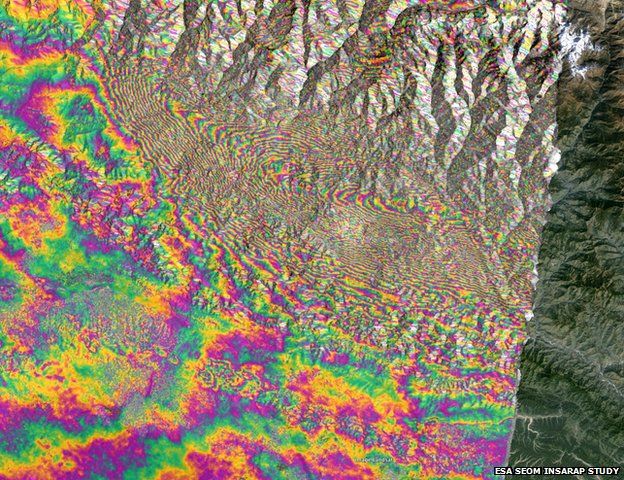
How Europe’s Sentinel radar satellite viewed the Nepal quake

Interferogram
  • S-1a practises something called Synthetic Aperture Radar Interferometry
  • This finds differences in “before” and “after” radar pictures taken from orbit
  • It enables quake scientists to detect even quite subtle ground movements
  • The amount of deformation is depicted in coloured contours, or “fringes”
  • Each contour shows 2.8cm of ground movement with respect to S-1a
  • 34 fringes in this image equate to a peak ground deformation of about 1m
  • Quake ruptured east from its epicentre; fault did not break the surface

Jonathan.Amos-INTERNET@bbc.co.uk and follow me on Twitter: @BBCAmos

Source: Satellites dissect Nepal quake – BBC News

Falling oil drives down Toronto stock market

TORONTO — The Toronto stock market ended its ninth consecutive session in the red, as lingering concerns about the Chinese economy dragged down the price of oil.

The S&P/TSX composite index lost 126.20 points, closing at 12,319.25.

The Canadian dollar, which has been on a steep slide since the start of the year, fell 0.37 of a U.S. cent to 70.31 cents US.

In New York, markets were mixed, with the Dow Jones up 52.12 points at 16,398.57, while the S&P500 gained 1.64 points to 1,923.67. Meanwhile, the Nasdaq slipped 5.64 points to 4,637.99.

The February contract for benchmark crude oil fell $1.75 to US$31.41 a barrel, while February natural gas lost 7.6 cents to US$2.396 per mmBtu.

February gold fell $1.70 to US$1,096.20 an ounce, while March copper lost five cents to US$1.97 a pound.

Follow @alexposadzki on Twitter.

By The Canadian Press

Source: Falling oil drives down Toronto stock market