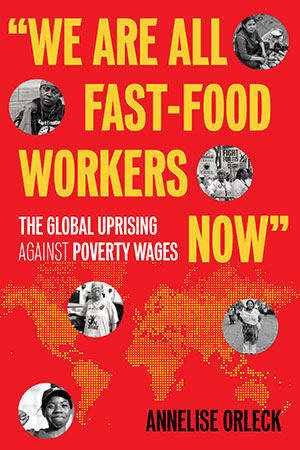
“We Are All Fast-Food Workers Now” The Global Uprising Against Poverty Wages

978-080708177-8

March 11, 2018

The story of low-wage workers rising up around the world to demand respect and a living wage.

Tracing a new labor movement sparked and sustained by low-wage workers from across the globe, “We Are All Fast-Food Workers Now” is an urgent, illuminating look at globalization as seen through the eyes of workers-activists: small farmers, fast-food servers, retail workers, hotel housekeepers, home-healthcare aides, airport workers, and adjunct professors who are fighting for respect, safety, and a living wage.

With original photographs by Liz Cooke and drawing on interviews with activists in many US cities and countries around the world, including Bangladesh, Cambodia, Mexico, South Africa, and the Philippines, it features stories of resistance and rebellion, as well as reflections on hope and change as it rises from the bottom up.

From: www.beacon.org

To Download, click link below:

We_Are_All_Fast-Food_Workers_Now_by_Annelise_Orlec

P.S.

This is my first post on my blog in almost two years, and I felt strongly about sharing this book, that chronicles the global fight of many low income earners for respect, safety and a living wage.

I dare you to be challenged; I dare you to confront your beliefs, your consciousness.

We are all by nature activists for ourselves, in our work, with our friends, family and in the community, in one way or another. Whether it is going for a bank loan for a new car, selling ourselves for a promotion at work, or a new job; casting our vote in a local, provincial or federal election.

I dare you to learn; I dare you to have your personal values and philosophy impacted, about a subject you may be ignorant of, know a little of or be well versed in——-because knowledge is power, and the pen is mighter than the sword——to coin two cliches.

Peace and out.

WorkLife: There’s Power in Youth and Unions Working Together

May 16, 2014    By Gabriel Bako    http://policyfix.ca

While the labour landscape has changed dramatically in Canada in the last 58 years, the legal framework has not. The labour relations framework that we use today in Canada was implemented in 1944 with PC-1003, and the Rand Formula in 1946. The models were based on the Wagner Act of 1935 that was implemented in the United States which gave important legal rights to organized workers. PC-1003 gives legal rights to unions to collectively bargain, represent, and organize workers and the Rand Formula gives the provisions for automatic dues check-offs.

It’s clear that these pieces of legislation are necessary to the viability of the labour movement, however there needs to be some updates. In 1944 organizing was radically different from today, as was the labour landscape. Industrial and manufacturing sectors are shrinking and today the largest employment growth is in the retail/service sector, accounting for 11.5 percent of all employment in Canada in 2011.  These new jobs are mainly precarious and non-union, with fast food and mall jobs becoming more common. They usually pay minimum wage, lack stable hours, and provide few or no benefits. Even union retail/service workplaces jobs are becoming increasingly precarious. The push from non-union competitors sets the tone for how union retail/service workplaces operate their business. In today’s unionized retail/service sectors the employers intentionally hire young workers with the knowledge they aren’t well informed about their workplace rights. In addition, even in unionized retail/service workplaces the opportunity of full-time hours or even a guarantee of set hours is unlikely.

Unions are trying to organize the precarious non-unionized sector, but at the same time they’re finding it increasingly difficult just to protect their current members. Whether union or non-union, the retail/service sector is precarious, and this push comes from neoliberal policies that have become more normalized and mainstream in recent years.

The push from corporate elites to undermine labour legislation has resulted in the weakening of card-check legislation and automatic certifications, attempts to enact so called right to work, attacks on the Rand Formula, and more recently the assault on unions through attempts to impose onerous financial reporting regulations on unions and restrictions on their social justice activities.

This assault on workers is making it increasingly difficult for unions to expand into areas where they need to gain ground. For example, the growing retail sector is characterized by high-turnover and the ability to jump between workplaces, making it difficult for unions to organize. However if we want a healthy and sustainable labour movement we must find new ways to connect with the many young people who work in this sector.

Unions are realizing that they must organize these workers; it is critical for the viability of unions, but also for the workers. Despite the reality that Monday to Friday 9-5 jobs are a distant memory, unions can still achieve better scheduling provisions, fair wage increases, respect and dignity, benefits, and the right for workers to have a democratic, participatory role in their workplaces. Youth want to organize, and the unions want to organize them, but the labour relations framework doesn’t allow for this to happen effectively with the changes brought on through increases in retail/service jobs.

In today’s society young people want to take collective action against all kinds of injustice but are often doing this in non-traditional ways that are grassroots and association based; such as community coalitions, worker cooperatives, and employee associations, rather than through formalized structures such as unions. The problem is that under the current labour relations framework, these grassroots and association based structures don’t have any legal rights in terms of the employment relationship. Under these systems employees cannot formally negotiate collective agreements, and they can’t access grievance and arbitration procedures. Therefore unionization is still the best option for achieving workplace rights.

While unions want to have more inclusivity and broader representation they haven’t been able to work out some of the internal barriers that allow for this to occur. Their often hierarchal structures don’t always reflect the diversity of the labour market today. This allows for things to remain status quo, and active young people who would like to give voice to change aren’t always given the opportunity.

Unions must recognize that in order to work they must allow youth to take on participatory roles in all aspects of the union – organizing drives, negotiations, advisory and executive boards, and even take on staff positions. Unions must begin to reflect the workforce they’re looking to organize. There are some unions doing this, and it’s creating positive changes. Yet the biggest change that needs to occur is that young people and unions must come together to find ways for a new organizing model that is successful; perhaps the Wagner model isn’t it.

The challenge is great. The legislative changes required to give the labour movement the tools it needs to organize increasing numbers of precarious youth will only come about with a substantial sea change in our political landscape. Before this will happen, more youth must become engaged in politics and in the labour movement, and labour must increasingly reach out to youth.

Gabriel Bako is major in the Labour Studies Department at the University of Manitoba and a member of  UFCW 832.

No shortage of workers – just a shortage of training

Tue, 11/19/2013 – 10:06
Posted by Andrew Jackson     http://www.broadbentinstitute.ca

Two major recent studies – from Derek Burleton and his colleagues at Toronto-Dominion Bank, and from former senior federal government official Cliff Halliwell published by the Institute for Research on Public Policy – provide excellent overviews of recent developments in the Canadian job market, and an informed framework for thinking about our future skills needs.

This message seems to have finally got through to the Harper government. In a speech to the Vancouver Chamber of Commerce on November 14, Employment and Skills Development Minister Jason Kenney told employers to stop complaining and to stop relying excessively upon temporary workers. Instead, he said, employers should “put more skin in the game” by increasing wages in high-demand occupations and by investing more in the training of Canadians.

The TD and IRPP studies provide balanced overviews of our future skill needs. Neither see generalized shortages as an acute danger, notwithstanding the pending (if increasingly delayed) retirement of the baby boom generation. Indeed, Mr. Halliwell says we should welcome a tighter job market, after years of stagnant real wages for most workers.

Graduates from our postsecondary education system, together with new immigrants, will more or less match job vacancies opening up due to the retirement of highly skilled workers. And employers can be expected to minimize shortages as they emerge by investing in capital and skills so as to raise productivity.

All that said, these studies note that we face some specific skills shortages today in a limited number of occupations and regions, and that some employers may face increasing difficulties finding workers with the right education and skills to fill available jobs in the future.

This can, however, be seen more as an opportunity than a curse, given the significant unemployment and underemployment of today, especially for youth, recent immigrants and aboriginals. The challenge is to invest in skills to increase access to good jobs for Canadians who want to get ahead, and thus to forestall future shortages that might lower our economic potential.

One set of policies that makes sense is to raise the education and skills level of marginalized groups and to ensure that unemployed workers, especially the long-term unemployed, have access to retraining. While Canada has one of the most educated work forces in the world, we have a relatively high proportion of workers with low literacy and numeracy levels, and many recent immigrants need help to upgrade their qualifications.

Programs delivered by the provinces with the support of the federal government address these issues to a degree, although spending is well below the industrial country average. Unfortunately, the federal government proposal to introduce the Canada Jobs Grant will shift some funds away from training the most marginalized workers and toward employer-sponsored training.

Mr. Halliwell argues that our current educational and labour market policies fail the significant proportion of the work force that leaves the educational system with less than a postsecondary qualification and finds relatively low-paying, less-skilled jobs. These workers tend to receive little or no employer training – and are excluded from current government programs.

He suggests that we think about “second chance” programs for this group, to improve their opportunities in the job market later in life and to help fill employer needs for skilled workers.

One option that Mr. Kenney might consider is to give more employed workers access to Employment Insurance (EI) benefits for training leaves, on the model of apprenticeship training. Apprentices qualify for EI benefits when they are away from their regular job for the classroom part of their program.

EI-supported training leaves would allow workers to take a community college or similar training programs – still at some considerable financial sacrifice to themselves, since benefits only replace up to 55 per cent of normal wages and since tuition costs would have to be paid.

Employers could contribute by making sure that a worker could return to the job from which she or he took a leave and, perhaps, by providing a supplementary income if the training program met the needs of their business.

EI-training leaves would empower individual workers to invest in their skills, and help create a higher-skilled work force for the future. Mr. Kenney might consider this option as an alternative to the proposed Canada Jobs Grant, which has won few supporters to date.

This article originally appeared on the Globe & Mail’s Economy Lab.

Photo: Cristiano Betta. Used under a Creative Commons BY 2.0 licence.

Top seven reasons unions matter to young people

By Tria Donaldson   August 22, 2013   http://rabble.ca

Tria Donaldson is a youth activist with roots in the environmental movement, the labour movement, and Indigenous Rights. Tria is a senior Communications Officer at CUPE National, and on the board of rabble.ca.

Top seven reasons unions matter to young people

Young workers today face many challenges in the workplace.

Entering the workplace is the first challenge. The youth employment rate is almost double the national average, at 13.6 per cent. You hear stories all the time of new graduates who are unable to find work in their field. Unpaid internships and short term coop placements are the norm for many workers.

Job insecurity is rampant. Many young workers have to work two or three jobs to make ends meet. Part time and contract work is common.

Soaring housing prices, lack of affordable child care and crippling levels of student debt for graduates mean putting off starting a family for many, and struggling to make ends meet for others.

These were just some of the issues identified by young workers at the Canadian Union of Public Employees’ (CUPE) first ever young workers strategy session. The three day meeting brought together over 60 young people from all across Canada to have their voices heard and discuss getting young people involved in the labour movement.

There is a perception amongst union activists that young people today are apathetic and don’t care about unions, but the conversations over the three days show that young people get it and are ready to get involved.

The words below are taken directly from the young people from across Canada who participated in CUPE’s recent strategy session. They remind me of the vital work that trade unions do on behalf of all society.

1. Unions allow workers to become united and to mobilize and come together during times of collective agreements and negotiations. Unionization is important to raise the standard of living for its workers and for society and social programs.

2. Unions make life better for people everywhere. Even if you are not in a union, you enjoy things that have become the norm are there because unions have fought for that. Unions are there to raise everyone up — it should be a race to a top not a race to the bottom.

3. Unions help put fairness in the workplace. People know when they are not being treated fairly, and equate unions with fairness.

4. In a unionized workplace you have a voice and an advocate. Whether you are a worker with disability or from another group, you have voice.

5. A union is there to be strong and united and to be there for workers in their struggles.

6. We live in a global world. It is important that unions can do international solidarity work and stand up against human rights violations.

7. Unions are instrumental in fighting for workers right to safety in the workplace. It is new and young workers that are often hurt on the job, and unions push for their rights.

In a world where the role of unions is constantly questioned and attacked, these young workers spoke to the heart of the matter of why unions matter.

This meeting was part of CUPE’s ongoing work to engage young workers and honour the Year of the New and Young worker. For more information visit CUPE’s young worker webpage here.