
Don’t play Neil Young or the Doors, BBC tells DJs and programme makers | Music | The Guardian.
Category Archives: world news
International Trade Union Confederation World Congress, Berlin 18 – 23 May 2014
Over 1500 trade unionists from 161 countries will gather at the Berlin City Cube in Berlin, Germany from May 18 to 23 for the 3rd International Trade Union Confederation World Congress which takes place every four years. The ITUC is the largest democratic organisation in the world representing 325 national trade unions and working people all over the world. The 2014 theme is “Building Workers’ Power”.

Press Conference: ITUC General Secretary Sharan Burrow will hold a press conference at 12:45 – 1:15 pm on Sunday 18th May at the Berlin City Cube.
The opening ceremony takes place 2:30 p.m. on Sunday, 18 May and includes addresses from German Foreign Minister Frank-Walter Steinmeier and Helen Clark, UNDP Administrator, representing the United Nations, and ITUC President Michael Sommer.
The ITUC General Secretary’s address by Sharan Burrow outlining the state of the world for working people and the findings of the ITUC Global Poll 2014 will take place on Monday 19th May followed by an address by ILO Director-General Guy Ryder.
Delegates will debate organising campaigns in multi-national companies including T-Mobile USA and Deutsche Telekom, organising in the informal sector, government action plans to address inequality including a minimum living wage and social protection, climate action and trade agreements. The Congress will hold a public vote for the worst boss in the world.
There will be workers’ hearings on the informal sector and discrimination and panel debates on indigenous rights, domestic workers. A new global rights index will be released on the worst countries for workers based on violations recorded from 2013 – 2014. The Congress will adopt an action plan for the ITUC mandated by the 325 national trade union centres for a four-year programme of work.
Special guests include former professional footballers Abdeslam Ouaddou and Zahir Belounis who was trapped in Qatar for 17 months; Gordon Brown MP, UN Special Envoy for Global Education; Jay Naidoo, Chairman of the Global Alliance for Improved Nutrition and a former Minister in the Mandela Cabinet; Professor Ozlem Onaran, Professor of Workforce and Economic Development Policy at University of Greenwich; Larry Elliott, Guardian Economics Editor; and Jayati Ghosh, Professor of Economics at Jawaharlal Nehru University, New Delhi, India.
For complete details of the ITUC World Congress agenda and arrangements please see: http://congress2014.ituc-csi.org/programme
The International Trade Union Confederation represents 176 million workers from 161 countries. The ITUC brings together the world’s independent and free national trade unions centres.
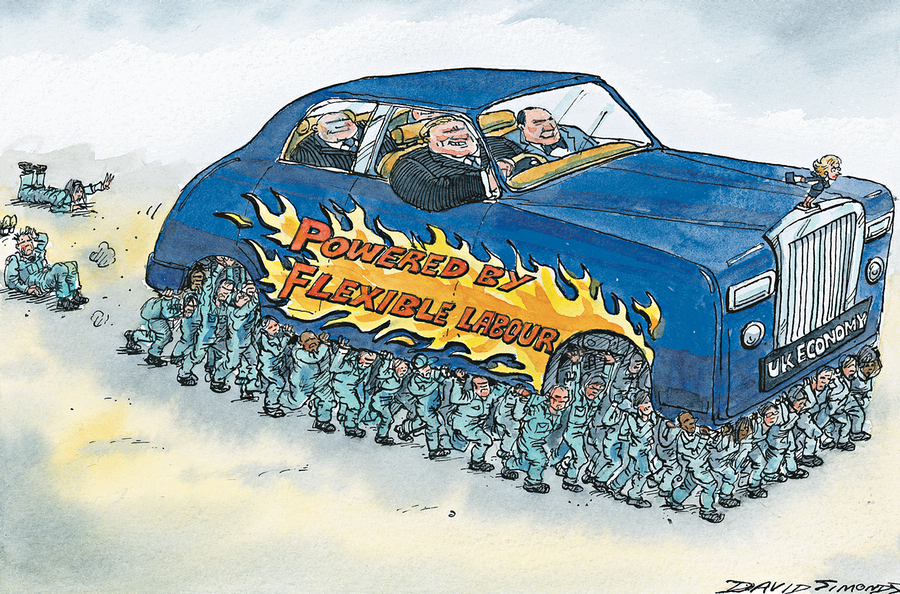
Workers have become the prey: now a natural balance needs to be restored
Britain’s flexible labour market has denied workers the security and purchasing power necessary to keep the economy healthy
In his book Why Most Things Fail, the economist Paul Ormerod tells the story of the struggle between the arctic hare and its predator, the lynx. Statisticians in Canada found that when the population of hares was big and growing, the lynx thrived because there was plentiful prey. The population of lynx went up and they killed more and more hares. Eventually, there were too few hares left and the lynx starved. The population of lynx went down and the number of hares started to rise again.
This story has a bearing on the way the UK economy works. For the past 30 years, one of the big aims of policy has been to make the labour market more flexible. Trade unions have been curbed, industries have been privatised, welfare reformed and employment protection reduced. The balance of power between labour and capital has been tilted decisively in favour of the latter.
The evidence of this is all around. There are 1.3m jobs on zero-hour contracts; wages can barely keep pace with price increases, even with unemployment coming down at a fair lick. Around 80% of the jobs created in the past year have been for the self-employed, with the suspicion that many of those “running their own business” are doing so involuntarily.
This is the flexible labour market in action. It is what has distinguished the UK economy from some of the more heavily regulated economies in the rest of Europe. Supporters of the reforms of the past three decades say the flexible labour market is the reason the jobless rate is around half the average for the eurozone. Critics say that the smashing of organised labour and the triumph of management is bad for workers, bad for growth and ultimately bad for employers.
Vince Cable can now be added to the list of those who wonder whether the labour market has become too flexible. The business secretary is right to pose the question because there are three big downsides to the way it works now.
The first is that the taxpayer ends up subsidising low pay through the tax credits and benefits system. There are now more people in poverty who are working than are jobless.
The second problem is that the loss of labour’s bargaining power has meant the share of national income taken by wages has fallen. That has created a problem of weak demand, which in the buildup to the financial crisis was solved by households taking on more debt. It was a period of rising house prices and equity withdrawal.
When the crisis broke, individuals became more debt-averse. They started to pay off some of what they had borrowed and were reluctant to take out new loans. What needed to happen was for real wages to grow, since that would have allowed living standards to rise while indebtedness fell. Instead, real wages have fallen by 8%, and ultra-low interest rates have been required to get people borrowing again. Household debt is on the way back up again.
The final problem is that the surfeit of cheap, insecure labour discourages investment. There is little inducement for firms to buy expensive new kit when demand rises, because they can always hire inexpensive labour that can be summarily dismissed later.
What does all this mean? It means that in the long term there is a clear choice. Either the power of labour will be increased by full employment, stronger trade unions and collective bargaining or the flexible labour market will arrive at its ultimate destination: a form of capitalism that cannot function without excessive debt; is marked by low wages, low investment and low productivity; and which eventually ends up eating itself.
Britain is well advanced down that road. As with the lynx, there is a price to be paid for slaughtering too many hares.
Pay battle hots up
As the weather gets warmer, so does the temperature at the annual shareholder meetings that take place at this time of year. Last week, investors at Hiscox, BG and ITV joined their peers at Pearson, Standard Chartered and AstraZeneca in registering their concerns about big bonuses. But a serious blow had yet to be landed.
And then it finally happened. Vince Cable’s binding vote on remuneration policies claimed its first victim: the FTSE 250 engineering company Kentz. Based in Jersey, Kentz was not only the first to have its remuneration policy opposed but also have its remuneration report voted down at the same time.
The significance? The vote on the remuneration report is one that has been in place for 10 years and covers pay that was handed out in the past. It is advisory. Companies can ignore it – but at their peril, as they risk a bad run with shareholders in the future. The vote on the remuneration policy is binding: it cannot be ignored and was introduced by the business secretary in October to cover the pay plans for the coming three years.
For Kentz, which had managed to avoid putting its pay deals to a vote until this year by exploiting a loophole created by its registration in Jersey, it was a moment of shame.
But it is one that has been narrowly avoided by others. The Lloyd’s of London insurer Hiscox, for instance, had a 42% vote against its remuneration policy. Standard Chartered had suffered a rebellion on a similar scale the week before.
Little wonder, then, that HSBC took steps to head off a full-scale row over proposals to hand its chairman Douglas Flint up to £2.2m in shares at this week’s shareholder gathering.
HSBC said Flint would be more likely get a smaller sum and only as a “one-off”: a valiant attempt to show it is listening to concerns. But shareholders may still ask if any bank chairman should be handed a bonus – as is being proposed here – for working to improve relationships with regulators. The HSBC vote will be one to watch.
Engineering a manufacturing boom
Celebrations to mark 175 years of train building in Derby were held last week at Bombardier’s factory, which is Britain’s oldest surviving rail plant.
With his thoughts on the 2015 election, transport secretary and member for Derbyshire Dales Patrick McLoughlin pointed to the renewed optimism around Bombardier as a sign that the economy is now back on track.
Yet the important contracts that have kept Bombardier’s historic Litchurch Lane works afloat did not come from the private sector, and were not the export orders that George Osborne craves. They were government-backed contracts. Had McLoughlin not signed off a £1bn deal to build trains for Crossrail back in February, it could have been 175 and out for Derby.
This economy wasn’t sustained by Osborneomics but by the Keynesian stimulus of a public infrastructure scheme: digging the giant Crossrail tunnels under London. Good news for Derby, and the supply chain, but a long way from evidence of a sustainable manufacturing-led recovery.
South Africa: Lonmin fails to break 16-week platinum strike
By Thabo Seseane Jr.
17 May 2014
70,000 striking platinum miners, members of the Association of Mineworkers and Construction Union (AMCU), ignored a May 14 back-to-work deadline sent for them in text messages by mining company Lonmin.
Workers at Anglo American Platinum (Amplats), Impala Platinum (Implats) and Lonmin have been on strike for basic entry-level wages of R12,500 [US$1,211] since January 23.
On the day of the deadline, Lonmin bussed scabs into work at the company’s Marikana mine under police guard. However, the number of strikebreakers was very low, prompting Lonmin spokeswoman Sue Vey to argue, “We are not going to provide a blow-by-blow insight of the number of people returning because that’s what incites violence.”
Meanwhile, an estimated 5,000 AMCU members gathered at Marikana’s Wonderkop Stadium, are refusing to return to work. They were addressed by AMCU President Joseph Mathunjwa as well as James Nichol, AMCU representative at the Marikana Commission of Inquiry into the death of 44 people in the mining town in 2012, including 34 miners shot by police.
Mathunjwa mocked the employers’ attempts to get workers to break the strike via text messages, and declared that Lonmin and the government were “in bed together.” Turning to the privations facing workers and their families, he said, “Yes, it’s difficult. But let’s hold each other by the hand and stay strong. Onward!”
At the stadium, Mathunjwa cut a very different figure from the upper-middle class bureaucrat who earlier spoke to the Mail & Guardian. In remarks to the newspaper in the days leading up to the deadline, he warned against a reprise of the August 2012 police massacre. “I have advised [the mine owners] that what they are doing now is a repeat of 2012 … I am getting very worried,” he cautioned. “One should draw from history.”
In comments to the South African Broadcasting Corporation, Mathunjwa gave the impression of a man aware that he is out of his depth. He querulously maintained that he could not take the blame for any violence during the unprecedented 16-week strike.
He was speaking as private security contractors bolstered a heavy police presence at mining operations near Rustenburg. The reinforcements arrived following a weekend of killings ahead of the deadline set by Lonmin management, over Mathunjwa’s head, for employees to return to work.
According to Business Day, Lonmin and the police confirmed the death of a scab killed on his way to work at the company’s Saffy shaft on May 12. In more than 20 incidents in the days leading to the Lonmin deadline, another six workers were attacked for scabbing, with one being strangled together with his girlfriend and another set on fire.
Tensions were clearly stoked by the employers’ efforts to circumvent the AMCU bureaucracy by communicating wage offers directly to workers. The companies sent teams to the rural areas from which they draw labour, as well as text messages to workers. Lonmin also used texting to take a snap survey whose results it claimed reflected a desire among the majority of strikers to return to work.
Miners and residents in the Marikana area are angry over the text messages. They see the campaign for the calculated effort to divide workers that it is. At Bapong village, community members on May 13 called on their headmen to take up the issue with mine managers at Marikana.
AMCU launched an urgent Labour Court application in Johannesburg last Monday to interdict the mining companies from communicating any new wage offers directly to workers. The union said this contravened the regulations of the Labour Relations Act.
In a joint statement, the companies said they would ask the court to endorse their efforts to reach workers directly following the negotiations deadlock. The statement rejected the AMCU assertion that they had contravened the act, recognition agreements or employees’ constitutional rights.
Having failed in their efforts to break the strike, the employers are now weighing legal action against AMCU. Parliament considered an amendment to the Labour Relations Act that would have given employers the chance of interdicting an ongoing strike in the event of violence. However, this clause was removed from the bill by a parliamentary committee in February following union criticism.
As matters now stand, legal experts are unanimous that the employers would gain nothing from such an effort. Business Day quoted University of Cape Town law professor, Halton Cheadle, saying, “There is no room in terms of the Labour Relations Act to interdict the strike or have its [legal] protection lifted on the basis of violence.”
The African National Congress government will now come under increasing pressure from international and domestic capital to find other means of breaking the strike, up to and including further violence.
Thus far, however, government is keeping its distance.
Through spokesman Thabo Masebe, the office of Deputy President Kgalema Motlanthe issued a statement saying, “The strike is a result of a dispute between workers … and the platinum producers. The government is not in power to intervene in a way that would benefit one party and disadvantage another.”
Motlanthe, a former National Union of Mineworkers bureaucrat, was appointed by President Jacob Zuma last year to head a task team to bring about peace and stability in the mining sector following the Marikana massacre.
The ANC is worried that direct intervention on its part may provoke ever wider and more determined opposition.
This week, President Jacob Zuma further restricted the already narrow terms of reference of the Farlam Commission of inquiry into the Marikana massacre, publishing an amendment in the Government Gazette of May 5 removing paragraph 1.5.
This derails the Marikana Commission’s second stage of proceedings, which has been running concurrently with the first stage since the beginning of April. The newer phase was supposed to take into account in a series of public seminars, the views of academics, industry experts and others on the underlying causes of the violence. It would necessarily have focused greater attention on political actors such as Police Minister Nathi Mthethwa, Mineral Resources Minister Susan Shabangu and African National Congress (ANC) Deputy President Cyril Ramaphosa, who is expected to serve as Zuma’s deputy president in the incoming administration.
On behalf of deceased miners, the Socio-Economic Rights Institute of South Africa had expressed concern that the trio, who are culpable for the mass killing, could now be excluded from testifying by the excision of paragraph 1.5.
Even before the new restriction, the commission’s terms of reference were composed in such a way as to focus the investigation as much as possible only on the police and their victims. This was done in an effort to whitewash the political origins of the massacre within the ANC government, which purposely unleashed a paramilitary force to assassinate workers carrying only sticks and spears.
Economic Freedom Fighters (EFF) leader Julius Malema has called on workers to “intensify” the strike. This led to a complaint from North West province police that the party was fuelling tensions on the platinum belt. “People should be very cautious of the statements they make,” police spokesman Thulane Ngubane observed. “This country is not a banana republic.”
Fresh from a general election performance that gives it the third largest bloc of seats in the next parliament, the EFF is intent on attracting wider sections of the working class into its ranks through striking a militant pose. Among its incoming MPs is Primrose Sonti, the widow of one of the workers slain in the 2012 Marikana killings.
An 80th Anniversary Message from Campbell Newman – Welcome to Germany 1933
November 16, 2013 http://archiebutterfly.wordpress.com
NOTE: Campbell Kevin Thomas Newman is an Australian politician and the 38th and current Premier of Queensland since 26 March 2012. His government in Queensland’s parliament passed a contentious industrial relation law on November 27, 2913 “but Queensland Council of Unions (QCU) president John Battams says the government’s urgency and lack of consultation has been breathtaking” and “the legislation is designed to instil fear in public servants and strip them of their workplace rights.”, according to ninemsn.
“They will have no rights whatsoever, the government will have total control over them,” he told AAP.
The following is a satirical comment on the passing of the contentious legislation, that the author believes bears a striking resemblance to Nazi Germany 1933.
With the Harper government and provincial governments in Canada declaring war on unions, the comment is thought provoking and sobering. Cheers.
When the great man Hitler came to power in Germany in 1933 one of the first things on his agenda was taking out the pinko commies and destroying the unions. He figured it would shut up any dissent and please his rich donors, and he was right. 80 years ago he gave the nod to the boys in black and brown and in shades of our boys in Mappoon they went in and smashed up all the trade union offices in the country, arrested all the union officials and made quite a few of them disappear if you know what I mean. And good riddance to them too. If only we had the same luxury we would fix this joint in a blink.
After they’d sorted the union bosses the Nazi state took over the role of looking after the interests of the working class, and a bloody good job they did too. They sorted out the gays and the gypsies and the Jehovah’s Witnesses (shut up JP) and the Jews and everyone else they didn’t like or who didn’t vote for them. And it worked – the economy was booming, business was making money, confidence was high. And then those bloody lefties Churchill and Roosevelt got involved and stuffed the whole thing up. Idiots.
But don’t you worry about that because Hitler knew what the go was and so does Can Do Campbell Newman, and we’ve decided to mark the 80th anniversary of the attack on unions by launching our very own barrage on the unions here in Nazi Queensland. Yes my loyal subjects, we’ve just introduced a bill into State Parliament that crushes the unions with the stroke of a pen. We’ve seen off the bikies and now wer’re going to see of those Labor loving fat cat bastards (What’s that? I earn 5 times as much as a union boss? Manassa Mauler – grab that man, throw a leather jacket on him and send him to the star chamber).
Yes Queensland rejoice, because no budding Labor hack union official or fat cat boss will ever again set foot in your workplace to bother you with nonsense about fair wages and conditions, or collective agreements, or strike action ever again because just like Uncle Adolf we’ve taken over the role of looking after the working class, and have we got some good news for you.
First off, you don’t have to worry about whether you’re going to Straddy at Xmas this year or saving your holidays to visit mum in Thargomindah in July, because your employer’s going to decide for you when you take your leave. Yep, you just sit back and concentrate on the job at hand and your boss will give you a fortnight’s notice and off on holidays you’ll go. It’ll take all the worry out of your hands and I bet that’s a bloody relief. And if it’s not, well I am sure you all appreciate that the boss pays the wages so unless you want us to stamp a Mongol tattoo on your forehead I’m sure you’ll simply do as you are told.
We’ve cut the red-tape around redundancy payments and made them easier for you to understand by simply trimming away the fat. Now you’ll have less money to count when we ask you to pursue a different career path, and because you’re getting paid less you’ll pay less tax, and no-one likes to pay tax. And if anyone tries to tell you your redundancy pay is less than the Fair Work Act minimum standard, well you just tell them that we do things differently up here and ask them if they are bloody two-headed Tasmanian or something.
You see up here we’re smarter than the average wombat, and Queenslanders know that if you’ve been bludging on the public purse for 9 years in the Department of Transport then you deserve to get 3 weeks less pay than you used to, and this productivity improvement will mean that instead of sitting around watching daytime TV for three months youll get off your ass and find another job. And that’s what public service redundancies are about – jobs, jobs, jobs.
And speaking of jobs, we hear that they’re looking for cleaners at the airport so take the tip and join the job queue outside Qantas at 4 o’clock tomorrow morning. They’re running 3 month unpaid job trials to assess your suitability so bring a mop and your own cleaning products.
And in the future don’t bother to go looking for help from those slugs who bludge off your union fees, because we’ve made it illegal for your boss to consult with Vicious Lawless Associations about workplace changes or involve them in any way in the decision-making process. Shoot, we’ve made it illegal for your boss to even tell the unionbastards that they are going to make any changes, and the whippersnapper will have your employer up against the wall if the jelly-legged cowards even try to slip the union any documents or information about the jobs they plan to cut.
Employment security’s also out the window. We can’t run this state properly if people aren’t running around in fear so it’s now illegal to mention job security in awards, contracts or agreements. It’s also illegal to talk about contracting out your jobs or services – that’s the bosses prerogative and they can do whatever the hell they like, and if your job is outsourced to Sri Lanka well you should be happy that you’re contributing to the war on terror and the evil axis, because we have to give the soldiers something to do when the’re not raping the wives or killing the kids of suspected terrorists don’t we?
We were working on a plan to send the union bosses over to Columbo just so the troops can keep their hand in, but we’ve hit a snag because they keep banging on about turning our boats back, but I’ll talk to Scotty and I’m sure he’ll work something out. We’ll let you know at the weekly briefing if we feel like it, otherwise we’ll just let you know that for reasons of national security we can’t let you know and I’m sure you won’t mind because you’re sick of hearing about brown bastards in boats anyway.
We’ve also taken the red tape off restrictions to when you can and can’t work and because we know you’re keen to put in 24/7 rostering will now be your bosses sole decision, just like it should be, and if you can’t work Tuesday nights because you’re a single mum and you can’t get a babysitter then maybe you should have a good hard look at yourself in the mirror at Centrelink in Tweed Heads because there’s no jobs here in Queensland for the likes of you.
And we know you don’t like the red-tape wrapped around the award, minimum conditions and all that crap, so we’re changing them too, and we’ve set it up so that the people who run this bloody state – that’s Jarrod and I – can tell those imbecile industrial commissioners exactly what they can and can’t put in the awards. In fact we’re probably going to write the bloody awards for them, because those buggers are just like the judges and if it’s not written down then they can’t be trusted to interpret the law the way we mean it to be. These bastards get up my nose they just sit their in their ivory towers and nitpick over whether arguing over the meaning of words and suffering up our laws. What a bloody waste of time. is, was, is going to be – they’re bloody bikies so just lock them up you twits.
While we’re on the subject, I’m thinking about cutting the red-tape big-time and getting rid of the law books altogether. We’ll just put our legislation up on Wikipedia, and if any half smart cocaine-snorting bleeding heart lefty lawyer finds a loophole Jarrod can just do an edit on his smartphone and Bob’s your uncle, problem fixed. And if any of those whineing academic posers on the bench try to make you pay more tax by giving you a pay rise, and let me make it clear more pay for you bludgers is not part of our fiscal strategy, then we’ll edit that out too with one big DELETE because only we get more money, and I’m sure you agree we bloody deserve it for having to put up with you lot.
But I’m sure you’ll be pleased to know that we’ve sorted out the problem with the teenage thugs who are on the path to becoming bikies by taking away all their employment rights. If they want to play the selfie-taking, we’re only young once card then these school-based apprentices and trainees, who couldn’t get their noses out of their iphones long enough to understand their rights anyway, can go and kiss my ass and if they’ve got a problem at work well that’s there problem and if they want to get smart about it we’ve got boot camps ready and waiting to sort their punk attitudes out.
And there’s no discrimination anymore in this State unless you’re young, disabled or an apprentice. We’re going to pay that lot less so if you think about it you’re actually getting a relative pay increase without it costing us a cent. How good’s that hey? We tried to cut the pay of these gay-marriage seeking homos too but the problem is that since we took the scalpel to their equal rights laws they’ve been difficult to spot because they’ve taken off their pink jackets and covered up their rainbow tattoos and the limp wristed Leo’s are hiding among normal Queenslanders like Jarrod and Tim and me.
We’ll find them though because I’ve called up the Doctor, the Rabbi and the Right to Life GP to form an advisory panel to the government to sort it out. While they’re up here I’m going to get them to do a review of our funding of Family Planning clinics too because the bloody things cost a fortune and these bloody women just need to keep their legs together and we wouldn’t have a problem would we?
But I digress. Now if like most slack-ass employees your collective agreement includes a whole lot of company policies then we’ve cut the red-tape and made things easier for you to understand by stripping them all out. So now you can forget all that rubbish about your boss feeling you up in lunchroom or making you work 27 shifts in a row being against policy, because Queensland only has one policy these days and that is to screw you down as tight as we can so that we can give more money to business. It’s a good policy and it’s the Reich policy and I’m sure you will agree.
So folks, thanks for coming to listen in your 10 minutes lunch break – yes we did think about cutting lunch out all together to give you the privilege of increasing productivity but then you’d be going to the toilet on the bosses time and we’re not having any of that – now shoot off and shackle yourselves to your desks again because Jarrod and I have got a bunch of badass Bandido’s to worry about and we need to take off to lunch at the Pier to discuss it over a few crabs and coldies.
But just before we go I’d like to take the pleasure of announcing that to mark today’s 80th anniversary law changes we have adopted a new motto for Queensland, and it’s a ripper.
And ain’t that the truth. Adolf would be proud of you all.
Now piss off and get back to work!
And don’t fall over the boxes in the doorway on your way out because accident pay’s for bludgers and we’ve made that illegal too.
 Andrew Phillip Chernoff