Woman wakes from coma to reveal boyfriend who stayed by bedside put her there

The not-so-loving story behind this boyfriend’s devotion. Picture: Weibo

HE WAS praised as a hero in Chinese media, pledging to take care of his partner for life after she was admitted to hospital with brutal head injuries, which left her in an eight-month coma.

But this romantic story is now under investigation, after the young woman woke from her coma, and accused the man in the photos, her boyfriend, as being the reason behind her brutal injuries.

Lin Yingying was placed in a coma in 2014 after receiving head injuries so severe, she was left in a vegetative state.

For 8-months, her partner Liu Fenghe stayed by her side, providing over $41,000 towards treatment, and telling reporters “I want to take care of her for the rest of my life. Even if I have to push her around in a wheelchair, I would be happy.”

But several months after Lin woke up, the 22-year-old revealed it was in fact Liu who put her in a coma, saying he beat her repeatedly when she accidentally burnt loaves of bread in the couple’s bakery.

The young woman went on to admit that the beating wasn’t the only instance of violence towards her.

During her coma, Liu had initially told doctors the injuries were due to a fall from at least five storeys.

The young woman’s family were shut-out by the 25-year-old man, having been told they were not allowed to visit her.

But the truth of her injury started to come out when, in February 2015, the young woman was released, and her family were able to take her home.

When she officially woke in May, Lin refused to speak out about her boyfriend’s violence, concerned about how he may react.

But after encouragement from her father, who said “you have died once, what more are you afraid of? It’s time to confront reality,” Lin told Chinese reporters what really happened.

According to the Daily Mail, the young woman recalled burning loaves of bread by accident, and that Liu became furious and hit her over the head with a rolling pin. While she lay on the floor, she could hear Liu making a call to emergency services.

The incident has been reported to authorities for investigation.

Source: Woman wakes from coma to reveal boyfriend who stayed by bedside put her there

Global stocks fall, bonds gain as investors seek safety

World stock markets fell while government debt prices rose on Tuesday as investors sought safety in low-risk assets after Turkish jets shot down a Russian warplane near the Syrian border.

The dollar fell against the traditionally safe-haven Japanese yen, helping to push oil and metals prices higher. Gold rose 1 percent.

Travel and leisure stocks .SXTP fell after the U.S. State Department late Monday warned U.S. citizens of the risk to worldwide travel posed by what it called increased terrorist threats. United Continental (UAL.N), American Airlines (AAL.O) and Delta Air Lines (DAL.N) all were lower in early U.S. trading.

The warplane incident was the first time a NATO member’s armed forces had shot down a Russian or Soviet military aircraft since the 1950s. Russia said its plane had been downed over Syria.

“This has really gotten investors’ attention,” said Jack Ablin, chief investment officer at BMO Private Bank in Chicago. “Investors are worried that tensions could escalate.”

Wall Street cut its losses in midday trading, however.

The Dow Jones industrial average .DJI fell 16.9 points, or 0.09 percent, to 17,775.78, the S&P 500 .SPX lost 5.46 points, or 0.26 percent, to 2,081.13 and the Nasdaq Composite .IXIC dropped 25.30 points, or 0.5 percent, to 5,077.18.

The MSCI index of global stock markets .MIWD00000PUS fell 0.3 percent, and a broad gauge of European stocks .FTEU3 dropped 1.3 percent.

Turkish shares .XU100 dropped, as well, while the prospect of escalating tension between the former Cold War foes gave an additional push lower to German yields.

In U.S. Treasuries, the 30-year yield hovered near 3 percent, while benchmark 10-year Treasuries notes US10YT=RR were up 6/32 in price to yield 2.227 percent.

The dollar index .DXY, which measures the dollar against six major world currencies, fell 0.1 percent.

But the dollar’s weakness and escalating tensions in the Middle East helped oil prices, with Brent futures LCOc1 up more than 2 percent at $45.81 a barrel and U.s. crude CLc1 also up more than 2 percent at $42.70.

Gold rose, recovering from near six-year lows after the warplane news. Spot gold XAU= peaked at $1,080.51 and was up 0.7 percent at $1,077.30 an ounce.

(Additional reporting by Nigel Stephenson in London; Abhiram Nandakumar in Bengaluru; Lisa Twaronite and Hideyuki Sano in Tokyo; Editing by Hugh Lawson and Nick Zieminski)

Source: Global stocks fall, bonds gain as investors seek safety | Reuters

Household debt seen as South Korea’s potential time bomb

By Lee Joon-seung       2015/11/24

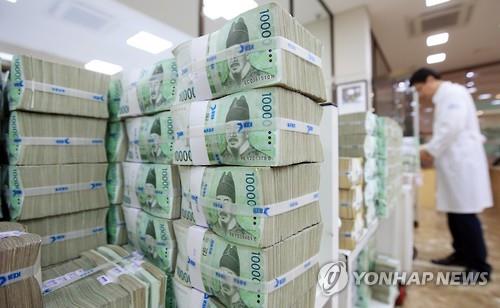
SEOUL/SEJONG, Nov. 24 (Yonhap) — Soaring household debt that could exceed 1,200 trillion won (US$1.03 trillion) by year’s end is becoming a serious liability to South Korea’s long-term economic well-being, local observers said Tuesday.

The alarm bells are going off as the Bank of Korea (BOK) announced earlier in the day that the country’s household credit hit an all-time high of 1,166.4 trillion won as of end-September. This is up 3 percent from 1,131.5 trillion won tallied three months earlier.

What is more worrisome is that the pace of credit growth in the third quarter. In the July-September period, money borrowed by households grew by 34.5 trillion won vis-a-vis the previous three month period. This is an acceleration from the previous record of 33.2 trillion won reported in the second quarter of this year.

“At this pace, there is a chance that the total will top the 1,200 trillion won mark as of end-December,” said a government official, who declined to be identified.

The recent rise in household debt comes as the central bank began lowering its key interest rates from last year, to cope with falling growth. The key rate stands at a record low 1.5 percent.

It also reflects measures taken by the government to prop up the local property market, and steady rise in local rent costs that forced many people to buy a home, instead of opting for a lease arrangement.

In August 2014, state policymakers eased rules governing debt-to-income (DTI) and loan-to-value (LTV) ratio that facilitated borrowing.

Market watchers said that the rise in household debt comes at a time when the U.S. Federal Reserve is widely expected to mark up it key policy rates next month, which can trigger an outflow of capital from emerging markets and fuel financial market volatility.

Domestic retail banks have been marking up interest rates slightly from September onwards in expectations that the BOK may eventually raise key rates, if the United States takes such a step, to prevent money from leaving the country.

A rise in rates can add more burdens to borrowers and low income earners, who will be forced to cut back on spending, especially if people borrowed money on floating rates.

Besides the overall rise in credit, local experts said a spike in loans taken out by secondary banks, like savings banks, shot up by 6.32 trillion won in the third quarter. This is the second largest quarterly increase since the second quarter of 2014.

Interest rates at savings banks are relatively high compared to regular banks and people who borrow money from these institutions generally have lower credit ratings.

More money taken out from these banks can burden borrowers and generally weigh down the economy in the long run.

In addition, data showed there has been a steady rise in borrowing by small-time, self-employed entrepreneurs who may not have the capability to pay back debt.

Reflecting on this, Lee Jun-hyup, a research fellow at Hyundai Research Institute (HRI), said of the 1,600 trillion won in debt, about 700 trillion may be money borrowed from self-employed people.

“As a rule, people spend money after they’ve covered their expenses, that includes interest paid to banks, so a rise in rates will lead to weakening on consumption,” the economist said.

This is a serious problem for Asia’s fourth-largest economy whose exports have contracted this year. In the first 10 months of 2015, South Korea’s cumulative exports reached $440.2 billion, down 7.6 percent from a year earlier,

On the positive side, the BOK has maintained that while household debt has been on the rise, so has income.

In its financial stability report published in June, the rate of disposable income to debt stood at 138.1 percent as of late March, an improvement from 135.4 percent tallied for September of last year.

In addition, the government and local lenders said that moves to curb borrowing, like getting people to pay back both interest and the principal, should restrict future spikes in debt.

“The government already asked lenders to tighten oversight on borrowing as of July with local banks putting the finishing touches on their own loan practice for implementation in 2016,” a finance ministry official said.

He said starting in January, it will become much harder for people to borrow money using homes as collateral.

Local banks have said that they will use new “stress tests” to more precisely determine if a person can handle excessive loans, and not issue loans if DTI levels exceed 80 percent.

The government, meanwhile, said that it is weighing various options on the table to deal with the debt problem, but made clear any further action will take into account the need to keep the current economic growth momentum alive and in particular, not cause serious problems for the real estate market.

Sung Tae-yoon, an economics professor at Yonsei University in Seoul, said government actions seem to be focused on maintaining the health of financial institutions.

“This approach, while a step in the right direction, is not enough and more must be done to push for economic and income growth,” he claimed.

Source: (News Focus) Household debt seen as S. Korea’s potential time bomb

Asia shares largely down on Tuesday hurt by iron ore – BBC News

Shares in Asia were largely in negative territory on Tuesday following declines in the US and as falling iron ore prices continued to hurt mining companies.

In Australia, the S&P/ASX 200 closed down 0.95% at 5,226.40.

Analysts said iron ore prices were continuing to move towards the decade low reached earlier this year.

The commodity is Australia’s biggest export and was trading at $44.20 a tonne in China on Monday.

Independent economist and commodities specialist Andy Xie has predicted that iron ore prices will fall below $40 a tonne before the end of the year.

He said prices could even sink as low as $30 for much of next year as demand from China continues to decline.

Three of the biggest iron ore producers recorded falls in their Sydney-listed shares. BHP Billiton closed down 1.8%, Rio Tinto fell 1.5%, while Fortescue Metals was the biggest loser, sinking 3.2%.

Japan’s Nikkei index spent much of the day flat but made gains late in the day to close up 0.23% at 19,924.89 points.

Shares in the country’s troubled electronics maker Sharp surged more than 35% at one point on reports its lenders may waive some of its debts.

Without citing sources, Kyodo News said a state-backed fund may invest in Sharp if Japanese lenders agreed to write off an unspecified amount of its debt.

Investors seem to shrug off fresh numbers released earlier on Tuesday that showed Japan’s manufacturing activity expanded in November as new orders and output increased.

The Markit/Nikkei Japan Flash Manufacturing Purchasing Managers Index (PMI) rose from 52.4 in October to 52.8 in November. A reading above 50 indicates expansion.

The PMI figure was the highest it had been since March last year – ahead of the introduction of the country’s sales tax.

Marcel Thieliant from Capital Economics said the reading suggested Japan’s economy had returned to growth this quarter.

“Today’s survey confirms that economic activity is on the mend. But with large amounts of spare capacity dampening price pressures, we still think that the Bank of Japan may have to step up the pace of easing in coming months,” he added.

In China, losses were extended for much of the day after new rules for the mainland’s stock exchanges aimed at limiting leveraged bets on the market and reducing speculative behaviour were introduced on Monday.

Investors were concerned over available liquidity ahead of the restart of initial public offerings.

The Shanghai Composite index was down as much as 1% but recovered ground later to stand 0.16% higher at 3,616.11 in afternoon trade.

Hong Kong’s Hang Seng index was down 0.44% at 22,568.23.

South Korea’s Kospi index closed up 0.63% at 2,016.29

Source: Asia shares largely down on Tuesday hurt by iron ore – BBC News

Waleed Aly on Paris Attacks, ISIS, Islamophobia

WALEED Aly has unleashed on Australia’s politicians and Muslim leaders who have preached “hate” in the wake of the Paris attacks saying their actions actually help Islamic State rather than defeat them.

The Project co-host used his regular ‘Something we should talk about’ segment to not only call for solidarity following the atrocity, which left 132 people dead and hundreds more injured, but to highlight what he says is the truth about the militant organisation — that they’re weak.

“There is a reason ISIL still want to appear so powerful, why they don’t want to acknowledge that the land they control has been taken from weak enemies, that they are pinned down by air strikes or that just last weekend they lost a significant part of their territory,” he said on The Project.

“ISIL don’t want you to know they would quickly be crushed if they ever faced a proper Army on a battlefield.

“They want you to fear them. They want you to get angry. They want all of us to become hostile and here is why:

“ISIL’s strategy is to split the world into two camps. It is that black and white. Again we know this because they told us.”

Ally said ISIL wanted to create World War III, and for societies around the world to turn on each other, and for countries like Australia to vilify Muslims.

He said this “evil organisation” believes if they can make Muslims the enemy of the West, then Muslims in France and England and America and here in Australia will have nowhere to turn but to ISIL.

“That was exactly their strategy in Iraq,” he said. “And now they want it to go global.

“Saying that out loud, it is both dumbfounding in its stupidity and bloodcurdling in its barbarity. “We are all feeling a million raging emotions right now. I am angry at these terrorists. I am sickened by the violence and I am crushed for the families that have been left behind, but, you know what, I will not be manipulated.

“We all need to come together. I know how that sounds. I know it is a cliche, but it is also true because it is exactly what ISIL doesn’t want.

“So, if you are a member of Parliament or a has-been member of Parliament preaching hate at a time when what we actually need is more love — you are helping ISIL. They have told us that. If you are a Muslim leader telling your community they have no place here or basically them saying the same thing — you are helping ISIL.

“They have told us that. If you are just someone with a Facebook or Twitter account firing off misguided messages of hate, you are helping ISIL — They have told us that.

“I am pretty sure that right now none of us wants to help these b*stards.”

Aly’s speech was welcomed on social media with many applauding the TV presenter for his measured remarks.

Aly’s comments came after his wife, Susan Carland appeared on Studio 10 to speak about the misconception that the Muslim community supports the Islamic State in the wake of the Paris attacks.

The Muslim sociologist and academic, who converted to Islam at the age of 19, shut down the misguided belief that the 480,000 Australians of the Muslim faith were in any way a “friend” of IS.

“ISIS are no friend to Muslim, by any stretch of the imagination, and so it’s really important that we never fall into the trap of thinking this is about Muslims against other people or anything like this,” Ms Carland said.

This is about a very, very problematic group that is trying to set themselves up against the rest of the world, and to say that all Muslims are with them, nothing could be further from the truth.

“Society tearing itself apart is actually one of the intended outcomes of terrorist attacks done by ISIS; this is what they want. ISIS have openly spoken about wanting to eliminate the grey area; they want a world that is black and white, that is us and them, that is good and evil as far as they define it,” she said.

“A flourishing, pluralistic society is the last thing ISIS want to see and so, in times like this, we all have to make the choice about whether we retreat into fear and anger and blaming or whether we actively choose to come together and say we will not allow this to pull us apart because that is part of the goal. It is a political tactic that is part of their approach and we can never let those be the people who define us as individuals or as a community.”

Source: Waleed Aly on Paris Attacks, ISIS, Islamophobia | The Project