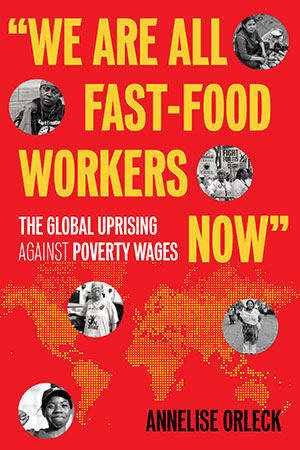
“We Are All Fast-Food Workers Now” The Global Uprising Against Poverty Wages

978-080708177-8

March 11, 2018

The story of low-wage workers rising up around the world to demand respect and a living wage.

Tracing a new labor movement sparked and sustained by low-wage workers from across the globe, “We Are All Fast-Food Workers Now” is an urgent, illuminating look at globalization as seen through the eyes of workers-activists: small farmers, fast-food servers, retail workers, hotel housekeepers, home-healthcare aides, airport workers, and adjunct professors who are fighting for respect, safety, and a living wage.

With original photographs by Liz Cooke and drawing on interviews with activists in many US cities and countries around the world, including Bangladesh, Cambodia, Mexico, South Africa, and the Philippines, it features stories of resistance and rebellion, as well as reflections on hope and change as it rises from the bottom up.

From: www.beacon.org

To Download, click link below:

We_Are_All_Fast-Food_Workers_Now_by_Annelise_Orlec

P.S.

This is my first post on my blog in almost two years, and I felt strongly about sharing this book, that chronicles the global fight of many low income earners for respect, safety and a living wage.

I dare you to be challenged; I dare you to confront your beliefs, your consciousness.

We are all by nature activists for ourselves, in our work, with our friends, family and in the community, in one way or another. Whether it is going for a bank loan for a new car, selling ourselves for a promotion at work, or a new job; casting our vote in a local, provincial or federal election.

I dare you to learn; I dare you to have your personal values and philosophy impacted, about a subject you may be ignorant of, know a little of or be well versed in——-because knowledge is power, and the pen is mighter than the sword——to coin two cliches.

Peace and out.

Workers have become the prey: now a natural balance needs to be restored

Britain’s flexible labour market has denied workers the security and purchasing power necessary to keep the economy healthy

  • The Observer, Sunday 18 May 2014


    In his book Why Most Things Fail, the economist Paul Ormerod tells the story of the struggle between the arctic hare and its predator, the lynx. Statisticians in Canada found that when the population of hares was big and growing, the lynx thrived because there was plentiful prey. The population of lynx went up and they killed more and more hares. Eventually, there were too few hares left and the lynx starved. The population of lynx went down and the number of hares started to rise again.

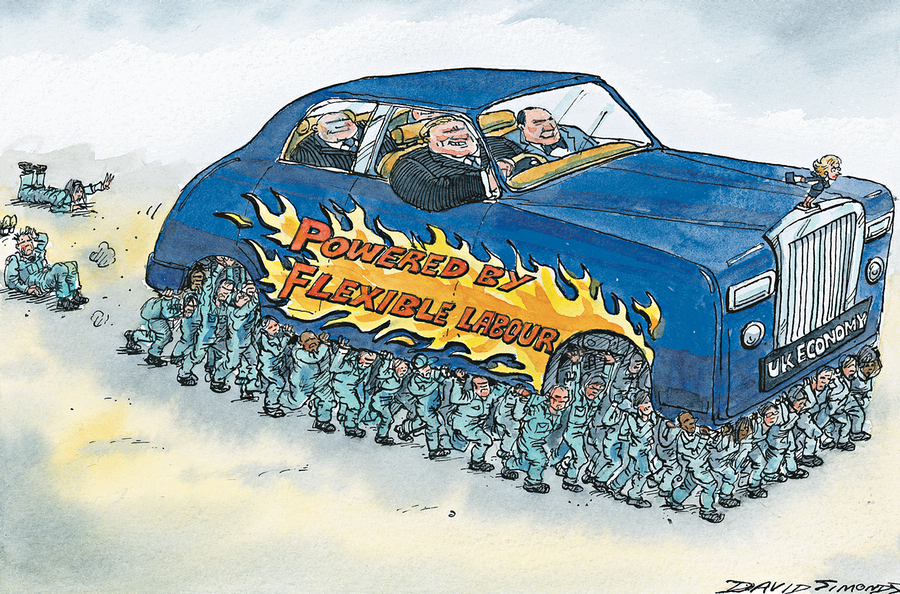
    This story has a bearing on the way the UK economy works. For the past 30 years, one of the big aims of policy has been to make the labour market more flexible. Trade unions have been curbed, industries have been privatised, welfare reformed and employment protection reduced. The balance of power between labour and capital has been tilted decisively in favour of the latter.

    The evidence of this is all around. There are 1.3m jobs on zero-hour contracts; wages can barely keep pace with price increases, even with unemployment coming down at a fair lick. Around 80% of the jobs created in the past year have been for the self-employed, with the suspicion that many of those “running their own business” are doing so involuntarily.

    This is the flexible labour market in action. It is what has distinguished the UK economy from some of the more heavily regulated economies in the rest of Europe. Supporters of the reforms of the past three decades say the flexible labour market is the reason the jobless rate is around half the average for the eurozone. Critics say that the smashing of organised labour and the triumph of management is bad for workers, bad for growth and ultimately bad for employers.

    Vince Cable can now be added to the list of those who wonder whether the labour market has become too flexible. The business secretary is right to pose the question because there are three big downsides to the way it works now.

    The first is that the taxpayer ends up subsidising low pay through the tax credits and benefits system. There are now more people in poverty who are working than are jobless.

    The second problem is that the loss of labour’s bargaining power has meant the share of national income taken by wages has fallen. That has created a problem of weak demand, which in the buildup to the financial crisis was solved by households taking on more debt. It was a period of rising house prices and equity withdrawal.

    When the crisis broke, individuals became more debt-averse. They started to pay off some of what they had borrowed and were reluctant to take out new loans. What needed to happen was for real wages to grow, since that would have allowed living standards to rise while indebtedness fell. Instead, real wages have fallen by 8%, and ultra-low interest rates have been required to get people borrowing again. Household debt is on the way back up again.

    The final problem is that the surfeit of cheap, insecure labour discourages investment. There is little inducement for firms to buy expensive new kit when demand rises, because they can always hire inexpensive labour that can be summarily dismissed later.

    What does all this mean? It means that in the long term there is a clear choice. Either the power of labour will be increased by full employment, stronger trade unions and collective bargaining or the flexible labour market will arrive at its ultimate destination: a form of capitalism that cannot function without excessive debt; is marked by low wages, low investment and low productivity; and which eventually ends up eating itself.

    Britain is well advanced down that road. As with the lynx, there is a price to be paid for slaughtering too many hares.

    Pay battle hots up

    As the weather gets warmer, so does the temperature at the annual shareholder meetings that take place at this time of year. Last week, investors at Hiscox, BG and ITV joined their peers at Pearson, Standard Chartered and AstraZeneca in registering their concerns about big bonuses. But a serious blow had yet to be landed.

    And then it finally happened. Vince Cable’s binding vote on remuneration policies claimed its first victim: the FTSE 250 engineering company Kentz. Based in Jersey, Kentz was not only the first to have its remuneration policy opposed but also have its remuneration report voted down at the same time.

    The significance? The vote on the remuneration report is one that has been in place for 10 years and covers pay that was handed out in the past. It is advisory. Companies can ignore it – but at their peril, as they risk a bad run with shareholders in the future. The vote on the remuneration policy is binding: it cannot be ignored and was introduced by the business secretary in October to cover the pay plans for the coming three years.

    For Kentz, which had managed to avoid putting its pay deals to a vote until this year by exploiting a loophole created by its registration in Jersey, it was a moment of shame.

    But it is one that has been narrowly avoided by others. The Lloyd’s of London insurer Hiscox, for instance, had a 42% vote against its remuneration policy. Standard Chartered had suffered a rebellion on a similar scale the week before.

    Little wonder, then, that HSBC took steps to head off a full-scale row over proposals to hand its chairman Douglas Flint up to £2.2m in shares at this week’s shareholder gathering.

    HSBC said Flint would be more likely get a smaller sum and only as a “one-off”: a valiant attempt to show it is listening to concerns. But shareholders may still ask if any bank chairman should be handed a bonus – as is being proposed here – for working to improve relationships with regulators. The HSBC vote will be one to watch.

    Engineering a manufacturing boom

    Celebrations to mark 175 years of train building in Derby were held last week at Bombardier’s factory, which is Britain’s oldest surviving rail plant.

    With his thoughts on the 2015 election, transport secretary and member for Derbyshire Dales Patrick McLoughlin pointed to the renewed optimism around Bombardier as a sign that the economy is now back on track.

    Yet the important contracts that have kept Bombardier’s historic Litchurch Lane works afloat did not come from the private sector, and were not the export orders that George Osborne craves. They were government-backed contracts. Had McLoughlin not signed off a £1bn deal to build trains for Crossrail back in February, it could have been 175 and out for Derby.

    This economy wasn’t sustained by Osborneomics but by the Keynesian stimulus of a public infrastructure scheme: digging the giant Crossrail tunnels under London. Good news for Derby, and the supply chain, but a long way from evidence of a sustainable manufacturing-led recovery.

  • South Africa: Lonmin fails to break 16-week platinum strike

    http://www.wsws.org

    By Thabo Seseane Jr.
    17 May 2014

    70,000 striking platinum miners, members of the Association of Mineworkers and Construction Union (AMCU), ignored a May 14 back-to-work deadline sent for them in text messages by mining company Lonmin.

    Workers at Anglo American Platinum (Amplats), Impala Platinum (Implats) and Lonmin have been on strike for basic entry-level wages of R12,500 [US$1,211] since January 23.

    On the day of the deadline, Lonmin bussed scabs into work at the company’s Marikana mine under police guard. However, the number of strikebreakers was very low, prompting Lonmin spokeswoman Sue Vey to argue, “We are not going to provide a blow-by-blow insight of the number of people returning because that’s what incites violence.”

    Meanwhile, an estimated 5,000 AMCU members gathered at Marikana’s Wonderkop Stadium, are refusing to return to work. They were addressed by AMCU President Joseph Mathunjwa as well as James Nichol, AMCU representative at the Marikana Commission of Inquiry into the death of 44 people in the mining town in 2012, including 34 miners shot by police.

    Mathunjwa mocked the employers’ attempts to get workers to break the strike via text messages, and declared that Lonmin and the government were “in bed together.” Turning to the privations facing workers and their families, he said, “Yes, it’s difficult. But let’s hold each other by the hand and stay strong. Onward!”

    At the stadium, Mathunjwa cut a very different figure from the upper-middle class bureaucrat who earlier spoke to the Mail & Guardian. In remarks to the newspaper in the days leading up to the deadline, he warned against a reprise of the August 2012 police massacre. “I have advised [the mine owners] that what they are doing now is a repeat of 2012 … I am getting very worried,” he cautioned. “One should draw from history.”

    In comments to the South African Broadcasting Corporation, Mathunjwa gave the impression of a man aware that he is out of his depth. He querulously maintained that he could not take the blame for any violence during the unprecedented 16-week strike.

    He was speaking as private security contractors bolstered a heavy police presence at mining operations near Rustenburg. The reinforcements arrived following a weekend of killings ahead of the deadline set by Lonmin management, over Mathunjwa’s head, for employees to return to work.

    According to Business Day, Lonmin and the police confirmed the death of a scab killed on his way to work at the company’s Saffy shaft on May 12. In more than 20 incidents in the days leading to the Lonmin deadline, another six workers were attacked for scabbing, with one being strangled together with his girlfriend and another set on fire.

    Tensions were clearly stoked by the employers’ efforts to circumvent the AMCU bureaucracy by communicating wage offers directly to workers. The companies sent teams to the rural areas from which they draw labour, as well as text messages to workers. Lonmin also used texting to take a snap survey whose results it claimed reflected a desire among the majority of strikers to return to work.

    Miners and residents in the Marikana area are angry over the text messages. They see the campaign for the calculated effort to divide workers that it is. At Bapong village, community members on May 13 called on their headmen to take up the issue with mine managers at Marikana.

    AMCU launched an urgent Labour Court application in Johannesburg last Monday to interdict the mining companies from communicating any new wage offers directly to workers. The union said this contravened the regulations of the Labour Relations Act.

    In a joint statement, the companies said they would ask the court to endorse their efforts to reach workers directly following the negotiations deadlock. The statement rejected the AMCU assertion that they had contravened the act, recognition agreements or employees’ constitutional rights.

    Having failed in their efforts to break the strike, the employers are now weighing legal action against AMCU. Parliament considered an amendment to the Labour Relations Act that would have given employers the chance of interdicting an ongoing strike in the event of violence. However, this clause was removed from the bill by a parliamentary committee in February following union criticism.

    As matters now stand, legal experts are unanimous that the employers would gain nothing from such an effort. Business Day quoted University of Cape Town law professor, Halton Cheadle, saying, “There is no room in terms of the Labour Relations Act to interdict the strike or have its [legal] protection lifted on the basis of violence.”

    The African National Congress government will now come under increasing pressure from international and domestic capital to find other means of breaking the strike, up to and including further violence.

    Thus far, however, government is keeping its distance.

    Through spokesman Thabo Masebe, the office of Deputy President Kgalema Motlanthe issued a statement saying, “The strike is a result of a dispute between workers … and the platinum producers. The government is not in power to intervene in a way that would benefit one party and disadvantage another.”

    Motlanthe, a former National Union of Mineworkers bureaucrat, was appointed by President Jacob Zuma last year to head a task team to bring about peace and stability in the mining sector following the Marikana massacre.

    The ANC is worried that direct intervention on its part may provoke ever wider and more determined opposition.

    This week, President Jacob Zuma further restricted the already narrow terms of reference of the Farlam Commission of inquiry into the Marikana massacre, publishing an amendment in the Government Gazette of May 5 removing paragraph 1.5.

    This derails the Marikana Commission’s second stage of proceedings, which has been running concurrently with the first stage since the beginning of April. The newer phase was supposed to take into account in a series of public seminars, the views of academics, industry experts and others on the underlying causes of the violence. It would necessarily have focused greater attention on political actors such as Police Minister Nathi Mthethwa, Mineral Resources Minister Susan Shabangu and African National Congress (ANC) Deputy President Cyril Ramaphosa, who is expected to serve as Zuma’s deputy president in the incoming administration.

    On behalf of deceased miners, the Socio-Economic Rights Institute of South Africa had expressed concern that the trio, who are culpable for the mass killing, could now be excluded from testifying by the excision of paragraph 1.5.

    Even before the new restriction, the commission’s terms of reference were composed in such a way as to focus the investigation as much as possible only on the police and their victims. This was done in an effort to whitewash the political origins of the massacre within the ANC government, which purposely unleashed a paramilitary force to assassinate workers carrying only sticks and spears.

    Economic Freedom Fighters (EFF) leader Julius Malema has called on workers to “intensify” the strike. This led to a complaint from North West province police that the party was fuelling tensions on the platinum belt. “People should be very cautious of the statements they make,” police spokesman Thulane Ngubane observed. “This country is not a banana republic.”

    Fresh from a general election performance that gives it the third largest bloc of seats in the next parliament, the EFF is intent on attracting wider sections of the working class into its ranks through striking a militant pose. Among its incoming MPs is Primrose Sonti, the widow of one of the workers slain in the 2012 Marikana killings.

    Georgetti: The Tories Attack on the Middle Class Should Worry You

    Ken GeorgettiKen Georgetti    President, Canadian Labour Congress

    12/04/2013   http://www.huffingtonpost.ca

    The Conservative government is engaged in a campaign to distract their supporters from a series of Senate scandals and cover ups. The Conservative fundraising machine believes that if it feeds its base a constant diet of someone to dislike, the donation cheques will keep rolling in. Workers and their unions are their current targets with a long list of legislation designed to keep their base happy.

    The Conservative government’s recent volleys against workers and their unions will only serve to undercut the well-being and security of middle-class families in Canada if they succeed in pushing through their anti-union legislation. The Globe and Mail said as much in a recent series of articles on growing inequality in Canada — “declining unionization has contributed to wage inequality.”

    Canada’s labour movement is not just about decent jobs, it’s about a better life for everyone. Unions have worked to protect good jobs, make workplaces safer, fought for paid vacation time, public health insurance and the Canada Pension Plan. When union members stand up for fairness everyone benefits — whether you belong to a union or not.

    Canadians will see through the government’s attempts to divide people against one another. At one end of the legislative spectrum, the government uses giant omnibus bills to throw everything but the kitchen sink into one piece of legislation. The current budget bill runs to 308 pages and in the fine print it makes sudden and dramatic changes to the Canada Labour Code. One of those changes would place workers’ lives at risk by eroding their right to refuse dangerous work.

    Other amendments to federal labour laws would erode workers’ constitutional right to bargain collectively by letting the government unilaterally, without negotiation, change the rules for bargaining with their employees. To add insult to injury, witnesses to the parliamentary committee studying the bill who would speak out against the changes were deliberately scheduled to testify after the deadline for the committee to make amendments passed.

    What is the government really trying to fix here? We know that well over 99 per cent of all collectively bargained contracts in Canada result in an agreement rather than a strike or lockout. There was no consultation with any of the parties affected by this proposed legislation, and changing the rules without consultation and negotiation is simply heavy-handed and unfair. Given the Supreme Court of Canada will soon rule on very similar legislation introduced by the Saskatchewan government, the ideological cousins of this government, it’s also premature.

    At the other end of the legislative spectrum, the Prime Minister’s Office (PMO) is offending parliamentary tradition by using its influence to introduce Private Member’s Bills and to force their passage. That is what happened with Bill C-377, an unconstitutional piece of legislation that will force labour organizations (but no one else) to undertake costly and time consuming reporting of even the most minute of financial transactions.

    Bill C-377 was supposedly the initiative of backbench Conservative MP Russ Hiebert but we know that special interest groups met frequently with the PMO, including the Prime Minister’s Chief of Staff Nigel Wright, and the PMO exerted pressure in order for the bill to pass.

    The senate found Bill C-377 to be so offensive that it was sent back to the House of Commons in June with numerous amendments. But then the Prime Minister shut down Parliament and Bill C-377 is now going to be sent to the senate all over again. Bill C-377 is ideologically-motivated and aimed at wasting union members’ money and it is not needed. Our members already have access to financial information about the unions to which they belong.

    Bill C-525, another Private Member’s Bill put forward by a Conservative MP, would make it nearly impossible for workers in the federally-regulated sector to join a union. The bill would consider workers who don’t bother to vote in a certification vote as casting “no” ballots on having a union. That’s not democratic — giving those who don’t vote control over those who do. If those rules applied to electing MPs, Parliament would be empty. One set of rules for Conservatives and a different set for workers — that’s unfair.

    Finally, the recent Conservative Party convention in Calgary passed a number of aggressively anti-worker resolutions. One of them would allow some workers to stop paying union dues but still receive all the benefits that the union negotiates – all at the expense of their coworkers who do pay their dues. Leave it to ethically-challenged Conservatives, counselling people that it’s okay to dine and dash at a restaurant while leaving others at your table to pay the bill. That’s unfair and it’s a recipe for conflict and disruption in the workplace.

    This government puts its extreme ideology ahead of all other considerations, but Canadians see these bullying tactics for what they are. The CLC and its affiliates ran a television advertising campaign during October and November 2013. We talked directly to Canadians about the positive role that the labour movement plays in our society. The response to our campaign has been overwhelmingly positive from both union members and the public at large. That response and our polling shows that we are on the side of the vast majority of Canadians. They will support a labour movement that works in the interest of fairness for everyone.

    Ken Georgetti is president of the 3.3 million member Canadian Labour Congress.

    War of words continues in FortisBC lockout, union says company saving $7 Million in wages

    by Bruce Fuhr on 01 Dec 2013 http://thenelsondaily.com

    Members of the IBEW say FortisBC should pass on savings due to the lockout back to customers. — The Nelson Daily file photo

    Members of the IBEW say FortisBC should pass on savings due to the lockout back to customers. — The Nelson Daily file photo

    The war of word continues to be exchanged between the two sides in the labour dispute at FortisBC.

    The locked out International Brotherhood of Electrical Workers 213 said in press release FortisBC has saved $7 Million from not paying wages and should not be granted an increase to raise rates by the BC Utilities Commission.

    “Considering FortisBC has saved millions of dollars from not paying its locked out workers, these rate increases do not seem fair or right,” said Rod Russell, Assistant Business Manager of IBEW Local 213.

    “FortisBC should not be profiting from locking out its workers, especially since its billing customers for services they are not receiving.”

    The IBEW Local 213 said in an October 18 submission to the BC Utilities Commission FortisBC outlined its five year plan to raise rates by 3.3%, 3.6%, 3.6%, 3.6% and 3.6%; through compounding these increases will make FortisBC rates 19% higher than they are now.

    However, speaking on behalf of FortisBC, Director of Communications Joyce Wagenaar said, although labour costs have decreased, there have been increases in other areas such as “such as management and exempt staff covering work usually done by IBEW employees and legal costs.” 

    “We’ve provided these updates to the BCUC as part of our annual rate setting process,” Wagenaar told The Nelson Daily.

    “As part of this rate setting process, we provided a five-year plan to the BCUC that anticipates electricity rate increases of 17.7 per cent over five years. “

    “These increases are required to make necessary investments in the electrical system and to address rising costs,” Wagenaar added.

    “This plan does not factor in BC Hydro increases or the addition of any major projects, which are taken into account during the annual rate setting process.”

    FortisBC managers have been performing the work of unionized workers since the company locked out IBEW Local 213 June 26.

    More than 200 employees (all with FortisBC Electric) that includes electricians, linemen, millwrights, meter readers and office staff have been affected by the lockout that stretches from Princeton to Creston and up through the Okanagan Valley to Winfield.

    FortisBC and IBEW Local 213 have been without a contract since January 31, 2013.

    Russell said FortisBC is doing a less than perfect job servicing customers during the lockout.

    Not only are customers getting less services from management staff, they are paying the same monthly costs as FortisBC estimates electricity consumption through the dispute instead of reading meters to obtain the correct charge.

    “A lot of people are struggling to pay their electricity bills and that’s including FortisBC’s own locked out workers,” Russell explained.

    “But not only has FortisBC locked them out in the cold and deprived them of a paycheque, it’s raising their bills too.

    “We do not know how FortisBC intends to correct customer billing given they have their two tiered rate structure and have not been reading meters consistently.”

    Waganeer disputes the union claims saying the company has been following the Essential Services Order won by the IBEW through application to the B.C. Labour Relations Board, which restricts company managers from reading customer meters,

    “Since June 26, we have been estimating customers’ electricity use,” said Waganeer.

    “Our estimates are based on historical usage at their address.”

    Waganeersaid for new customers without any historical information, FortisBC uses a comparison based on the region where they live.

    “Since September, our ability to read meters has increased but we are assessing and prioritizing based on the limited resources we have available to fulfill these duties,” Waganeer said.

    “At any time, if customers feel that their bill does not reflect their use, or that energy use has changed, please call our contact center at 1-866-436-7847.”

    Russell said the IBEW Local 213 has been contacted directly by customers asking if the union would lead a class action suit to recover these funds. 

    IBEW Local 213 is looking into a class action suit feeling FortisBC should ensure customers are not overbilled. 

    The lockout entered its sixth month last week.

    No new talks are planned as the sides are spending more time at the B.C. Labour Board than at the negotiating table.

    The last labour dispute at the power company was in 2001.

    The job action in 2001 lasted almost four months.