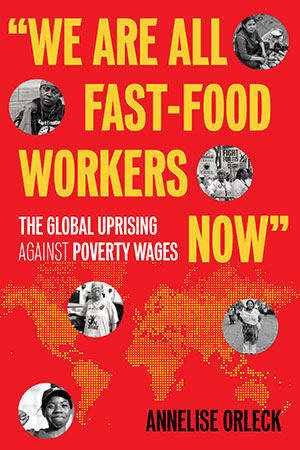
“We Are All Fast-Food Workers Now” The Global Uprising Against Poverty Wages

978-080708177-8

March 11, 2018

The story of low-wage workers rising up around the world to demand respect and a living wage.

Tracing a new labor movement sparked and sustained by low-wage workers from across the globe, “We Are All Fast-Food Workers Now” is an urgent, illuminating look at globalization as seen through the eyes of workers-activists: small farmers, fast-food servers, retail workers, hotel housekeepers, home-healthcare aides, airport workers, and adjunct professors who are fighting for respect, safety, and a living wage.

With original photographs by Liz Cooke and drawing on interviews with activists in many US cities and countries around the world, including Bangladesh, Cambodia, Mexico, South Africa, and the Philippines, it features stories of resistance and rebellion, as well as reflections on hope and change as it rises from the bottom up.

From: www.beacon.org

To Download, click link below:

We_Are_All_Fast-Food_Workers_Now_by_Annelise_Orlec

P.S.

This is my first post on my blog in almost two years, and I felt strongly about sharing this book, that chronicles the global fight of many low income earners for respect, safety and a living wage.

I dare you to be challenged; I dare you to confront your beliefs, your consciousness.

We are all by nature activists for ourselves, in our work, with our friends, family and in the community, in one way or another. Whether it is going for a bank loan for a new car, selling ourselves for a promotion at work, or a new job; casting our vote in a local, provincial or federal election.

I dare you to learn; I dare you to have your personal values and philosophy impacted, about a subject you may be ignorant of, know a little of or be well versed in——-because knowledge is power, and the pen is mighter than the sword——to coin two cliches.

Peace and out.

The Power Of Union Is Strength

Three interesting advertisement illustrating the Power of Union is Strength.
An individual maybe brilliant and have strong core competencies but unless you are able to work in a TEAM and harness each others core competencies, you will always perform below par because there will always be situations at which you will do poorly and someone else does well.

Baseball striking out on player pay equity


Is it so much to ask of an organization to pay its employees a fair wage? Trials and tribulations are part of the journey to the show, but it shouldn’t be at the expense of living a decent life. As fans, we should demand the very best athletes that our dollars can buy. It doesn’t seem that those with two or more jobs get to focus solely on baseball.

https://i0.wp.com/peweb.htl.dc.publicus.com/apps/pbcsi.dll/storyimage/PE/20140518/news/305189966/AR/0/AR-305189966.jpg

By Bret Thixton  May 18, 2014  http://www.myjournalcourier.com

Under the federal minimum wage, an individual working full-time can expect to earn around $15,080. Most Minor League Baseball players earn between $3,000 and $7,500 in a five month season. The average Major League Baseball player will make $3.39 million in a year.

When thinking of income inequality, the discussion has rarely focused on the professional sports world. While there exist income differences among the major sports, a glaring issue exists in the world of baseball. The numbers above point to a huge gap in the salaries for the athletes in our national pastime.

There can be a number of Minor League affiliates associated with a Major League organization. From AAA to rookie leagues, this system is designed to prepare players to make the leap to the MLB. The development of these players is important to Major League clubs as they work toward the ultimate goal of winning the World Series. However, only a very select few of these players will ever make it to the show. The players who don’t make it to the big leagues serve simply as agents of making sure the ones who do are ready.

The importance of these players can’t be understated. Because of them, the players that eventually make the big leap are prepared for the competition at the highest level.

The MLB has been able to get away with these low wages due to a historical exemption from antitrust laws. They are allowed to set salaries and working conditions without players suing under the Sherman Act. This, combined with the inability to unionize, has led to low wages and no major lawsuits.

A new lawsuit, Senne v. MLB, sparked discussion over the payment of these minor leaguers. This lawsuit, brought on by three former Minor Leaguers, claims that wages were unlawfully low. It is currently in the U.S. District Court for the Northern District of California for violations of wage and overtime laws.

The usage of contracts is what the MLB will rely on as they prepare to face legal action. Because players voluntarily agreed to these contracts of their pay, they aren’t guaranteed any more pay. The Fair Labor Standards Act classifies players as professional employees, making players exempt. The players either deal with these terms or do not play.

However, the other side is arguing that the MLB is violating the Fair Labor Standards Act and other laws that guarantee minimum wage and overtime pay. In a sport where you must constantly train and perform, it’s easy to put in more than 40 hours in a week. The players who are suing the league claim to put in 60 or 70 hours in a typical work week.

The MLB and MiLB enjoy the low wages for the players and the low cost of attendance for the games, as they are quite popular in the cities they play in. They state that an increase in wages would be passed onto fans. That is not fair, nor the right answer to the issue.

When Alex Rodriguez gets paid $29 million per year, it’s hard to justify not paying the Minor Leaguers a fair wage. By subtracting just $1 million off the top contract in each organization, an organization could pass around $5,000 to each and every player in their MiLB affiliated clubs.

It may not be fair to take money away from those who pull in the top contracts. But at some point, the MLB needs to understand the true value of its Minor League systems. Minor Leaguers playing today make less than those in 1976, while mega deals seem to break records every year.

These minor leaguers often get jobs in the off-season to make ends meet. This doesn’t allow them to focus on baseball in the off-season or play in other winter leagues.

Is it so much to ask of an organization to pay its employees a fair wage? Trials and tribulations are part of the journey to the show, but it shouldn’t be at the expense of living a decent life. As fans, we should demand the very best athletes that our dollars can buy. It doesn’t seem that those with two or more jobs get to focus solely on baseball.

In a culture that worships veterans and the journey to the majors, baseball has lost sight of the importance that these young men bring to the game itself.

WorkLife: There’s Power in Youth and Unions Working Together

May 16, 2014    By Gabriel Bako    http://policyfix.ca

While the labour landscape has changed dramatically in Canada in the last 58 years, the legal framework has not. The labour relations framework that we use today in Canada was implemented in 1944 with PC-1003, and the Rand Formula in 1946. The models were based on the Wagner Act of 1935 that was implemented in the United States which gave important legal rights to organized workers. PC-1003 gives legal rights to unions to collectively bargain, represent, and organize workers and the Rand Formula gives the provisions for automatic dues check-offs.

It’s clear that these pieces of legislation are necessary to the viability of the labour movement, however there needs to be some updates. In 1944 organizing was radically different from today, as was the labour landscape. Industrial and manufacturing sectors are shrinking and today the largest employment growth is in the retail/service sector, accounting for 11.5 percent of all employment in Canada in 2011.  These new jobs are mainly precarious and non-union, with fast food and mall jobs becoming more common. They usually pay minimum wage, lack stable hours, and provide few or no benefits. Even union retail/service workplaces jobs are becoming increasingly precarious. The push from non-union competitors sets the tone for how union retail/service workplaces operate their business. In today’s unionized retail/service sectors the employers intentionally hire young workers with the knowledge they aren’t well informed about their workplace rights. In addition, even in unionized retail/service workplaces the opportunity of full-time hours or even a guarantee of set hours is unlikely.

Unions are trying to organize the precarious non-unionized sector, but at the same time they’re finding it increasingly difficult just to protect their current members. Whether union or non-union, the retail/service sector is precarious, and this push comes from neoliberal policies that have become more normalized and mainstream in recent years.

The push from corporate elites to undermine labour legislation has resulted in the weakening of card-check legislation and automatic certifications, attempts to enact so called right to work, attacks on the Rand Formula, and more recently the assault on unions through attempts to impose onerous financial reporting regulations on unions and restrictions on their social justice activities.

This assault on workers is making it increasingly difficult for unions to expand into areas where they need to gain ground. For example, the growing retail sector is characterized by high-turnover and the ability to jump between workplaces, making it difficult for unions to organize. However if we want a healthy and sustainable labour movement we must find new ways to connect with the many young people who work in this sector.

Unions are realizing that they must organize these workers; it is critical for the viability of unions, but also for the workers. Despite the reality that Monday to Friday 9-5 jobs are a distant memory, unions can still achieve better scheduling provisions, fair wage increases, respect and dignity, benefits, and the right for workers to have a democratic, participatory role in their workplaces. Youth want to organize, and the unions want to organize them, but the labour relations framework doesn’t allow for this to happen effectively with the changes brought on through increases in retail/service jobs.

In today’s society young people want to take collective action against all kinds of injustice but are often doing this in non-traditional ways that are grassroots and association based; such as community coalitions, worker cooperatives, and employee associations, rather than through formalized structures such as unions. The problem is that under the current labour relations framework, these grassroots and association based structures don’t have any legal rights in terms of the employment relationship. Under these systems employees cannot formally negotiate collective agreements, and they can’t access grievance and arbitration procedures. Therefore unionization is still the best option for achieving workplace rights.

While unions want to have more inclusivity and broader representation they haven’t been able to work out some of the internal barriers that allow for this to occur. Their often hierarchal structures don’t always reflect the diversity of the labour market today. This allows for things to remain status quo, and active young people who would like to give voice to change aren’t always given the opportunity.

Unions must recognize that in order to work they must allow youth to take on participatory roles in all aspects of the union – organizing drives, negotiations, advisory and executive boards, and even take on staff positions. Unions must begin to reflect the workforce they’re looking to organize. There are some unions doing this, and it’s creating positive changes. Yet the biggest change that needs to occur is that young people and unions must come together to find ways for a new organizing model that is successful; perhaps the Wagner model isn’t it.

The challenge is great. The legislative changes required to give the labour movement the tools it needs to organize increasing numbers of precarious youth will only come about with a substantial sea change in our political landscape. Before this will happen, more youth must become engaged in politics and in the labour movement, and labour must increasingly reach out to youth.

Gabriel Bako is major in the Labour Studies Department at the University of Manitoba and a member of  UFCW 832.