The best defence is a good offence: Lessons from Canadian labour history

By Mark Leier   September 3, 2013   http://rabble.ca

Workers in Saint John, NB on strike, Oct. 1976. (Photo: Frank & Ella Hatheway Labour Exhibit Centre)

Contemporary labour activists might find inspiration in the history of Labour Day. It isn’t a simple lesson of how to fight for a statutory holiday. It is a broader one about the nature of political struggle, reform and militancy.

The federal government created the holiday in 1894, and the labour movement deserves the credit for it. But Labour Day was not something labour specifically struggled for and won. The real significance of the holiday is in the broader struggle that pushed the government to make concessions and in a movement that dared to aim high.

The formal request for a holiday to celebrate labour came in 1889 in the report of the Royal Commission on the Relations of Labour and Capital. The commission produced five volumes of testimony and analysis and dozens of recommendations. These ranged from separate factory washrooms for men and women to arbitration boards to shorter hours to better regulation of railways and the oil industry. Among the recommendations was the suggestion “that one day in the year, to be known as Labour Day, be set apart as a holiday by the Government.”

None of the recommendations were taken up by the government of the day. Workers continued to celebrate Labour Day and May Day without the benefit of a statutory holiday, as they had for years. Five years and two prime ministers later, Labour Day was proclaimed, but it is not clear that the government had consulted the report of the Royal Commission. What is clear is that the government was responding to a wave of worker militancy, strikes and radicalism.

By 1886, when John A. Macdonald created the Royal Commission, workers had made the “labour question” the most important issue of the day. It was not an abstract question. It was impressed upon the minds of politicians and capitalists by workers across North America who used strikes and street protests with increasing frequency and militancy.

1872 saw the movement for the nine-hour workday culminate in a Toronto printers’ strike and several thousand workers marching in the streets in support. In the U.S., the railway strike of 1877 broke out in several states and mobilized tens of thousands of workers who engaged in running battles with police, state militia and federal troops in what became known as the Great Upheaval.

The 1880s saw even more strikes; 425 took place in Canada, double the number of the previous decade. Workers formed new unions, federations and councils; the Vancouver Trades and Labour Council, for example, was created in 1889 to provide a single, strong voice for the city’s workers.

Perhaps most worrisome to the authorities was the growth of the Knights of Labor, which organized not just the skilled trades, but all workers, including women. Pierre Berton’s grandfather, Phillips Thompson, was a Knight of Labor and in his book, The Politics of Labor, published in 1887, he warned “capitalism is a wrong, an usurpation, and a growing menace to popular freedom.”

In language that is echoed by the Occupy movement, Thompson pointed out that “the poverty of the many is caused by the unearned, and therefore stolen, wealth of the few.”

At the same time, workers engaged in political action, supporting those Liberals and Conservatives who supported labour and running their own candidates. In B.C., four “workingmen’s candidates” ran in the 1886 provincial election. One of the candidates was Samuel Myers, a miner and a Knight of Labor, who ran against the infamous coal baron Robert Dunsmuir. Myers lost the election and the following year would lose his life in a Nanaimo coal mine explosion that killed 147 workers.

This rising militancy pushed Macdonald to launch the investigation into the relations of labour and capital.

In his view, the “labour question” prompted by the Knights of Labor was as critical a political issue as Louis Riel, temperance, and Irish Home Rule.

By 1894, the creation of Labour Day was almost an afterthought, the belated recognition of the fact of the growing and increasingly radical labour movement across Canada and the U.S.

What is clear from this is that changes in the law, including holidays, come as a response to labour’s militancy, not as a reward for workers staying quiet. Labour influences the political agenda when it is active in the streets, the workplace and the ballot box, when it develops new tactics and forms of organization, and when it poses alternatives to “business as usual.”

It is not so clear that the union leadership has always grasped this lesson. It has usually been the radical edge of the labour movement that created new movements and organized new constituencies, from the Knights of Labor to the Industrial Workers of the World to the Communist Party and the early CCF, to the Canadian Association of Industrial, Mechanical and Allied Workers (CAIMAW) to the Service, Office and Retail Workers’ Union of Canada (SORWUC) and to contemporary rank and file activists.

But too often these dissident movements have been purged from the so-called main house of labour. Without that creative rebel energy, new ideas and new directions rarely emerge.

If strike activity is an indication of militancy, then Canadian labour has lost momentum.

In 1919, when the population of Canada was about 8.3 million, worker-days on strike totaled 3,401,843. In 2011, with a population of 33.4 million, worker-days on strike totaled only 1,966,587. More recently, Canadians spent 10.6 hours on the picket line in 1976; in 2011, that was down to a single hour.

During that same period, governments have made it harder for unions to organize, wages have stagnated, the minimum wage is worth less than it was 35 years ago, the working day has lengthened, social benefits have declined and employers have been successful in decertification drives across the country.

No one likes strikes, and 2013 is not 1976 or 1919. Nonetheless, one lesson from the history of Labour Day may be that the best defence is a good offence.

Mark Leier is a historian at Simon Fraser University. The second revised edition of his book, Rebel Life: The Life and Times of Robert Gosden, Revolution, Mystic, Labour Spy, will be published by New Star Books later this month. He will give a talk on the book at Simon Fraser University’s Harbour Centre on Sept. 19. For more details, click here.

This article was originally published by The Tyee, and is reprinted here with permission.

Following our extensive coverage of the founding convention of Unifor, this week we continue our coverage with a focus on the labour movement’s future. 

Photo: Frank & Ella Hatheway Labour Exhibit Centre

Ottawa Turns Its Back on Steelworkers-Op-Ed

Aug 23, 2013    http://www.thespec.com   https://i0.wp.com/www.thespec.com/Portals/9/Images/logo.png

U.S. Steel’s destructive agenda is tacitly condoned by Harper government

By Marty Warren, Ontario Director of the United Steelworkers

For the second time in three years, 1,000 families in Nanticoke and surrounding communities face an uncertain future, targeted again by a deliberate attack on working-class living standards achieved over generations of struggle in Canada.

U.S. Steel’s lockout of employees at the Lake Erie Works steel mill — now in its 17th week — reflects the impunity foreign multinationals enjoy to slash Canadian jobs and drive down wages, benefits and working conditions.

U.S. Steel, in particular, has ample reason to believe it has the tacit consent of Stephen Harper’s Conservative government to run roughshod over Canadian working families.

In 2007, the Harper Conservatives approved U.S. Steel’s takeover of Canadian steelmaker Stelco. The deal included legally binding commitments from U.S. Steel to maintain production levels and a 3,100-strong workforce at former Stelco operations.

Time after time, the Harper Conservatives have demonstrated they stand with giant multinationals that abuse their dominant economic power.

U.S. Steel broke those legally binding commitments, with devastating results for working families and pensioners whose combined losses ran into tens of millions of dollars.

“(Their) working lives, retirement and income security have been seriously and adversely affected,” a Federal Court judge stated in 2011 after legal proceedings were launched against U.S. Steel.

The legal action was brought against U.S. Steel under terms of the Investment Canada Act, which dictates foreign takeovers must provide a “net benefit” to Canadians.

The government’s case against U.S. Steel included expert analysis that concluded the company knew full well the implications of its legal commitments. Even in the midst of the recession, fulfilling those promises “would not have threatened the financial viability” of the company, the analysis concluded.

However, rather than enforce the law and hold U.S. Steel accountable, the Harper government struck a secret deal that abruptly ended the court case. Promises of jobs and healthy production levels were abandoned. Workers, pensioners and communities devastated by U.S. Steel’s behaviour were denied their day in court.

With a nudge and a wink from our federal government, U.S. Steel was free to continue its onslaught against Canadian employees and pensioners.

U.S. Steel has now followed the same transparent, destructive pattern in three successive rounds of contract negotiations with former Stelco employees — twice at Lake Erie Works and once at Hamilton’s Hilton Works.

In each case, U.S. Steel has betrayed even the pretense of attempting to negotiate a fair deal for Canadian employees. The agenda has been to abuse the full force of its corporate power and resources to impose its will — under threat of arbitrary, lengthy shutdowns.

In each instance the workers refused to be provoked into a strike. To their credit, they proposed to keep operating their plants while pursuing a settlement through good-faith negotiations aided by government mediation.

U.S. Steel’s agenda dictated otherwise. It locked out Lake Erie Works employees for eight months in 2009-2010, then imposed an 11-month lockout in Hamilton in 2010-2011.

In April of this year, with carte blanche from the federal and Ontario governments to do as it pleases, U.S. Steel locked out Lake Erie Works employees for a second time. Four months later, the community’s largest employer remains shut down.

The locked-out employees, members of United Steelworkers Local 8782, remain committed to negotiating a fair collective agreement and are eager to get back to work.

They have received tremendous support within and outside their community, from like-minded Canadians who understand the need to resist a relentless and orchestrated assault on our middle class.

The workers, their families and supporters will continue to fight the good fight. However, it is beyond shameful that they don’t have their government on their side.

Time after time, the Harper Conservatives have demonstrated they stand with giant multinationals that abuse their dominant economic power to drive down our working and living standards and eliminate good jobs. It is part and parcel of the Conservatives’ low-wage economic strategy for our country.

Earlier this year, without meaningful public debate or consultation, the Harper government decided to arbitrarily amend the Investment Canada Act, folding the changes into its latest omnibus budget bill.

The Conservatives’ changes weaken the Act. They allow for more foreign takeovers to be rubber-stamped. Secret deals will remain the norm. Neither the government nor multinational corporations will be required to consult with, or be accountable to, the Canadian families and communities directly affected by foreign takeovers.

It has never been clearer that only a change in government can reverse this disgraceful trend.

Cheap labour and the lessons of the Plaza Hotel strike

Robyn Benson By Robyn Benson on August 23, 2013   http://www.aec-cea.ca


plaza hotel strike.JPG

Who are those people pounding the pavement outside Toronto’s Plaza Hotel, whom the owner called “animals?” They are workers with little or no hope for the long-term, decently-paid jobs that many of us take for granted, living a precarious existence. If you want to know how many of them there are these days, take one Plaza Hotel and multiply by a very big number.

The low-wage workers at the Plaza are at least unionized. Largely due to their Steelworkers Union and to the Ontario Federation of Labour, the public is becoming more aware of the appalling working conditions there.

But this is just the tip of the cheap-labour iceberg.

I’ve posted before about the Temporary Foreign Workers program, a part of this new race to the bottom, in which the Harper government has been complicit. A victory or two have been won in that area, but there is much more to the problem than offshore workers entering Canada on a government program. In some ways, that was just a matter of domestic Canadian cheap labour being edged out of jobs by foreign cheaper labour.

Take the North American fast-food service industry, for example. It used to be that this was a good sector for young people to find a job for a while, and then move on. Now more adults than teens are asking if you want fries with that, and they’re in it for the long haul.

The new employees of this largely non-union sector are more experienced and better educated than formerly, but their wages and benefits don’t reflect that. Small wonder, as we have seen recently in Halifax with coffee-shop baristas, and in the US with employees of McDonald’s and other franchises, that these workers are beginning to look to unionization—and a substantial increase in the minimum wage—as a way of making their circumstances comparatively less precarious.

Would this make hamburgers, coffee and fried chicken too expensive? That’s always the scare-story put about by the anti-union types. But it’s not founded upon fact:

Several studies show that raising the minimum wage would have minimal effects on the industry as a whole. One letter signed by more than 100 economists and published by the University of Massachusetts said that raising the minimum wage to $10.50 would increase the price of a Big Mac by a nickel. Another study shows that doubling the salaries and benefits of all of McDonald’s employees would add 68 cents to each Big Mac.

Perhaps one of the more comical aspects of the corporate fightback was the spectacle of McDonald’s solemnly informing its low-wage employees how to budget. The bosses’ scheme works perfectly—if the minimum wage is doubled, and you can do without water, clothing, gas, heat and child care.

Are low wages the natural cost of working for a living wage in the service sector these days? Well, no:

Consider Costco and Wal-Mart’s Sam’s Club, which compete fiercely on low-price merchandise. Among warehouse retailers, Costco…is number one, accounting for about 50% of the market. Sam’s Club…is number two, with about 40% of the market.

…A 2005 New York Times article by Steven Greenhouse reported that at $17 an hour, Costco’s average pay is 72% higher than Sam’s Club’s ($9.86 an hour).

On the benefits side, 82% of Costco employees have health-insurance coverage, compared with less than half at Wal-Mart.

…In return for its generous wages and benefits, Costco gets one of the most loyal and productive workforces in all of retailing, and, probably not coincidentally, the lowest shrinkage (employee theft) figures in the industry….Costco’s stable, productive workforce more than offsets its higher costs.

A cheap labour strategy doesn’t work. It costs just about everybody. Costco knows this from experience, and has resisted calls to lower its wages and benefits.

So the push-back against impoverishing workers is not only a union concern, although we can certainly play a lead role in it. But we in the labour movement can’t do that by focusing too narrowly. We need to be part of a wider movement to defend the right to a living, dignified wage and secure employment for everyone. After all, it’s our whole society that is at stake here—and surely that makes it everybody’s fight.

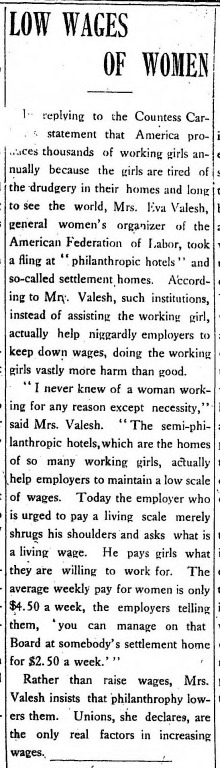
Unions…The Only Real Factors In Increasing Wages, So Says Mrs. Eva Valesh

NOTE: Women have been involved in the Labour Movement for untold generations, advocating proper working conditions, fair wages, and worker rights throughout Canada and the United States. One such woman was Mrs. Eva Valesh, general women’s organizer of the American Federation of Labour.

Mrs. Valesh knew then, what Unions and Canadians know today, Union wages lift the wages of all people and stimulate local, regional, provincial economies. Canada is a better country for the inclusion of Unions. Enjoy the article.

From: Boundary Creek Times, Greenwood, B.C., July 15, 1910

lowwagesofwomen

MP welcomes bill’s second chance

Bill C-377 To Revert To When  It Passed third reading In The House On Dec. 12 – Nullifying  Senators’ Amendments, Deliberations.

By Alex Browne – Peace Arch News    August 21, 2013 3:00 PM

https://i0.wp.com/media.bclocalnews.com/images/29576whiterockHiebert-Russ0411FC.jpg

South Surrey-White Rock-Cloverdale Conservative MP Russ Hiebert

Russ Hiebert, Conservative MP for South Surrey-White Rock-Cloverdale, says he’s pleased by Prime Minister Stephen Harper’s decision to prorogue – or suspend – Parliament until October.

For Hiebert, prorogation means the clock will be turned back to last December on his controversial private member’s bill, C-377, which would require labour unions to publish detailed financial information.

Harper has said prorogation is in anticipation of a throne speech putting forward a new agenda for the government at the midpoint of its mandate.

Following heated debate, the Senate sent C-377 back to the Commons in June, with extensive amendments reducing the scope and impact of the bill that Hiebert claimed, at the time, had “gutted” it.

Under prorogation, according to the Library of Parliament, the bill will revert to the way it was when it passed third reading in the House on Dec. 12 – essentially nullifying the Senators’ amendments and the deliberations leading to them.

The unamended bill will subsequently be resubmitted to the Senate, Hiebert noted in a statement issued Tuesday.

“As such, I am hopeful my colleagues in the Senate will give C-377 appropriate and timely consideration,” he said, adding that the restored bill will “once again reflect the wishes of the elected lower house of Parliament.”

Wednesday, Peace Arch News asked Hiebert if that means he expects the bill will receive a smoother ride the second time around.

“I’m always hopeful,” Hiebert said, adding that he’s making no predictions about how quickly the Senate will deal with the bill when it returns to the chamber.

“This does give me an opportunity to communicate with the small number of members of my caucus who had concerns about the bill. I’ll do my best to persuade them that the bill should pass as it stands.”

Hiebert acknowledged going back to square one with the Senate also raises the possibility the bill could face further Senate Banking Committee hearings before being debated by senators.

“That decision would have to rest with them,” he said. “My hope is that, because we have already had three weeks of testimony, that could be taken into consideration. But it’s completely in the hands of the senators.”

A total of 16 Tory senators joined their Liberal counterparts in approving the amendments to Hiebert’s bill in June.

Hiebert has argued that since unions receive tax deductions through union dues, their finances should be made public, and that the transparency he’s asking for is no greater than that currently required for charities.

Opponents, however, claim the legislation – as it stands – will cost unions millions of dollars, adding that the bill also ventures into dangerous  areas of unconstitutionality and invasion of privacy.

Conservative Senator Hugh Segal was among those who spoke out against the bill in June, saying it was poorly drafted and likely to be challenged.

“Whatever may have been its laudable transparency goals, (it is) really – through drafting sins of omission and commission – an expression of statutory contempt for the working men and women in our trade unions and for the trade unions themselves and their right under federal and provincial law to organize,” Segal said.

Conservative Senator Diane Bellemare, a former economics professor at the University of Quebec, was also critical of the legislation.

“Even with the proposed amendments, this bill remains an unbalanced bill that has no similarity to other transparency bills in France, the United Kingdom and Australia,” she said.