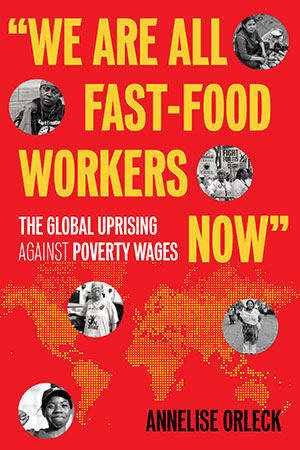
“We Are All Fast-Food Workers Now” The Global Uprising Against Poverty Wages

978-080708177-8

March 11, 2018

The story of low-wage workers rising up around the world to demand respect and a living wage.

Tracing a new labor movement sparked and sustained by low-wage workers from across the globe, “We Are All Fast-Food Workers Now” is an urgent, illuminating look at globalization as seen through the eyes of workers-activists: small farmers, fast-food servers, retail workers, hotel housekeepers, home-healthcare aides, airport workers, and adjunct professors who are fighting for respect, safety, and a living wage.

With original photographs by Liz Cooke and drawing on interviews with activists in many US cities and countries around the world, including Bangladesh, Cambodia, Mexico, South Africa, and the Philippines, it features stories of resistance and rebellion, as well as reflections on hope and change as it rises from the bottom up.

From: www.beacon.org

To Download, click link below:

We_Are_All_Fast-Food_Workers_Now_by_Annelise_Orlec

P.S.

This is my first post on my blog in almost two years, and I felt strongly about sharing this book, that chronicles the global fight of many low income earners for respect, safety and a living wage.

I dare you to be challenged; I dare you to confront your beliefs, your consciousness.

We are all by nature activists for ourselves, in our work, with our friends, family and in the community, in one way or another. Whether it is going for a bank loan for a new car, selling ourselves for a promotion at work, or a new job; casting our vote in a local, provincial or federal election.

I dare you to learn; I dare you to have your personal values and philosophy impacted, about a subject you may be ignorant of, know a little of or be well versed in——-because knowledge is power, and the pen is mighter than the sword——to coin two cliches.

Peace and out.

The Power Of Union Is Strength

Three interesting advertisement illustrating the Power of Union is Strength.
An individual maybe brilliant and have strong core competencies but unless you are able to work in a TEAM and harness each others core competencies, you will always perform below par because there will always be situations at which you will do poorly and someone else does well.

It it ethical to take union-won benefits without joining?

Some U.S. states say people should have the right not to join a union

By: Ken Gallinger Ethically speaking columnist, Published on Fri Jun 13 2014

http://www.thestar.com

Many American states permit employees in unionized worksites to opt out of dues. It’s not legal in Canada. But after Michigan passed such a law, some conservative politicians began promoting the idea here. The argument made by proponents is “the right of employees to decide for themselves whether or not to join a union.” Is it ethical to refuse to pay dues if you work in a job covered by a union contract?

There are two viable ways of paying for services we enjoy. On the one hand, there are a limited number of services (roads, police, hospitals etc.) that we all pay for, whether we use them or not. These are provided by government, and deemed to some degree essential.

The vast majority of services on which we depend, however, are to some extent user-pay — i.e., if you use the service, you pay some of the cost. Included on the long list of services we fund on a per-use (or per-season, etc.) basis are things like provincial parks, museums, public transit, theatre tickets, etc. Almost all of these enjoy some public subsidization, because we are still, essentially, a socialist country. But users pay some per-pop cost, and in recent years the percentage has generally shifted away from subsidies, and towards higher user fees. Even in education, parents report a never-ending chorus of gimme from schools their kids attend.

Proponents of so-called “Right to Work” legislation (a euphemism gone malignant if there ever was one) argue, on the one hand, that union membership/dues should be a discretionary, user-pay arrangement; those who choose to support unions would be free to do so, but others equally free to opt out. Where their logic goes weirdly off track, however, is on the question of whether those who opt out of dues would also relinquish the benefits won by unions, not only on that particular worksite, but across society. Well, no, they wouldn’t in fact; they would continue to receive all the benefits of union negotiations, advocacy and so on — either without paying a cent, or in return for a paltry fee-for-service. That’s why Rick Unger, writing in Forbes, said this would be better described as “Right to Freeload” legislation.

The question is not whether everyone in society should be legally required to pay union dues; I’ve never paid dues in my life — but I’ve also never enjoyed the protections that workers in unionized environments take for granted. If I had a dispute with my employer, I was completely, 100 per cent on my own.

The real question is: could it ever be OK to accept work in a context where employees enjoy salary levels, pension plans, working conditions and other benefits that have been won, over many years, by unions, and still not support the unions that won those benefits?

The obvious answer is “no.”

Unless we create a society where worker’s rights, pensions and other benefits are universally protected by government — and we’re all prepared to pay for that protection the same way we pay for cops and hospitals — unions remain the only effective vehicle by which those benefits are won and protected. And ethically speaking, if you dance the jig, you pay the piper.

Labour power among the rank and file


June 13, 2014 http://rankandfile.ca

AC_pension_workers

ByDavid Bush

For the first time in Canadian Labour Congress (CLC) history an incumbent presidential candidate was defeated. The house of labour has its first new president in 15 years, but what does that really mean for the labour movement?

Newly elected Hassan Yussuff used increasingly militant rhetoric throughout his campaign and began to speak about the need for more grassroots organizing, a change from former CLC president Ken Georgetti’s conservative approach to membership mobilization. Yussuff’s campaign was, no doubt, influenced by the rhetoric coming from Hassan Husseini’s presidential campaign, which was focused on restoring workers’ power at the CLC. For those who are concerned about rebuilding the trade union movement and empowering workers to engage in collective struggle, this change can be nothing but positive.

However, the change possible as a result of new leadership is limited. Many on the left, from social democrats to the far left, cling to a narrative that says those at the top dictate the direction of the labour movement. This can lead to problematic conclusions such as believing a new leader will bring about a new day for labour, or that weak leaders are holding the workers’ movement back.

Yes, we need better leaders; leaders who are willing to use their bully pulpit and open up the space for action. And yes, we need to organize to win local and national leadership contests on progressive terms. But in the absence of an organized rank and file willing to seize these opportunities, even the most radical labour leadership can do little.

Perhaps the most compelling story of the importance of grassroots organizing comes from the Chicago Teachers Union; its inspiring defense of public education was made possible by grassroots activists. Facing a conservative union leadership, teachers organized through the Caucus of Rank and File Educators began to organize a network of progressive teachers that eventually won leadership. CORE remained active and helped push their union towards a very strong strike mandate: of the 90 per cent of CTU members who voted, 98 per cent were in favour of striking. The successful strike reinvigorated activists in Chicago to fight against neoliberal policies that affect both schools and communities.

In Canada, despite union density remaining somewhat stable, the Canadian labour movement faces a challenging situation. The employer offensive has put unions on their back foot. We have seen an increasing number of lockouts, a higher frequency of legislative attacks, a pattern of concessionary bargaining at the table and a decline in days lost to strikes.

Objective economic and political factors explain the weak position that unions find themselves in: the decline of manufacturing, the restructuring away from larger workplaces (which are and have been bastions of high unionization), the growth of the service sector, the decline of the American labour movement, the ideological shift towards neoliberalism and so forth. But there are also subjective factors such as a move away from devoting resources to organizing, the entrenchment of a servicing culture within unions and the inability of unions to mobilize their membership around political goals beyond their own workplaces.

Union administration is often seen as a layer of individuals whose social position within the union structure leads them to be more conservative, no matter how great or progressive they are on an individual level. Analyses can collapse into simply blaming the bureaucracy: elected officials and staff are motivated to rein in the class struggle in order to preserve the material benefits and political voice their position affords them. The nature of their position also separates them from the day-to-day concerns on the shop floor.

This analysis doesn’t acknowledge deeper structural realities of trade unions in our society.

The trade union movement is the product of a deeply unjust and unequal economic system called capitalism that aims to squeeze as much profit from workers as possible. Unions were formed to defend and increase what little power workers had through collective action. Through many hard fought battles, labour activists won collective legal rights. This allowed unions to entrench more gains at the bargaining tables but it also created the conditions for the growth of bureaucratic structures to regulate and manage labour relations under the new and increasingly specialized legal framework.

To understand the trade union bureaucracy as only a layer of individuals whose social position is divorced from the rank and file rather than a structural product of the class struggle opens the door for a less than helpful understanding of the problems facing unions. It is not a matter of union leaders and bureaucrats simply holding back the union movement. In this regard, a certain leftist criticism of the union bureaucracy begins to dovetail with a very conservative reading of how change is enacted: everything focused on the top.

We must start to think about how change happens in the union movement.

Last February, when a UPS worker in Queens, New York, was unfairly fired, a union briefing turned into a wildcat strike of 90 minutes. After the wildcat, UPS made their intentions clear to fire all 250 workers involved, and started firing workers at random. Thanks to intense organizing, enough pressure was placed on UPS by their clients and other unions that they were forced to re-hire all threatened workers.

As Sarah Jaffe notes, “the wildcat action had to be backed up with organizing both inside the union and within the community.” Indeed, the militancy of the membership, and their willingness to place their jobs on the line to save a colleague’s won the day.

As  a good friend of mine once told me, those who want the labour leadership to simply call for the most militant of tactics without actually doing the work of creating the conditions for this happen ourselves, want to substitute the power of workers for the pronouncements of leaders. You want to wildcat, go on general strike or occupy your workplace? Great, but if we can’t win that argument in our own workplace then why should we expect leadership to do the heavy lifting for us?

To make the union movement a stronger force for the whole working class, we must move beyond expecting leaders and bureaucrats to lead the charge, or blame them when militancy fails to materialize. The left must organize to empower the widest layer of workers to take action to better their lives. This means actively engaging with all unions, regardless of if they are deeply conservative.

Scapegoating the labour leadership for a variety of collective failures won’t turn the tide of the attacks. The only way we can begin to challenge the forces lined up against it is to reach out to and empower the broader working class to fight back.

This can only truly happen if rank and file activists organize from the bottom up.

This piece was first published on Rabble.ca

Baseball striking out on player pay equity


Is it so much to ask of an organization to pay its employees a fair wage? Trials and tribulations are part of the journey to the show, but it shouldn’t be at the expense of living a decent life. As fans, we should demand the very best athletes that our dollars can buy. It doesn’t seem that those with two or more jobs get to focus solely on baseball.

https://i0.wp.com/peweb.htl.dc.publicus.com/apps/pbcsi.dll/storyimage/PE/20140518/news/305189966/AR/0/AR-305189966.jpg

By Bret Thixton  May 18, 2014  http://www.myjournalcourier.com

Under the federal minimum wage, an individual working full-time can expect to earn around $15,080. Most Minor League Baseball players earn between $3,000 and $7,500 in a five month season. The average Major League Baseball player will make $3.39 million in a year.

When thinking of income inequality, the discussion has rarely focused on the professional sports world. While there exist income differences among the major sports, a glaring issue exists in the world of baseball. The numbers above point to a huge gap in the salaries for the athletes in our national pastime.

There can be a number of Minor League affiliates associated with a Major League organization. From AAA to rookie leagues, this system is designed to prepare players to make the leap to the MLB. The development of these players is important to Major League clubs as they work toward the ultimate goal of winning the World Series. However, only a very select few of these players will ever make it to the show. The players who don’t make it to the big leagues serve simply as agents of making sure the ones who do are ready.

The importance of these players can’t be understated. Because of them, the players that eventually make the big leap are prepared for the competition at the highest level.

The MLB has been able to get away with these low wages due to a historical exemption from antitrust laws. They are allowed to set salaries and working conditions without players suing under the Sherman Act. This, combined with the inability to unionize, has led to low wages and no major lawsuits.

A new lawsuit, Senne v. MLB, sparked discussion over the payment of these minor leaguers. This lawsuit, brought on by three former Minor Leaguers, claims that wages were unlawfully low. It is currently in the U.S. District Court for the Northern District of California for violations of wage and overtime laws.

The usage of contracts is what the MLB will rely on as they prepare to face legal action. Because players voluntarily agreed to these contracts of their pay, they aren’t guaranteed any more pay. The Fair Labor Standards Act classifies players as professional employees, making players exempt. The players either deal with these terms or do not play.

However, the other side is arguing that the MLB is violating the Fair Labor Standards Act and other laws that guarantee minimum wage and overtime pay. In a sport where you must constantly train and perform, it’s easy to put in more than 40 hours in a week. The players who are suing the league claim to put in 60 or 70 hours in a typical work week.

The MLB and MiLB enjoy the low wages for the players and the low cost of attendance for the games, as they are quite popular in the cities they play in. They state that an increase in wages would be passed onto fans. That is not fair, nor the right answer to the issue.

When Alex Rodriguez gets paid $29 million per year, it’s hard to justify not paying the Minor Leaguers a fair wage. By subtracting just $1 million off the top contract in each organization, an organization could pass around $5,000 to each and every player in their MiLB affiliated clubs.

It may not be fair to take money away from those who pull in the top contracts. But at some point, the MLB needs to understand the true value of its Minor League systems. Minor Leaguers playing today make less than those in 1976, while mega deals seem to break records every year.

These minor leaguers often get jobs in the off-season to make ends meet. This doesn’t allow them to focus on baseball in the off-season or play in other winter leagues.

Is it so much to ask of an organization to pay its employees a fair wage? Trials and tribulations are part of the journey to the show, but it shouldn’t be at the expense of living a decent life. As fans, we should demand the very best athletes that our dollars can buy. It doesn’t seem that those with two or more jobs get to focus solely on baseball.

In a culture that worships veterans and the journey to the majors, baseball has lost sight of the importance that these young men bring to the game itself.