
Category Archives: union advantage
Canada Shows the Power of Unions
 Jim Stanford is an economist with Unifor.
December 4, 2013 http://www.nytimes.com
The dream of a decent, “middle class” life still exerts a powerful influence in North American culture. But we often forget that the middle class is actually a relatively recent creation. It was largely a result of working people organizing to win a decent share of prosperity, especially through unionization and collective bargaining.
A major reason for Canada’s greater income equality is that unions represent 31 percent of its workers, compared to 12 percent in the U.S.
There is an inherent asymmetry between employers and workers. Without institutional structures to strengthen workers’ position, workers get enough to survive, while owners, investors and a few professionals pocket the lion’s share of economic growth.
Auto factory wages and working conditions were traditionally poor. Unionization and collective bargaining improved incomes and security, so workers could afford home ownership, a comfortable retirement and college tuition for their kids. In other industries, too, lousy jobs became middle-class jobs, thanks largely to unions.
Many assume that a restaurant job is inherently a poverty-level job. But collective bargaining could help restaurant workers improve wages and working conditions and attain a better life.
Income distribution is far more equal in Canada than in the United States, despite the similarity of their economies. That’s largely because unions represent 31 percent of workers in Canada, compared to 12 percent in the United States. (The minimum wage is Canada is generally around $10 an hour.) Prosperity is shared more broadly.
Higher unionization in Canada is the culmination of many small differences in labor law. In most jurisdictions, unions can be certified when a clear majority of workers sign union cards. There are stronger protections against being fired for union activity (including organizing drives and strikes). Union dues are usually deducted at source by the employer and forwarded to the union. Contracts can be settled by arbitration for new bargaining units or in the event of long work stoppages. In some provinces, employers are not permitted to hire replacement workers during strikes. All of this means that Canadian workers have a better chance to form a union and negotiate a fair deal with their employers.
To be sure, unions are under pressure in Canada (as in the United States) from globalization and hostile employers, and the erosion of unionization would undermine Canada’s social equality. But the positive impact of collective bargaining on equality and social inclusion is still evident.
The collective action of restaurant workers brought public attention to their low pay and insecurity. By formalizing that collective power they could turn their lousy jobs into decent ones.
IBEW 213: Unions Still Needed
 Support IBEW 213 @Support_IBEW213
When people tell me things have changed, unions aren’t needed anymore I smile &say, “Why? Have corporations stopped being greedy?” #bcpoli
Cheap labour and the lessons of the Plaza Hotel strike
 By Robyn Benson on August 23, 2013 http://www.aec-cea.ca

Who are those people pounding the pavement outside Toronto’s Plaza Hotel, whom the owner called “animals?” They are workers with little or no hope for the long-term, decently-paid jobs that many of us take for granted, living a precarious existence. If you want to know how many of them there are these days, take one Plaza Hotel and multiply by a very big number.
The low-wage workers at the Plaza are at least unionized. Largely due to their Steelworkers Union and to the Ontario Federation of Labour, the public is becoming more aware of the appalling working conditions there.
But this is just the tip of the cheap-labour iceberg.
I’ve posted before about the Temporary Foreign Workers program, a part of this new race to the bottom, in which the Harper government has been complicit. A victory or two have been won in that area, but there is much more to the problem than offshore workers entering Canada on a government program. In some ways, that was just a matter of domestic Canadian cheap labour being edged out of jobs by foreign cheaper labour.
Take the North American fast-food service industry, for example. It used to be that this was a good sector for young people to find a job for a while, and then move on. Now more adults than teens are asking if you want fries with that, and they’re in it for the long haul.
The new employees of this largely non-union sector are more experienced and better educated than formerly, but their wages and benefits don’t reflect that. Small wonder, as we have seen recently in Halifax with coffee-shop baristas, and in the US with employees of McDonald’s and other franchises, that these workers are beginning to look to unionization—and a substantial increase in the minimum wage—as a way of making their circumstances comparatively less precarious.
Would this make hamburgers, coffee and fried chicken too expensive? That’s always the scare-story put about by the anti-union types. But it’s not founded upon fact:
Several studies show that raising the minimum wage would have minimal effects on the industry as a whole. One letter signed by more than 100 economists and published by the University of Massachusetts said that raising the minimum wage to $10.50 would increase the price of a Big Mac by a nickel. Another study shows that doubling the salaries and benefits of all of McDonald’s employees would add 68 cents to each Big Mac.
Perhaps one of the more comical aspects of the corporate fightback was the spectacle of McDonald’s solemnly informing its low-wage employees how to budget. The bosses’ scheme works perfectly—if the minimum wage is doubled, and you can do without water, clothing, gas, heat and child care.
Are low wages the natural cost of working for a living wage in the service sector these days? Well, no:
Consider Costco and Wal-Mart’s Sam’s Club, which compete fiercely on low-price merchandise. Among warehouse retailers, Costco…is number one, accounting for about 50% of the market. Sam’s Club…is number two, with about 40% of the market.
…A 2005 New York Times article by Steven Greenhouse reported that at $17 an hour, Costco’s average pay is 72% higher than Sam’s Club’s ($9.86 an hour).
On the benefits side, 82% of Costco employees have health-insurance coverage, compared with less than half at Wal-Mart.
…In return for its generous wages and benefits, Costco gets one of the most loyal and productive workforces in all of retailing, and, probably not coincidentally, the lowest shrinkage (employee theft) figures in the industry….Costco’s stable, productive workforce more than offsets its higher costs.
A cheap labour strategy doesn’t work. It costs just about everybody. Costco knows this from experience, and has resisted calls to lower its wages and benefits.
So the push-back against impoverishing workers is not only a union concern, although we can certainly play a lead role in it. But we in the labour movement can’t do that by focusing too narrowly. We need to be part of a wider movement to defend the right to a living, dignified wage and secure employment for everyone. After all, it’s our whole society that is at stake here—and surely that makes it everybody’s fight.
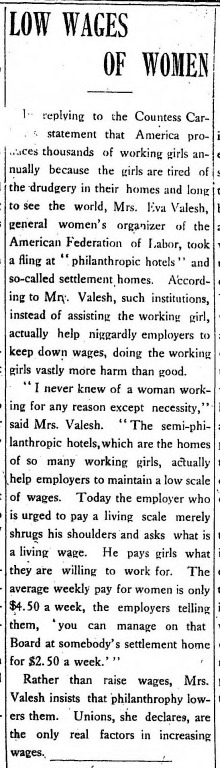
Unions…The Only Real Factors In Increasing Wages, So Says Mrs. Eva Valesh
NOTE: Women have been involved in the Labour Movement for untold generations, advocating proper working conditions, fair wages, and worker rights throughout Canada and the United States. One such woman was Mrs. Eva Valesh, general women’s organizer of the American Federation of Labour.
Mrs. Valesh knew then, what Unions and Canadians know today, Union wages lift the wages of all people and stimulate local, regional, provincial economies. Canada is a better country for the inclusion of Unions. Enjoy the article.
From: Boundary Creek Times, Greenwood, B.C., July 15, 1910
 Andrew Phillip Chernoff