High blood sugar levels could lead to heart attack complications

  • First study to show direct evidence of blood vessel contraction due to glucose (sugar)
  • Effects observed even at glucose levels that could be reached after a large meal
  • Research provides a potential therapeutic target for improving outcomes following a heart attack or stroke

Scientists at the University of Leicester have demonstrated for the first time the mechanism by which the level of sugar in your blood can affect the contraction of blood vessels, with potentially dangerous effects on the heart and blood pressure.

Researchers led by Dr Richard Rainbow from the University’s Department of Cardiovascular Sciences have shown that blood vessels contract more strongly at raised glucose levels than at ‘normal physiological’ levels.

Blood vessels contract and relax to control blood pressure. In general, the more contracted the blood vessels are, the higher the blood pressure. Using electrophysiology and myography techniques to examine the impact of glucose on arterial myocytes, cells that make up the tissue of our blood vessels, the team has identified a mechanism that controls the narrowing of blood vessels.

The research comes as MPs and health experts debate proposals for a ‘sugar tax’ and highlights the potential health risks of consuming large amounts of rich, sugary foods regularly in your diet. With healthy eating among the most common New Year’s resolutions, it adds another incentive to reduce our intake of these foods all year round.

Heart attacks occur when a coronary artery, which provides the blood to the heart muscle to give the required nutrients and oxygen, are blocked. High glucose at the time of heart attack could make this block more severe by causing the blood vessel to contract, leading to a higher risk of complications.

Dr Richard Rainbow, Lecturer in Cardiovascular Cell Physiology, said: “We have shown that the amount of sugar, or glucose, in the blood changes the behaviour of blood vessels making them contract more than normal. This could result in higher blood pressure, or could reduce the amount of blood that flows through vital organs.

“This was an experimental lab study which means that we can draw conclusions about cause and effect in a controlled environment. Here, we have identified a known signalling protein family, protein kinase C, is a key part of this enhanced contractile response, and have also shown in our experiments that we can restore the normal level of contractile response, and reverse the effects on the heart, with inhibitors of these proteins.

“This is the first study to show direct evidence of blood vessel contraction to glucose, and the potential mechanism behind this contractile response. In the experimental models we used in this study, including human blood vessels, increasing glucose to the levels that could be reached after a large meal altered vascular contraction.

“A large number of people who suffer a heart attack will have high glucose due to the ‘stress response’. This means that even people who are not diabetic may become hyperglycaemic during a heart attack.”

The research team that worked on this study has a history of investigating the effects of glucose on the cardiovascular system, diabetes and heart function. Previous research in 20101 showed that high glucose from any cause, not just diabetes, was an indicator of a ‘worse outcome’ following a heart attack. Further research in 20142 by the Leicester group showed that glucose has potentially damaging effects on the normal function of the heart, such as arrhythmia and abolishing the built-in protective mechanisms that the heart can activate on stress.

Dr Rainbow added: “Our studies show that glucose has an important physiological effect on the normal functioning of the cardiovascular system. Increases in blood sugar to pathophysiological levels cause marked changes in normal blood vessel and cardiac muscle behaviour that could be life-threatening if left untreated.

“Our data show a clear glucose-induced potentiation of contraction in blood vessels. Targeting the specific types of protein kinase C that we’ve shown to be involved in this can provide a novel therapeutic route for improving outcome in ischaemic diseases, such as heart attack or stroke.”

Professor Jeremy Pearson, Associate Medical Director at the British Heart Foundation, said: “This team have shown that, in multiple species, it is possible to use PKC as a target to block blood vessel constriction caused by high levels of glucose in the blood. This opens up the possibility for improved treatment for patients where recovery from heart attack is complicated by raised glucose levels.”

Source: University of Leicester

Source: High blood sugar levels could lead to heart attack complications | Science Codex

Chinese shares turn positive after rout

Mainland Chinese shares reversed early losses on Tuesday, following Monday’s suspension of trading, which led to a global equities sell-off.

The Shanghai Composite was up 0.7% at 3,321.87 after opening more than 3% lower, while the Hang Seng also changed direction to head up 0.1% to 21,342.09.

Trading in Shanghai was suspended early on Monday after it triggered a new circuit breaker mechanism.

The 7% fall spooked global markets.

Overnight, US benchmark indexes lost up to 2% as concerns grew that the dive in the Chinese stocks was the start of another volatile period after last summer’s dramatic market rout.

The addition of escalating tensions in the Middle East on oil prices also dented investors’ confidence.

Oil prices were flat after rising as much as 4% on the brewing dispute between Saudi Arabia and Iran.

South Korean shares also headed higher after a senior finance ministry official told Reuters that the government would take action to stabilise the market if needed, following Monday’s steep plunge.

The Kospi was up 0.2% to 1,922.62 points.

Asia’s biggest market – Japan’s Nikkei 225 index was down 0.4% to 18,369.77, while Australia’s S&P/ASX 200 lost 0.9% to 5,222.90.

Analysts said investors were waiting to see if Beijing could stem the latest selling in Chinese stocks and whether more measures would be introduced.

The circuit breaker rule that suspended trading nationwide for the first time on Monday was created after sharp falls last summer and was meant to curb market volatility in China.

Source: Chinese shares turn positive after rout – BBC News

Global stock markets dive on China worries

Wall Street has continued the rout on global share markets, with the Dow Jones, S&P 500 closing down more than 1.5% and Nasdaq down 2%.

It followed sharp falls in China, where trading on the main stock markets was halted early after indexes tumbled 7%.

A survey indicating China’s manufacturing sector contracted again last month was blamed for the falls.

Other Asian markets also fell, while in Europe, the FTSE 100 closed down 2.6% and Germany’s Dax index dropped 4.3%.

Meanwhile, news that Saudi Arabia had broken off diplomatic ties with Iran sent oil and gold prices higher.

On Wall Street, all 10 major S&P sectors were lower, led by the 2.4% fall in the technology sector. Bank stocks were also hard hit, with JP Morgan down 3.65%.

“Those are violent New Year fireworks,” said Andre Bakhos, managing director at Janlyn Capital. “That’s quite a way to start the day off.”

China weakness

Earlier on Monday, trading on China’s Shanghai and Shenzhen stock exchanges was halted for the first time under new “circuit breaker” rules, which are designed to curb market volatility.

The share price falls came after more signs of trouble in the world’s second-largest economy.

The Caixin/Markit purchasing managers’ index slipped to 48.2 in December, marking the 10th consecutive month of shrinking factory activity in the sector. A reading below 50 indicated contraction.

Some analysts also attributed the decline in share prices to the imminent end of a six-month lockup period on share sales by major institutional investors, a policy implemented to shore up indexes. Big shareholders may start dumping shares once the ban is lifted on Friday.

Huang Cengdong, an analyst for Sinolink Securities in Shanghai, said: “The market will not improve because there will be heavy selling in the near future.”

Monday’s sell-off in China had a knock-on across the region. Japan’s Nikkei 225 tumbled 3.1% and Hong Kong’s Hang Seng retreated 2.6%.

Analysis: Karishma Vaswani, Asia business correspondent

There’s nothing like the herd mentality to get things started for the new year. Retail investors in the Chinese stock market are often driven by sentiment and tend to follow the crowd.

When they hear of some bad news from brokers or their friends, and other people start selling, they start selling too.

Falling prices attract more people to dump their stocks, and although shares are still above their lows, authorities will be keen to avoid the kind of share market crash we saw last summer.

Read Karishma’s full analysis here.

“Welcome to 2016, though you’d be forgiven for thinking the markets were back in August 2015 with China causing some early New Year issues,” said Spreadex analyst Connor Campbell.

And Alastair McCaig, market analyst at IG, said: “Anyone hitting the trading floor expecting a calm and quiet start to 2016 was given a rude surprise as Asian chaos affected European markets.”

Markets were also rattled by growing tensions between Middle East powerhouses Saudi Arabia and Iran over the execution of Shia cleric Nimr al-Nimr.

The execution in Saudi Arabia led to protests in Tehran. Saudi has cut diplomatic ties with Iran and given diplomats 48 hours to leave.

Iran’s supreme leader has warned Saudi Arabia it would face “quick consequences” for the execution.

‘Supply glut’

Fearing further upheaval in the already volatile Middle East, the US has urged regional leaders to try to ease tensions.

The price of Brent crude jumped more than 3% at the start of the day on the back of heightened tensions, but then fell back sharply after US stock markets opened. In late afternoon trading, Brent was down 1% at $36.96 a barrel, while US crude was down 1.4% at $36.52.

Analysts said the underlying trend of oversupply would continue to weigh on prices over the longer term.

“Unless we see a convincing drop in oil output from these two nations, and the broader oil-producing community, the supply glut issue will persist, which means oil prices would remain under pressure for a longer period,” said Bernard Aw at IG Markets in Singapore.

Oil prices are down by two-thirds since mid-2014, with analysts estimating that producers are pumping between 0.5 million and two million barrels of oil every day in excess of demand.

Worries about the impact of Middle East tensions were underlined in the gold price, which rose more than 1% on Monday to $1,070.20 an ounce.

Gold is frequently seen as an alternative investment during times of geopolitical and financial uncertainties. The gold price lost 10% last year.

Another traditional haven is the Swiss franc, which gained about 0.8% against both the dollar and the euro in early trading on Monday.

Source: Global stock markets dive on China worries – BBC News

Forward looking Expectations Sub-indice declines for sixth week in succession – Post election exuberance wanes (released January 4, 2016)

c7b6bc28-5306-484c-a3d8-9d8998ff23c8

Bloomberg Nanos Weekly Consumer Confidence Tracking

The negative prospective mood on the state of the Canadian economy continues as 2015 is closed out. Canada’s energy rich Prairies, once again have hit a new 12 month low on the Bloomberg Nanos Canadian Confidence Index (BNCCI).

“After period of economic exuberance following the Canadian federal election we are now entering a period of greater pessimism in terms of the future strength of the Canadian economy ,” said Nanos Research Group Chairman Nik Nanos.

“Canadian households have endured labor-market upheavals and a loss of wealth in 2015. For working-age cohorts, the unemployment rate — which had improved to a cyclical low of 6.6% in January — rose to 7.1% in November. For older and higher-income households, expectations were dashed as the equity market fell 16% from 2014 peak levels”, said Robert Lawrie of Bloomberg Economics.

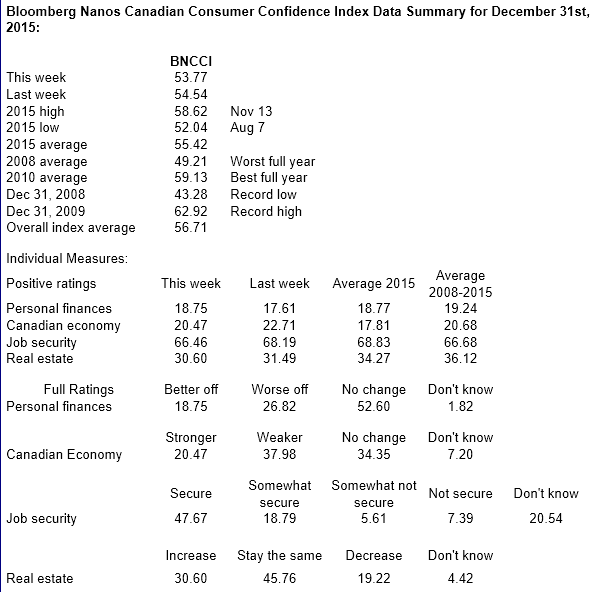
The BNCCI, a composite of a weekly measure of financial health and economic expectations, registered at 53.77 compared with last week’s 54.54. The twelve month high stands at 58.62.

The Bloomberg Nanos Pocketbook Index is based on survey responses to questions on personal finances and job security. This sub-indice was at 59.08 this week compared to 59.06 the previous week. The Bloomberg Nanos Expectations Index, based on surveys for the outlook for the economy and real estate prices, was at 48.47 this week (compared to 50.01 last week).

The average for the BNCCI since 2008 has been 56.71 with a low of 43.28 in December 2008 and a high of 62.92 in December 2009. The index has averaged 55.42 this year.

To view the weekly tracking visit our website.

Methodology

The BNCCI is produced by the Nanos Research Corporation, headquartered in Canada, which operates in Canada and the United States. The data is based on random telephone interviews with 1,000 Canadian consumers (land- and cell-lines), using a four week rolling average of 250 respondents each week, 18 years of age and over. The random sample of 1,000 respondents may be weighted by age and gender using the latest census information for Canada and the sample is geographically stratified to be representative of Canada. The interviews are compiled into a four week rolling average of 1,000 interviews where each week, the oldest group of 250 interviews is dropped and a new group of 250 interviews is added. The views of 1,000 respondents are compiled into a diffusion index from 0 to 100. A score of 50 on the diffusion index indicates that positive and negative views are a wash while scores above 50 suggest net positive views, while those below 50 suggest net negative views in terms of the economic mood of Canadians.

A random telephone survey of 1,000 consumers in Canada is accurate 3.1 percentage points, plus or minus, 19 times out of 20.

All references or use of this data must cite Bloomberg Nanos as the source.

screenshot-{domain} {date} {time}

Canucks ownership not veering from plan to remain ‘competitive’

In Buffalo, they prepared the fans for “suffering.”

In Arizona, they used the same word: “suffering.”

In Toronto, the word was “pain.”

In Calgary, it took a while, but the Flames finally admitted, “We are rebuilding.”

And, of course, we all know the path the Edmonton Oilers have taken. It’s netted them four first overall draft picks.

The Vancouver Canucks, in contrast, have taken a different approach to building what they hope is one day a Stanley Cup contender.

“We want to draft and develop well, but we want our young kids to learn how to play in a winning environment, so they learn the right way to play.”

That’s how GM Jim Benning put it in April. And that’s how he continues to put it today, despite Vancouver’s modest 14-15-9 record and the consensus that they are nowhere close to Cup contenders.

It’s also — and this is the important part — what Canucks ownership wants.

“They understand where we’re at,” Benning told The Province yesterday. “They’ve been supportive but they want to be competitive. I understand that.”

You’ll recall back in May of 2014 when the newly hired Benning called the Canucks “a team we can turn around in a hurry.”

That belief no doubt helped get Benning the job.

(A similar pitch may have helped John Tortorella get his short-lived job with the Canucks, though the Aquilinis vehemently denied through their lawyers that they were the driving force behind that ill-fated hiring.)

The big question in Vancouver is whether ownership’s pursuit of playoff revenue every year is folly. Because while the Canucks do have some good, young players, they don’t have a Connor McDavid or Jack Eichel.

Or, to put it another way, they don’t have a future Daniel Sedin or Henrik Sedin, the twins having been drafted with the second and third overall picks in 1999.

All this is why the Canucks will be interesting to watch as the trade deadline approaches. Despite their modest record, they could still make the playoffs. Nobody’s out of it yet in the Pacific Division.

So, let’s say the Canucks are still in the race come Feb. 29. Will they keep pending unrestricted free agents like Radim Vrbata and Dan Hamhuis? If healthy, those two could be worth a second-round draft pick each, if not more.

Of course, if healthy, Vrbata and Hamhuis could also help the Canucks make the playoffs, which the club maintains is the objective.

“Going into it, I knew what the job entailed,” Benning told The Province. “We needed to inject some youth and build up our prospect pool but we’re trying to be competitive and bring these kids up in a winning environment. Sometimes that’s a tough job.”

Others might call it something else.

Trying to have your cake, and eat it too.

Source: Canucks ownership not veering from plan to remain ‘competitive’ | ProHockeyTalk