Calgary Dominate Canucks In 4-1 Win Burying The Nail Deeper In Vancouver’s Playoff Hopes

CANUCKS BANTER     By Andrew Chernoff    FEBRUARY 6, 2016

The Vancouver Canucks (20-20-12) hosted division opponent Calgary Flames (23-25-3) tonight at Rogers Place, in a key divisional game; the final game of a three game home stand.

Calgary visited Vancouver for their second game in consecutive nights after losing 2-1 at home to the Columbus Blue Jackets on Friday night.

Vancouver was looking for a better finish against Calgary tonight and end their 3 game losing streak, and salvage a victory on their three game home stand.

Coach Willie Desjardins told reporters after the  morning skate, that the Canucks, “have to find ways to win games or we will not stay in the playoff hunt.”

Desjardins added it was time for his players “to really focus on our game”, and not the games of the teams ahead of them or behind them, in their division.

So, how would they do?

Vancouver could not find a way to win, and dealt themselves a serious blow to their playoff chances, as they lost their 4rth consecutive game; including all three games on their brief home stand, as the Calgary Flames out battled and out worked the Canucks to win 4-1.

Emerson Etem had the lone Vancouver goal; Linden Vey had an assist; Alex Burrows had a helper; Ryan Miller stopped 26 of 28 shots for a .929 Sv%.

The first 7:38 of the game had a good pace to it, as their was only been two whistles, with 5:40 between them,and both teams created scoring chances and shots on net, with Calgary having a 5 to 2 advantage.

The Flames would draw a penalty in the Canuck end, with a scoring attempt, to get the first power play of the game. Alex Edler for tripping David Jones at 10:21.

Brandon Sutter got a good scoring attempt shorthanded but was unable to finish the play to put Vancouver up by a goal. Canucks would be successful in killing the penalty.

With 6:55 left in the opening period Calgary was out shooting Vancouver 6-4; out hitting the Canucks 7-3 and leading on face-off wins, 4-2.

With 4:34 left in the period, Luca Sbisa of the Canucks and Micheal Ferland of Calgary would draw offsetting fighting majors.

The Flames were winning all the key battles in the period, as it was nearing an end. Vancouver was trying but Calgary continued to dominate shots, face-offs and the physical side of the game. Canucks were kept wide to the outside, along the boards for the most part, unable to get in front of Hiller.

Game scoreless after the opening period.

After one period:

  • Team Shots On Net: Calgary-7; Canucks-5;  Team Hits: Flames-9; Canucks-6
  • Team Face-offs: Flames-7/13; Canucks-6/13;  Team Blocked Shots: Canucks-5; Flames-3
  • Team Takeaways: Flames-1; Canucks-0;  Team Giveaways: Flames-2; Canucks-1
  • Power Play: Flames:0/1;  Penalty Kill: Canucks: 1/1
  • Individual Shots: 5 Canucks with 1 shot each;   Individual Hits: D. Dorsett: 2 hits
  • Individual Face-offs: H. Sedin: 3/5; B.Horvat: 2/5; B. Sutter: 1/2
  • Teams Corsi For:
    • EV 5v5—>Flames-13; Canucks-12
    • All Strengths—>Flames-15; Canucks-13
  • Canucks Individual Corsi For:
    • EV 5v5—>A.Edler +3; A.Burrows –1; B.Hutton -1
    • All Strengths—>A.Edler +3; B.Sutter +3; J.Virtanen +2

The second period started with more of the same of the first period, with Calgary having an edge on the play over Vancouver.

Approaching the first five minutes, Canucks were just out shooting Calgary 5-4, but Calgary continued to out hit, and dominate the face-off circle, and take their game to the Canucks.

And it would pay off.

The Flames would score the opening goal of the game to take a 1-0 lead. Michael Frolik, his 9th of the season, on a tip-in, assisted by TJ Brodie (23) and Mikael Backlund (18), at 6:25.

After the Calgary goal, Vancouver made an more aggressive effort to get puck action in front of the Calgary net,unlike the opening period, and were succeeding, but the Flames did a great job of boxing out the front of the net and the middle of the slot, frustrating the Canucks as Hiller and the Flames were able to withstand Vancouver swarming the net.

At 15:35 Sam Bennett of the Flames would receive a penalty for slashing Bo Horvat, putting the Canucks on their first power play of the game. Canucks had two shots on the power play but were unable to score.

The middle frame ended with Calgary up in the score, 1-0.

After two periods:

  • Team Shots On Net: Canucks-23; Flames-16;  Team Hits: Flames-14; Canucks-11
  • Team Face-offs: Flames: 14/23; Canucks: 9/23;  Team Blocked Shots: Canucks-9; Flames-8
  • Team Takeaways: Flames-2; Canucks-0;   Team Giveaways: Flames-7; Canucks-2
  • Power Play: Flames-0/1; Canucks-0/1;    Penalty Kill: Flames-1/1; Canucks-1/1
  • Individual Shots: J.Hansen & E.Etem-3 each;   Individual Hits: D.Dorsett-3; B.Sutter-2
  • Individual Face-offs: H.Sedin: 5/10; B.Horvat: 2/6; B.Sutter: 2/5
  • Teams Corsi For:
    • EV 5v5—> Canucks-39; Flames-27
    • All Strengths—> Canucks-44; Flames-30
  • Canucks Individual Corsi For:
    • EV 5v5—> D.Hamhuis +10; H.Sedin +6; J.Virtanen +6; B.Sutter, D.Sedin, J.Hansen: +5 each
    • All Strengths—> B.Sutter +10; D.Hamhuis, H.Sedin, D. Sedin; A.Edler: +9 each

Vancouver entered the final period of the game with a poor record trailing after two periods, and needed to finish around the Calgary net, to pull out a win to keep pace with Arizona, Anaheim and San Jose.

The Canucks needed to dig down deep and find a way to win and that was not evident the  last three previous games.

Calgary made it three periods in a row that they took the play to the Canucks off the period face-off, using their speed to get some offensive zone time and generate some shots on Ryan Miller and around the Canucks net, to give themselves an early two goal lead.

As the Canucks made it to the eight minute mark, Calgary had the edge in shots on net 5-2, while Vancouver had a number of chances that they could not get on net.

Just under 12 minutes left, Calgary scored a goal but it was ruled that their was a glove pass on the play and it was disallowed.

Henrik Sedin was due for a goal, as he came into the game, scoreless in his last 16 games played.

At 10:01, Radim Vrbata of Vancouver received a penalty for hooking Ladislav Smid, putting the Flames on the power play with a great chance to go up by two goals, with the man advantage. Vancouver would kill the penalty giving themselves a chance to work at tying the game.

Calgary was out shooting Vancouver with 6:41 left, being aggressive to keep Vancouver to the outside and keep them from penetrating in front of the net. Very similar to the Columbus and Nashville games.

With less than five minutes left in the game, the Flames would add their second goal of the game when Sean Monahan would score, giving the Canucks a tough set back to overcome to force overtime, with Calgary now leading 2-0.

Monahan, his 16th of the season, on a wrist shot, assisted by Jiri Hudler (21) and Sam Bennett(10) at 15:07.

Soon after getting the two goal lead, Calgary would almost make it 3-0, but the puck would not cross the goal line, and Alex Edler would come to the rescue.

Vancouver would pull Miller for the extra attacker in an effort to make a comeback, and get within a goal, but the Flames would score an empty net goal to disappoint Canuck fans.

Mikael Backland, his 6th, on a wrist shot, at 17:45, unassisted.

Canuck’s Emerson Etem would break Hiller’s shutout, pulling the Canucks within two goals at 3-1 at 18:26.

Etem, his 1rst goal of the season, assisted by Linden Vey (6) and Alex Burrows (8).

With the Canuck net empty a second time for an extra attacker, the Flames would score another empty net goal, at 19:24.

Sam Bennett, his 14th goal, on a wrist shot, assisted by Michael Frolik (11) and TJ Brodie (24).

Canucks on the losing end by a score of 4-1.


OECD Study: The gap between Canada’s rich and poor is significantly bigger than previously thought

It looks like inequality in Canada is much higher than previously thought.

A recent study published by the Organisation for Economic Co-operation and Development, a major voice on global economic policy representing 34 developed countries, suggests past measures of inequality have failed to capture the true scale of the growing gap between the rich and the poor.

The study, authored by OECD economists Nicolas Ruiz and Nicolas Woloszko, explains that past measures of income inequality relied on data from household surveys that, although useful, are “well-known” to under-report top incomes, something that “can lead to [a] large bias in the measurement of inequality.”

To get a clearer picture of how rich the wealthy truly are, the OECD looked at tax data to fill in the gaps for top incomes.

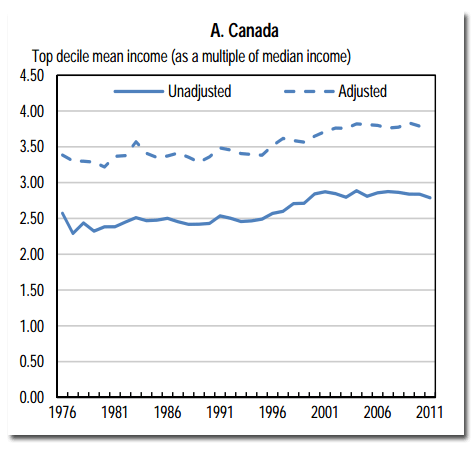
The results? Canada’s top 10% of income earners were previously thought to earn around three times more than median income earners, but the OECD’s new numbers suggest they’re actually earning closer to four times more than those in the middle:

oecd-inequality-canada.png

The same also rings true of top earners around the world.

“The results point to a significant increase of the level of inequality measured by standard statistics based on official figures,” the OECD study concludes.

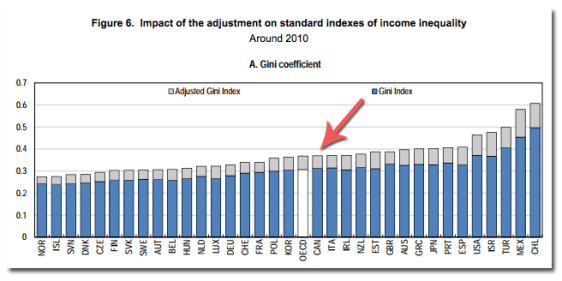
Using the Gini coefficient (a commonly used measure of inequality), the OECD finds inequality in Canada ranks slightly above the average in other OECD countries:

oecd-inequality-world-arrow.png

A 2014 survey commissioned by the Broadbent Institute found Canadians “vastly underestimate how skewed the distribution of wealth actually is.”

Apparently the income gap is bigger than previously thought too.

Photo: Pixabay. Used under Creative Commons license.

Source: OECD Study: The gap between Canada’s rich and poor is significantly bigger than previously thought

How forest management and deforestation are impacting climate

Two new studies reveal how altering the composition of trees in forests is influencing not only the carbon cycle, but air surface temperatures to a significant degree as well. The results highlight how human-made changes to forests hold more severe consequences than previously believed.

Worldwide, reforested areas are increasingly prominent; for example, in Europe, 85% of forests were managed by humans as of 2010. Strong favoritism of foresters to plant more commercially valuable trees – such as Scot pines, Norway spruce and beech – has resulted in reforestation of 633,000 square kilometers of conifers at the expense of broadleaved forests, which decreased by 436,000 square kilometers since 1850.

To gain more insights into the impact of this favoritism, Kim Naudts and colleagues reconstructed 250 years of forest management history using a land-cover model, but also included forest management factors such as changes in tree species.

Their analysis reveals that the conversion of broadleaved forests to coniferous forests caused significant changes in evapotranspiration and albedo, the amount of solar energy reflected from the Earth back into space. These changes, in combination with the release of carbon that is associated with managed forests, are contributing to warming rather than mitigating it. This is happening despite an overall increase in tree coverage. Thus, climate frameworks should account for land management practices in addition to land cover when trying to mitigate warming, the authors say.

A second study describes how changes in global forest cover are affecting the fluxes of energy and water between the land and the atmosphere, and how this process can vary across different forest regions. In the past, the degree to which biophysical effects of deforestation can influence climate have been debated in the scientific community, but these results shed new light on the matter, suggesting that aridness and forest type are important variables.

Such data could better inform climate treaties, the authors, Ramdane Alkama and Alessandro Cescatti, note. Their analysis, based on satellite data of surface temperature and variations in forest cover, reveals that forest clearing is causing an increase in average and maximum surface temperatures, except at the northernmost latitudes.

They note that evapotranspiration plays a key role in how forest clearing impacts temperatures, since arid areas show the strongest warming pattern, followed by the temperate, the tropical, and the boreal zones.

Together, these two studies demonstrate previously unappreciated complexities of the role that forests play in affecting the carbon cycle and air surface temperatures.

pic

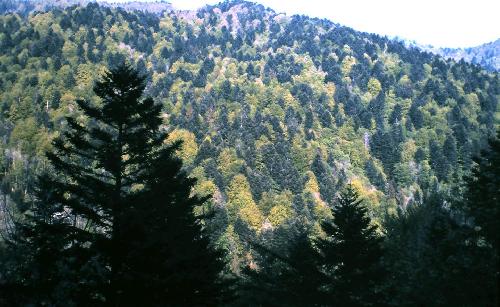
Coniferous (dark green) and broadleaved (light green) trees in summer in Alsace (France) exhibit differences in surface properties. This material relates to a paper that appeared in the Feb. 5, 2016, issue of Science, published by AAAS. The paper, by K. Naudts at Institut Pierre Simon Laplace in Gif-sur-Yvette, France, and colleagues was titled, “Europe’s forest management did not mitigate climate warming.” Credit: Ernst-Detlef Schulze

source: American Association for the Advancement of Science

Source: How forest management and deforestation are impacting climate | Science Codex

Bee virus spread manmade and emanates from Europe

The spread of a disease that is decimating global bee populations is manmade, and driven by European honeybee populations, new research has concluded.

A study led by the University of Exeter and UC Berkeley and published in the journal Science found that the European honeybee Apis mellifera is overwhelmingly the source of cases of the Deformed Wing Virus infecting hives worldwide. The finding suggests that the pandemic is manmade rather than naturally occurring, with human trade and transportation of bees for crop pollination driving the spread.

Although separately they are not major threats to bee populations, when the Varroa mite carries the disease, the combination is deadly, and has wiped out millions of honeybees over recent decades. Varroa feed on bee larvae while the Deformed Wing Virus kills off bees, a devastating double blow to colonies. The situation is adding to fears over the future of global bee populations, with major implications for biodiversity, agricultural biosecurity, global economies, and human health.

The study was funded by the Natural Environment Research Council (NERC) and supported by a Royal Society Dorothy Hodgkin Fellowship. It involved collaborators from the universities of Sheffield, Cambridge, Salford and California, as well as ETH Zurich in Switzerland.

Lead author Dr Lena Wilfert, of the University of Exeter’s Centre for Ecology and Conservation, on the Penryn Campus in Cornwall, said: “This is the first study to conclude that Europe is the backbone of the global spread of the bee killing combination of Deformed Wing Virus and Varroa. This demonstrates that the spread of this combination is largely manmade – if the spread was naturally occurring, we would expect to see transmission between countries that are close to each other, but we found that, for example, the New Zealand virus population originated in Europe. This significantly strengthens the theory that human transportation of bees is responsible for the spread of this devastating disease. We must now maintain strict limits on the movement of bees, whether they are known to carry Varroa or not. It’s also really important that beekeepers at all levels take steps to control Varroa in their hives, as this viral disease can also affect wild pollinators.”

Researchers analysed sequence data of Deformed Wing Virus samples across the globe from honeybees and Varroa mites, as well as the occurrence of Varroa. They used the information to reconstruct the spread of Deformed Wing Virus and found that the epidemic largely spread from Europe to North America, Australia and New Zealand. They found some two-way movement between Europe and Asia, but none between Asia and Australasia, despite their closer proximity. The team also looked at samples from other species suspected of transmitting the disease, including different species of honeybee, mite and bumblebees, but concluded that the European honeybee was the key transmitter.

Professor Roger Butlin, Professor of Evolutionary Biology at the University of Sheffield, said: “Our study has found that the deformed wing virus is a major threat to honeybee populations across the world and this epidemic has been driven by the trade and movement of honeybee colonies.

“Domesticated honeybee colonies are hugely important for our agriculture systems, but this study shows the risks of moving animals and plants around the world. The consequences can be devastating, both for domestic animals and for wildlife. The risk of introducing viruses or other pathogens is just one of many potential dangers.”

Senior author Professor Mike Boots of Exeter and UC Berkeley concluded: “The key insight of our work is that the global virus pandemic in honeybees is manmade not natural. It’s therefore within our hands to mitigate this and future disease problems.”

source: University of Exeter

Source: Bee virus spread manmade and emanates from Europe | Science Codex

Relief rally pushes TSX, loonie higher

Strengthening oil prices sent North American stock markets higher while also helping the commodity-sensitive Canadian dollar briefly punch through the 70-cent U.S. mark Thursday.

At mid-afternoon, the loonie added 0.89 of a U.S. cent to 69.9 cents U.S. after cresting above 70 cents earlier in the day — more than a full cent higher than its Wednesday close. The Canadian dollar hasn’t closed above 70 cents U.S. in more than a week.

The Toronto Stock Exchange’s S&P/TSX composite index was up 120.09 points at 11,963.20 as the March contract for benchmark crude oil rose $1.13 or almost four per cent to US$29.48 a barrel. The oil subsector was the biggest advancer on the TSX, up 4.39 per cent.

The increase in oil prices came despite a report showing a big jump in U.S. oil inventories last week, up four million barrels versus the 2.2 million that had been expected.

Strength in energy issues also led gains in New York, where markets were mixed. The Dow Jones industrial average rose 81.09 points to 15,847.83 after losses Wednesday, while the broader S&P 500 added 4.79 points to 1,864.12 and the Nasdaq fell 5.57 points to 4,466.12.

Elsewhere in commodities, the February contract for natural gas was unchanged at US$2.12 per mmBtu, while February gold fell $4.10 to US$1,102.10 an ounce and March copper rose three cents to US$1.99 a pound.

Besides the boost from oil prices, markets were also encouraged by remarks from the head of the European Central Bank, Mario Draghi, who said the bank would consider using more stimulus measures for the European economy at its next meeting in March.

Source: Relief rally pushes TSX, loonie higher | Toronto Star