Tomb in China Yields Ancient Game Board and Pieces

A broken game board and several pieces have been recovered in an ancient tomb in China already known to have been heavily looted over the countless centuries it has been in existence.

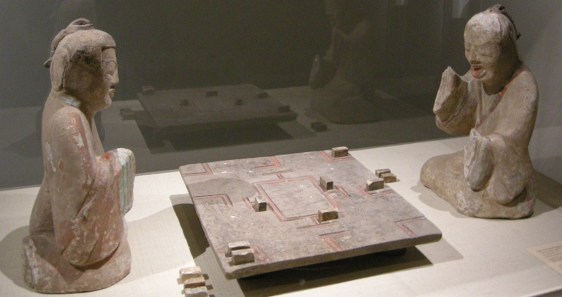
The 2,300 year old tomb was ostensibly built for aristocrats from the nearby Qingzhou City and the ancient Chinese state known as Qi. The pieces discovered by archaeologists include 21 rectangular numbered tokens, a large broken tile that once comprised the game board, and a single 14-sided die made from animal tooth. The board itself, once reconstructed, had at one time been decorated with a stylized pattern of clouds and thunderbolts, with a pair of eyes in the center, while the die had been numbered in “seal script”, an ancient type of Chinese writing, on 12 of its faces; the remaining two faces were left blank.

Researchers believe that the recovered pieces were part of an ancient game referred to as “bo” or “liubo”. The rules of the game have been lost to antiquity, as Bo fell out of favor around 1,500 years ago. While the rules are likely to have changed significantly over the centuries, a 2,200 year old poem attributed to the author Song Yu describes a chess or checkers-like game where two players faced off against each other, pieces were “kinged” and points were earned.

The massive scale of the tomb that the pieces were found in is likely part of the reason why the game board and pieces have survived to this day. Over centuries the tomb has been robbed thoroughly according to the archaeologists involved in the discovery, with more than 25 shafts dug into the tomb by those looking to loot the graves within. Countless cultural treasures have disappeared from the coffin chamber, which has been severely damaged by the process, yet the sheer size of the tomb likely led to grave robbers overlooking the game pieces – or perhaps simply dismissing them as worthless. The tomb itself is thought to have claimed the life of at least one looter who attempted to make off with any precious artifacts to be had, as the research team discovered the skeletal remains of an unidentified individual within one of the sunken shafts used to plunder the tomb. It is still to be determined when the tomb robber died, the circumstances surrounding his or her death, or even the age and gender of the individual.

The initial excavation of the tomb was conducted in 2004. Archaeological teams from the Shandong Provincial Institute of Cultural Relics and Archaeology as well as the Qingzhou Municipal Museum participated in the dig, with the results of the excavation initially reported in the Chinese-language journal Wenwu in 2014. An English-language version of the article was recently published in the journal Chinese Cultural Relics, which is available here

Photos of some of the artifacts excavated from the tomb can be found here

Image courtesy of Wikimedia Commons user: sailko

Source: Tomb in China Yields Ancient Game Board and Pieces

Black Tea May Protect Bone Health for Elderly

While everyone continues to go wild for coffee, in some countries tea is considered a necessity of life. It’s a beverage that can make you feel relaxed, or wake you up when you need an extra push to get through the day.

Besides from simply being enjoyable, a recent study published in the American Journal of Clinical Nutrition suggests that drinking three cups of tea per day may cut down on the risk of fragile bones among the elderly, as well as reduce the risk of illnesses such as cancer and heart disease.

Researchers from the Sir Charles Gairdner Hospital in Perth, the Royal Perth Hospital and the Flinders University of South Australia in Adelaide, studied approximately 1,200 women in their seventies over a 10-year period who drank black tea. They closely monitored subjects for signs of fractures caused by osteoporosis.

During this period 288 women — nearly a third — had fallen and broken a bone, with nearly half of those injuries involving a hip fracture. The results indicated that women who drank three or more cups of tea every day were 30 percent less likely to have suffered a bone break, as compared to those who drank less than one cup of tea per week.

Researchers also noted that even one cup of tea per week can reduce the risk of fracture by 9 percent. Findings were linked to powerful flavonoids in black tea that contain antioxidants.

Black tea comes from the same plant as white and green tea, yet it’s flavonoid profile is not the same. During the growth process, black tea develops different types of flavonoids, containing antioxidant traits that may help prevent heart disease and some cancers. However, further research is needed to support this theory.

One in three women will develop osteoporosis in their lifetime. Women most at risk are those who use steroids, take drugs, drink alcohol excessively or have a family history of the disease.

As the U.S. population ages, the number of of people suffering hip fractures annually is expected to rise to 250,000, according to Centers for Disease Control and Prevention.

Source: Black Tea May Protect Bone Health for Elderly – American Council on Science and Health

British PM ‘Wants Syrian Airstrikes Within Two Weeks’

David Cameron’s new push for support from MPs comes as the Chancellor unveils plans to buy 138 stealth fighter jets for £12bn.

David Cameron is launching a final attempt to win backing for airstrikes in Syria – with MPs expected to vote in the Commons within the next fortnight.

The first bombing raids against Islamic State would begin within hours of a “yes” vote, The Sunday Times has reported.

Mr Cameron is to start privately warning MPs that the UK needs to act like “Churchill not Chamberlain” if it wishes to defeat terrorism.

Downing Street sources told the newspaper that Mr Cameron is preparing a seven-point plan for military intervention, including a blueprint for Syria’s future.

This report would be in response to the findings of the influential Commons Foreign Affairs Committee, which warned against military involvement until there was an international strategy in place to end the conflict.

The Prime Minister’s push for airstrikes comes as the Chancellor plans to announce that Britain is purchasing 138 stealth fighter jets in a £12bn deal.

In an interview with The Sunday Times, George Osborne said the investment will ensure the UK has the world’s second most potent carrier strike force after the United States, with the resources to tackle IS and other extremist groups for a generation.

The purchase, which goes far beyond what military experts expected, is reportedly the centre piece of the Government’s strategic defence review, to be published on Monday.

However, the Navy is likely to suffer considerable scale-backs. Two existing warships are to be pulled off front line duty, and plans to field a fleet of 13 brand-new frigates are being watered down on cost grounds, according to the newspaper.

On Monday, David Cameron is meeting French President Francois Hollande for talks on how to tackle IS in Iraq and Syria.

This gathering follows the unanimous UN backing of France’s call to redouble action against the extremist group following the Paris attacks – however, the resolution passed does not provide any legal basis for an intervention.

A ComRes poll performed for the Sunday Mirror and The Independent On Sunday suggested that 46% of Britons believe the UK should participate in airstrikes against IS – with or without UN approval. However, 32% of those surveyed disagree.

In a speech to activists in Bristol on Saturday, Jeremy Corbyn appeared to rule out military intervention in Syria – but MPs within his own party have warned it would be “deplorable” if Labour failed to back in the Government in a Commons vote.

Source: PM ‘Wants Syrian Airstrikes Within Two Weeks’

New footage of TV’s ‘first’ interracial kiss

By Sheena McKenzie for CNN

(CNN) –Six years before Capt. Kirk and Lt. Uhura locked lips on “Star Trek” in what is often credited as TV’s first interracial kiss, another couple were pushing boundaries

Newly uncovered footage from the British Film Institute (BFI) shows a black man and a white woman kissing in a televised play of “You in Your Small Corner,” in 1962.

In 1960s Britain such displays of affection were unheard of on the small screen, and the institute believes this is not just the earliest interracial kiss on British TV — but possibly the world.

The play aired years before the famous 1968 “Star Trek” scene starring William Shatner and Nichelle Nichols — believed to be the first interracial kiss on U.S. TV.

The footage was found in the BFI’s National Archive during research for an upcoming event on race and romance in television.

It also came two years before actors John White and Joan Hooley embraced on “Emergency Ward 10” in what was previously thought to be the UK’s first interracial kiss, in 1964.

“This ground-breaking TV play is such an important re-discovery. A document of British social history, it demonstrates the role of progressive television drama as a reflection of our society,” said BFI Creative Director, Heather Stewart.

“Fifty years on, diverse on-screen representation is still an urgent issue and we must continue as an industry to effect much-needed change.”

Written by Jamaican-born playwright Barry Reckord, “You in Your Small Corner” was originally staged at the Royal Court and was televised live on ITV, airing just the once.

It features the playwright’s brother Lloyd Reckord as an immigrant arriving from Jamaica to Brixton in south London, where he stays with his mother before going to study at Cambridge University.

During that time, he strikes up an intimate relationship with a young white woman, played by Elizabeth MacLennan.

Source: New footage of TV’s ‘first’ interracial kiss | News – Home

Dominant at 30 years old, but is the Windows OS future bleak?

James Nunns         November 20 2015

Microsoft’s Windows Operating System is 30 years and it is still dominating the desktop OS market.

Combined, its operating systems total 88.55% of current desktop market share, according to Netmarketshare.

Windows 7 dominates with 57.79% of the market, while its latest OS Windows 10 accounts for 1.87%.

The dominance is clear but to highlight it further, the largest slice of the pie that doesn’t go to Microsoft is only 4.18% from Mac OS X 10.10.

It seems that age has not dampened its appeal to the market as it remains typically the default choice for businesses and consumers.

Released on the 20th of November 1985, Windows 1.0 sold 500,000 copies in just under two years, part of the foundation for success can be attributed to its price compared to its competitor Apple. Windows 1.0 came in at $99, while Apple’s Lisa OS cost around $10,000.

Dan Ulzhoefer, CEO, UI Centric said: “Windows was the first platform to truly realise the dream of the personal computer. The idea that every person could have access to their own programmable computing device is now at the heart of our relationship with technology today.”

Although use of its OS seems to be ubiquitous there have been bumps in the road. Microsoft would probably rather forget about problems with Vista and Windows 8.

Windows Vista attempted to fix some of the security problems that persisted on XP, however, compatibility issues with applications resulted in slow uptake.

In the end the company has focused on making the end user more productive, simplifying tasks that were once perhaps cumbersome and building a cross-platform strategy with Windows 10.

Challenging across platforms, the company faces stiff competition from the likes of Apple with its iPad Pro, a potential replacement for the laptop and, with PC sales continuing to decline, the future may not be rosy for the OS.

Chipping away at Microsoft’s desktop dominance, Mac OS X grew from a 3.68% marketshare in 2014 to 4.18% in 2015. While minimal compared to the market share of Windows, Apple is making in-roads little by little.

Windows 10 could potentially be the last version, with Microsoft employee Jerry Nixon saying: “Right now we’re releasing Windows 10, and because Windows 10 is the last version of Windows, we’re all still working on Windows 10,” during the Ignite conference in may.

At least it could be the end of Windows in its current format, as rolling updates replace versions; the next step could be for it simply to be called Windows.

The future, with the rise of cloud, could perhaps see Windows-as-a-Service, with the OS becoming something based on a pay-as-you-go model.

Source: Enterprise IT/Software