Electric buses too costly and complex, Metro Tasmania says

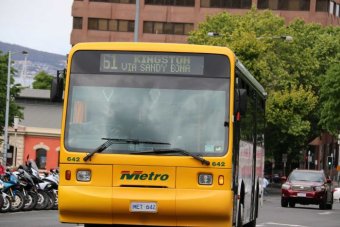
State-owned public transport operator Metro Tasmania has ruled out investing in electric buses until the technology improves and becomes cheaper.

Metro chairwoman Lynn Mason told a Government business enterprise scrutiny hearing that it was preparing a long-term carbon reduction plan, but could not afford to buy any electric buses.

The business, which operates at least 218 public buses across the state, is instead considering replacing some of its diesel-fuelled fleet with hybrid buses.

Ms Mason told the hearing an Adelaide bus company had paid about $1 million for an electric bus as part of a trial, double the amount the average bus costs Metro Tasmania.

“We simply could not afford to embark on that kind of experimental technology until it’s far more reliable, we’re confident that it’s suitable to our particular terrain, and the price comes down,” she said.

The State Opposition promised to invest $10 million in electric vehicles, if it wins the next election, including retro-fitting public buses to run on electricity.

Infrastructure Minister Rene Hidding described the policy during today’s hearings as “voodoo economics”.

Metro Tasmania has recently purchased 11 second-hand buses from Melbourne airport to service routes in Burnie.

Payments to government defended

Earlier, the Motor Accidents Insurance Board (MIAB) fronted the parliamentary scrutiny hearings.

The State Opposition and the Greens questioned how the business could afford to pay more to the State Government when profits had decreased.

The board upped its contribution to the Government from half of its average after-tax profits over the last four years to 60 per cent, as well as providing a one-off special dividend of $100 million during the last financial year.

MAIB chairman Don Challen told the committee the board was confident it would be able to meet all claims from people injured on Tasmania’s roads after paying increased dividends to the Government.

“I’ve got total confidence we will be able to meet our liabilities with no concern,” he said.

“We would not have recommended these dividends unless we were totally comfortable.”

Source: Electric buses too costly and complex, Metro Tasmania says – ABC News (Australian Broadcasting Corporation)

Vote on UK airstrikes in Syria to take place on Wednesday

A Commons debate and vote on whether to launch UK airstrikes against Islamic State in Syria will take place on Wednesday, David Cameron has said.

It comes after Labour leader Jeremy Corbyn offered his MPs a free vote on the PM’s proposal to begin strikes.

Mr Corbyn opposes the strikes but has decided not to force his MPs to also vote against the proposal.

Source: Vote on UK airstrikes in Syria to take place on Wednesday

Consumer sentiment slides for second week in success – decline tempered by more positive sentiment in residential

c7b6bc28-5306-484c-a3d8-9d8998ff23c8
Bloomberg Nanos Weekly Consumer Confidence Tracking

Consumer sentiment slid for the second week in succession in the Bloomberg Nanos Canadian Consumer Confidence Index.

“Although sentiment on job security and the future strength of the Canadian economy slid, it was partially offset by more positive sentiment on the future value of residential real estate”, said Nanos Research Group Chairman Nik Nanos.

“There is obvious slack in the economy that will likely take considerable time to work out across the regions and sectors. Because non-energy exports (rather than household consumption) are expected to be the leading contributor to GDP over the next two years, households might be factoring in the uncertainty of external demand as the main engine of growth,” said Robert Lawrie of Bloomberg Economics.

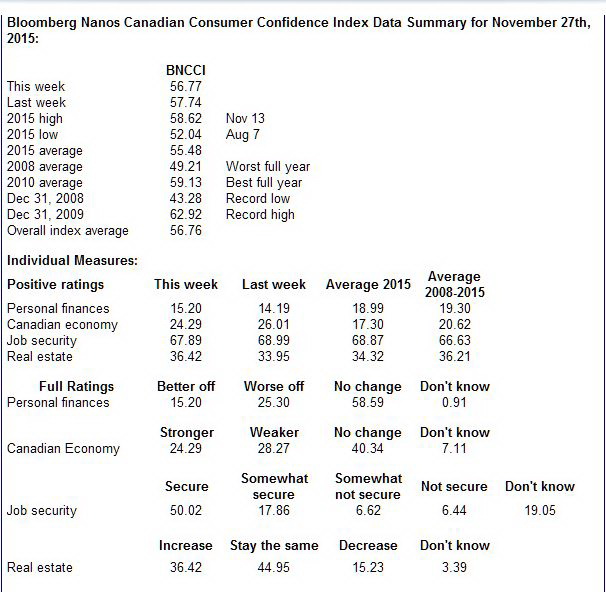
The BNCCI, a composite of a weekly measure of financial health and economic expectations, registered at 56.77 compared with last week’s 57.74. The twelve month high stands at 58.62.

The Bloomberg Nanos Pocketbook Index is based on survey responses to questions on personal finances and job security. This sub-indice was at 59.24 this week compared to 59.65 the previous week. The Bloomberg Nanos Expectations Index, based on surveys for the outlook for the economy and real estate prices, was at 54.30 this week (compared to 55.83 last week).

The average for the BNCCI since 2008 has been 56.76 with a low of 43.28 in December 2008 and a high of 62.92 in December 2009. The index has averaged 55.48 this year.

To view the weekly tracking visit our website.

Methodology

The BNCCI is produced by the Nanos Research Corporation, headquartered in Canada, which operates in Canada and the United States. The data is based on random telephone interviews with 1,000 Canadian consumers (land- and cell-lines), using a four week rolling average of 250 respondents each week, 18 years of age and over. The random sample of 1,000 respondents may be weighted by age and gender using the latest census information for Canada and the sample is geographically stratified to be representative of Canada. The interviews are compiled into a four week rolling average of 1,000 interviews where each week, the oldest group of 250 interviews is dropped and a new group of 250 interviews is added. The views of 1,000 respondents are compiled into a diffusion index from 0 to 100. A score of 50 on the diffusion index indicates that positive and negative views are a wash while scores above 50 suggest net positive views, while those below 50 suggest net negative views in terms of the economic mood of Canadians.

A random telephone survey of 1,000 consumers in Canada is accurate 3.1 percentage points, plus or minus, 19 times out of 20.

All references or use of this data must cite Bloomberg Nanos as the source.

nanos30nov15

Are Global warming alarmists wrong?

Man-made climate change is complete BS. Every single one of these climate summits is a total waste of time.

Global warming alarmists have been proven spectacularly wrong time and time again. So why should we believe them now?

Watch this video to discover the real agenda behind the Paris climate summit.


Source: Global Warming is a Crock of Sh*t | Exposing Modern Mugwumps

Tarn lake in the Himalayas

Saturday, November 28, 2015, 6:32 PM – The lakes that have formed near Mount Everest could posed a threats to nearby communities if they continue to grow.

In the Himalaways, on the surface of the Khumbu glaciers, tarns or glacier lakes like the one featured in the video above have been forming. As of late, they have been expanding and merging into larger lakes.

http://c.brightcove.com/services/viewer/federated_f9?isVid=1&isUI=1

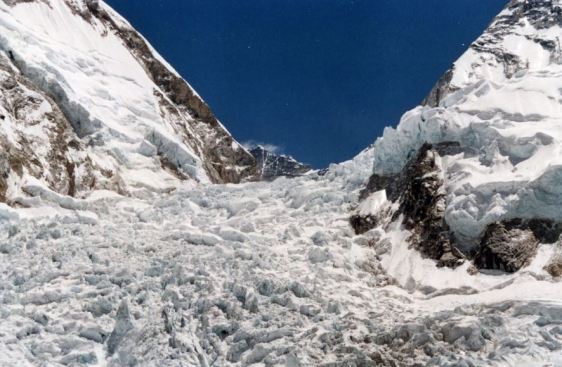
The Khumbu glacier, including the infamous Khumbu Icefall, is part of the path climbers cross to reach the peak of Mount Everest.

Experts are now warning that the glacier is melting at an accelerated rate and the overflow could eventually lead to flooding endangering those that are caught downstream of it.

//platform.twitter.com/widgets.js

After the Earthquake

Scientists made these discoveries after visiting the sector for the first time since a powerful earthquake struck the region earlier this year.

“A decade or so ago, there were individual ponds on the Khumbu glacier but in the past five years or so they have begun to get larger and join up,” Ann Rowan told the BBC. “Particularly, on the left hand side of the lower reaches of the glacier, there is a series of about seven or eight large ponds that are now starting to link and form a big chain.”

Dr. Rowan’s team has been studying the area, looking at pictures of the site since the year 2000 as well as field visits for the last six years.

Source: BBC

Source: Tarn lake in the Himalayas