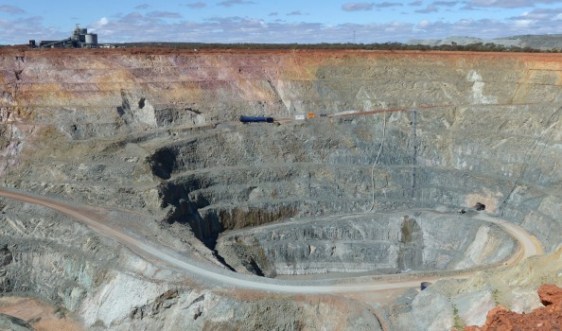
The close: TSX falls as oil plummets

Canadian stocks dropped on Monday, joining a rout in commodities prices as iron ore slumped below $40 a metric ton and oil extended a sell-off after OPEC on Friday effectively abandoned its production target.

The S&P/TSX Composite Index fell 315.94 points, or 2.37 per cent, to 13,042.83 in Toronto, the most in two months. The gauge has declined for two consecutive weeks and has lost more than 10 per cent so far this year.

Canada’s oil-sensitive loonie dropped 0.85 of a cent from Friday’s close to 73.99 cents (U.S.).

The dollar last closed below 74 cents U.S. on June 23, 2004.

Energy-related shares dropped 5.9 per cent as crude extended losses below $38 a barrel in New York. The drop followed speculation that Organization of Petroleum Exporting Countries move would prolong a record global glut.

Raw-materials producers lost 3.3 per cent as iron ore dipped below $40 on weakening demand in China and rising low-cost supply from the world’s top miners. Raw material and energy companies together make up about 30 per cent of the Canadian benchmark and have lost at least 20 per cent year to date.

A volatility gauge for 60 of the largest, most liquid Canadian stocks jumped 12 per cent after falling for three consecutive weeks.

The Bloomberg Commodity Index, a basket of prices for natural resources from copper to oil and gold, dropped 1.6 per cent. The gauge has slumped 23 per cent this year.

Hudbay Mineral Inc., First Quantum Minerals Ltd. and Teck Resources Ltd. sank at least 9.4 per cent as copper futures and gold fell by more than 1 per cent in New York. Penn West Petroleum Ltd. fell 18.5 per cent, its biggest drop in more than three months as energy stocks retreated. Paramount Resources Ltd. and Baytex Energy Corp. fell at least 16.5 per cent. Energy companies dropped 28 per cent this year.

As crude declined, Canadian airlines jumped on the cheaper oil prices. Air Canada gained 2.6 per cent while WestJet Airlines Ltd. gained 0.9 per cent. Macquarie Research also upgraded WestJet to the equivalent of buy from neutral.

Also among the S&P/TSX’s best performers, ProMetic Life Sciences Inc. rose 6.6 per cent. The bio-pharmaceutical company said its a trial for a coagulation disorder drug met safety metrics, while patients showed an immediate therapeutic response.

U.S. stocks retreated as tumbling oil prices weighed on energy and raw-material companies, sparking a sell-off after equities posted their biggest one-day gain in three months.

The S&P 500 fell 0.7 per cent to 2,077.15 in New York, trimming an earlier drop of as much as 1.2 per cent, after jumping 2.1 per cent on Friday.

Tthe Dow Jones industrial average fell 115.91 points, or 0.65 per cent, to 17,731.72, while the Nasdaq Composite dropped 40.46 points, or 0.79 per cent, to 5,101.81.

“Equity markets have basically treaded water this year as economic data has been fairly weak, particularly as it relates to the global scene,” said Kevin Caron, a market strategist and portfolio manager who helps oversee $170-billion at Stifel Nicolaus & Co. in Florham Park, NJ. “As we come into this period of time where the Fed is going to begin raising interest rates, we continue to be confronted with slow global growth, which is going to continue to be a challenge.”

U.S. stocks are coming off their most volatile week since the summer as investors were faced with releases from the Labor Department, the European Central Bank and speeches by Federal Reserve Chair Janet Yellen. The S&P 500’s rally on Friday left it little changed for a second straight week after a report showed U.S. employers added more jobs than forecast in November, increasing speculation that the economy is strong enough to withstand higher borrowing costs — something that  Ms. Yellen has signalled.

Traders are pricing in a 78-per-cent chance of liftoff before the Fed’s interest-rate decision on Dec. 16. Investors will have little data this week to assess the strength of the economy. Reports on retail sales, a measure of producer prices and the University of Michigan’s preliminary consumer sentiment index are due, though not until the end of the week.

“Weak oil is the story today,” said Stephen Carl, principal and head equity trader at Williams Capital Group LP. “The lack of economic numbers today is compounding the effect of energy losses. The Fed rate hike is imminent, and people are trying to square up heading into year-end.”

Crude oil futures tumbled 6 per cent on Monday, reaching their lowest in nearly seven years, after OPEC failed to address a growing supply glut, while a stronger dollar made it more expensive to hold crude positions.

Brent and U.S. crude settled at or near February 2009 lows in belated reaction to the OPEC policy meeting on Friday which ended without an agreement to lower production.

OPEC oil ministers dropped any reference to the group’s output ceiling for the first time in decades, highlighting disagreement among members about how to accommodate Iranian barrels once Western sanctions are lifted.

“What matters from here is whether there’ll be any meaningful production cuts in the U.S., which don’t seem to be coming,” said Doug King, chief investment officer in London for the Singapore-based Merchant Commodity Fund. As of Monday, the $220 million hedge fund was flat on the year after its bearish oil views helped it recoup a 10-per-cent loss through November.

“Price-wise, the market could be going for max pain after this,” Mr. King said. “The leader to the downside will be probably be WTI, because that’s where the production cuts have to come.”

WTI, the West Texas Intermediate benchmark for U.S. crude , settled down $2.32 at $37.65 a barrel. That was its lowest settlement since February 2009, and after reaching a session low of $37.50.

Brent, the global crude benchmark, settled down $2.27 at $40.73, after striking a February 2009 low of $40.60.

WTI forward contracts through 2024 all dropped below $60 a barrel.

Source: The close: TSX falls as oil plummets – The Globe and Mail

‘Game of chess’ could see CP Rail boost bid up to US$35.8 billion, says analyst

MONTREAL – Canadian Pacific Railway has room to raise its bid for one of America’s largest railways by nearly US$8 billion, or as much as 26 per cent, an industry observer says.

The company has said its initial offer for Norfolk Southern, which would create the biggest railway in North America, was just a starting point. Scotiabank analyst Turan Quettawala said the Calgary-based railway can go as high as US$120 per share in cash and stock or US$35.8 billion.

“If Norfolk Southern’s board is willing to play ball, it will definitely have to be at a price which is above the approximately US$95 (per share) which CP has suggested so far,” he wrote in a report Monday.

The Virginia-based railway rejected CP Rail’s (TSX:CP) offer Friday as “grossly inadequate.” It also assailed CP’s “cut-to-the-bone strategy” and suggested the U.S. regulator is unlikely to approve a takeover deal at any price.

Canadian Pacific CEO Hunter Harrison and activist investor Bill Ackman of Pershing Square Capital are scheduled to hold a conference call Tuesday morning to respond in detail and “correct every inaccuracy” raised, the railway says.

Quettawala described the takeover battle as a “game of chess.”

Moving first with a takeover bid is risky, but it puts CP Rail in a commanding position to benefit from any consolidation in the rail industry by choosing a target that will deliver the most savings and offering concessions that could win regulatory approval, he wrote.

He also questioned whether the deal would lead to other mergers.

“If this were to be the only merger, then it may end up being the deal of the century in the railway world.”

While U.S. regulatory approval is uncertain, Quettawala said there is a low risk of Canada objecting. But that could change, he said, if CP is required during negotiations to make concessions, move the headquarters to the U.S. or change the company’s name.

The combined company would initially have more than 44,000 employees with about 53,000 kilometres of track — greater than the circumference of the Earth — stretching from the Pacific to the Atlantic Ocean and south to the Gulf of Mexico.

Already, some U.S. politicians have expressed their opposition to the deal.

Democratic U.S. Sen. Amy Klobuchar and Republican Sen. David Vitter have introduced legislation to repeal a measure that prevents the Justice Department from blocking the merger, even in cases where a merger is determined to harm competition. Currently, the department only has an advisory role, Klobuchar said in a letter to the attorney general and head of the Surface Transportation Board.

Klobuchar said increased prices and diminished service have “burdened” the shipping industry and those that rely on freight rail. She said that’s costly for her state of Minnesota, which is the third largest for agricultural exports.

Source: Business News | TMXmoney | ‘Game of chess’ could see CP Rail boost bid up to US$35.8 billion, says analyst

Copper shorts suggest metal oversold, says Citi

Teck Resources Stock Plummets Further Monday

Dec 8 2015 at 6:53 AM  by Luzi Ann Javier

Copper bears may have gone too far this time.

Money managers are holding the biggest net-short position in two years in copper futures traded in New York, US government data show. Total bearish wagers doubled last month, approaching a record set in August even as prices have dropped more than 10 per cent since then.

Now, Citigroup says the metal may be “oversold” and that the near-record short position could exacerbate price swings in 2016.

Net-short positions in copper futures and options surged in the past five weeks to 36,893 contracts, the most since April 2013, when they reached an all-time high, according to the Commodity Futures Trading Commission data Friday. On the London Metal Exchange, money managers trimmed their net-long positions for five straight weeks, while in Shanghai, the 20 largest brokers are cutting their bullish bets, according to exchange data.

“Copper prices across most major exchanges appear oversold in our view, as funds continue to pile-on short positions,” Citigroup analysts including Aakash Doshi and David Wilson, wrote in a report Monday. “The dangers of being too short could expose highly levered retail investors to margin calls and exacerbate copper price volatility into 2016.”

Copper futures for March delivery fell 1.4 per cent to $2.0490 a pound at 2.14 p.m. on the Comex in New York. Benchmark copper on the London Metal Exchange earlier ended 1.2 per cent down at $US4557 a tonne.

Prices on the Comex have plunged 27 per cent this year, poised for a third annual loss, the worst streak since 1998, as demand concerns mount amid the slowest economic growth in a generation in China, the world’s largest user of the metal. Adding to copper’s woes is the strengthening dollar, buoyed by the outlook for rising interest rates in the US. The deteriorating emerging-markets outlook has helped push copper lower “despite price-supportive mine-supply disruptions, closures” and cuts to capital spending, Citi said.

In 14 of the 20 trading days in November, Comex copper’s 14-day relative strength index was below 30, a level viewed by some traders who study charts as a signal the security is oversold and is poised to rebound. The RSI was at 36 on Monday.

A gauge of the largest base-metals producers tracked by Bloomberg Intelligence fell to the lowest since 2008 on Monday, led by Teck Resources and Freeport-McMoRan. Supply reductions may help buoy prices. Glencore and Freeport are among miners that have said they’re

Source: Copper shorts suggest metal oversold, says Citi | afr.com

Sweetening of the global diet, particularly beverages: patterns, trends, and policy responses

Feature_151201

Summary

Evidence suggests that excessive intake of added sugars has adverse effects on cardiometabolic health, which is consistent with many reviews and consensus reports from WHO and other unbiased sources.

74% of products in the US food supply contain caloric or low-calorie sweeteners, or both. Of all packaged foods and beverages purchased by a nationally representative sample of US households in 2013, 68% (by proportion of calories) contain caloric sweeteners and 2% contain low-calorie sweeteners.

We believe that in the absence of intervention, the rest of the world will move towards this pervasiveness of added sugars in the food supply.

Our analysis of trends in sales of sugar-sweetened beverages around the world, in terms of calories sold per person per day and volume sold per person per day, shows that the four regions with the highest consumption are North America, Latin America, Australasia, and western Europe.

The fastest absolute growth in sales of sugar-sweetened beverages by country in 2009–14 was seen in Chile.

We believe that action is needed to tackle the high levels and continuing growth in sales of such beverages worldwide. Many governments have initiated actions to reduce consumption of sugar-sweetened beverages in the past few years, including taxation (eg, in Mexico); reduction of their availability in schools; restrictions on marketing of sugary foods to children; public awareness campaigns; and positive and negative front-of-pack labelling.

In our opinion, evidence of the effectiveness of these actions shows that they are moving in the right direction, but governments should view them as a learning process and improve their design over time.

A key challenge for policy makers and researchers is the absence of a consensus on the relation of beverages containing low-calorie sweeteners and fruit juices with cardiometabolic outcomes, since decisions about whether these are healthy substitutes for sugar-sweetened beverages are an integral part of policy design.

Report: PDF (754 KB)

Source: Sweetening of the global diet, particularly beverages: patterns, trends, and policy responses – The Lancet Diabetes & Endocrinology

Smoking: Is The Fault In Our Genes?

DNA

A new study finds that people with a particular version of a gene involved in the brain’s reward system are more likely to succeed in quitting smoking.

Compared with people who have other versions of this gene, those with the lucky DNA were also more likely to abstain from cigarettes. The study in Translational Psychiatry was a meta-analysis (a review of other studies) and supports a role for heredity, i.e., genotype, in the likelihood that someone will become a smoker and how difficult it will be, once starting to smoke, to eventually quit.

The primary objective was to determine whether the variant  DRD2/ANKK1 gene Taq1A has any effect on smoking cessation. ANKK1 happens to be next to the DRD2 gene, which helps the brain recognize dopamine, the chemical that’s produced in the brain to reinforce useful behaviors like eating and having sex. Addictive drugs, including nicotine, also cause dopamine levels to spike.

People inherit either an A1 or A2 version of this gene fragment from each of their parents. That means there are three possible genotypes: two A1s, two A2s or one of each. When it comes to quitting smoking, the helpful type is A2/A2. Those with two A2s had better odds of kicking the habit than those with one or two A1s.

Their literature survey consisted of 9,487 Caucasians (an obvious limitation.) Using statistical and epidemiological techniques, they determined that Taq1A A1/ genotypes were significantly associated with smoking cessation. They found an approximately 22 percent higher rate of smoking cessation among the study subjects with the A2A2 variant in the dopamine receptor gene Taq1A.

It is unclear how many smokers, or how many Americans, carry this particular gene variant. Given the fact that even if one carries this trait, the benefit (in the 22 percent better chance of quitting) is not so large as to confer any reliable hope of getting your genes to help you quit. Fortunately, this is a problem going out of existence and we are proud we have helped for 37 years. CDC data show that the smoking rate for both adults and teens in the U.S. is declining but the dire consequences of smoking make me want to remind everyone that it’s better not to rely on lucky genes – the best way to “quit” is to never start! Once addicted to nicotine and smoking, it is very difficult to quit, whatever your genome.

This study is interesting from a “personalized medicine” point of view and for those studying pharmacogenetics but for the rest of us, let me repeat: the fault (smoking) is in ourselves, not in our stars, nor in our genes.

Source: Smoking: Is The Fault In Our Genes? – American Council on Science and Health