Researchers Create Light-Driven Submersible Nano machines

U.S. scientists have created UV light-driven, single-molecule submersibles. Image credit: Loic Samuel / Rice University.

A team of researchers from North Carolina State University and Rice University has created UV light-driven, unimolecular ‘submarines’ that contain just 244 atoms.

Each of the nanomachines has a motor powered by UV light. With each full revolution, the motor’s tail-like propeller moves the machine forward 18 nm.

And with the motors running at more than a million RPM, that translates into speed.

“These are the fastest-moving molecules ever seen in solution,” said Prof. James Tour of Rice University in Houston, Texas, senior author of a study published this month in the journal Nano Letters.

The study proves molecular motors are powerful enough to drive the sub-10-nm submarines through solutions of moving molecules of about the same size.

“This is akin to a person walking across a basketball court with 1,000 people throwing basketballs at him,” Prof. Tour explained.

The motors of these nanomachines operate more like a bacteria’s flagellum than a propeller and complete each revolution in four steps.

“When excited by light, the double bond that holds the rotor to the body becomes a single bond, allowing it to rotate a quarter step. As the motor seeks to return to a lower energy state, it jumps adjacent atoms for another quarter turn. The process repeats as long as the light is on,” the researchers explained.

For comparison tests, they made nanosubmarines with no motors, slow motors and motors that paddle back and forth.

All versions of the nanomachines have pontoons that fluoresce red when excited by a laser.

“One of the challenges was arming the motors with the appropriate fluorophores for tracking without altering the fast rotation,” said Victor García-López, a graduate student at Rice University and lead author on the study.

The researchers then measured how well their nanomachines moved. “We had used scanning tunneling microscopy and fluorescence microscopy to watch our cars drive, but that wouldn’t work for the submersibles. They would drift out of focus pretty quickly,” Prof. Tour said.

The team sandwiched a drop of diluted acetonitrile liquid containing a few nanosubmarines between two slides and used a custom confocal fluorescence microscope to hit it from opposite sides with both UV light and a red laser.

“The laser defined a column of light in the solution within which tracking occurred,” García-López said.

The team hopes future submersible nanomachines will be able to carry cargoes for medical and other purposes.

Source: Researchers Create Light-Driven Submersible Nanomachines | Chemistry, Nanotechnologies | Sci-News.com

Scientists Develop LDL Cholesterol-Lowering Vaccine

This image shows that high levels of active PCSK9 gene (green color) prevent LDL cholesterol (red color) from binding to the surface of liver cells. Image credit: Rockefeller University.

A new virus-like particle-based vaccine leads to dramatic reductions in ‘bad’ LDL cholesterol in mice and macaques, says a team of scientists led by the University of New Mexico and NIH’s Lung and Blood Institute.

LDL (low-density lipoprotein) cholesterol, also known as ‘bad’ cholesterol, makes up the majority of the body’s cholesterol.

A high LDL cholesterol level is considered a risk factor for coronary artery disease because, under certain conditions, it can cause hardening of the arteries.

According to the CDC, 73.5 million adults (31.7%) in the United States have high LDL cholesterol and fewer than 1 out of every 3 adults (29.5%) with high LDL cholesterol has the condition under control.

Diet and exercise are key to keeping cholesterol down, but millions of people worldwide take statins, a family of medications that lower cholesterol. Even more important, statins lower the chances of having a heart attack or stroke. They include atorvastatin, fluvastatin, lovastatin, pitavastatin, pravastatin, rosuvastatin, and simvastatin.

However, they have some potentially serious side effects, such as muscle pain, an increased risk of diabetes and cognitive loss.

The newly developed vaccine could provide an alternative to statins, by targeting a protein that controls cholesterol levels in the blood.

“One of the most exiting things about this new vaccine is it seems to be much more effective than statins alone,” said Dr Bryce Chackerian, a scientist at the University of New Mexico and lead author of a study in the journal Vaccine.

The new vaccine targets a protein called proprotein convertase subtilisin/kexin type 9 (PCSK9), which regulates the cholesterol in the blood.

PCSK9 is a secretory protein that controls cholesterol homeostasis by enhancing endosomal and lysosomal degradation of the low-density lipoprotein receptor,” the scientists explained.

People who have a mutation in the protein often suffer from increased risk of heart disease, and people who do not produce the protein have a decreased risk.

By targeting PCSK9, the vaccine can stop it from functioning, lowering the amount of cholesterol in the blood.

Dr Chackerian and his colleagues tested the vaccine in mice, which showed a reduced level of LDL cholesterol. They then tested it in a small group of macaques, along with statins, resulting in a dramatic decrease in cholesterol.

“Mice and macaques vaccinated with bacteriophage VLPs displaying PCSK9-derived peptides developed high titer IgG antibodies that bound to circulating PCSK9,” Dr Chackerian and co-authors said.

“Vaccination was associated with significant reductions in total cholesterol, free cholesterol, phospholipids, and triglycerides.”

“A vaccine targeting PCSK9 may, therefore, be an attractive alternative to monoclonal antibody-based therapies.”

Source: Scientists Develop LDL Cholesterol-Lowering Vaccine | Medicine | Sci-News.com

‘No place’ for genetic testing to spot young sporting talent or boost performance

No child or young athlete should be subjected to genetic testing to spot sporting talent or boost performance, concludes an international panel of experts in a consensus statement published in the British Journal of Sports Medicine.

The scientific evidence on the effectiveness of these commercial tests is simply far too weak to back their use, says the panel of 22 experts in the fields of genomics, exercise, sports performance, disease, injury, and anti-doping.

While the science of genomics has advanced rapidly over the past decade, the ability to interpret the meaning of genetic test results is still at a relatively early stage, says the statement.

But that has not hindered the growth of DIY ‘direct to consumer’ genetic tests, which claim to be able to talent spot children’s athletic prowess or tailor training to maximise performance, it says. Anyone willing to stump up the cost and send a sample of spit or a mouth smear for lab analysis can request one of these tests.

This burgeoning market has prompted fears that the current limited level of knowledge on the genetics of sports performance is being misrepresented for commercial gain, it says.

To inform the consensus statement, the panel looked at the availability of DIY genetic tests. It found 39 companies marketing tests associated with sport or exercise performance or injury–almost twice as many as in 2013, when a similar review found 22.

Since 2013, 14 of the original 22 companies have ceased trading, meaning that 25 companies have entered the market within the past two years.

Claims included: ‘Personalise your training based on your sports genetics,’ ‘Gives parents and coaches early information on their child’s genetic predisposition for success in team or individual speed/power or endurance sports,’ and ‘We use your DNA results to help you lose fat, get lean, build muscle, get fitter.’

For over half (54%) of the 39 companies, it was impossible to find out which gene sequences and variants would be tested, because this information wasn’t provided. For the remainder, the average number of variants tested was 6, but ranged from 1 to 27.

But the absence of any good scientific data to guide selection of which variants to test undermines the value of multiple testing, says the statement.

The most popular genetic variants tested were ACTN3 R577X and ACE I/D, both of which have been relatively well studied. While there is some evidence to suggest a link with enhanced physical performance, it is very weak, rendering the predictive value of these tests “virtually zero,” says the statement.

Of further concern is that several companies use the results to market additional products, such as training advice and nutritional supplements, for which the evidence is again limited, it says.

The statement emphasises that the speed of change in gene sequencing technology has far outpaced regulation, or universally accepted guidelines. And legislation varies widely among countries–the UK has none, for example.

And it points out the importance of counselling before any genetic test is taken, particularly as this may have implications for health or life insurance–but which is not part of the package offered with these tests.

Furthermore, the sensitive nature of an individual’s genetic information should be subject to the highest level of security and confidentiality, says the statement. But it is not at all clear what happens to these data when one of these companies goes under.

“While further evidence will undoubtedly emerge around the genetics of sport performance in the future, the data are currently very limited,” says the consensus statement.

“Consequently, in the current state of knowledge, no child or young athlete should be exposed to [direct to consumer] genetic testing to define or alter training or for talent identification aimed at selecting gifted children or adolescents,” it concludes.

Source: BMJ

Source: ‘No place’ for genetic testing to spot young sporting talent or boost performance | Science Codex

Scientists Invent Liquid with Permanent Porosity | Chemistry, Physical Chemistry | Sci-News.com

A team of chemists, physicists and material scientists has invented a porous liquid and found that it can dissolve large amounts of gas.

“Materials which contain permanent holes, or pores, are technologically important. They are used for manufacturing a range of products from plastic bottles to petrol. However, until recently, these porous materials have been solids,” said Prof. Stuart James of Queen’s University Belfast, co-author of a paper published this week in the journal Nature.

The new liquid dissolves unusually large amounts of gas, such as methane, the main component of natural gas, which is absorbed into the ‘holes’ in the liquid.

“This invention is a proof of concept and much work is needed to compete with porous solids. But it is an exciting direction, and liquids have a major advantage in that they can flow,” said co-author Prof. Andrew Cooper, from the University of Liverpool.

“Industrial chemical plants are often designed to use liquids and gases, rather than solids, because they can be moved around through pipes. But nature abhors a vacuum, and it proved very challenging to make a liquid with holes in it.”

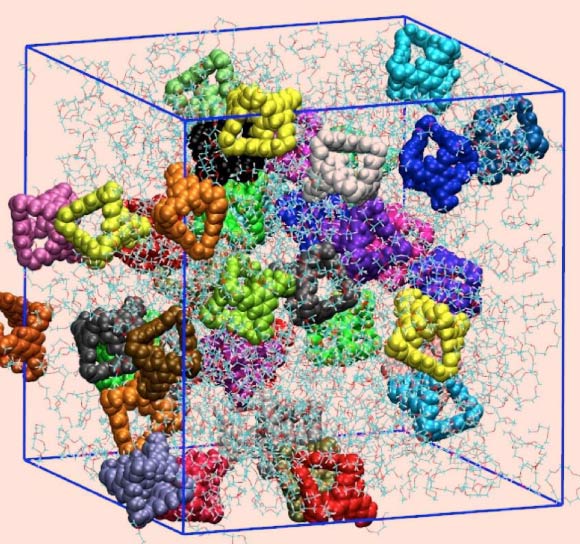
The scientists have prepared a ‘porous liquid’ by taking rigid organic cage molecules, each of which defines a molecular pore space, and dissolving them at high concentration in a solvent that is too large to enter the pores.

“What we have done is to design a special liquid from the bottom-up. We designed the shapes of the molecules which make up the liquid so that the liquid could not fill up all the space,” Prof. James explained.

“Because of the empty holes we then had in the liquid, we found that it was able to dissolve unusually large amounts of gas.”

“These first experiments are what is needed to understand this new type of material, and the results point to interesting long-term applications which rely on dissolution of gases,” Prof. James said.

“We have managed to demonstrate a very new principle – that by creating holes in liquids we can dramatically increase the amount of gas they can dissolve. These remarkable properties suggest interesting applications in the long term.”

Source: Scientists Invent Liquid with Permanent Porosity | Chemistry, Physical Chemistry | Sci-News.com

Kitchen utensils can spread bacteria between foods, UGA study finds

Griffin, Ga. – In a recent study funded by the U.S. Food and Drug Administration, University of Georgia researchers found that produce that contained bacteria would contaminate other produce items through the continued use of knives or graters–the bacteria would latch on to the utensils commonly found in consumers’ homes and spread to the next item.

Unfortunately, many consumers are unaware that utensils and other surfaces at home can contribute to the spread of bacteria, said the study’s lead author Marilyn Erickson, an associate professor in the College of Agricultural and Environmental Sciences’ department of food science and technology.

“Just knowing that utensils may lead to cross-contamination is important,” Erickson said. “With that knowledge, consumers are then more likely to make sure they wash them in between uses.”

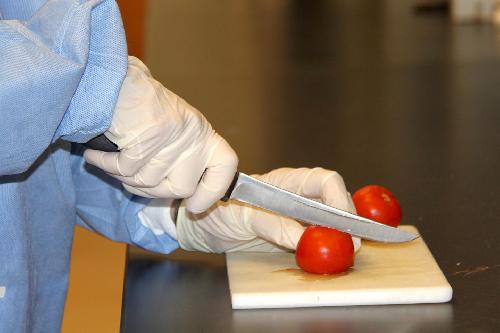
picMarilyn Erickson cuts into a tomato to test the chances of cross-contamination in home kitchens. An associate professor, she conducts her research at the University of Georgia Center for Food Safety in Griffin. Credit: Sharon Dowdy/University of Georgia

Erickson has been researching produce for the past 10 years. Her past work has mainly focused on the fate of bacteria on produce when it’s introduced to plants in the field during farming.

In 2013, she was co-author on a study looking at the transfer of norovirus and hepatitis A between produce and common kitchen utensils–finding that cutting and grating increased the number of contaminated produce items when that utensil had first been used to process a contaminated item.

This study, published in Food Microbiology, is similar in that it considers the influence that knives and graters have on the transfer of pathogenic bacteria to and from produce items. She urges consumers to realize that these germs can spread in their kitchens as well.

Researchers have known that poor hygiene and improper food preparation practices in a consumer’s home can lead to foodborne illnesses, but considering what practices in the kitchen are more likely to lead to contamination has not been examined extensively.

“The FDA was interested in getting more accurate numbers as to what level of cross-contamination could occur in the kitchen using standard practices,” Erickson said.

In her recent study, Erickson contaminated many types of fruits and vegetables in her lab–adding certain pathogens that often can be found on these foods, such as salmonella and E. coli.

Using a knife, Erickson would cut into things like tomatoes or cantaloupe and other types of produce to see how easily the bacteria could spread when the knife was continuously used without being cleaned. Because they “were looking at what would be the worst-case scenario,” she said, Erickson and study co-authors did not wash between cutting these different produce items.

Researchers also grated produce, like carrots, to see how easily the pathogens spread to graters. They found that both knives and graters can cause additional cross-contamination in the kitchen and that the pathogens were spread from produce to produce if they hadn’t washed the utensils.

“A lot of the broken up material and particles from the contaminated produce remained on the graters,” said Erickson, who conducts her research at the UGA Center for Food Safety in Griffin. “Then if you were to shred another carrot or something else immediately after that, it gets contaminated, too.”

The study also found that certain fruits and vegetables spread pathogens to knives to different degrees.

“For items like tomatoes, we tended to have a higher contamination of the knives than when we cut strawberries,” Erickson said. “We don’t have a specific answer as to why there are differences between the different produce groups. But we do know that once a pathogen gets on the food, it’s difficult to remove.”

Knives and graters aren’t the only utensils in the kitchen consumers should be worried about. Erickson has also helped study the role brushes and peelers have on the transfer of dangerous kitchen bacteria.

In concurrent studies, Erickson found that scrubbing or peeling produce items–like melons, carrots and celery–did not eliminate contamination on the produce item but led to contamination of the brush or peeler. Even when placed under running water, the utensils still became contaminated; however, the ability to cross-contaminate later produce items depended on the brush type and the pathogenic agent.

These studies combined give researchers a better idea as to how common cross-contamination is in the kitchen–even when just using standard practices.

Erickson explained there is a small chance of buying fruits and vegetables contaminated with bacteria, but the problem can occur–whether the product is store-bought or locally grown.

source: University of Georgia

Source: Kitchen utensils can spread bacteria between foods, UGA study finds | Science Codex