Stanford researchers find sleep gene linked to heart failure

Researchers at the Stanford University School of Medicine have identified a gene that, when working properly, appears to reduce the risk of heart failure and improve treatment outcomes, highlighting a possible target for the development of new drugs.

The gene codes for a protein that was first identified when a mutated form was shown to cause narcolepsy.

Caring for patients with heart failure costs the United States $40 billion a year, according to Euan Ashley, MRCP, DPhil, associate professor of cardiovascular medicine at Stanford. Despite the condition’s enormous impact, few new treatments have been developed, and those that exist produce varied responses among patients. One major challenge to the development of new treatments has been the lack of genes that can be confidently associated with heart failure. Ashley is hopeful that the new finding will open doors to evaluating possible treatments.

The research is described in a paper to be published online Nov. 30 in the Journal of the American College of Cardiology. Ashley is the senior author. The lead author is Marco Perez, MD, assistant professor of cardiovascular medicine, who said the study was motivated by the observation that individual patients with heart failure often respond differently to the same types of medical interventions.

“We have noticed some patients with heart failure who get medical therapy respond really nicely,” Perez said. “Their heart function improves dramatically with medications. Whereas other patients, despite medical therapy, continue to worsen and require transplant.”

Perez wondered if there were genetic reasons for the discrepancies in treatment outcomes observed in the study. He suspected genetic variation in the study’s patient group might point toward a link.

From men to mice

The team genotyped heart-failure patients at the extremes of responses — those who had the best and worst responses to therapy. They combined these results with gene expression data from human cardiac tissue available from a large, publicly accessible data set. By combining a variety of approaches including network modeling, which looks at the relationship between genes, the team searched for genetic variants associated with heart health.

Intrigued that their analyses spotlighted a gene near the region coding for the orexin receptor protein, which is known to be involved in the control of sleep, appetite and blood pressure, the team investigated further. Through a series of experiments, the researchers concluded that the gene likely regulates how much of the receptor is made in a cell. They then looked for evidence that the orexin receptor could be involved in heart function and found that its expression was increased in diseased human heart tissue. The researchers wondered whether this could mean that the receptor and its binding partner, orexin, have a protective function in the heart.

“We found this new receptor that looked very promising,” said Ashley. “But what I’m most proud of is that the team didn’t stop there; they went on to validate it in another data set, explore its mechanism in cellular models and then test the effect in several different mouse models.”

Using a mouse model that mimics heart failure through artificially elevated levels of adrenaline, the researchers examined the role of the receptor and orexin. They found that if they gave orexin to the mice with failing hearts, those mice showed better systolic heart function — relating to the contraction phase of a heartbeat — than did mice that did not receive orexin.

Ultrasounds of the hearts in a different group of mice, which were missing the orexin receptor, showed that these mice had greater diastolic heart dysfunction — relating to the relaxation phase of a heartbeat — another hint suggesting that the receptor is important for healthy hearts.

“The exciting thing is that this gene is in a completely different neurohormonal axis — a completely different pathway than what has been looked at previously,” Perez said. “Nobody had ever studied heart function in relation to this gene.”

The project was selected to receive funding from Stanford’s SPARK program, a drug and diagnostic development program that supports promising research with the potential to move from the laboratory to the bedside.

Perez, whose work won him recognition as a finalist for the 2013 American Heart Association Young Investigator’s Award, said he is optimistic that exploring the role of this receptor in the heart could inform new research, possibly leading to the development of novel therapies.

Sleep and hearts

The orexin receptor’s link to narcolepsy was identified in 2000 by a research group that included Emmanuel Mignot, MD, PhD, professor of psychiatry and behavioral sciences, but the new study marks the first time the gene and receptor have been associated with heart failure. Perez, Ashley and their team are eager to do further studies to explore this link.

“The connection between sleep and the heart is fascinating,” said Ashley, who has recently been spending more time interacting with his sleep-expert colleagues in an effort to explore possible associations.

In fact, the finding has raised the question of whether insomnia medications that work by blocking the function of the orexin receptor could harm the heart, although this has not yet been studied, Perez said.

“We already know that sleep apnea is bad for the heart,” said Ashley. “One of the things we are now hoping to do is look at heart function in patients with narcolepsy.”

Source: Stanford University Medical Center

Source: Stanford researchers find sleep gene linked to heart failure | Science Codex

Ancient DNA Provides an Evolutionary Roadmap

In the first study of its nature, scientists have found genetic evidence – through the analysis of ancient DNA – connecting the arrival of agriculture in Europe approximately 8,500-years ago with widespread genetic changes to the DNA of people living at the time; altering their immune system, digestion, skin color and height. The finding secures the agricultural revolution’s distinction as one of the most profound events in all of human history.

Researchers had previously found unconnected clues relating to these alterations while studying the genes of living Europeans, but the new study makes it possible to see the changes as they occurred over thousands of years. According to Rasmus Nielsen, a geneticist with the University of California, Berkeley, who was not directly involved in the recent study, scientists have been trying for decades to find out what happened in the past – and now there’s a figurative time machine.

Prior to this study of ancient DNA, scientists had to rely primarily on bones or other physical remains from early humans in order to understand European history. In Europe, researchers have determined that the earliest human bones date to approximately 45,000 years ago. Early Europeans survived as hunter-gatherers for more than 35,000 years. It was only around 8,500 years ago that farmers left their first archaeological mark in the history of the continent.

Scientists had already uncovered evidence which suggested the ancestors of living Europeans adapted to agriculture by natural selection. With DNA sequencing tools becoming more advanced and more available scientist were even able to find some of the traits’ molecular underpinnings. But what these studies couldn’t do was determine when the changes occurred with any precision, or whether they were the result of the migration of people into Europe or natural selection.

Scientists can now tackle these questions directly, thanks to the quickly growing supply of DNA supplied by ancient skeletons. It’s already been determined that the average European’s DNA comes typically from three sources.

Before agriculture took hold, Europeans were a population of hunter-gatherers; next came a wave of people with DNA similar to residents of the Near East (it was likely these people who introduced agriculture to Europe). Finally, a nomadic population from Russia known as the Yamnaya swept across Europe 4,500 years ago.

Evidence of these migrations was found after the analysis of dozens of ancient European genomes. In the new study the international team of experts analyzed the genomes of 230 people who were alive between 2,300 and 8,500 years ago. The huge sample size has given researchers the data needed to track distinct genetic variations as they became more common or less common throughout ancient Europe’s history.

By comparing the ancient and living human genes scientists have confirmed previous hypotheses founded on living Europeans, but they have also revealed the other genes that evolved as well. Earlier studies indicated that once Europeans began raising cattle they became better at digesting milk, the new study has confirmed that the presence of a gene that aids in milk digestion (LCT) became much more common. Surprisingly it was determined this change didn’t occur with the advent of farming, because this change dates back only 4,000 years.

Agriculture benefited people by providing a new source of protein; however a diet dependent on grains also created the risk of not getting enough other key nutrients. So along came the gene SLC22A4 which works on the surface of a cell to increase absorption, thereby increasing a person’s chance of survival. An indirect consequence of this genetic fix is the raised risk of digestive disorders.

Changes to the color of European skin have also been tracked. The original hunter-gatherers were descendants of people from Africa and the farmers who arrived next were lighter skinned and it’s this latter trait which spread throughout Europe – helped along by the later appearance of an additional gene variant that lightened skin even further. But why? It was a long held belief that at higher latitudes light skin would capture additional vitamin D from sunlight; but early hunter-gatherers got along fine with dark skin. The new hypothesis proposes it was the move to agriculture which caused a reduction in Vitamin D intake that led to the change.

Another puzzle the collection of ancient DNA addresses is the evolution of height in Europe. After combing through 169 height related genes they discovered that the early famers were relatively tall, and the Yamnaya were even taller. People living in northern Europe then inherited more Yamnaya DNA – making them taller. It’s not apparent why nature favored a shorter stature in the south but it’s clear this genetic history still affects the differences in height across the continent even now.

Image courtesy of Wikimedia Commons user: Myrabella

Source: Ancient DNA Provides an Evolutionary Roadmap

Mystery of how snakes lost their legs solved by reptile fossil

Fresh analysis of a reptile fossil is helping scientists solve an evolutionary puzzle – how snakes lost their limbs.

The 90 million-year-old skull is giving researchers vital clues about how snakes evolved.

Comparisons between CT scans of the fossil and modern reptiles indicate that snakes lost their legs when their ancestors evolved to live and hunt in burrows, which many snakes still do today.

The findings show snakes did not lose their limbs in order to live in the sea, as was previously suggested.

Scientists used CT scans to examine the bony inner ear of Dinilysia patagonica, a 2-metre long reptile closely linked to modern snakes. These bony canals and cavities, like those in the ears of modern burrowing snakes, controlled its hearing and balance.

They built 3D virtual models to compare the inner ears of the fossils with those of modern lizards and snakes. Researchers found a distinctive structure within the inner ear of animals that actively burrow, which may help them detect prey and predators. This shape was not present in modern snakes that live in water or above ground.

The findings help scientists fill gaps in the story of snake evolution, and confirm Dinilysia patagonica as the largest burrowing snake ever known. They also offer clues about a hypothetical ancestral species from which all modern snakes descended, which was likely a burrower.

The study, published in Science Advances, was supported by the Royal Society.

Dr Hongyu Yi, of the University of Edinburgh’s School of GeoSciences, who led the research, said: “How snakes lost their legs has long been a mystery to scientists, but it seems that this happened when their ancestors became adept at burrowing. The inner ears of fossils can reveal a remarkable amount of information, and are very useful when the exterior of fossils are too damaged or fragile to examine.”

Mark Norell, of the American Museum of Natural History, who took part in the study, said: “This discovery would not have been possible a decade ago – CT scanning has revolutionised how we can study ancient animals. We hope similar studies can shed light on the evolution of more species, including lizards, crocodiles and turtles.”

Source: Mystery of how snakes lost their legs solved by reptile fossil | Science Codex

Will Ebola change the game? Ten essential reforms before the next pandemic. The report of the Harvard-LSHTM Independent Panel on the Global Response to Ebola – The Lancet

Executive summary

The west African Ebola epidemic that began in 2013 exposed deep inadequacies in the national and international institutions responsible for protecting the public from the far-reaching human, social, economic, and political consequences of infectious disease outbreaks. The Ebola epidemic raised a crucial question: what reforms are needed to mend the fragile global system for outbreak prevention and response, rebuild confidence, and prevent future disasters? To address this question, the Harvard Global Health Institute and the London School of Hygiene & Tropical Medicine jointly launched the Independent Panel on the Global Response to Ebola. Panel members from academia, think tanks, and civil society have collectively reviewed the worldwide response to the Ebola outbreak. After difficult and lengthy deliberation, we concluded that major reforms are both warranted and feasible. The Panel’s conclusions offer a roadmap of ten interrelated recommendations across four thematic areas:

1. Preventing major disease outbreaks

All countries need a minimum level of core capacity to detect, report, and respond rapidly to outbreaks. The shortage of such capacities in Guinea, Liberia, and Sierra Leone enabled Ebola to develop into a national, and worldwide, crisis.

  • Recommendation 1: The global community must agree on a clear strategy to ensure that governments invest domestically in building such capacities and mobilise adequate external support to supplement efforts in poorer countries. This plan must be supported by a transparent central system for tracking and monitoring the results of these resource flows. Additionally, all governments must agree to regular, independent, external assessment of their core capacities.

  • Recommendation 2: WHO should promote early reporting of outbreaks by commending countries that rapidly and publicly share information, while publishing lists of countries that delay reporting. Funders should create economic incentives for early reporting by committing to disburse emergency funds rapidly to assist countries when outbreaks strike and compensating for economic losses that might result. Additionally, WHO must confront governments that implement trade and travel restrictions without scientific justification, while developing industry-wide cooperation frameworks to ensure private firms such as airlines and shipping companies continue to provide crucial services during emergencies.

2. Responding to major disease outbreaks

When preventive measures do not succeed, outbreaks can cross borders and surpass national capacities. Ebola exposed WHO as unable to meet its responsibility for responding to such situations and alerting the global community.

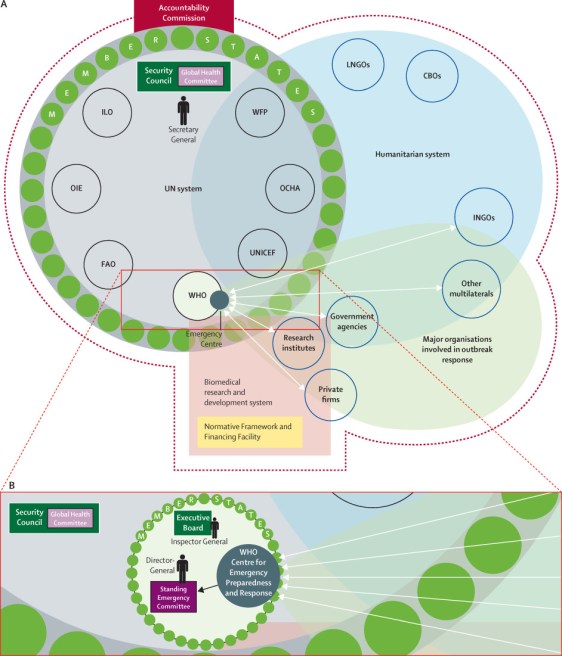
  • Recommendation 3: A dedicated centre for outbreak response with strong technical capacity, a protected budget, and clear lines of accountability should be created at WHO, governed by a separate Board.

  • Recommendation 4: A transparent and politically protected WHO Standing Emergency Committee should be delegated with the responsibility for declaring public health emergencies.

  • Recommendation 5: An independent UN Accountability Commission should be created to do system-wide assessments of worldwide responses to major disease outbreaks.

3. Research: production and sharing of data, knowledge, and technology

Rapid knowledge production and dissemination are essential for outbreak prevention and response, but reliable systems for sharing epidemiological, genomic, and clinical data were not established during the Ebola outbreak.

  • Recommendation 6: Governments, the scientific research community, industry, and non-governmental organisations must begin to develop a framework of norms and rules operating both during and between outbreaks to enable and accelerate research, govern the conduct of research, and ensure access to the benefits of research.

  • Recommendation 7: Additionally, research funders should establish a worldwide research and development financing facility for outbreak-relevant drugs, vaccines, diagnostics, and non-pharmaceutical supplies (such as personal protective equipment) when commercial incentives are not appropriate.

4. Governing the global system for preventing and responding to outbreaks

An effective worldwide response to major outbreaks needs leadership, clarity about roles and responsibilities, and robust measures for accountability, all of which were delayed or absent during the Ebola epidemic.

  • Recommendation 8: For a more timely response in the future, we recommend the creation of a Global Health Committee as part of the UN Security Council to expedite high-level leadership and systematically elevate political attention to health issues, recognising health as essential to human security.

  • Recommendation 9: Additionally, decisive, time-bound governance reforms will be needed to rebuild trust in WHO in view of its failings during the Ebola epidemic. With respect to outbreak response, WHO should focus on four core functions: supporting national capacity building through technical advice; rapid early response and assessment of outbreaks (including potential emergency declarations); establishing technical norms, standards, and guidance; and convening the global community to set goals, mobilise resources, and negotiate rules. Beyond outbreaks, WHO should maintain its broad definition of health but substantially scale back its expansive range of activities to focus on core functions (to be defined through a process launched by the WHO Executive Board).

  • Recommendation 10: The Executive Board should mandate good governance reforms, including establishing a freedom of information policy, an Inspector General’s office, and human resource management reform, all to be implemented by an Interim Deputy for Managerial Reform by July 2017. In exchange for successful reforms, governments should finance most of the budget with untied funds in a new deal for a more focused WHO. Finally, member states should insist on a Director-General with the character and capacity to challenge even the most powerful governments when necessary to protect public health.

These ten recommendations are concrete, actionable, and measurable. High-level political leadership is now needed to translate this roadmap into enduring systemic reform so that the catastrophe of the Ebola outbreak will never be repeated.

Source: Will Ebola change the game? Ten essential reforms before the next pandemic. The report of the Harvard-LSHTM Independent Panel on the Global Response to Ebola – The Lancet

Gut microbes signal when dinner is done

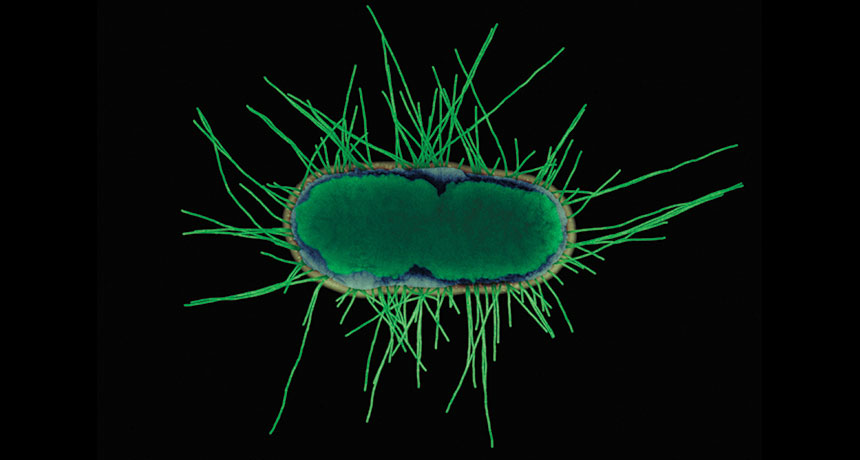
LOSS OF APPETITE  Experiments show that helpful gut bacteria like this E. coli K12 produce proteins that could influence the appetite of mice and rats.

LOSS OF APPETITE Experiments show that helpful gut bacteria like this E. coli K12 produce proteins that could influence the appetite of mice and rats.

Gut bacteria are not polite dinner guests. They fill up fast and tell their host to quit eating, too.

After only 20 minutes, helpful E. coli populations that live in animal guts produce proteins that can curb how hungry its animal partner is, researchers show November 24 in Cell Metabolism. In mice and rats, the proteins stimulated brain-body responses that led the animals to eat less. The new findings indicate that gut microbes could be more involved with regulating food intake in animals, including humans, than previously thought.

“It suggests that the growth and activity of the microbiome might specifically regulate appetite and feeding behavior,” says Kevin Murphy, an endocrinologist at Imperial College London not involved with the study.

Food provides loads of nutrients to the gut. There, microbes use the nourishment to maintain population size. In the lab, Sergueï Fetissov and colleagues found that E. coli populations stopped growing 20 minutes after receiving nutrients. Upon hitting the 20-minute mark, the microbes also made some different proteins than before and boosted production of the protein ClpB, which mimics a hormone in humans that acts on appetite. When the E. coli stopped growing, they produced “two times as much of this protein,” says Fetissov, a physiologist at Rouen University in France.

Proteins from the E. coli no-growth stage were then injected in rats and mice. Compared with rodents that didn’t receive the proteins, those that did ate less and had higher levels of ClpB in their guts. The researchers also found that the protein encouraged the release of peptide YY — a hormone associated with reduced appetite — and stimulated nerve cells that decrease hunger levels.

The E. coli proteins seem to influence feeding behavior in the rats and mice. But it’s too soon to say whether the results are applicable to humans. “Further work is required to determine how physiologically relevant the findings are,” Murphy says.

The interaction between gut microbes and host organisms isn’t well understood, Fetissov says, so it’s important to study pathways and mechanisms that relate to food intake. Human gut microbes, for instance, may play a role in obesity, and he says that studies like this could help explain links between microbes and human health.

Source: Gut microbes signal when dinner is done | Science News