Periodic Table’s 7th Period is Finally Complete, IUPAC-IUPAP Officials Say

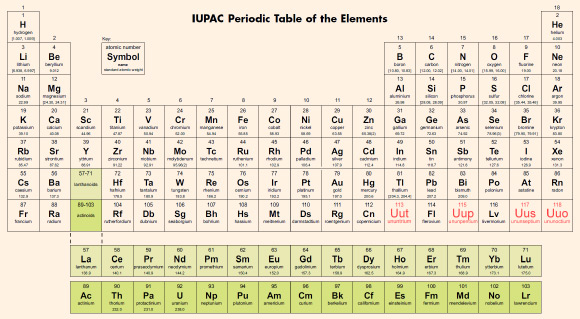
The 7th period of the periodic table now has four new elements: element 113 (temporarily named as Ununtrium, or Uut), element 115 (Ununpentium, or Uup), element 117 (Ununseptium, or Uus), and element 118 (Ununoctium, or Uuo), says a group of experts from the International Union of Pure and Applied Chemistry (IUPAC) and the International Union of Pure and Applied Physics (IUPAP).

“As the global organization that provides objective scientific expertise and develops the essential tools for the application and communication of chemical knowledge for the benefit of humankind, IUPAC is pleased and honored to make this announcement concerning elements 113, 115, 117, and 118 and the completion of the 7th row of the periodic table of the elements,” said Dr Mark C. Cesa, President of IUPAC.

IUPAP and IUPAC experts have reviewed the relevant literature for elements 113, 115, 117, and 118 and have determined that the claims for the discovery of these elements have been fulfilled:

(i) a team of scientists from the RIKEN Nishina Center for Accelerator-based Science in Japan has fulfilled the criteria for the discovery of element with atomic number Z=113;

(ii) Dubna-Livermore-Oak Ridge collaboration has met the criteria for discovery of the elements with atomic numbers Z=115 and Z=117;

(iii) and the Dubna–Livermore collaboration has fulfilled the criteria for the discovery of element Z=118.

“These groups will be invited to propose permanent names and symbols,” IUPAC/IUPAP experts explained.

The decisions are detailed in two reports accepted for publication in the journal Pure and Applied Chemistry.

“The chemistry community is eager to see its most cherished table finally being completed down to the 7th row,” said Prof. Jan Reedijk, President of the Inorganic Chemistry Division of IUPAC. “IUPAC has now initiated the process of formalizing names and symbols for these elements temporarily named as Ununtrium, Ununpentium, Ununseptium, and Ununoctium.”

“We are excited about these new elements, and we thank the dedicated scientists who discovered them for their painstaking work, as well the members of the IUPAC/IUPAP Joint Working Party for completing their essential and critically important task,” Dr Cesa said.

_____

Paul J. Karol et al. 2016. Discovery of the elements with atomic numbers Z = 113, 115 and 117. Pure and Applied Chemistry, vol. 88, no. 1

Paul J. Karol et al. 2016. Discovery of the element with atomic number Z = 118 completing the 7th row of the Periodic Table. Pure and Applied Chemistry, vol. 88, no. 1
Source: Periodic Table’s 7th Period is Finally Complete, IUPAC-IUPAP Officials Say | Chemistry | Sci-News.com

Loss of cells in brain’s memory center linked to schizophrenia

New York, NY, January 6, 2015–Scientists at Columbia University’s Mortimer B. Zuckerman Mind Brain Behavior Institute, Columbia University Medical Center (CUMC), and the Université Paris Descartes have found that deficits in social memory–a crucial yet poorly understood feature of psychiatric disorders such as schizophrenia–may be due to a decrease in the number of a particular class of brain cells, called inhibitory neurons, in a little-explored region within the brain’s memory center.

The findings, which were reported today in the journal Neuron, explain some of the underlying mechanisms that lead to the more difficult-to-treat symptoms of schizophrenia, including social withdrawal, reduced motivation and decreased emotional capacity.

Scientists have long speculated that schizophrenia, which affects about 1 in every 100 adults worldwide, originates in part in the hippocampus–the brain’s headquarters for memory and spatial navigation. As a result, nearly every region of the hippocampus has been studied extensively in the hopes of gaining insight into the disorder. One notable exception is a tiny region of the hippocampus known as CA2.

“Smaller and less well-defined than other parts of the hippocampus, CA2 was like a small island that was depicted on old maps but remained unexplored,” explained Vivien Chevaleyre, PhD, group leader in neuroscience at the Université Paris Descartes and a lead author of the paper.

Several discoveries have focused attention on a possible association between CA2 and schizophrenia. This region of the hippocampus is associated with vasopressin, a hormone that plays a role in sexual bonding, motivation and other intensely social behaviors, which become impaired in people with the disorder. In addition, postmortem examinations of people with schizophrenia have revealed a marked decrease in the number of CA2 inhibitory neurons, while the rest of the hippocampus remained largely unaffected. However, the significance of this loss had remained unclear.

In this study, the researchers performed a series of electrophysiological and behavioral experiments on a mouse model of schizophrenia developed at CUMC.

By examining the brains of these mice, the researchers observed a substantial decrease in inhibitory CA2 neurons, as compared to a control group of normal, healthy mice–a change remarkably similar to that previously observed in postmortem examinations of people with schizophrenia. Moreover, the team discovered that the modified mice had a significantly reduced capacity for social memory compared with the controls. This raises the hypothesis that changes to CA2 may account for some of the social behavioral changes that occur in individuals with the disorder.

“Even the timing of the emergence of symptoms in the mice–during young adulthood–parallels the onset of schizophrenia in humans,” said Joseph Gogos, PhD, a professor of physiology and neuroscience at CUMC, a principal investigator at the Zuckerman Institute and a lead author of the paper.

“We can now examine the effects of schizophrenia at the cellular level and at the behavioral level,” said Steven Siegelbaum, PhD, chair of the Department of Neuroscience at CUMC, a principal investigator at the Zuckerman Institute and a co-author of the paper. “This essentially opens up a whole new avenue for research that could lead to earlier diagnosis and more effective treatments for schizophrenia.”

source: Zuckerman Mind Brain Behavior Institute

Source: Loss of cells in brain’s memory center linked to schizophrenia | Science Codex

Exercise to improve skill and coordination can help reduce lower back pain

A new Cochrane Review published today shows that targeting exercises to muscles that support and control the spine offers another strategy to reduce pain and disability caused by lower back pain.

Lower back pain is one of the most common health conditions worldwide. It can have substantial health and economic costs as people experience disability and general ill health, leading them to need time off work.

Motor control exercise is a popular form of exercise that aims to improve coordination of the muscles that control and support the spine. Patients are initially guided by a therapist to practise normal use of the muscles with simple tasks. As the patient’s skill increases the exercises become more complex and include the functional tasks that the person needs to perform during work and/or leisure activities.

The new study, published today in the Cochrane Library, gathered together data from 29 randomized trials involving a total of 2,431 men and women, aged between 22 and 55 years old. The trials investigated the impact of using motor control exercises as a treatment for lower back pain compared with other forms of exercise or doing nothing.

The Cochrane authors found that people who used motor control exercises experienced improvements, especially in pain and disability compared with minimal intervention. When compared with other types of exercise at intervals between 3 and 12 months motor control exercise provided similar results for pain and disability.

Lead author, Physiotherapist Bruno Saragiotto, from The George Institute, University of Sydney, Australia, said, “Targeting the strength and coordination of muscles that support the spine through motor control exercise offers an alternative approach to treating lower back pain. We can be confident that they are as effective as other types of exercise, so the choice of exercise should take into account factors such as patient or therapist preferences, cost and availability. At present, we don’t really know how motor control exercise compares with other forms of exercise in the long term. It’s important we see more research in this field so that patients can make more informed choices about persisting with treatment.”

Source: Wiley

Source: Exercise to improve skill and coordination can help reduce lower back pain | Science Codex

Chemists Develop Fully Recyclable Polymer

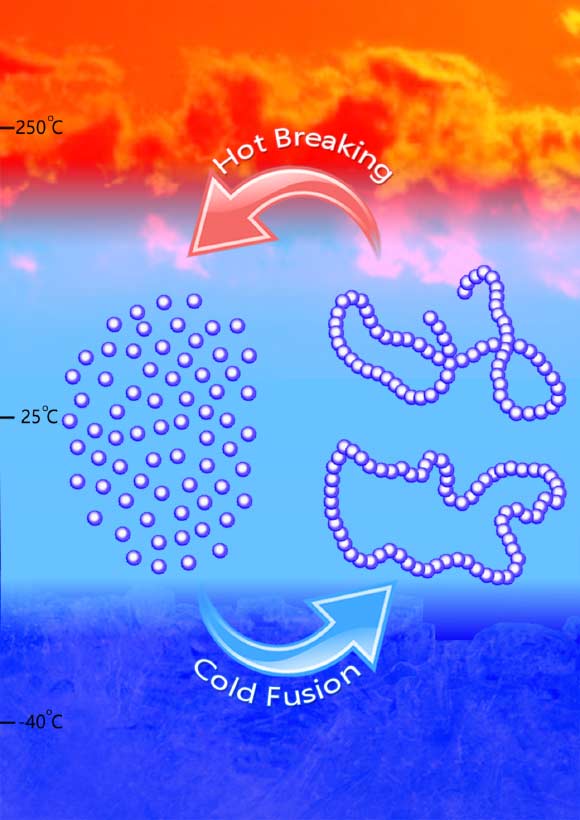
A graphical illustration of the polymer synthesis process: monomers are cooled in order to polymerize; to cycle back, heat is applied. Image credit: Jing Tang / Chen lab.

“More than 200 pounds of synthetic polymers are consumed per person each year – plastics probably the most in terms of production volume. And most of these polymers are not biorenewable,” said Prof. Eugene Chen of CSU’s Department of Chemistry.

“The big drive now is to produce biorenewable and biodegradable polymers or plastics. That is, however, only one part of the solution, as biodegradable polymers are not necessarily recyclable, in terms of feedstock recycling.”

Writing in the journal Nature Chemistry, Prof. Chen and his colleague, Miao Hong, describe synthesizing a polymer that, when reheated for about an hour, converts back to its original molecular state, ready for reuse.

Their starting feedstock was gamma-butyrolactone (GBL), a monomer that scientists had declared non-polymerizable.

Prof. Chen and Ms Hong used both metal-based and metal-free catalysts to synthesize the polymer, called poly(GBL).

They employed specifically designed reaction conditions, including low temperature, to make the poly(GBL), and heat between 428 – 572 degrees Fahrenheit (220 – 300 degrees Celsius) to convert the polymer back into the original monomer, GBL, demonstrating the thermal recyclability of the polymer.

“This work established relationships between the poly(GBL) structure and its thermal and dynamic mechanical properties, and it demonstrated the complete thermal recyclability of poly(GBL) back into its monomer, which thereby opens up unique opportunities for discovering new sustainable (renewable and recyclable) biomaterials based on the ROP (ring-opening polymerization) of other five-membered lactones,” Prof. Chen and Ms Hong said.

Their discovery has promising market potential, and a provisional patent has been filed with the help of CSU Ventures.

_____

Miao Hong & Eugene Y.-X. Chen. 2016. Completely recyclable biopolymers with linear and cyclic topologies via ring-opening polymerization of γ-butyrolactone. Nature Chemistry 8, 42-49; doi: 10.1038/nchem.2391

Source: Chemists Develop Fully Recyclable Polymer | Chemistry | Sci-News.com

Large and increasing methane emissions from northern lakes

Methane is increasing in the atmosphere, but many sources are poorly understood. Lakes at high northern latitudes are such a source. However, this may change with a new study published in Nature Geoscience. By compiling previously reported measurements made at a total of 733 northern water bodies – from small ponds formed by beavers to large lakes formed by permafrost thaw or ice-sheets – researchers are able to more accurately estimate emissions over large scales.

“The release of methane from northern lakes and ponds needs to be taken seriously. These waters are significant, contemporary sources because they cover large parts of the landscape. They are also likely to emit even more methane in the future”, says Martin Wik, PhD student at the Department of Geological Sciences and Bolin Centre for Climate Research, Stockholm University, who led the study.

With climate warming, particularly at high northern latitudes, longer ice-free seasons in combination with permafrost thaw is likely to fuel methane release from lakes, potentially causing their emissions to increase 20-50 precent before the end of this century. Such a change would likely generate a positive feedback on future warming, causing emissions to increase even further.

“This means that efforts to reduce human induced warming are even more urgent in order to minimize this type of feedback of natural greenhouse gas emissions. In a sense, every reduction in emissions from fossil fuels is a double victory”, says David Bastviken, Professor at Tema Environmental Change, Linköping University.

source: Stockholm University

Source: Large and increasing methane emissions from northern lakes | Science Codex