
USGS Researchers Reveal First-Ever Digital Geologic Map of Alaska

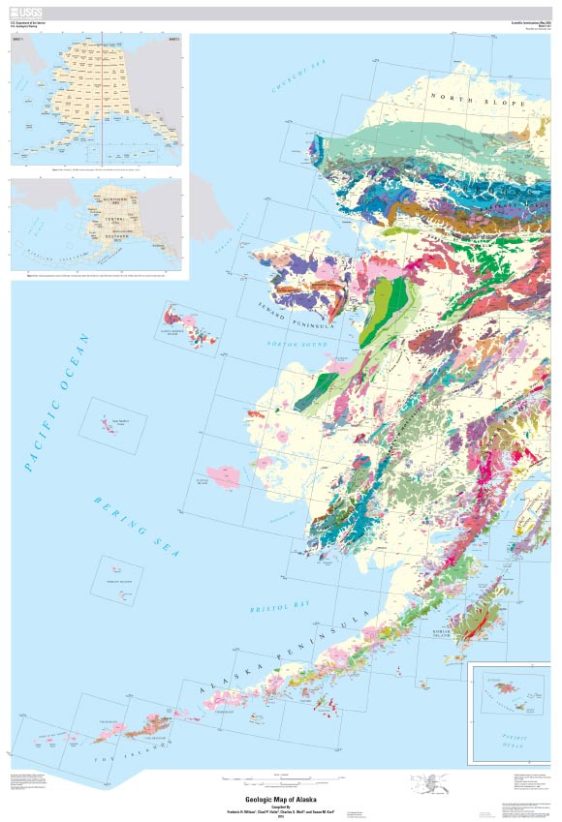
This map (Part 1 – the western part of Alaska and the Aleutian Islands, and Part 2 – the eastern part of Alaska and the list of map units) is a completely new compilation, carrying the distinction of being the first 100% digital statewide geologic map of Alaska.

More than 750 references were used in creating the map, some as old as 1908 and others as new as 2015.

“This new map and associated digital databases are the result of compilation and interpretation of published and unpublished 1:250,000-scale and limited 1:500,000- to 1:63,360-scale maps,” the USGS researchers explained.

The map gives visual context to the abundant mineral and energy resources found throughout Alaska in a beautifully detailed and accessible format.

“Covering the entire state of Alaska, it reflects more than a century of work by a host of geologists and almost two decades of compilation work,” the scientists said.
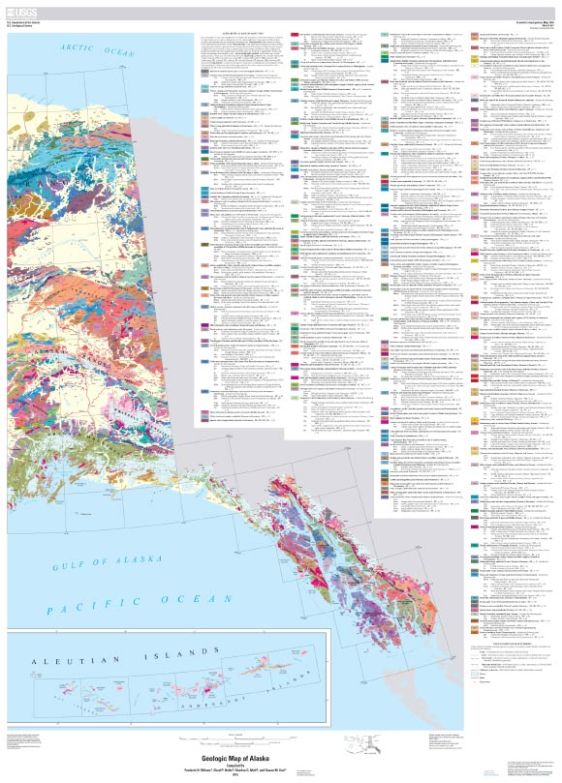
Geologic map of Alaska, part 2: generalized geologic map of the eastern part of Alaska. Image credit: U.S. Geological Survey / U.S. Department of the Interior.

Geologic map of Alaska, part 2: generalized geologic map of the eastern part of Alaska. Image credit: U.S. Geological Survey / U.S. Department of the Interior.

“I am pleased that Alaska now has a state-wide digital map detailing surface geologic features of this vast region of the United States that is difficult to access,” said USGS Director Suzette Kimball.

“This geologic map provides important information for the mineral and energy industries for exploration and remediation strategies. It will enable resource managers and land management agencies to evaluate resources and land use, and to prepare for natural hazards, such as earthquakes.”

“The data contained in this digital map will be invaluable. It is a great resource and especially enhances the capacity for science-informed decision making for natural and cultural resources, interpretive programs, and visitor safety,” added National Park Service Director Jonathan B. Jarvis.

“A better understanding of Alaska’s geology is vital to our state’s future,” said Sen. Lisa Murkowski, R-Alaska. “This new map makes a real contribution to our state, from the scientific work it embodies to the responsible resource production it may facilitate. Projects like this one underscore the important mission of the USGS, and I’m thankful to them for completing it.”

“This map is the continuation of a long line of USGS maps of Alaska, reflecting ever increasing knowledge of the geology of the state,” said USGS research geologist Dr Frederic Wilson, who is the lead author of the new map.

_____

Wilson, F.H. et al. 2015. Geologic map of Alaska: U.S. Geological Survey Scientific Investigations Map 3340, pamphlet 196 p., 2 sheets, scale 1:1,584,000; doi: 10.3133/sim3340

Source: USGS Researchers Reveal First-Ever Digital Geologic Map of Alaska | Geology | Sci-News.com

Sugar-sweetened drinks linked to increased visceral fat

DALLAS, Jan. 11, 2016–Drinking sugar-sweetened beverages every day was associated with an increase in a particular type of body fat that may affect diabetes and heart disease risk, according to new research in the American Heart Association’s journal Circulation.

Data from the Framingham Heart Study — federally supported, ongoing research that has advanced the understanding of cardiovascular disease — showed that among middle-aged adults, there was a direct correlation between greater sweetened beverage consumption and increased visceral fat.

Visceral fat or “deep” fat wraps around a number of important internal organs such as the liver, pancreas and intestines. Visceral fat affects how our hormones function and is thought to play a larger role in insulin resistance – which may boost Type 2 diabetes and heart disease risk.

Researchers looked at both sugar-sweetened beverage and diet soda consumption. The researchers did not observe this association with diet soda, which is often promoted as low in calories and sugar.

“There is evidence linking sugar-sweetened beverages with cardiovascular disease and type 2 diabetes,” said Caroline S. Fox, M.D., M.P.H, lead study author and a former investigator with the Framingham Heart Study of the National Heart, Lung, and Blood Institute. She is currently a special volunteer with the National Institutes of Health (NIH). “Our message to consumers is to follow the current dietary guidelines and to be mindful of how much sugar-sweetened beverages they drink. To policy makers, this study adds another piece of evidence to the growing body of research suggesting sugar-sweetened beverages may be harmful to our health.”

A total of 1,003 study participants, average age 45 and nearly half women, answered food questionnaires and underwent CT scans at the start and the end of the study to measure body fat changes.

They were ranked into four categories: non-drinkers; occasional drinkers (sugar-sweetened beverages once a month or less than once a week); frequent drinkers (once a week or less than once a day); and those who drank at least one sugar sweetened beverage daily.

Over a six-year follow-up period, independent of the participants’ age, gender, physical activity, body mass index and other factors, they found visceral fat volume increased by:


  • 658 centimeters cubed for non-drinkers;
  • 649 centimeters cubed for occasional drinkers;
  • 707 centimeters cubed for frequent drinkers; and
  • 852 centimeters cubed for those who drank one beverage daily.While the exact biological mechanism is unknown, Jiantao Ma, M.D., Ph.D., post-doctoral fellow at the NIH and co-leader of the study, said that it’s possible that added sugars may contribute to insulin resistance, a hormonal imbalance that increases the risk for Type 2 diabetes and heart disease.Sugar-sweetened beverages are the largest contributor of added sugar intake in the United States. Sucrose or high fructose corn syrup are two of the most common sugars found in these popular drinks, which include caffeinated and de-caffeinated soda, carbonated and non-carbonated drinks with added sugar, fruit juice, and lemonade.

    Daily consumption of added sugar, such as those found in sugar-sweetened beverages and processed foods, is high; in 2001 to 2004, the usual intake of added sugars for Americans was 22.2 teaspoons per day or an extra 355 calories. Growing evidence revealing the health risks associated with drinking sweetened beverages led the American Heart Association to provide added sugar recommendations in 2009; for most women, no more than 100 calories per day of added sugars, such as those found in sweetened beverages, and for most men, a limit of 150 calories per day.

    “Our findings are in line with current dietary guidelines that suggest limiting the consumption of sugar-sweetened beverages,” Ma said.

    Source: American Heart Association


Source: Sugar-sweetened drinks linked to increased visceral fat | Science Codex

Polymer puts new medical solutions within reach

The liquid crystalline hydrogel in a dry state. Credit: Patrick Mather

Researchers, particularly those in the medical field, have been searching for a way to combine the properties of liquid crystallinity with those of hydrogels.

Liquid crystals are characterized as having the fluidity of liquid but some of the order of a crystal so they can be oriented to have structure. They are not water-loving, in that they will dissolve in water, making them less than ideal candidates for use inside the body.

Hydrogels, however, are water-loving but they lack the order to orient them into specific shapes.

Combining the properties of liquid crystals and hydrogels in just the right proportions creates the potential for new materials that have the same mechanical properties as soft tissues in the body. A material that is water-loving and has structure opens up the door the possibility for artificial blood vessels that are mechanically stealth so they wouldn’t be viewed as a foreign body.

Professor Pat Mather has developed a process that can create this type of a polymer.

The paper “A hydrogel-forming liquid crystalline elastomer exhibiting soft shape memory” authored by Mather and graduate student Amir Torbati G’14, now a post-doc at UC Denver, was featured on the cover the Journal of Polymer Science B: Polymer Physics.

“It is a balancing act of not having too many water-loving groups in the polymer and balancing that with other chemicals in the polymer that promote structure.” said Mather.

Whatever the hydrogels do to make the liquid crystals water-loving destroys the order of crystallinity, so historically creating a material like this has been a challenge but Mather’s process opens to the door to new medical applications that were previously out of reach.

source: Syracuse University

Source: Polymer puts new medical solutions within reach | Science Codex

Researchers’ metallic glue may stick it to soldering and welding

Per­haps no startup was launched for a more intriguing reason than that of Northeastern’s Hanchen Huang. From the com­pany website:

“MesoGlue was founded by Huang and two of his PhD stu­dents: They had a dream of a better way of sticking things together.”

Those “things” are every­thing from a computer’s cen­tral pro­cessing unit and a printed cir­cuit board to the glass and metal fil­a­ment in a light bulb.

The “way” of attaching them is, aston­ish­ingly, a glue made out of metal that sets at room tem­per­a­ture and requires very little pres­sure to seal.

“It’s like welding or sol­dering but without the heat,” says Huang, who is pro­fessor and chair in the Depart­ment of Mechan­ical and Indus­trial Engineering.

In a new paper, pub­lished in the Jan­uary issue of Advanced Mate­rials & Processes, Huang and col­leagues, including North­eastern doc­toral stu­dent Paul Elliott, describe their latest advances in the glue’s devel­op­ment. Our curiosity was piqued: Sol­dering with no heat? We asked Huang to elaborate.

On new devel­op­ments in the com­po­si­tion of the metallic glue:

“Both ‘metal’ and ‘glue’ are familiar terms to most people, but their com­bi­na­tion is new and made pos­sible by unique prop­er­ties of metallic nanorods–infinitesimally small rods with metal cores that we have coated with the ele­ment indium on one side and galium on the other.

These coated rods are arranged along a sub­strate like angled teeth on a comb: There is a bottom ‘comb’ and a top ‘comb.’ We then inter­lace the ‘teeth.’ When indium and galium touch each other, they form a liquid. The metal core of the rods acts to turn that liquid into a solid.

The resulting glue pro­vides the strength and thermal/?electrical con­duc­tance of a metal bond. We recently received a new pro­vi­sional patent for this devel­op­ment through North­eastern University.”

On the spe­cial prop­er­ties of the metallic glue:

“The stan­dard polymer glue does not func­tion at high tem­per­a­tures or high pres­sures, but the metallic glue does. The stan­dard glue is not a great con­ductor of heat and/?or elec­tricity, but the metallic glue is. Fur­ther­more, the stan­dard glue is not very resis­tant to air or gas leaks, but the metallic glue is.

“‘Hot’ processes like sol­dering and welding can result in metallic con­nec­tions that are sim­ilar to those pro­duced with the metallic glue, but they cost much more.

In addi­tion, the high tem­per­a­ture nec­es­sary for these processes has dele­te­rious effects on neigh­boring com­po­nents, such as junc­tions in semi­con­ductor devices. Such effects can speed up failure and not only increase cost but also prove dan­gerous to users.”

What are some appli­ca­tions of the technology?

“The metallic glue has mul­tiple appli­ca­tions, many of them in the elec­tronics industry. As a heat con­ductor, it may replace the thermal grease cur­rently being used, and as an elec­trical con­ductor, it may replace today’s sol­ders. Par­tic­ular prod­ucts include solar cells, pipe fit­tings, and com­po­nents for com­puters and mobile devices.”

source: Northeastern University


Source: Researchers’ metallic glue may stick it to soldering and welding | Science Codex

Gradual reduction of sugar in soft drinks without substitution as a strategy to reduce overweight, obesity, and type 2 diabetes: a modelling study

Summary

Background

Sugar-sweetened beverages are a major source of free sugar intake in both children and adults, and are an important contributor to obesity and obesity-related diseases, including type 2 diabetes. We proposed an incremental and stepwise reduction in free sugars added to sugar-sweetened beverages by 40% over 5 years without the use of artificial sweeteners and assessed the effect of the proposed strategy on energy intake and weight status.

Methods

In this modelling study, we used nationally representative data from the National Diet and Nutrition Survey rolling programme (NDNS RP) from 2008–12 and British Soft Drinks Association annual reports to calculate sugar-sweetened beverage consumption (both with and without fruit juices) and its contribution to free sugar and energy intake in the UK population. We then estimated the predicted reduction in energy intake resulting from the proposed strategy at an individual level. We further predicted the reduction in steady-state bodyweight for each adult using a weight loss model. By scaling up the distribution of the predicted bodyweight in the NDNS RP to the UK adult population, we estimated reductions in the number of overweight and obese adults, and the number of adults with type 2 diabetes.

Findings

A 40% reduction in free sugars added to sugar-sweetened beverages over 5 years would lead to an average reduction in energy intake of 38·4 kcal per day (95% CI 36·3–40·7) by the end of the fifth year. This would lead to an average reduction in steady-state bodyweight of 1·20 kg (1·12–1·28) in adults, resulting in a reduction in the prevalence in adults of overweight by 1·0 percentage point (from 35·5% to 34·5%) and obesity by 2·1 percentage points (from 27·8% to 25·7%). This reduction would lead to a reduction of roughly 0·5 million adults from being overweight and 1 million adults from being obese, which in turn would prevent about 274 000–309 000 incident cases of obesity-related type 2 diabetes over the two decades after the predicted reduction in bodyweight is achieved. If fruit juices were excluded from the category of sugar-sweetened beverages (because of potential challenges for reformulation), the corresponding reductions in energy intake and steady-state bodyweight would be 31·0 kcal per day (95% CI 28·6–33·7) and 0·96 kg (0·88–1·04), respectively. These reductions would result in a 0·7 percentage point (0·3 million) reduction in overweight and a 1·7 percentage point (0·8 million) reduction in obesity, which would in turn prevent about 221 000–250 000 cases of type 2 diabetes over two decades after the predicted reduction in bodyweight is achieved. The predicted effect was greater in adolescents, young adults, and individuals from low-income families (who consume more sugar-sweetened beverages).

Interpretation

An incremental reduction in free sugars added to sugar-sweetened beverages without the use of artificial sweeteners is predicted to reduce the prevalence of overweight, obesity, and type 2 diabetes. The proposed strategy should be implemented immediately, and could be used in combination with other approaches, such as taxation policies, to produce a more powerful effect.

Funding

None.

Source: Gradual reduction of sugar in soft drinks without substitution as a strategy to reduce overweight, obesity, and type 2 diabetes: a modelling study – The Lancet Diabetes & Endocrinology