
Fifty Years Later: How Far Have We Marched?

Jeff Faux          August 26, 2013 By    Jeff Faux      http://www.epi.org
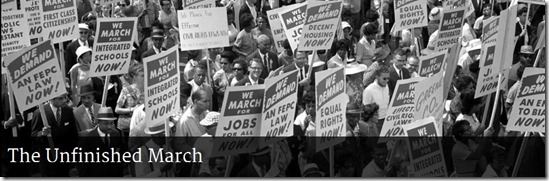
                 unfinished march

The March on Washington fifty years ago was the first of many marches I would make: for civil rights; against one war, then another; against poverty; for women’s rights; for gun control; for the environment; and now back to celebrate the first.

They merge a bit in my memory. I’m not totally sure who all was with me at which event. I definitely remember sweltering in a suit and tie to help bring a white middle-class look to that first March for Jobs and Freedom.

I was inspired by King’s speech. But I was also inspired by practically everyone who spoke that day. To my young earnest policy wonk mind others seemed to be more on the specific agenda message than he was. Certainly I had no sense that his speech would be so historic. Nor that the March would be.

Demand for a Decent Wage Remains Unmet

I was a volunteer foot soldier in Dr. King’s army: registering black voters in Virginia, picketing against discrimination in housing and hiring practices, helping get white faces to meetings and rallies. In 1965, I joined the march from Selma to Montgomery Alabama, where unlike the earlier Washington march, real fear walked with us.

This activism didn’t come naturally. I came from a family of white working poor—mostly indifferent to the oppression of the “Negroes.” We had our own problems paying the rent and putting food on the table. And, at least subconsciously, we were vaguely aware that the subjugation of black people kept us from joining them at the absolute bottom of the economic ladder.

Nor was I a student activist. I had married young and had a wife and two children to support. Just being at the March was something most in my family and the old neighborhood did not understand. Why was this my fight?

Hispanics and Blacks Face Underemployment Crisis

I didn’t fully understand it myself. But King helped me see how the issues of class and race exploitation overlapped. He brought me–like many others–with him on a political journey from the initial moral disgust at the brutal repression in the Jim Crow South to an understanding of the way the entire country’s elite used racial antagonism to keep the working class divided. Finally, to his prescient grasp of the massive damage that the Vietnam War would do to this country.

The spirit on the Mall that day fifty years ago was alive with anger, joy, anxiety and hope. Our goal was to shape America’s future.

We did, in part. But not quite the way I would have guessed. In 1963, I imagined that the economic demands—the “Jobs” part of the March for Jobs and Freedom—would certainly have been met by now. Most of us at that time assumed a more or less continuous rise in living standards for all Americans far into the future. Not just through higher and higher wages, but in public goods and services as well. Certainly, I would have thought that by 2013 we would have had permanent full employment, universal health care, free higher education for anyone who wanted it, and a work week that was well below forty hours.

A More Educated Workforce Earns Higher Wages

On the other hand, I would have thought that the social barriers to integration would fall slower. After all, prosperity was just a technical issue of getting the policy right, while integration meant changing values that seemed deeply rooted in the human psyche.

The social struggle continues of course; how is it that a young black man is shot to death in Florida and no one is guilty? And the gaps between white and black and Latino rates of unemployment and poverty remain. But for anyone who remembers what the relationship between the races 50 years ago, the progress toward a multi-racial society has been remarkable—symbolized by the election of an African-American President with a name like Barack Obama, which at the time would have seemed like science fiction.

Moreover, the civil rights movement later inspired the War on Poverty, the women’s movement, and from there the various drives to extend political and social equality to all who had been left out of the American Dream.

Americans’ Wages Have Been Flat for a Decade

But we were blindsided by the economy. A decade after the 1963 March, the post World War II improvement in income and wealth equality began to reverse. Globalization, the war on unions, deregulation and privatization and the rising influence of the rich on economic policy lowered real incomes and living standards for everyone—whatever the color of their skin. Today, after five years of high unemployment, wage depression and shrinking opportunities, there is no serious plan to change our trajectory—even among those who this week will strut in front of the cameras claiming to be King’s heirs.

The people marching around me Saturday seemed to understand all this. But the images and phrases that we need to galvanize the sense of wider class solidarity still elude us. I know we will eventually find them. Which is why I also know that this was not my last March on Washington.

Ottawa Turns Its Back on Steelworkers-Op-Ed

Aug 23, 2013    http://www.thespec.com   https://i0.wp.com/www.thespec.com/Portals/9/Images/logo.png

U.S. Steel’s destructive agenda is tacitly condoned by Harper government

By Marty Warren, Ontario Director of the United Steelworkers

For the second time in three years, 1,000 families in Nanticoke and surrounding communities face an uncertain future, targeted again by a deliberate attack on working-class living standards achieved over generations of struggle in Canada.

U.S. Steel’s lockout of employees at the Lake Erie Works steel mill — now in its 17th week — reflects the impunity foreign multinationals enjoy to slash Canadian jobs and drive down wages, benefits and working conditions.

U.S. Steel, in particular, has ample reason to believe it has the tacit consent of Stephen Harper’s Conservative government to run roughshod over Canadian working families.

In 2007, the Harper Conservatives approved U.S. Steel’s takeover of Canadian steelmaker Stelco. The deal included legally binding commitments from U.S. Steel to maintain production levels and a 3,100-strong workforce at former Stelco operations.

Time after time, the Harper Conservatives have demonstrated they stand with giant multinationals that abuse their dominant economic power.

U.S. Steel broke those legally binding commitments, with devastating results for working families and pensioners whose combined losses ran into tens of millions of dollars.

“(Their) working lives, retirement and income security have been seriously and adversely affected,” a Federal Court judge stated in 2011 after legal proceedings were launched against U.S. Steel.

The legal action was brought against U.S. Steel under terms of the Investment Canada Act, which dictates foreign takeovers must provide a “net benefit” to Canadians.

The government’s case against U.S. Steel included expert analysis that concluded the company knew full well the implications of its legal commitments. Even in the midst of the recession, fulfilling those promises “would not have threatened the financial viability” of the company, the analysis concluded.

However, rather than enforce the law and hold U.S. Steel accountable, the Harper government struck a secret deal that abruptly ended the court case. Promises of jobs and healthy production levels were abandoned. Workers, pensioners and communities devastated by U.S. Steel’s behaviour were denied their day in court.

With a nudge and a wink from our federal government, U.S. Steel was free to continue its onslaught against Canadian employees and pensioners.

U.S. Steel has now followed the same transparent, destructive pattern in three successive rounds of contract negotiations with former Stelco employees — twice at Lake Erie Works and once at Hamilton’s Hilton Works.

In each case, U.S. Steel has betrayed even the pretense of attempting to negotiate a fair deal for Canadian employees. The agenda has been to abuse the full force of its corporate power and resources to impose its will — under threat of arbitrary, lengthy shutdowns.

In each instance the workers refused to be provoked into a strike. To their credit, they proposed to keep operating their plants while pursuing a settlement through good-faith negotiations aided by government mediation.

U.S. Steel’s agenda dictated otherwise. It locked out Lake Erie Works employees for eight months in 2009-2010, then imposed an 11-month lockout in Hamilton in 2010-2011.

In April of this year, with carte blanche from the federal and Ontario governments to do as it pleases, U.S. Steel locked out Lake Erie Works employees for a second time. Four months later, the community’s largest employer remains shut down.

The locked-out employees, members of United Steelworkers Local 8782, remain committed to negotiating a fair collective agreement and are eager to get back to work.

They have received tremendous support within and outside their community, from like-minded Canadians who understand the need to resist a relentless and orchestrated assault on our middle class.

The workers, their families and supporters will continue to fight the good fight. However, it is beyond shameful that they don’t have their government on their side.

Time after time, the Harper Conservatives have demonstrated they stand with giant multinationals that abuse their dominant economic power to drive down our working and living standards and eliminate good jobs. It is part and parcel of the Conservatives’ low-wage economic strategy for our country.

Earlier this year, without meaningful public debate or consultation, the Harper government decided to arbitrarily amend the Investment Canada Act, folding the changes into its latest omnibus budget bill.

The Conservatives’ changes weaken the Act. They allow for more foreign takeovers to be rubber-stamped. Secret deals will remain the norm. Neither the government nor multinational corporations will be required to consult with, or be accountable to, the Canadian families and communities directly affected by foreign takeovers.

It has never been clearer that only a change in government can reverse this disgraceful trend.

Guardian Charlottetown: Prorogation proves pivotal to prime minister

Harper delays Parliament’s return to redirect attention to economy

https://i0.wp.com/www.theguardian.pe.ca/images/logo/204_GuardianFlag2013.jpg     Published on August 21, 2013

Prime Minister Stephen Harper has thrived by following the abridged axiom: “if it gets too hot in the House, prorogue Parliament.” It has worked well in previous cases of threatened coalitions and heated questioning in the House of Commons. No one should be surprised the PM has chosen the same course this week.

Why not delay facing his critics by another four to five weeks while he fine tunes a new economic plan to distract Canadians from the Senate scandals and get their attention back on jobs and the economy, a trump card he has played so well the past two elections. Whether it work this time remains to be determined.

While making his annual trek through Canada’s north this week, Mr. Harper confirmed he intends to prorogue what has been a disastrous session of Parliament for his Conservative government, a session largely derailed by the scandal over Senate expenses.

It’s a guarantee that Mr. Harper will still face a barrage of questions about those expenses. But the new session will also give him an opportunity to lay out a fresh legislative agenda, concentrating on economic issues which he hopes will steer the Conservatives to victory in the fall of 2015.

The optics are obvious and they are all wrong for the PM. His decision fools no one. Proroguing also kills a number of pieces of legislation. Is it simply irony or part of the overall strategy that Senate reform legislation is just one of the bills that will die on the order paper? The bill would set nine-year term limits for senators and create a mechanism for elections to the upper chamber.

But this stalling tactic to delay a return to fiery Commons question periods is the smart, political move. Who knows what other contentious issue, either nationally or internationally, might arise by late October that could push the Senate scandal off the front pages. It makes little sense to meet NDP, Liberal and Green MPs any earlier than necessary. The PM is a master at the game of playing politics.

The prime minister has used prorogation very effectively in his career. In December 2008, it saved his government from a looming defeat at the hands of a dubious Liberal, NDP and Parti Quebecois coalition, an alliance desperate for power. He prorogued again the following year, halting heated House of Commons committee hearings into the treatment of Afghan detainees.

So Canadians will see a new throne speech in October that will finish off some old business of course, but more importantly set out a new direction for the country towards the end of this decade.

Mr. Harper has already tested the central theme of the next election, attacking other party leaders who have “vacuous minds” and featuring out of control, hire and spend agendas. But he can also expect repeated question about his own good judgment concerning an ill-advised decision to appoint 18 senators, many with dubious credentials, in December 2008 with his government facing defeat and his own future in doubt. That class of 2008 included Pamela Wallin, Patrick Brazeau and Michael Duffy.

So, while NDP Leader Thomas Mulcair thunders a barrage of criticism this week about a desperate government worn out by ethical scandals and mismanagement, and Deputy Liberal leader Ralph Goodale suggests that Mr. Harper is trying to avoid answering questions about his former chief of staff’s $90,000 cheque to Sen. Duffy, the prime minister is nonchalantly posing for photo ops with polar bears, far from the madding crowd.

Democracy delayed

https://i0.wp.com/www.capebretonpost.com/images/logo/cbpost-header.png

Staff ~ The Cape Breton Post      Published on August 22, 2013

Prime Minister Stephen Harper makes a sound argument for proroguing Parliament. He says it’s a chance for his government to set out its agenda for the last half of its current mandate via a new throne speech.

Fair enough. But extending the parliamentary break by about a month in concert with prorogation is both unnecessary and undemocratic.

So far in 2013, the House of Commons sat for 75 days, between Jan. 28 and June 18, after which MPs started their three-month summer break.

They were due back in the House on Sept. 16, but now the prime minister says that parliamentarians won’t get their bums back in the House of Commons seats until October, reportedly after Thanksgiving, which lands in the middle of the month.

As NDP Leader Tom Mulcair noted, Harper could prorogue and restart Parliament with a throne speech on Sept. 16. There’s no need for an extended break.

In June, Mervyn Poole of North Sydney penned a letter to the editor criticizing the length of the House of Commons summer break. He wrote: “Three months is preposterous. A month seems ample to me.”

In response, Sydney-Victoria MP Mark Eyking wrote that he would spend the break “attending meetings, festivals and community events, travelling hundreds of kilometres around Cape Breton and enjoying it. This gives me the opportunity to hear first-hand the constituents’ personal issues and community concerns to take back to Ottawa in September.”

Eyking added: “I enjoy travelling and connecting with everyone throughout the summer. I guess you could say I am on a working vacation.”

That wasn’t a surprising response coming from Eyking, who, like many politicians, isn’t known for his dynamic parliamentary speaking skills or for his mastery of policy matters. His advantage lies in being a strong constituency politician — attending as many community events, shaking as many hands, listening to as many complaints and appearing in as many photos as possible.

Constituency work is important. But Parliament exists for a reason.

After Harper prorogued Parliament in December 2009, Cape Breton Post political columnist David Johnson wrote a followup piece.

Johnston stated: “Canadians love to make fun of politicians and to lament the silly games and partisanship often found in Parliament, especially in question period. But such criticisms should never be seen as Canadians showing disrespect for the institution of Parliament, or laughing at the symbolism of Parliament.

“To most Canadians, Parliament is where the government works. Parliament is where our democratically elected representatives are supposed to serve us. Parliament is where Canadian democracy is enshrined.”

By extending the current parliamentary break by another month, Harper can delay answering uncomfortable and potentially damaging questions about, for example, Sen. Pamela Wallin’s inappropriately claimed travel expenses, which, we learned Wednesday, total almost $139,000.

At the same time, the prime minister will delay democracy.


Prorogation marks desperate attempt to change the channel

Written by Carol Hughes, MP

Friday, 23 August 2013    http://www.wawa-news.com

If you watched Question Period during the last five weeks parliament sat in the spring, you didn’t see much of the Prime Minister.  When Stephen Harper was around over that stretch, it was anything but smooth sailing.  Day after day he faced a tough line of questioning from Tom Mulcair about the Mike Duffy/Senate expense scandal and the attempted cover-up performed by the Prime Minister’s chief of staff.  His answers were weak and it was clear he was losing patience with the situation.

For a man with a reputation for controlling every situation it was easy to understand that he wouldn’t want to be in Question Period.   That doesn’t mean that he should have avoided Parliament so much.  Much the same, it is no excuse to avoid facing those same, tough, unanswered questions, but that is what the Prime Minister is doing by proroguing Parliament and delaying the start of the autumn sitting likely by as much a five weeks.

The problem with the growing cynicism over prorogation is of the Prime Minister’s own making.  This is the fourth time he has used the parliamentary tool and in each case it has been employed primarily to avoid scandal.   The scandal he is avoiding this time is also of his own making. With the exception of Liberal Senator, Mac Harb, Stephen Harper appointed the Senators at the centre of the storm.

Throughout the summer the problem has only deepened.  While we do hear less about Mike Duffy and Nigel Wright, we are hearing more and more about Senator Pamela Wallin, who has now been ordered to repay $138,970 due to misappropriation and is the subject of an ongoing RCMP investigation.

It looks as if the Prime Minister considered the appropriateness of his Senate appointments as a secondary concern when vetting candidates.  The clear emphasis seems to have been on whether they were politically useful to the Conservative Party – especially with Senators Duffy and Wallin. 

Now it is time to be accountable for those appointments and any attempts that members of the Prime Minister’s inner circle have made to sweep these problems under the rug.  Instead of returning to Parliament, answering the tough questions, and working our way through the government bills that remain at various stages of the parliamentary process, the Prime Minister is going to hide out for another month and start from scratch – again.

This buys a little time, but Canadians are clearly outraged by the entitled behavior of these patronage appointees and that anger won’t dissipate as quickly as the Prime Minister hopes.  What is being slowly ground down is any faith Canadians have in the effectiveness of our democratic institutions.  It is beyond ironic that the Senate, which is inherently undemocratic, is at the heart of the problem.  While the Prime Minister makes vague statements about reforming the Senate, public opinion is growing in support of the long held New Democrat position that we should just abolish it altogether.

As far as answering for the actions of his patronage appointees and senior members of his inner circle, the Prime Minister will eventually have to deal with the fact that no amount of hiding can wash away the bitter taste of deceit that Canadians are experiencing.  Although it is clear he is going to give that another try.