Category Archives: News
Check out @bersonphoto’s Tweet: https://twitter.com/bersonphoto/status/718561695837237249?s=09
BC FERRIES OFFERS COMPLIMENTARY FERRY TRAVEL FOR EMERGENCY FIRST RESPONDERS ATTENDING CONSTABLE SARAH BECKETT’S MEMORIAL SERVICE
Additional Tsawwassen – Swartz Bay sailing added at 10 a.m. on April 12
National Executive Board Highlights – March 2016 | Canadian Union of Public Employees

Our National Executive Board met March 21–23, 2016 in Ottawa. These are the highlights of their deliberations and decisions.
In Memory
The National Executive Board (NEB) observed a minute of silence to reflect upon the loss of members in our CUPE family. Remembered were: Brother Elwin “Sonny” Kalynchuk, Local 474; Brother Leonard Sarnosky, Local 941; Brother Thierry Leroux, Local 5153 (workplace fatality); Brother Claude Davidson, Local 3333 (workplace fatality); Sister Linda Hildebrand, Local 1858; retirees Sister Margaret Churchward, Brother Thomas Osborn, Brother Pierre Thériault; and CUPE Nova Scotia President Brother Mike McNeil. The NEB also remembered victims of the violent attacks in Belgium that morning.
Broadbent Institute
The NEB met with Ed Broadbent and Rick Smith of the Broadbent Institute and discussed the work they have undertaken and their priorities for the coming year, including income inequality and democratic renewal. It was an honour to have Mr. Broadbent’s presence on his 80th birthday, and he was appropriately feted.
NEB Resolution – Electoral Reform
The NEB adopted a strong resolution which commits CUPE to support the introduction of proportional representation for federal elections, develop materials for internal use to explain and promote it, and work with civil society partners to engage in the conversation about democratic reform in Canada. View the full resolution at: http://cupe.ca/neb-resolution-proportional-representation.
The NEB also voted to join the Every Voter Counts Alliance: http://www.everyvotercounts.ca/
Support for Striking Workers
In solidarity with 61 members of the Halifax Typographical Union who have been on strike at the Halifax Herald since January 23, 2016, the NEB approved a donation in the amount of $10,000.
The NEB also approved a donation of $7,000 to seven members of the Nova Scotia Union of Public and Private Employees who have been on strike against Canadian Blood Services in Prince Edward Island for more than six months.
2016 Federal Budget
CUPE economist Toby Sanger joined the NEB on March 23 to provide an overview of the federal budget, which had been introduced the previous day. There was some good news in the budget, including some improvements to Employment Insurance (EI), measures to start combating climate change, investments in infrastructure, and new funding for Canada’s indigenous communities especially on education.
However, there are still significant improvements needed to EI; there was no commitment to expanding the Canada Pension Plan, no commitment on the creation of affordable and accessible child care. And while the Minister pledged in his speech to negotiate a new health accord with the provinces and territories, there is no new money to do so.
CUPE Fightback Fund
The NEB approved a request from SCFP-Québec for financial support in order to fend off an unprecedented attack on the province’s municipal workers, in anticipation of legislation that would undermine the right of these workers and their unions to free and fair negotiations.
A request from CUPE Nova Scotia, for financial support to mount a provincial fightback campaign in response to legislation that removes free collective bargaining in the provincial public service and mandates the terms of a public sector agreements, also received NEB approval.
Financial Support
The NEB approved 15 cost shares for a total of $762,089.46. The NEB also received and approved 14 requests for legal/arbitration costs for $508,933.
Attachments  NEB Highlights – March 2016
NEB Highlights – March 2016Source: National Executive Board Highlights – March 2016 | Canadian Union of Public Employees
Budget 2016: Key Issues for Parliamentarians

Get the report
Budget 2016: Key Issues for Parliamentarians.pdf
Summary
The presentation of the fiscal plan
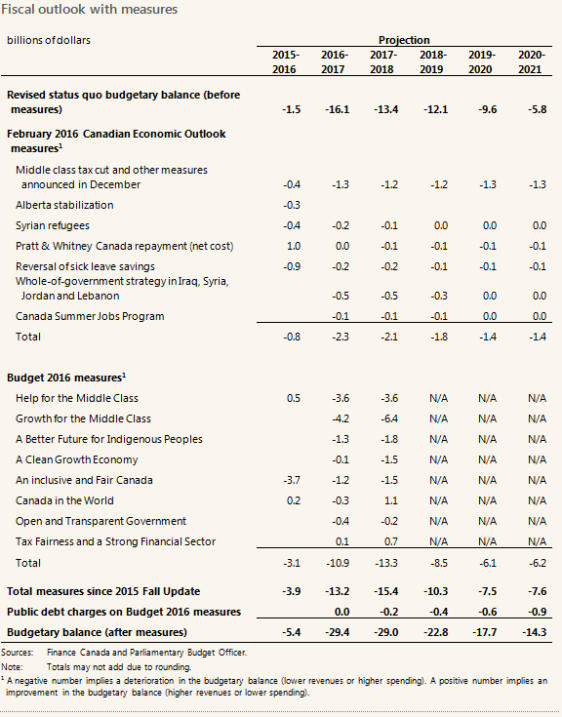
The Government has made changes to the presentation of its fiscal plan that have made it more difficult for parliamentarians to scrutinize public finances.
- The Government did not provide detailed tables that identify the impact of changes to its adjustment to the private sector forecast and the effect of policy measures.
- Budget 2016 shortened the time horizon of cost estimates from 5 years to 2 years.
- Key fiscal information is being released outside of the budget and Fall Update with no reconciliation between the main documents.
To maintain consistency with past presentation practices, PBO has attempted to compile the standard fiscal planning tables for Budget 2016. However, PBO is unable to provide completed tables due to the lack of information provided in Budget 2016. PBO requested the necessary data from Finance Canada in order to publish completed tables for parliamentarians.
The Government’s adjustment to private sector economic assumptions
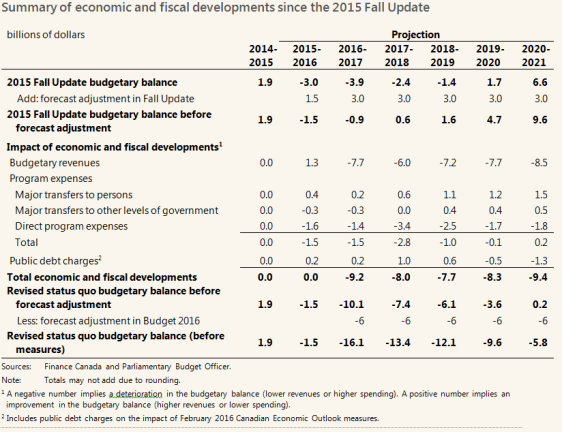
Budget 2016 highlights that the use of private sector economic forecasts for fiscal planning “introduces an element of independence in the Government’s fiscal forecast.” However, in Budget 2016, the Government judged it appropriate to lower the private sector forecast of nominal gross domestic product (GDP)—the broadest single measure of the tax base—by $40 billion per year over 2016 to 2020. This forecast adjustment translates into a fiscal impact of $6 billion annually over 2016-17 to 2020-21.
Based on historical experience, PBO believes that the $40 billion per year forecast adjustment to the February 2016 private sector forecast of nominal GDP in 2016 and 2017 is excessive. Indeed, based on the past performance of private sector forecasters, it is likely that the actual outcome for nominal GDP in 2016 and 2017 will exceed the levels used for fiscal planning purposes, resulting in smaller-than-expected budgetary deficits in 2016-17 and 2017‑18, all else being equal.
PBO believes that the Government’s adjustments to the private sector forecast (particularly when the adjustments are excessive and always in the same direction) erode the “element of independence” that is introduced into the fiscal plan by using the average private sector forecast.
PBO is, however, encouraged by the inclusion of alternative growth scenarios in Budget 2016 to gauge the sensitivity of the fiscal track. Budget 2016 also commits the Government to develop alternative growth scenarios and their fiscal implications, communicating the analysis “to Canadians as projections are updated.”
Finance Canada’s estimates of the economic impacts of Budget 2016 measures
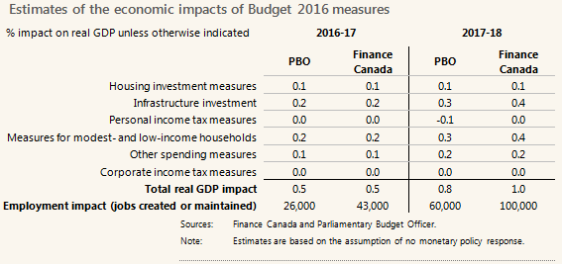
Finance Canada has provided estimates of the economic impacts of measures contained in Budget 2016 based on its macroeconomic and fiscal model. However, unlike previous analyses, Finance Canada did not conduct an external assessment of its estimates. For instance, in Budget 2009, to gauge the sensitivitiy of its estimates, Finance Canada asked private sector organizations to calculate comparable fiscal multipliers.
To provide parliamentarians with an independent estimate of the economic impacts of Budget 2016 measures, PBO has used its own macroeconomic and fiscal model. On balance, these estimates are somewhat smaller than Finance Canada’s.
PBO’s estimates assume that measures in Budget 2016 will be implemented as scheduled and as targeted. Aside from the uncertainty surrounding fiscal multiplier estimates, differences in timing (for example by lapsing funds) or in the targeted sector would impact these results.