
Federal Budget 2016 in depth: Infrastructure | Canadian Union of Public Employees

Apr 18, 2016

Summary

As promised and expected, the 2016 federal budget focuses extensively on infrastructure. While the proposed spending falls short of the Liberals’ promise to provide an immediate injection of $5 billion into the economy, it does outline a substantial output of $11.9 billion over the next five years, much of which will be available immediately.

The infrastructure spending will come in two phases. The first phase begins in 2016 and comprises the $11.9 billion, allocated in three major areas:

  • infrastructure ($3.4 billion)
  • Water, wastewater, and green infrastructure ($5 billion)
  • Social infrastructure such as affordable housing and child care ($3.4 billion)

Phase one has been described as the “maintenance” phase, where existing infrastructure or already-planned infrastructure projects will receive a necessary influx of federal cash. To this end, a number of new funds, such as the Public Transit Infrastructure Fund, have been established to manage disbursement. The government will also leverage existing funds, such as the Gas Tax Fund, to target infrastructure priorities. Finally, the government plans to download some of the fund management to partners such as the Federation of Canadian Municipalities – which will deliver $250 million of new funding to its members for various infrastructure projects – and the Canada Mortgage and Housing Corporation – which will participate in the design of affordable housing strategies.

Phase two of the infrastructure funding will commence in two years, and will be focus on larger long-term goals such as transitioning to a clean and green economy, and facilitating a greater capacity for global trade.

The Good

There are a number of aspects of the federal budget’s infrastructure plan that appear positive. Generally speaking, the Liberal government has halted the previous government’s trend of reduced social spending and austerity budgets. Increased infrastructure spending is the right move in a stagnant economic period, when borrowing costs are relatively low.

More specifically, we are pleased to see the government:

  • Remove the public-private partnership (P3) screen on large infrastructure projects, and the P3 requirement on transit projects.
  • Commit to funding up to 50 per cent of most infrastructure projects, rather than maintain the previous 1/3 ratio. Many communities would have been unable to meet the previous financial threshold, so this is a welcome change.
  • Focus on the importance of water-related infrastructure, particularly on First Nation reserves.
  • Focus on affordable housing, including housing for seniors, for the homeless, and for those fleeing domestic violence.
  • Commit to green infrastructure, including the integration of climate resiliency into building standards. In particular, we applaud the commitment to environmentally-conscious repairs and retrofits for federal infrastructure, which includes an exploration of alternative energy sources.

The Bad

While this budget reverses the previous government’s move to shackle public infrastructure spending to the private sector, the current government’s infrastructure plan establishes an open and fertile ecosystem for privatization. Indeed, the budget specifically mentions that the government will “examine new innovative financing instruments” and “engage public pension plans and other innovative sources of funding” to get projects moving. It also states the government’s interest in so-called “asset recycling” – one of the newest terms used for the privatization of public assets to for-profit interests.

Most of the evidence suggests that when public services and public assets are privatized, costs are higher and quality suffers. The private ownership of infrastructure – even if that owner is a workers’ pension plan – represents a real diminishment in value for Canadians. It is both ironic and unfortunate that the loosening of P3 requirements by the Liberals may result in a proliferation of privatization fights over infrastructure.

In addition to its gestures toward privatization, the amounts allocated in the budget are not sufficient to close the infrastructure gap in Canada. Furthermore, we note that a financial commitment and a capacity to carry out that commitment are very different things. Already, for example, Engineers Canada has speculated publicly about the shortage of engineers prepared to carry out this work, and the Federation of Canadian Municipalities has pointed out that detailed spending requirements have not yet been established.

The Fix

While the federal budget displays an important commitment to infrastructure spending, we call on the government to bolster this commitment – in policy and/or in subsequent budgets – with the following:

  • Implement strict rules around transparency and accountability for public-private partnerships.
  • Eliminate PPP Canada Inc. and redirect the $1.25 billion P3 Canada Fund to public infrastructure projects.
  • Ensure that federal money only goes to projects with clear ethical procurement policies.
  • Maintain basic oversight over projects that receive infrastructure funding to ensure shovels in the ground as quickly as possible.

CUPE will continue to encourage our members, and other labour organizations, to:

  • Speak out against the privatization of infrastructure in your communities.
  • Resist moves by municipalities to enter into P3 arrangements for infrastructure and public services.
  • Challenge the administrators and trustees of pension plans to move away from investment in P3s for infrastructure, and support investments that renew and strengthen public ownership and control.

Source: Federal Budget 2016 in depth: Infrastructure | Canadian Union of Public Employees

TPP: Urgent need for full, independent assessment | Canadian Union of Public Employees
Apr 18, 2016

Hearings into the massive Trans-Pacific Partnership kicked off in Vancouver with a stark warning from the Trade Justice Network about the deal’s many negative consequences, and an urgent call for a comprehensive, public and independent assessment of the pact.

TJN co-chair Blair Redlin told members of the House of Commons Committee on International Trade there is no rush to ratify the TPP, and every reason for a proper economic, social and environmental evaluation of the deal. CUPE is a member of the Trade Justice Network.

Outside the hearings, demonstrators rallied against Canada ratifying the deal, and advocacy group OpenMedia organized a giant TV screen displaying protest messages from across the country.

Redlin told the committee the TPP’s main goal is to protect foreign investors by securing and expanding corporate rights. The deal is less about trade, as 97 per cent of Canada’s exports to TPPcountries are already duty-free.

The TPP’s investor-state dispute settlement (ISDS) system will let foreign corporations sue governments if a law or regulation interferes with their investments – and profits. Under theseNAFTA-style rules, Canada is already the most-sued developed country. Expanding access to this one-sided process could mean a spike in new cases.

The TPP’s controversial ISDS rules will limit government powers to regulate in the public interest, including by supporting industries that create good local jobs, and protecting the environment. A government investing in transit or wind turbines could face challenges for favouring local procurement.

Ratifying the TPP comes at a high price, said Redlin. Independent analysis of the deal has found it will:

  • Cost Canada 58,000 jobs
  • Increase income inequality
  • Limit access to generic drugs, which in turn will drive up health care costs
  • Let corporations move to countries with cheaper labour and weaker labour laws
  • Hurt Canada’s agricultural, manufacturing and technology sectors
  • Threaten internet freedom

Redlin highlighted the outcomes of a recent TJN-sponsored forum, where Nobel Prize-winning economist Joseph Stiglitz described the TPP as the “worst trade deal ever.”

The TPP was finalized by the former Harper government during last year’s federal election, and then signed by the new Liberal government. Consultations on the deal have been limited, poorly publicized, and have appeared to favour the voices of corporations – not citizens.

Source: TPP: Urgent need for full, independent assessment | Canadian Union of Public Employees

Prime Minister to Travel to New York to Sign the Paris Agreement on Climate Change

OTTAWA, April 18, 2016 /CNW Telbec/ – The Prime Minister, Justin Trudeau, today announced that he will travel to New York Cityfrom April 20 to 22, 2016, to sign the Paris Agreement on climate change.

Canada has committed to play a positive and constructive role in the world, and to make meaningful contributions to important global challenges such as climate change.

In November 2015, Canada and 194 other countries reached the Paris Agreement— an international agreement to address climate change that is ambitious, durable, and applicable to all parties. It recognizes the important role of subnational governments, civil society, and the private sector, and it highlights Indigenous, community, human, and gender rights.

During his visit, the Prime Minister will also discuss the issues of climate change and youth engagement with students at New York University, and meet with counterparts.

Canada has resolved to be an international leader in the low carbon global economy over the coming decades. The government will continue to work with our provincial, territorial, and international partners to develop a more coordinated approach to climate change, so that our children and our grandchildren can enjoy a world more prosperous and sustainable than the one we know today.

Quote

Canada is a country whose greatest strength is its respect for diversity and pluralism.  We have much to contribute to the international community – from combatting climate change to helping build a more peaceful and prosperous world.”

– Rt. Hon. Justin Trudeau, Prime Minister of Canada

This document is also available at http://pm.gc.ca

For further information: PMO Media Relations: 613-957-5555

Source: Prime Minister to Travel to New York to Sign the Paris Agreement on Climate Change

Silver Price Manipulation Class Action Brought on Behalf of Canadian Investors

TORONTO, April 15, 2015 /CNW/ – A class action lawsuit seeking $1 billion in damages on behalf of Canadian investors was launched today in the Ontario Superior Court of Justice.

The class action alleges that the defendants, including The Bank of Nova Scotia, conspired to manipulate prices in the silver market under the guise of the benchmark fixing process, known as the London Silver Fixing, for a fifteen-year period.

It is further alleged that the defendants manipulated the bid-ask spreads of silver market instruments throughout the trading day in order to enhance their profits at the expense of the class. This alleged conduct affected not only those investors who bought and sold physical silver, but those who bought and sold silver-related financial instruments.

Law enforcement and regulatory authorities in the United States, Switzerland, and the United Kingdom have active investigations into the defendants’ conduct in the precious metals market.

The case is on behalf of all persons in Canada who, between January 1, 1999 and August 14, 2014, transacted in a silver market instrument either directly or indirectly, including investors who participated in an investment or equity fund, mutual fund, hedge fund, pension fund or any other investment vehicle that transacted in a silver market instrument.

A copy of the Notice of Action can be found at sotosllp.com. Potential class members can register on the website to obtain more information as the case progresses.

The plaintiffs and the proposed national class are being represented by a national team of lawyers from Sotos LLP (www.sotosllp.com), Koskie Minsky LLP (www.kmlaw.ca) and Camp Fiorante Matthews Mogerman (www.cfmlawyers.ca) with offices inOntario and British Columbia.

SOURCE Sotos LLP

For further information: contact David Sterns at 416-977-5229 or dsterns@sotosllp.com

Source: Silver Price Manipulation Class Action Brought on Behalf of Canadian Investors

Alberta business owners still worrying about labour: ATB poll

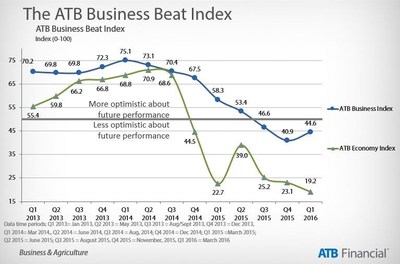
The ATB Business Beat Index (CNW Group/ATB Financial)

CALGARY, April 18, 2016 /CNW/ – Just as it was one year ago, Alberta small and mid-sized enterprise owners and operators (SMEs) are worried about labour and workforce issues. But the reasons they worry about employee-related issues has changed. That’s the key finding from the latest edition of the ATB Business Beat survey.

In each survey, ATB asks SMEs what, besides sales, keeps them up at night. One year ago, the most popular answer was labour/workforce, with comments focusing on the difficulty of finding and retaining skilled employees. In the latest edition of the Business Beat, worries about keeping staff members employed and busy, pending layoffs and meeting payroll were the most common SME concerns.

“What a difference a year can make,” said Wellington Holbrook, ATB’s Executive Vice-President, Business & Agriculture. “The economic downturn has had a major impact on small and mid-sized businesses in Alberta, especially when it comes to keeping staff on. We encourage any business owner in Alberta having difficulty making payroll to talk to your banker. Depending on your unique situation, we may be able to help, both in the short term and long term.”

The ATB Economy Index—which measures confidence in the province’s economy among Alberta SMEs—is at an all-time low. The Economy Index currently sits at 19.2, down from 23.1 in January. The ATB Business Index, meanwhile, rebounded slightly to 44.6, up from 40.9 in the previous survey. The Business Index measures small and mid-sized business owners’ confidence in their own operations. Scores below 50 mean more respondents feel pessimistic than optimistic.

Breaking down the results to specific sectors, SMEs in the energy sector are the most optimistic in the Alberta economy with an Economy Index result of 21.6. SMEs in the retail sector are the least optimistic with an index of 16.4. When it comes to confidence in their own operations, SMEs in the construction sector are the most optimistic with a Business Index result of 52.0. Once again, retail SMEs are the least optimistic in their own operations with an index of 32.0.

Click here to view the full report.

Source: Alberta business owners still worrying about labour: ATB poll