Researchers Create Detailed ‘Semantic Atlas’ of the Mind 

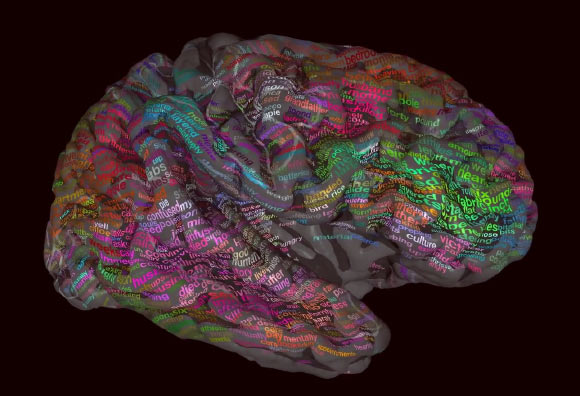
Scientists at the University of California, Berkeley, build a semantic atlas to chart how the brain responds to language. Image credit: University of California, Berkeley.

A team of neuroscientists and psychologists at the University of California, Berkeley, has created a detailed ‘semantic atlas’ showing which human brain areas respond to hearing different words. The results were published this week in the journal Nature.

“Our goal in this study was to map how the brain represents the meaning (or semantic content) of language,” explained lead author Alexander Huth, from the University of California’s Helen Wills Neuroscience Institute. “Most earlier studies of language in the brain have used isolated words or sentences.”

“We used natural, narrative story stimuli because we wanted to map the full range of semantic concepts in a single study. This made it possible for us to construct a semantic map for each individual, which shows which brain areas respond to words with similar meaning or semantic content.”

“Another aim of this study was to create a semantic atlas by combining data from multiple subjects, showing which brain areas represented similar information across subjects.”

Huth and six other native English-speakers served as subjects for the experiment.

They listened passively to several stories selected from The Moth Radio Hourwhile brain activity was monitored using functional magnetic resonance imaging (fMRI). The stories were then transcribed and annotated with the time each word was spoken.

Then the scientists used the fMRI data and story transcripts to build computational models that predict brain activity as a function of which words the subject heard. To validate these models, they were used to predict fMRI responses to a new story that had not been used before.

“We found that the models were able to predict responses relatively well throughout several broad regions of the cerebral cortex,” Huth said.

“Next, we aimed to discover what types of semantic information were represented at each point in cortex. In order to visualize the very high-dimensional semantic models, we used a dimensionality reduction technique called principal components analysis (PCA).”

PCA finds the most important dimensions in a dataset, which allowed the team to reduce the 985-dimensional models to only three dimensions, while preserving as much information as possible.

“We used these three dimensions to visualize roughly which types of semantic information were represented at every location in the cortex, revealing complex semantic maps that tile the brain,” Huth said.

“Finally, to discover which aspects of these maps are shared across subjects we developed and applied a new computational approach called PrAGMATiC. This approach finds functional areas that are shared across subjects, while also allowing for individual variability in the anatomical location of each area.”

According to Huth and co-authors, detailed maps showing how the brain organizes different words by their meanings could eventually help give voice to those who cannot speak, such as victims of stroke or brain damage, or motor neuron diseases such as ALS.

“While mind-reading technology remains far off on the horizon, charting how language is organized in the brain brings the decoding of inner dialogue a step closer to reality,” they said.

For example, clinicians could track the brain activity of patients who have difficulty communicating and then match that data to semantic language maps to determine what their patients are trying to express.

Another potential application is a decoder that translates what you say into another language as you speak.

_____

Alexander G. Huth et al. 2016. Natural speech reveals the semantic maps that tile human cerebral cortex. Nature 532, 453-458; doi: 10.1038/nature17637

Source: Researchers Create Detailed ‘Semantic Atlas’ of the Mind | Neuroscience | Sci-News.com
One in six children hospitalized for lung inflammation positive for marijuana exposure 

BALTIMORE, MD – A new study to be presented at the Pediatric Academic Societies 2016 Meeting found that one in six infants and toddlers admitted to a Colorado hospital with coughing, wheezing and other symptoms of bronchiolitis tested positive for marijuana exposure.

The study, “Marijuana Exposure in Children Hospitalized for Bronchiolitis,” recruited parents of previously healthy children between one month of age and two years old who were admitted to Children’s Hospital Colorado (CHC) between January 2013 and April 2014 with bronchiolitis, an inflammation of the smallest air passages in the lung. The parents completed a questionnaire about their child’s health, demographics, exposure to tobacco smoke, and as of October 2014, whether anyone in the home used marijuana. Marijuana became legal in Colorado on January 1, 2014.

Of the children who were identified as having been exposed to marijuana smokers, urine samples showed traces of a metabolite of tetrahydrocannabinol (THC), the psychoactive component of marijuana, in 16 percent of them. The results also showed that more of the children were THC positive after legalization (21 percent, compared with 10 percent before), and non-white children were more likely to be exposed than white children.

The findings suggest that secondhand marijuana smoke, which contains carcinogenic and psychoactive chemicals, may be a rising child health concern as marijuana increasingly becomes legal for medical and recreational use in the United States, said lead researcher Karen M. Wilson, MD, MPH, FAAP, an associate professor of pediatrics at the University of Colorado School of Medicine and section head at CHC. Most states with legal marijuana do not restrict its combustion around children, she said.

“Our study demonstrates that, as with secondhand tobacco smoke, children can be exposed to the chemicals in marijuana when it is smoked by someone nearby,” Dr. Wilson said. “Especially as marijuana becomes more available and acceptable, we need to learn more about how this may affect children’s health and development.” In the meantime, she said, “marijuana should never be smoked in the presence of children.”

Source: American Academy of Pediatrics

Source: One in six children hospitalized for lung inflammation positive for marijuana exposure | Science Codex

Scientists Identify Brain Circuit that Controls Binge Drinking 

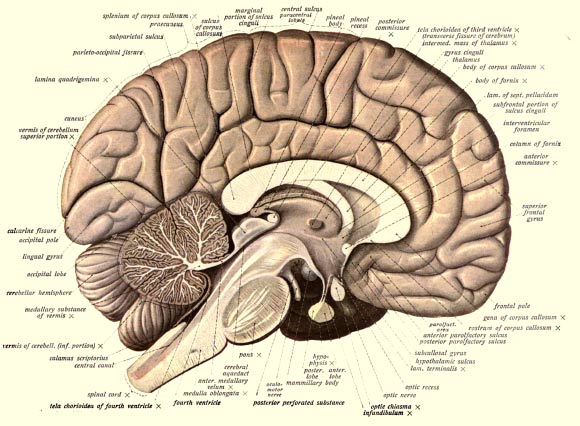
An anatomical illustration from Sobotta’s Human Anatomy, 1908, shows the structure of a human brain. Image credit: Dr Johannes Sobotta.

A team of scientists led by Dr. Todd Thiele from the University of North Carolina at Chapel Hill has identified a circuit between two brain regions that controls binge ethanol intake.

The two brain areas – the extended amygdala and the ventral tegmental area – have been implicated in alcohol binge drinking in the past.

However, this is the first time that the two areas have been identified as a functional circuit, connected by long projection neurons that produce a substance called corticotropin releasing factor (CRF).

The results, published online March 3, 2016 in the journal Biological Psychiatry, provide the first direct evidence in mice that inhibiting a circuit between two brain regions protects against binge alcohol drinking.

“The puzzle is starting to come together, and is telling us more than we ever knew about before,” Dr. Thiele said.

“We now know that two brain regions that modulate stress and reward are part of a functional circuit that controls binge drinking and adds to the idea that manipulating the CRF system is an avenue for treating it.”

In their study, Dr. Thiele and co-authors show that alcohol activates the CRF neurons in the extended amygdala, which directly act on the ventral tegmental area.

These observations in mice suggest that when someone drinks alcohol, CRF neurons become active in the extended amygdala and act on the ventral tegmental area to promote continued and excessive drinking, culminating in a binge.

“The findings may shed light on future pharmacological treatments that may help individuals curb binge drinking and may also help prevent individuals from transitioning to alcohol dependence,” Dr. Thiele said.

“It’s very important that we continue to try to identify alternative targets for treating alcohol use disorders.”

_____

Jennifer A. Rinker et al. Extended Amygdala to Ventral Tegmental Area Corticotropin-Releasing Factor Circuit Controls Binge Ethanol Intake.Biological Psychiatry, published online March 3, 2016; doi: 10.1016/j.biopsych.2016.02.029

Source: Scientists Identify Brain Circuit that Controls Binge Drinking | Neuroscience | Sci-News.com

Canucks sign Thatcher Demko

Vancouver, B.C. – Vancouver Canucks General Manager Jim Benning announced today that the club has signed goaltender Thatcher Demko to a three-year entry-level contract.

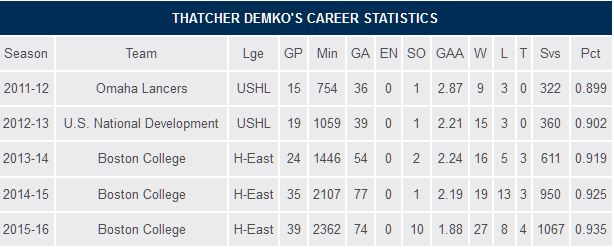
Demko, 20, completed his third season with Boston College, leading the Eagles to the Hockey East regular season championship and a berth in the NCAA Frozen Four. Demko posted a 27-8-4 record along with a .935 save percentage and a 1.88 goals-against average in 39 games with the Eagles this season. His 10 shutouts on the year set a new Boston College school record and ranks as the second most in college hockey history for a single season.

The 6-4, 195-pound goaltender was awarded the 2016 Mike Richter Award as the most outstanding goaltender in NCAA men’s hockey. He was also a finalist for the 2016 Hobey Baker Award.

In three seasons at Boston College, Demko has posted a 62-26-10 record, along with a 2.08 goals-against average and a .928 save percentage. A native of San Diego, California, Demko was originally selected by Vancouver in the second round, 36th overall, at the 2014 NHL Entry Draft.

Capture

Source: Canucks sign Thatcher Demko – Vancouver Canucks – News

Canadian Government Economic and Fiscal Outlook – April 2016

Get the report
Economic and Fiscal Outlook – April 2016

Get the data

EFO April 2016 – Figures.xlsx  

Summary

This report responds to the 4 February 2016 Standing Committee on Finance motion. It incorporates data available up to and including 12 April 2016.

Since the Parliamentary Budget Officer’s November 2015 report, the outlook for the global economy has deteriorated further. Expectations of the future path of prices for key commodities have also been revised lower.

Despite this weaker external outlook, PBO anticipates that the combination of fiscal measures in Budget 2016 and accommodative monetary policy will help bolster the Canadian economy.

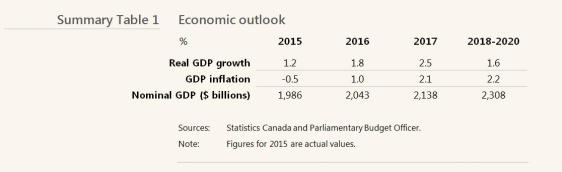
PBO projects that growth in real gross domestic product (GDP) will rebound to 1.8 per cent in 2016 and then rise to 2.5 per cent in 2017. Economic growth is then expected to moderate over 2018 to 2020, reflecting the tapering of fiscal measures and the normalization of monetary policy.

The level of nominal GDP—the broadest single measure of the tax base—is projected to be almost $20 billion lower each year, on average, between 2016 and 2020 compared to our November report.

However, relative to the Government’s planning assumption for nominal GDP in Budget 2016 our projection is, on average, $40 billion higher per year over 2016 to 2020. The difference is most pronounced in 2016 and 2017, reaching close to $50 billion in those years.

PBO’s November 2015 fiscal outlook provided an independent status quo planning assumption for the start of the 42nd Parliament. We have updated our fiscal outlook to include measures announced in Budget 2016 as well as measures announced prior to the budget.

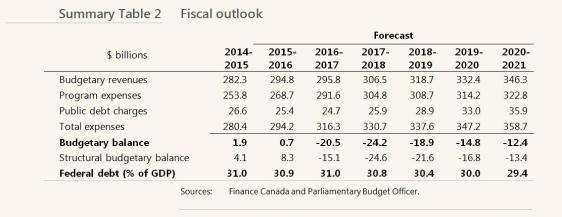
PBO estimates there was a small surplus in 2015-16. We expect a budgetary deficit of $20.5 billion in 2016-17, which is mostly attributable to $13.2 billion of new measures since the Fall Update. The deficit is then projected to rise to $24.2 billion in 2017-18 as the result of moving to the 7-year breakeven mechanism for Employment Insurance premium rates (a 15 per cent reduction in contributions) and a $7.5 billion increase in direct program expenses.

We project the deficit to decline to $12.4 billion over 2018-19 to 2020-21 based on the Government’s forecast that direct program expenses (DPE)—in particular the operating costs of departments—will remain flat over the period 2017-18 to 2019-20.

PBO’s forecast of the budgetary deficit is $4.5 billion lower, on average, than Budget 2016 over the projection horizon. The average difference is roughly in line with the Budget 2016 forecast adjustment, which removed $40 billion from GDP (equivalent to $6 billion in revenues) in each year of the Government’s planning horizon.

Source: Economic and Fiscal Outlook – April 2016