Canada Winter Forecast 2017 Is A Grim One, Sorry

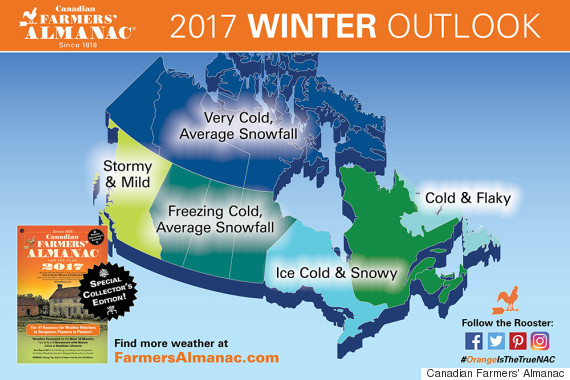
Don’t you dare brag, B.C. Karma will come for you someday. (Photo: Canadian Farmers’ Almanac)

By Emma Prestwich

Sept 21, 2016

Shh, shh. Just curl up under the covers. It’ll all be over by April. We hope.

After a warmer-than-normal winter last year, Canada is due for an old-fashioned deep freeze in 2017, according to the Canadian Farmer’s Almanac.

Most of the country will see a cold or very cold winter, the publication says, with the Prairies, Ontario, Quebec, the north and the Maritimes expected to shiver until spring.

British Columbia, however, will be “stormy and mild.” Of course.

The Northwest Territories, Yukon, Nunavut and the Prairies will see average levels of snow, but an active storm track will dump above-average levels of precipitation on Quebec and the Maritimes.

Another active storm track will bring B.C. more precipitation than normal, but with the temperatures expected to be mild, we’re going to assume that just means more rain.

The Almanac also forecasts a chilly February. It said between Feb. 16 to 19, a small, powerful storm near the U.S. mid-Atlantic coast will gift heavy snow to Nova Scotia — potentially up to 30 centimetres — along with powerful winds.

canada snow

A man shovels snow during a winter storm in Ottawa, Feb. 16, 2016. (Photo: Chris Wattie/Reuters)

The middle of the month will also bring chilly temperatures over the eastern three-quarters of the country, with temperatures dropping as low as -40 C in some places.

Apparently the Almanac is usually right

In an interview with CBC Radio’s Metro Morning, the Almanac’s Pete Geiger predicted that the cold will start in October and won’t really go away. He said, however, that mid-January and February will be the worst.

“It’ll be winter in Canada, just as we always dreamed it would be.”

But how does the publication come up with its predictions? It uses a formula that takes into consideration factors like the position of the planets, sunspot activity, and the way the moon affects the tides.

We don’t like the forecast either, but according to Geiger, the publication is usually about 80 to 85 per cent accurate, during years without an El Nino weather pattern.

Even if it’s often right, it doesn’t mean we have to be happy about it.

Source: Canada Winter Forecast 2017 Is A Grim One, Sorry

Six of ten Canadians would consider voting Liberal but numbers trending downward (ending September 16, 2016)

b5ad68c8-9ced-4798-b6a2-6a4139d994a4

The Nanos Party Power Index

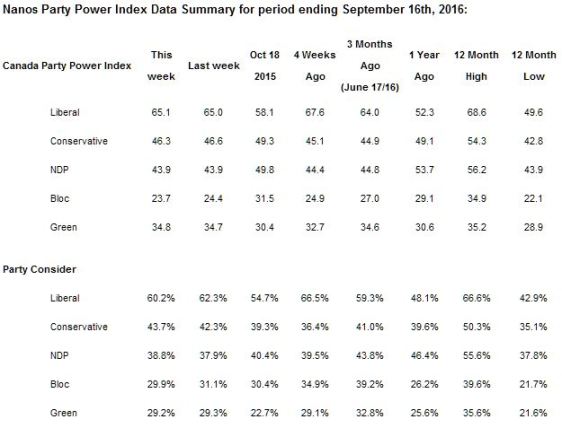
  • Nanos Party Power Index – The Nanos Index which is a compilation of a series of questions including ballot preferences and impressions of the leaders has the Liberals with 65.1 out of a possible 100 points.  The Conservatives scored 46.3 points, the NDP 43.9 points, the Greens 34.8 points and the BQ 23.7 points (QC only).
  • Accessible Voters – Asked a series of independent questions for each federal party, six of ten Canadians (60.2%) would consider voting Liberal while 43.7 per cent would consider voting Conservative, 38.8 per cent would consider voting NDP and 29.2 per cent would consider voting Green.

The team at Nanos in conjunction with Klipfolio have launched our new live political data portal where you run the numbers you want and can explore the trends and data you need.  This is part of our campaign, not only to provide the most reliable data to Canadians but to let them use it as they wish. We were the first to do nightly tracking and now we are the first research organization to post live public opinion data for Canadians. Here’s the link to check it out.

To view the detailed tracking visit our website.

Methodology

The views of 1,000 respondents are compiled into a party power brand index for each party that goes from 0 to 100, where 0 means that the party has no brand power and 100 means it has maximum brand power. A score above 50 is an indication of brand power for the party and its leader at this time.

The important factors in this weekly tracking include the direction of the brand strength or weakness and also the brand power of one federal party relative to another.

The data is based on random telephone interviews with 1,000 Canadians, using a four week rolling average of 250 respondents each week, 18 years of age and over. The random sample of 1,000 respondents may be weighted by age and gender using the latest census information for Canada, and the sample is geographically stratified to be representative of Canada.

The interviews are compiled into a four week rolling average of 1,000 interviews where each week, the oldest group of 250 interviews is dropped and a new group of 250 interviews is added. The current wave of tracking is based on a four-week rolling average of 1,000 Canadians (250 per week) ending September 16th, 2016.

A random telephone survey of 1,000 Canadians is accurate 3.1 percentage points, plus or minus, 19 times out of 20.

All references or use of this data must cite “Nanos Party Power Index” as the source.

nanos453

Source: Nanos Party Power Index

Teleportation across Calgary marks ‘major step’ toward creation of ‘quantum internet’ 

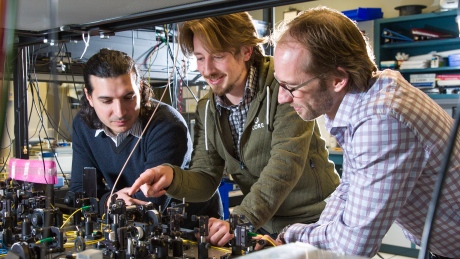
From left, postdoctoral fellows Daniel Oblak, Erhan Saglamyurek and physics professor Wolfgang Tittel, look over lab equipment. Their team recently published a paper on quantum computing advances. (Riley Brandt/University of Calgary)

By Robson Fletcher,  CBC News

September 20, 2016

In a “major step” toward practical quantum networking, researchers at the University of Calgary have successfully demonstrated the teleportation of a light particle’s properties between their lab and the city’s downtown area, six kilometres away.

“What is remarkable about this is that this information transfer happens in what we call a disembodied manner,” said physics professor Wolfgang Tittel, whose team’s work was published this week in the journal Nature Photonics.

“Our transfer happens without any need for an object to move between these two particles.

Their research relies on advanced lasers, a dedicated fibre-optic line, and light-detecting sensors that must be kept incredibly cold because they won’t work at temperatures above –272 C.

It also relies on the increasingly well-known but still baffling phenomenon of quantum entanglement.

The concept is so bizarre that a dubious Albert Einstein famously dubbed it “spooky action at a distance” in the 1940s, as he described what he saw as flaws in the emerging theory of quantum mechanics.

But today, an increasing body of evidence has confirmed the most counterintuitive predictions of quantum theory, including the strange behaviour of “entangled” particles.

These are pairs of particles that are fundamentally linked, such that the properties of each one is intrinsically tied up in the other and actions affecting one particle have an immediate effect on the other, no matter how far apart the particles are.

Wolfgang Tittel

Wolfgang Tittel, professor of physics and astronomy at the University of Calgary, and a group of PhD students have practically demonstrated how to transfer quantum states of photons over a distance of more than six kilometres. (Riley Brandt/University of Calgary)

For their demonstration, the U of C team used a specialized laser to create a pair of entangled photons — elementary particles of light — and sent one to Calgary City Hall via a dedicated fibre-optic line while keeping the other in their lab at the university in the city’s northwest.

At the same time, a third photon was sent to city hall from another location (a data centre in the southeast community of Manchester) so that it would meet and interact with the entangled photon.

“We had to make sure it arrived at the same time at city hall as the photon that was created at the data centre,” said Tittel.

“And that’s pretty tricky, because ‘the same’ in our case means with a provision of a few picoseconds.”

(For the non-physics crowd: A picosecond is one-trillionth of a second, or 0.000000000001 seconds — which means not much room for error.)

Tittel said the team had to create feedback mechanisms in the experimental setup to ensure “very precise timing” of the photons’ arrivals at city hall, as small changes in outdoor temperature that cause the fibre-optic cables to expand or contract by minuscule amounts could throw off the timing.

Success from kilometres away

In the end, though, the system worked and the transfer of properties between the photon at city hall and the photon at the university — 6.2 kilometres away, as the crow flies — was confirmed.

“It’s fascinating to see that, not only teleportation exists, but that you can … transfer the state without transferring the photon over a large distance,” Tittel said.

“From a fundamental point of view, that is fascinating. From a practical point of view, we used a standard fibre network to do so, which of course moves this whole demonstration into the realm of something that will be practical and useful.”

The team’s article in Nature Photonics says the demonstration “constitutes a milestone towards a global quantum internet,” as it is one of the longest distances over which quantum teleportation has been achieved using a fibre-optic network in this way.

“The way we localized all the different stations within the city of Calgary reflects what needs to be done in a future quantum repeater that will allow us to send quantum information, in principle, over arbitrarily long distances,” Tittel said.

“So, it’s a major step forward toward that goal.”

Coincidentally, in the same edition of the same journal, an independent team of Chinese researchers published the results oftheir own demonstration  — one that used a slightly different setup but employed the same principles and confirmed quantum teleportation using a fibre-optic network over a span of 12 kilometres.

“Our experiment marks a critical step towards the realization of a global ‘quantum internet’ in the real world,” the Chinese team wrote.

What is the ‘quantum internet,’ anyway?

It doesn’t exist yet, but the dream of a “quantum internet” involves taking advantage of a key element of quantum mechanics — the fact that observing a particle’s quantum state changes that particle’s quantum state.

This creates the opportunity to communicate with a degree of security never before possible, because no one can intercept a communication without the intended receiver of the information knowing about it.

“If you encode keys into quantum states and send them from person to another — for instance, through teleportation — then it turns out that you can verify at the receiver’s side … if an eavesdropper has acquired any information about that key,” Tittel said.

“If you find out that nobody has tampered with this transmission, you know that you share a perfectly secure key and then you can use it to encrypt some sensitive data.”

Partnership between university, municipality

The development of functional quantum networks is still a long time off, but Sylvain Mayer, an information architecture engineer with the City of Calgary, said the city plans to continue working with the university to speed up the process.

The fibre-optic network the U of C team used normally carries information between various city departments, but a dedicated portion of it was made available to the researchers through theUrban Alliance, a partnership developed in 2007.

“We’re happy that part of our fibre infrastructure can be used by these fellows to be able to research cutting-edge technology,” Mayer said.

“The city just wants to be able to continue to be able to help educational institutions in their pursuit of next-generation types of services that will eventually be able to help everyone around the world.”

Source: Teleportation across Calgary marks ‘major step’ toward creation of ‘quantum internet’ – Calgary – CBC News

Potential profits big enough to justify a massive lawsuit: 6 things you should know about the Cambie trial : Policy Note

At the heart of the case is whether patients have a constitutional right to pay for their medically necessary treatment in private surgery centres, thus bypassing long waits for many non-emergency operations in the public system.The trial before Justice John Steeves began September 6, 2016 and is scheduled to last at least four months with evidence from nearly 200 witnesses.

By Dr. Vanessa Brcic    http://www.policynote.ca

September 8, 2016

The biggest constitutional trial “perhaps ever” in Canada is now in court. The future of our publicly funded health care system is at stake.

Putting Canadian Medicare on trial is complex, and vulnerable to the blatantly false and simplistic messaging that increasing “private care” will take the pressure off public wait lists, increase patient choice, and foster competition and innovation. Sounds nice, doesn’t it?

I want to break it down to a few key points so you can be equipped to follow these important legal proceedings, and more importantly, so you can build on this opportunity to speak up—loudly—for real health care reform. Now is the right time – we have a federal health minister and government that is carefully listening, and BC politicians vying for your vote next year.

Here’s what you need to know:

 1. This case is not about patient choice. It’s about private profit.

 Quite simply, this case is about the potential for doctors and health insurance companies to make a lot of money by charging patients for medically necessary hospital and physician care. The narrative of patient choice is a convenient smokescreen.

2. This case is not about improving health care service delivery at all. It is about expanding private, for-profit funding for health care.

Want to improve health care? Let’s talk about how we deliver health care services – let’s make them high quality, efficient, cost-effective, coordinated and patient-centred. This trial isn’t about that. It’s about how we pay for health care in Canada.

Dr. Day wants a constitutionally protected right to bill patients, health insurance companies and the government, and any combination thereof – whatever the market will bear. This will allow unrestricted profits for doctors and health insurance companies.

As a nation, do we want patients who can pay to get faster care than those who can’t? The Worker’s Compensation Board’s priority surgical access is an example of a two-tiered system that already exists (with its own big problems). Do we want more or less of this? In times of health crises, do we want more patients to have to choose whether they can afford to pay out of pocket for care, or insurance premiums that are unregulated and increasingly costly?

3. For-profit clinics are not illegal. This case is about expanding the market for these clinics by growing the profitable private health insurance sector.

In BC, doctors can unenroll from the public system and in many circumstances (including the Cambie Surgical Centre) charge patients however much they want for medical care. So why this court case if this is already legal?

Dr. Day has said that only about 10% of the patients at his for-profit surgical centre pay privately – it would be hard to expand this market given rising poverty and income inequality in Canada. However, 90% of the care at Cambie is funded through contracts, including with WCB (workers’ compensation) – this is the market that can be expanded upon, and where there is huge opportunity for profit.

Health care is not fully protected under the North American Free Trade Agreement (NAFTA), which allows foreign investors to sue the Canadian government if any policy denies them opportunity for investment or profit. US investors consider Canadian Medicare “the last great uncracked oyster in the North American marketplace.”

In Canada, private health insurance is unregulated, and for-profit insurance companies that pay for extended benefits like physiotherapy and medications have been increasingly reducing their payouts to plan holders. In the last twenty years, benefits paid to Canadians dropped from 92 cents for every dollar spent on premiums to 74 cents – below the legal “medical loss ratio” (the ratio of profit to paid benefits) in the US. Meanwhile, administrative costs for these companies have tripled. In 2011, Canadians paid $6.8 billion more in private health insurance premiums than they received in benefits.

Exorbitant profits in the health insurance sector in the US are the norm. The US spends 12% of its health budget on administration; Canada spends 1.2%. The US could save hundreds of billions of dollars annually if it moved to a single payer system like ours. It is simply not cost effective for us to move towards a payment system like theirs.

4. In a multi-tiered health care system, patients have less freedom, not more.

If Day wins, the vast majority of patients will have less freedom, not more – not only because they can’t afford the second tier of care, but because wait times will increase in the public system when doctors and nurses are busy working for patients who can pay for faster care.

Working in both publicly and privately funded health care tiers is an ethical slippery slope for doctors with a clear financial incentive to channel patients into a more profitable setting.

We know that American health insurance companies are in charge of what care their planholders can and can’t get reimbursed for. Private health insurance puts power in the hands of the insurance companies more than the patients.

5. Cherry-picking the most profitable elements of European health care systems won’t work.

For hospital and physician care, Canada has a 100% publicly funded (government pays), privately delivered (doctors work independently) system. That makes it hard to compare Canada to health systems that have public delivery systems (like the NHS in the UK). Looking at total health expenditures, many OECD countries also have a higher proportion of publicly funded care (and a higher proportion of spending on social services); many European countries fund pharmacare, home care, dental care, early childhood programs and more.

While private out-of-pocket health care spending in Canada has been increasing (due to pharmaceutical costs, insurance premiums and non-Medicare services), government spending has grown more slowly than inflation and population growth. No wonder Medicare has gaps.

If we want to look more like Europe and save money, we should spend more public dollars on currently uninsured health services like those listed above – we could save billions of dollars annually that could fund more public surgeries and chronic pain care.

6. This lawsuit is a distraction from the real work of health care reform being led by the federal government.

Let’s stop distracting ourselves and talk about efficiency and real care delivery solutions, now that we have a federal government on board and a provincial election next year.

If we truly have in common the desire to advocate for those with poor access, then let’s consider all of the patients who have inadequate access to needed health care services. There are aboriginal women who don’t have access to clean water, birthing care or cervical cancer screening, for example.

Regarding those “suffering and in pain”, access to surgery is distracting us from access to chronic pain care, which is more than surgery. Access to mental health services and non-surgical chronic pain services remain a huge gap in Canadian health care, despite being largely privately funded.

Dr. Day isn’t the only person listening to patient stories of long wait times and difficulty navigating services. But in contrast to doctors being paid privately at Cambie Surgery Centre, we are trying to improve the public system. Let’s stop wasting our time talking about expensive and inefficient funding models and advocate for what we really need: improvement in health care services in Canada.

This case is about how we pay for health care in Canada. What we need is to reform how we deliver care. That is how we will improve patient freedom.

Source: Potential profits big enough to justify a massive lawsuit: 6 things you should know about the Cambie trial : Policy Note


An increase so small it keeps B.C. minimum wage workers in poverty : Policy Note

By Iglika Ivanova    http://www.policynote.ca

September 20, 2016

Today, BC’s lowest paid workers get a 40-cent raise. The latest increase of the provincial minimum wage—now $10.85 per hour for most workers isn’t much to celebrate. It works out to an extra $16 per week for someone working full-time – and that doesn’t stretch far in a province with such high cost of living.

In fact, minimum wage workers continue to earn less than the poverty line even if they work full-time 52-weeks a year.

It’s not just minimum wage earners who face the threat of working poverty. Making a dollar or two above than the minimum wage is still a poverty wage for a full-time, full-year worker. Even three dollars above the minimum wage barely clears today’s poverty line for a single person, and falls short of the poverty line for a single parent with one child.

Nearly half a million British Columbians—a quarter of all paid employees in the province—work for $15 or less per hour. And they would all benefit from a $15 minimum wage.

Critics like to argue that the minimum wage doesn’t matter for working poverty because too few people earn exactly the minimum. But they seem to forget that nearly half a million British Columbians—a quarter of all paid employees in the province—work for $15 or less per hour. And they would all benefit from a $15 minimum wage.

Some people mistakenly believe that low-wage jobs are filled mainly by teenagers and youth who work part-time after school, live with their parents, and are on their way to a better-paying job after graduation. But Statistics Canada data reveal a very different reality for the low-wage workforce earning less than $15.

The majority of BC’s low-wage workers are adults between the ages of 25 and 64 (53%). Few are (21%). Most are supporting a household (58%). And most are women (58%). students

The majority of low-wage workers also have full-time jobs (59%), and just over half work for corporations with more than 100 employees.

And while there is some truth to the belief that for youth, low-wage jobs are a stepping stone to higher-paying careers, many low-wage workers over 25 face a real risk of getting stuck in their jobs with little opportunity to earn more. Almost half of BC workers over 25 who earn less than $15 have been in the same job for longer than three years (45%).

Studies also indicate that recent immigrants and persons of colour are likely to be overrepresented among the low-wage workforce.

BC’s economy relies on these workers but it’s failing to provide them with a path out of poverty. The consequences are far reaching: from chronic stress and health problems to poorer school performance for children – and, fundamentally, lost human potential. At the end of the day this isn’t just a problem for low-wage workers and their families – it affects us all.

It’s also why a growing number of cities in the US, including Seattle, San Francisco and Los Angeles are moving to a $15 minimum wage. Washington DC, New York State and California have also approved gradual increases to reach a $15 minimum wage, and a number of other states are considering similar measures.

Closer to home, Alberta’s provincial government officially passed regulations to raise the minimum wage to $15 by 2018, and is eliminating its lower “liquor servers” wage.

BC’s economy relies on these workers but it’s failing to provide them with a path out of poverty.

Any proposal to increase the minimum wage by any amount seems to be met with dire warnings of massive job losses and impending economic doom. But neither history nor academic research supports these claims.

Just last year, the CCPA published a report by UBC economics professor David Green, whose analysis indicates that the likely impact of a $15 minimum wage on job losses would be much lower than feared. His research found that the overall benefits of meaningfully raising the minimum wage through a series of staged increases would far outweigh the costs.

A $15 minimum wage would significantly boost the income of low-wage workers as a group and, unlike today’s small minimum wage increase, would be enough to lift full-time workers out of poverty.

An often-overlooked benefit of higher minimum wages is that they make low-wage, high-turnover business models more expensive, thus creating incentives for employers to offer better, more stable jobs.

The evidence is clear: sticking with BC’s poverty-level minimum wage just doesn’t make sense.

This piece was originally published in The Province.

Source: An increase so small it keeps minimum wage workers in poverty : Policy Note