China Releasing Chemicals To Kill Fish Around Philippine Islands | The Daily Trends

May 13, 2016

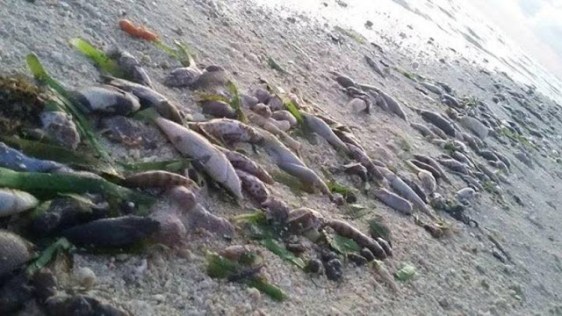
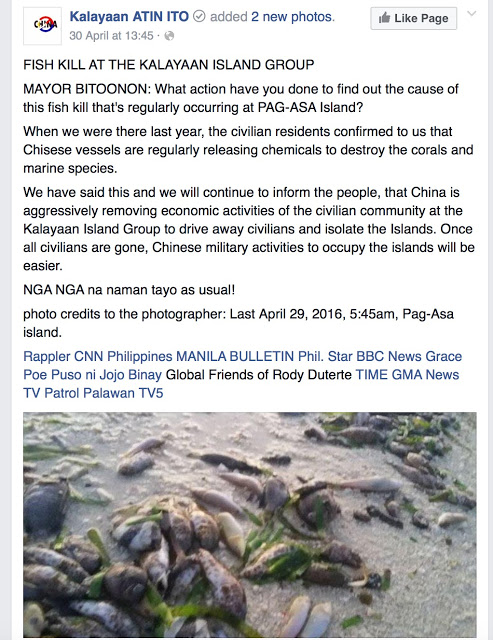
Residents of Philippine-occupied Pag-asa Island in the West Philippine Sea reportedly confirmed that Chisese vessels are regularly releasing chemicals to destroy the corals and marine species around the island.

According to Kalayaan ATIN ITO Facebook page, “China is aggressively removing economic activities of the civilian community at the Kalayaan Island Group to drive away civilians and isolate the Islands.”

Natural ecosystem and the “bahura” or coral reefs around Pag-asa Island are destroyed and the source of livelihood of Filipino fisherfolk are adversely affected.

“Once all civilians are gone, Chinese military activities to occupy the islands will be easier.” it said.

Pag-asa is surrounded by around 20 to 30 hectares of reefs that are home to aquarium and commercial fish.

It provides livelihood and food for the island’s 200 dwellers. It is often visited by rare types of turtles like the endangered leatherback.

Source: China Releasing Chemicals To Kill Fish Around Philippine Islands | The Daily Trends

Got Plaid? Canadians Encouraged to Wear Plaid for Dad before Father’s Day

Prostate Cancer Canada team members pose in their best plaid with members of the Royal Canadian Navy, Toronto Police & Fire, as well as business leaders from far and wide to mark the launch of #PlaidforDad. (CNW Group/Prostate Cancer Canada)

Prostate Cancer Canada invites workplaces and individuals across the country to join the fun for a good cause

TORONTO, May 12, 2016 /CNW/ – This morning marked the launch of Canada’s second annual Plaid for Dad campaign in support of Prostate Cancer Canada (PCC).  To formally announce the start of the campaign, Vice-Admiral Mark Norman, Commander of the Royal Canadian Navy, arrived at the shores of Toronto’s harbourfront aboard a naval ship waving official plaid flags.

In the spirit of uniforms that symbolize the protection of others, we will be honouring the men and women in uniform who protect Canadians every day as well as promoting a uniform that symbolizes the protection of the one in eight Canadian men who will be diagnosed with prostate cancer in their lifetime – plaid.

Launched for the first time last year, Canadian workplaces and individuals are again invited to designate the ‘Casual Friday’ before Father’s Day as a day to wear Plaid for Dad in support of the one in eight Canadian men who will be diagnosed with prostate cancer in their lifetime. After weeks of fundraising and events, Canadians can wear their plaid ensembles on Friday, June 17th and share photos online using the hashtag #PlaidforDad to showcase their involvement.

“Plaid for Dad is an easy and fun opportunity for organizations and individuals to support a cause that impacts all Canadians on some level,” said Rocco Rossi, President and CEO of PCC. “Businesses can take this time to promote their commitment to team-building and philanthropy by making a difference in the lives of all Canadians affected by the most common cancer in men.”

Looking to update your plaid? Hudson’s Bay has you covered.

Canada’s most iconic retailer, Hudson’s Bay has declared its support for the cause by becoming the Official Retail Partner of Plaid for Dad. Through the support of the HBC Foundation, six different, limited-edition Hudson North plaid shirt designs have been created, with $12 from each sale going to benefit prostate cancer research. The shirts will be available mid-May 2016 at all Hudson’s Bay locations across Canada and at www.thebay.com.

To learn more about Plaid for Dad, please visit plaidfordad.ca.

About Prostate Cancer Canada
Prostate Cancer Canada is the leading national foundation dedicated to the elimination of the most common cancer in men through research, advocacy, education, support and awareness. As one of the largest investors in prostate cancer research in Canada, Prostate Cancer Canada is committed to continuous discovery in the areas of prevention, diagnosis, treatment, and support.

SOURCE Prostate Cancer Canada

For further information: For Media Inquiries please contact: Zandra Miljan, Senior Communications Advisor, Prostate Cancer Canada, Conseillère Principale des Communications, Cancer de la Prostate Canada, Office: 416-441-2131 ext./poste 264, Mobile: 647-462-1886, Email: zandra.miljan@prostatecancer.ca

RELATED LINKS
www.prostatecancer.ca

Source: Got Plaid? Canadians Encouraged to Wear Plaid for Dad before Father’s Day

Fruit discovery could provide new treatments for obesity, type 2 diabetes and cardiovascular disease

May 12, 2016

A combination of two compounds found in red grapes and oranges could be used to improve the health of people with diabetes, and reduce cases of obesity and heart disease.

The find has been made by University of Warwick researchers who now hope that their discovery will be developed to provide a treatment for patients.

Professor Thornalley who led research said: “This is an incredibly exciting development and could have a massive impact on our ability to treat these diseases. As well as helping to treat diabetes and heart disease it could defuse the obesity time bomb.”

The research ‘Improved glycemic control and vascular function in overweight and obese subjects by glyoxalase 1 inducer formulation’ has been published in the journal Diabetes, and received funding from the UK’s innovation agency, Innovate UK. The project was a collaboration between the University of Warwick and University Hospitals Coventry and Warwickshire (UHCW) NHS Trust.

A team led by Paul Thornalley, Professor in Systems Biology at Warwick Medical School, studied two compounds found in fruits but not usually found together. The compounds are trans-resveratrol (tRES) – found in red grapes, and hesperetin (HESP) – found in oranges. When given jointly at pharmaceutical doses the compounds acted in tandem to decrease blood glucose, improve the action of insulin and improve the health of arteries.

The compounds act by increasing a protein called glyoxalase 1 (Glo1) in the body which neutralises a damaging sugar-derived compound called methylglyoxal (MG). MG is a major contributor to the damaging effects of sugar. Increased MG accumulation with a high energy diet intake is a driver of insulin resistance leading to type 2 diabetes, and also damages blood vessels and impairs handling of cholesterol associated with increased risk of cardiovascular diseases. Blocking MG improved health in overweight and obese people and will likely help patients with diabetes and high risk of cardiovascular disease too. It has already been proven experimentally that blocking MG improves health impairment in obesity and type 1 and type 2 diabetes.

Although the same compounds are found naturally in some fruits, the amounts and type required for health improvement cannot be obtained from increased fruit consumption. The compounds that increase Glo1 and are called a ‘Glo1 inducer’. Pharmaceutical doses for patients with obesity, diabetes and high risk of heart disease could be given to patients in capsule form.

Professor Thornalley increased Glo1 expression in cell culture. He then tested the formulation in a randomised, placebo-controlled crossover clinical trial.

Thirty-two overweight and obese people within the 18-80 age range who had a BMI between 25-40 took part in the trial. They were given the supplement in capsule form once a day for eight weeks. They were asked to maintain their usual diet and their food intake was monitored via a dietary questionnaire and they were also asked not to alter their daily physical activity. Changes to their sugar levels were assessed by blood samples, artery health measured by artery wall flexibility and other assessments by analysis of blood markers.

The team found that the highly overweight subjects who had BMIs of over 27.5 with treatment displayed increased Glo1 activity, decreased glucose levels, improved working of insulin, improved artery function and decreased blood vessel inflammation. There was no effect of placebo.

Professor Thornalley said: “Obesity, type 2 diabetes and cardiovascular disease are at epidemic levels in Westernised countries. Glo1 deficiency has been identified as a driver of health problems in obesity, diabetes and cardiovascular disease.”

“Diabetic kidney disease will be the initial target to prove effective treatment for which we are currently seeking commercial investors and partners. Our new pharmaceutical is safe and expected to be an effective add-on treatment taken with current therapy.

“The key steps to discovery were to focus on increasing Glo1 and then to combine tRES and HESP together in the formulation for effective treatment.

“As exciting as our breakthrough is it is important to stress that physical activity, diet, other lifestyle factors and current treatments should be adhered to.”

Professor Martin O Weickert, Consultant in Diabetes and Endocrinology at UHCW NHS Trust, and co-applicant for the grant, said: “We were really excited to participate in this study with Warwick Medical School, as taking part in world-leading research makes a real difference to our patients both now and in the future.

“As well as the positive effects for the UHCW patients who took part in the trial, we hope this study will lead to new treatments to help patients with diabetes and cardiovascular diseases all over the world.”

Prof. Thornalley and his team are now hoping manufacturers will want to explore the use of the compound as pharmaceutical products.

source: University of Warwick

Source: Fruit discovery could provide new treatments for obesity, type 2 diabetes and cardiovascular disease | Science Codex


Statement by the Prime Minister of Canada on Israel Independence Day 

STATEMENT BY THE PRIME MINISTER OF CANADA ON ISRAEL INDEPENDENCE DAY

Ottawa, Ontario

12 May 2016

The Prime Minister, Justin Trudeau, today issued the following statement in celebration of Yom Ha’atzmaut:

“Today, we celebrate the 68th anniversary of the founding of the State of Israel with our Israeli friends and Jewish communities, both here in Canada, and around the world.

“The State of Israel is a thriving and vibrant country, which Canada is proud to call a close partner and steadfast ally.

“Canada and Israel unite in their people-to-people ties, shared values, respect for democracy, and growing trade relationship. I look forward to continuing to strengthen our strong friendship.

“Although today is a joyous day, let us also reflect on the threat that Israel and its people continue to face throughout the world in the form of terrorist attacks, acts of anti-Semitism, and religious intolerance. Canada stands with Israel and will continue to promote peace and stability in the region.

“On behalf of Sophie and our children, I wish everyone celebrating Israel’s Independence Day a Yom Ha’atzmaut Sameach. Shalom.”

Source: Statement by the Prime Minister of Canada on Israel Independence Day | Prime Minister of Canada

Competition Bureau statement regarding the proposed acquisition by Lowe’s of RONA

OTTAWA, May 12, 2016 — On May 12, 2016, the Bureau issued a No Action Letter (NAL) to Lowe’s Companies, Inc. (Lowe’s) and RONA inc. (RONA) indicating that the Commissioner of Competition does not, at this time, intend to make an application under section 92 of the Competition Act in respect of the proposed acquisition.

This statement summarizes the approachFootnote 1 taken by the Competition Bureau in its review of Lowe’s proposed acquisition of RONA, which was announced on February 3, 2016.

In the course of its review, the Bureau conducted interviews with numerous market participants, including home improvement retailers (both corporate owned stores and independent local dealers), buying groups, and distributors; reviewed documents and information provided by the parties and third parties; and analyzed transaction level data.

Background

In Canada, Lowe’s and RONA (the Parties) are both retailers of home improvement products. Lowe’s entered the Canadian market in 2007. At the time the proposed acquisition was announced, Lowe’s had 42 corporate stores in British Columbia, Alberta, Saskatchewan, and Ontario, and RONA had 496 stores across Canada that are a mix of 236 corporate stores and 260 dealer owned stores. Although RONA has stores across Canada, its largest provincial footprint is found in Quebec, where it had 238 stores.

Unlike Lowe’s, RONA also operates a wholesale distribution business that supplies both its retail network, including dealer‑owned RONA stores, and other third party wholesale customers. As such, the Bureau considered whether the proposed acquisition raised any vertical concerns. The Bureau’s review revealed that many buying groups, alternative wholesalers and competing retail banners are, and would remain readily available to supply RONA’s wholesale customers with distribution of home improvement products and other retail support services.

Analysis

The Bureau identified a number of local markets where Lowe’s and RONA stores are likely direct competitors as a consequence of their relative proximity to each other. In assessing the competitive impact of the proposed transaction, the Bureau considered various possible local geographic markets by adjusting for the presence or absence of different competitors, including the Parties, other big box retailers and specialty stores.

The Parties compete for the sale of items across many product categories, including lumber and building materials, paint, fashion fixtures, electrical and plumbing supplies. At any one time, some proportion of consumers only require the purchase of items from a single product category, while consumers engaged in more extensive projects may require, for example, a mix of paint, fashion fixtures, and plumbing supplies. Apart from price‑based comparisons, market participants indicated that box stores that sell items from multiple product categories offer consumers the convenience of a one‑stop shop, whereas specialty stores which focus on the sale of only a single product category, may offer a higher level of customer service. The competitive impact of excluding and including specialty stores as direct competitors to box stores was tested to assess the competitive effects of the transaction.

Under the various possible market definitions tested by the Bureau, it was determined that there were sufficient effective remaining competitors in each local market, including national retailers such as Home Depot, Home Hardware, and Canadian Tire, such that the proposed acquisition is unlikely to result in a substantial lessening or prevention of competition.

The Bureau also examined to what extent the proposed transaction could prevent the development of future competition between the Parties due to Lowe’s future entry. The Bureau determined that such entry did not satisfy the timely, likely and sufficient threshold set out in the Merger Enforcement Guidelines. In any event, the examination also found that effective competition from Home Depot, Canadian Tire and strong regional big box operators would remain in all local markets in which competition between Lowe’s and RONA could have likely developed in the future.

Conclusion

Based on the presence of a sufficient number of effective remaining competitors in each local market, the Bureau concluded that the proposed transaction is unlikely to result in a substantial lessening or prevention of competition in retail home improvement in any local market in Canada.

This publication is not a legal document. The Bureau’s findings, as reflected in this Position Statement, are not findings of fact or law that have been tested before a tribunal or court. Further, the contents of this Position Statement do not indicate findings of unlawful conduct by any party.

However, in an effort to further enhance its communication and transparency with stakeholders, the Bureau may publicly communicate the results of certain investigations, inquiries and merger reviews by way of a Position Statement. In the case of a merger review, Position Statements briefly describe the Bureau’s analysis of a particular proposed transaction and summarize its main findings. The Bureau also publishes Position Statements summarizing the results of certain investigations, inquiries and reviews conducted under the Competition Act. Readers should exercise caution in interpreting the Bureau’s assessment. Enforcement decisions are made on a case-by-case basis and the conclusions discussed in the Position Statement are specific to the present matter and are not binding on the Commissioner of Competition.


For media enquiries, please contact:
Media Relations
Telephone: 819-994-5945
Email: ic.media-cb-bc.ic@canada.ca

For general enquiries, please contact:
Information Centre
Competition Bureau
Telephone: 819-997-4282
Toll free: 1-800-348-5358
TTY (hearing impaired): 1-800-642-3844
www.competitionbureau.gc.ca
Enquiries/Complaints
Stay connected

The Competition Bureau, as an independent law enforcement agency, ensures that Canadian businesses and consumers prosper in a competitive and innovative marketplace.

Source: Competition Bureau statement regarding the proposed acquisition by Lowe’s of RONA – Competition Bureau