New Report Highlights Critical Economic Impact of Canada’s Defence Industry

OTTAWA, 25 May 2016 /CNW/ – Canada’s defence industry contributed $6.7 billion in GDP, $10 billion in revenues and 63,000 jobs to the Canadian economy in 2014, according to a new report developed by Science, Innovation and Economic Development Canada and Statistics Canada in collaboration with the Canadian Association of Defence and Security Industries (CADSI) on behalf of the Canadian Defence Industry.

The report, State of Canada’s Defence Industry, 2014, was launched on the opening day of CANSEC 2016, Canada’s global defence and security trade show at the EY Centre in Ottawa.

“This study is important for both industry and government,” said CADSI President Christyn Cianfarani. “It is the most detailed and comprehensive study of the Canadian defence sector ever conducted and it confirms that Canada’s defence industry is high wage, export intensive, technology rich and pan-Canadian.”

The report indicates that Canada’s defence industry compensation is 60 per cent higher than the national average. The sector’s export performance is 60 per cent of sales, up from 50 percent in 2011. Engineers, scientists, researchers, technicians and technologists comprise over 30 per cent of the jobs in the defence industry, which highlights the innovative nature of the sector. Production workers make up another 40 per cent of the defence labour force.

“Companies that make up the Canadian defence industrial base—most of which are present here at CANSEC—and the types of jobs they offer, are what Canada needs and what governments should value in today’s global economy,” concluded Ms. Cianfarani. “With the recapitalisation of the Canadian Armed Forces currently underway, the Government of Canada has the opportunity of a generation to make the Canadian defence industry a source of innovation-led growth.”

CANSEC is Canada’s global defence and security trade show, hosted by CADSI since 1998. Over the years, CANSEC has grown to a global show that welcomes over 11,000 registrants from Canada and abroad to see first-hand Canadian goods and technologies sought the world over.

The full report can be found at: www.madeacrosscanada.ca.

About CADSI

The Canadian Association of Defence and Security Industries (CADSI) is the national industry voice of more than 700 Canadian defence and security companies that produce world-class goods, services and technologies made across Canada and sought the world over. The industries contribute to the employment of more than 63,000 Canadians and generate $10 billion in annual revenues, roughly 60 per cent of which come from exports. To learn more, visit www.defenceandsecurity.ca and follow us on Twitter at @CadsiCanada.

SOURCE Canadian Association of Defence and Security Industries (CADSI)

RELATED LINKS
www.defenceandsecurity.ca

Source: New Report Highlights Critical Economic Impact of Canada’s Defence Industry

Bank of Canada maintains overnight rate target at 1/2 per cent

OTTAWA, 25 May 2016 /CNW/ – The Bank of Canada today announced that it is maintaining its target for the overnight rate at 1/2 per cent. The Bank Rate is correspondingly 3/4 per cent and the deposit rate is 1/4 per cent.

The global economy is evolving largely as the Bank projected in its April Monetary Policy Report (MPR). In the United States, despite weakness in the first quarter, a number of indicators, including employment, point to a return to solid growth in 2016. Financial conditions remain accommodative, with ongoing geopolitical factors contributing to fragile market sentiment. Oil prices are higher, in part because of short-term supply disruptions.

In Canada, the economy’s structural adjustment to the oil price shock continues, but is proving to be uneven. Growth in the first quarter of 2016 appears to be in line with the Bank’s April projection, although business investment and intentions remain disappointing. The second quarter will be much weaker than predicted because of the devastating Alberta wildfires. The Bank’s preliminary assessment is that fire-related destruction and the associated halt to oil production will cut about 1 1/4 percentage points off real GDP growth in the second quarter. The economy is expected to rebound in the third quarter, as oil production resumes and reconstruction begins. While the Canadian dollar has been fluctuating in response to shifting expectations of US monetary policy and higher oil prices, it is now close to the level assumed in April.

Inflation is roughly in line with the Bank’s expectations. Total CPI inflation has risen recently, largely due to movements in gasoline prices, but remains slightly below the 2 per cent target. Measures of core inflation remain close to 2 per cent, reflecting the offsetting influences of past exchange rate depreciation and excess capacity.

Canada’s housing market continues to display strong regional divergences, reinforced by the complex adjustment underway in the economy. In this context, household vulnerabilities have moved higher. Meanwhile, the risks to the Bank’s inflation projection remain roughly balanced. Therefore, the Bank’s Governing Council judges that the current stance of monetary policy is still appropriate, and the target for the overnight rate remains at 1/2 per cent.

Information note:

The next scheduled date for announcing the overnight rate target is 13 July 2016. The next full update of the Bank’s outlook for the economy and inflation, including risks to the projection, will be published in the MPR at that time.

SOURCE Bank of Canada

For further information: Media Relations, 613 782-8782

RELATED LINKS
http://www.bank-banque-canada.ca

Source: Bank of Canada maintains overnight rate target at 1/2 per cent

Culture-Bound Syndromes: Entire Disease Category Your Doctor May Be Missing

Jumping Frenchmen of Maine, a rare disorder characterized by an unusually extreme startle reaction, is similar to Latah. It was first identified during the 19th century in Maine and Quebec among an isolated population of lumberjacks of French Canadian descent. This image shows a group of lumberjacks who have just downed a giant sequoia (California, 1905). Image credit: Library of Congress, Washington, DC

May 23, 2016 by Rafid Rahman

How is that possible?

A physician goes through four years of medical school, at least two-three years of residency (postgraduate medical training), and potential fellowships.

Why would a doctor not know about an entire category of disease?

Answer: Physicians, themselves, are confused about these mysterious diseases.

Let me elaborate.

Physicians are not always sure how to treat culture-bound syndromes, so the category may not be discussed in great detail until specialized training takes place. The classifications for these diseases are continuously under debate in the medical community.

In fact, the Diagnostic and Statistical Manual of Mental Disorders (DSM) – the standard classification of mental disorders in the United States – actually reclassified them in DSM-5 [1] in 2013 under ‘Cultural Concepts of Distress’ to more accurately describe the cultural influences.

Thus, doctors may easily overlook the category… making it imperative for patients to be knowledgeable about the existence of these peculiar diseases.

Metaphorically, physicians tend to look for horses instead of zebras when they hear hoof beats.

What does that mean?

The old adage signifies that physicians are trained to diagnose diseases in a pyramidal fashion. Treat the symptoms of the most common disease and move onto more rare, lesser-known diseases if the treatments don’t seem to work.

Although this method may seem like a guess-or-check system, physicians are rigorously trained in recognizing prevalent, difficult-to-treat diseases. I mean, they should be… right? They spend at least a decade of their lives learning basic sciences and clinical medicine!

So, the challenge remains… how to define culture-bound syndromes?

Ranging from diseases that include psychiatric, genetic, environmental, neurological, or even cultural origins, scientists have not been able to explicitly define the category of culture-bound syndromes. Moreover, the illnesses are included into this category because they are traditionally seen in specific cultures or locations of the world, and because the patients may present with a wide range of severity that may or may not include DSM listed symptoms for each disease.

Basically, this category of disease is a conglomeration of misfits that are not unified by common disease pathology or presentation as seen in traditional western medical classifications, but associated by clinically important cultural differences.

You may be asking right now… Why should I worry about culture-bound syndromes if I don’t live in that culture or location? I won’t be affected or get the disease, right?

Answer: Maybe, maybe not.

The reason why patients should know about the existence of this often overlooked treasure chest of diseases is for the same reason why it was recently reclassified under Cultural Concepts of Distress in DSM-5. Physicians, medical anthropologists, and other scientists have studied and come to the conclusion that the term ‘culture-bound syndrome’ may overemphasize the regional diagnosis of the disease, which may cause physicians worldwide to miss potential cases [2].

Which makes it particularly important for patients to be aware of this category of disease, so they can spark the discussion with their doctors, if their physicians are having a difficult time finding a solid diagnosis. Even if patients do not know specific diseases in the category, bringing up the topic with their puzzled physicians may give the doctors the extra hint they need to diagnose the appropriate disease and formulate the proper treatment plan.

What should patients do next?

Even though this potential hole in a physician’s training may make you want to run for the hills, be assured that your doctor has years of in-depth, expertise in many areas and there are always specialists in every field to help you out. So don’t drop everything and start reading WebMD just yet!

However, it is important to be familiar with at least a few diseases so you can better communicate with your physician.

Disease of Interest: Latah [3]

Latah is commonly presented in Southeast Asia and has been documented by European observers for more than a century.

The disease can be provoked with shock or acute fright, which results in social tics: imitative gestures, words, actions, obey commands, or situations where patients cannot control his or her emotions.

Disease of Interest: Gururumba [4]

Gururumba is more prevalent in New Guinea and describes the actions of a person, usually a married man, who burglarizes homes and takes items of little importance.

However, the person thinks the items are invaluable and he/she runs away for a period of time, but then returns without the items or knowledge of the event.

Disease of Interest: Amok [5]

Amok has been seen in various areas of Southeast Asia and Scandinavia and it usually presents as a violent, homicidal rage. Typically, the person does not pre-meditate the attack, nor does he or she usually remember it but insulting actions towards the Amok patient can provoke a ferocious episode.

Although this is not a comprehensive list, it gives patients an insight into the world of culture-bound syndromes, and maybe -just maybe- this knowledge will help a countless number of people bridge the gap of knowledge between the physician and patient.

_____

1. Culture concepts. In: American Psychiatric Association. Diagnostic and Statistical Manual of Mental Disorders, Fifth Edition. 2013. Washington, DC: American Psychiatric Association

2. Tseng W. 2006. From peculiar psychiatric disorders through culture-bound syndromes to culture-related specific syndromes. Transcult Psychiatry 43: 554-576

3. Bhidayasiri R. & Truong D.D. 2011. Startle syndromes. Handb Clin Neurol. 100: 421-430

4. Paniagua F.A. 2000. Culture-bound syndromes, cultural variations, and psychopathology. In: Cuéllar I, Paniagua FA, eds. Handbook of Multicultural Mental Health: Assessment and Treatment of Diverse Populations. New York: Academic Press; 140-141

5. Bartelsman M. & Eckhardt P.P. 2007. Mental illness in the former Dutch Indies — four psychiatric syndromes: amok, latah, koro and neurasthenia. Ned Tijdschr Geneeskd. 151: 2845-2851

Source: Culture-Bound Syndromes: Entire Disease Category Your Doctor May Be Missing | Medicine, Opinions | Sci-News.com

Light drinkers, and non-alcohol drinkers, should watch for fatty liver disease

May 24, 2016 – 8:02pm

People who have reduced enzyme activity to breakdown active aldehyde, i.e., those who become easily inebriated, are more likely to develop fatty liver disease even if they do not drink alcohol. This discovery was made by a clinical research team from Kumamoto University in Japan.

It is generally understood that fatty liver is triggered by alcoholism or heavy drinking. Recently, however, the number of patients with non-alcoholic fatty liver disease (NAFLD), a type of liver function disorder caused by increasing neutral fat in the liver that is caused by overeating and lack of exercise, has increased.

NAFLD is easily overlooked because of the lack of associated symptoms, and it is often only found when it has progressed to an advanced stage, such as cirrhosis., It is therefore important to detect it early so that preventative measure may be implemented.

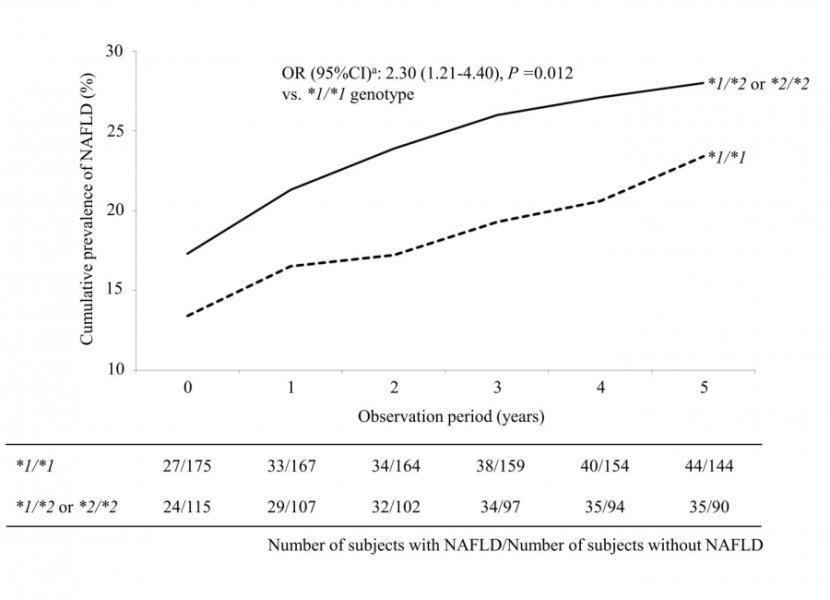
The risk of NAFLD was significantly higher in the ALDH2*2 allele carriers than in the non-carriers. Credit: Dr. Kentaro Oniki

When a person drinks, alcohol is changed to acetaldehyde in the liver. Acetaldehyde is toxic and contributes to sickness and hangovers in those who drink alcohol. Aldehyde dehydrogenase 2 (ALDH2) is a type of enzyme in stem cells that breaks down acetaldehyde and transforms it into other harmless substances. The action of the enzyme is determined genetically and affects the amount of alcohol that a person is able to consume without feeling sick.

Eastern Asia has an especially high population with low ALDH2 activity, in other words, light drinkers. Particularly in Japan where 40% of the people have low ALDH2 activity and 10% have no activity. People with low or no activity have a low risk of alcohol-related diseases, such as alcoholic fatty liver, because they drink little to no alcohol at all.

However, recent studies have reported that East Asian people with a genotype supporting low ALDH2 activity are at risk for cardiovascular disease. Further studies with mice found that ALDH2 activity reduced the accumulation of neutral fat in the liver and improved arteriosclerosis regardless of alcohol intake. Nevertheless, the association between the low activity ALDH2 genotype and NAFLD had not been made.

To determine that relationship, researchers of Kumamoto University began investigating the effects of various ALDH2 genotypes on NAFLD. A retrospective follow-up study of 341 Japanese health screening participants with no drinking habits was performed in the Japanese Red Cross Kumamoto Health Care Center. The researchers found that patients with a low activity ALDH2 genotype had a prevalence of NAFLD that was about twice as high as patients with a high activity genotype.

The patients’ gamma(γ)GTP, which is used in daily medical practice as an indicator of liver damage, was also assessed. A value of 25.5 IU/L is usually associated with the onset of NAFLD so the researchers focused on cases which had a combination of a low activity ALDH2 genotype and a γGTP level that was greater than 25.5 IU/L.

The results clearly showed that people with a low activity ALDH2 genotype who also had γGTP levels over 25.5 IU/L have a quadrupled risk of developing NAFLD compared to those with a high activity ALDH2 genotype and γGTP levels less than 25.5 IU/L. People who have a low activity ALDH2 genotype should be wary of developing NAFLD even if their γGTP levels are not very high.

“It is necessary for light or non-drinkers to pay attention to the possibility of NAFLD development,” said Assistant Professor Kentaro Oniki from Kumamoto University. “Even if you don’t drink much, it is recommended that you check your γGTP levels frequently to prevent NAFLD.”

Future research based on this study is expected to include treatment and early prediction of the disease.

source: Kumamoto University

Source: Even light drinkers should watch for fatty liver disease | Science Codex

Government of Canada highlights improved support for Veterans and their families

Budget 2016 reaffirms commitment to Veterans

REGINA, May 24, 2016 /CNW/ – The Honourable Kent Hehr, Minister of Veterans Affairs and Associate Minister of National Defence, spoke with Veterans and community leaders in Regina today to highlight the Government of  Canada’s support for Canada’s ill and injured Veterans and how Budget 2016 will enhance that support.

To help Veterans and their families as they transition from military to civilian life, Veterans Affairs Canada will build on an existing suite of programs and supports with enhancements to financial benefits, restored access to critical services and more front-line staff.

An increase to the Disability Award to a maximum of $360,000 will mean more money in the pockets of Veterans who suffer from illnesses such as post-traumatic stress disorder (PTSD) as a result of service.

Increasing the Earnings Loss Benefit to 90% of a Veteran’s pre-release salary will ensure former members undergoing rehabilitation have the financial support they need.

Expanding access to the Permanent Impairment Allowance by introducing an individualized assessment will ensure Veterans are more appropriately compensated for the impact of a service-related impairment on their career.

Finally, Veterans Affairs Canada will re-open nine offices across the country and hire additional case managers so that each serves no more than 25 individuals. Additionally, a new office will open in Surrey, B.C., and outreach to Veterans in the North will be expanded by working with local partners.

Budget 2016 delivers $5.6B in additional benefits and takes historic steps to treat Veterans with care, compassion and respect.

Quick Facts

  • The Government of Canada will make it easier for Veterans’ families to access the Funeral and Burial Program for a dignified burial. The Department plans to increase the estate exemption from $12,015 to $35,279 and also apply an annual cost of living adjustment to this amount.
  • Plans are also underway to expand the scope of the Commemorative Partnership Program to allow funding for the building of new community war memorials and to streamline the application process.
  • The new Have Your Say consultation tool, available on the Veterans Affairs Canada website, invites Veterans, stakeholders and Canadians to their provide feedback on Veterans’ issues and priorities.
  • The Minister of Veterans Affairs remains committed to all items in his mandate letter, including pensions for life.

Quote


“The Government of Canada is taking historic steps to ensure Canadian Veterans and their families are treated with care, compassion and respect. Budget 2016 reaffirmed our intent to give back to Veterans and deliver on our promises to restore critical access to services and improve the long-term financial security and independence of disabled Veterans and their families.”

The Honourable Kent Hehr, Minister of Veterans Affairs and Associate Minister of National Defense

Associated Links


SOURCE Veterans Affairs Canada

For further information: Media Relations, Veterans Affairs Canada, 613-992-7468 1

RELATED LINKS
www.veterans.gc.ca

Source: Government of Canada highlights improved support for Veterans and their families