Prime Minister announces new infrastructure agreement with British Columbia 

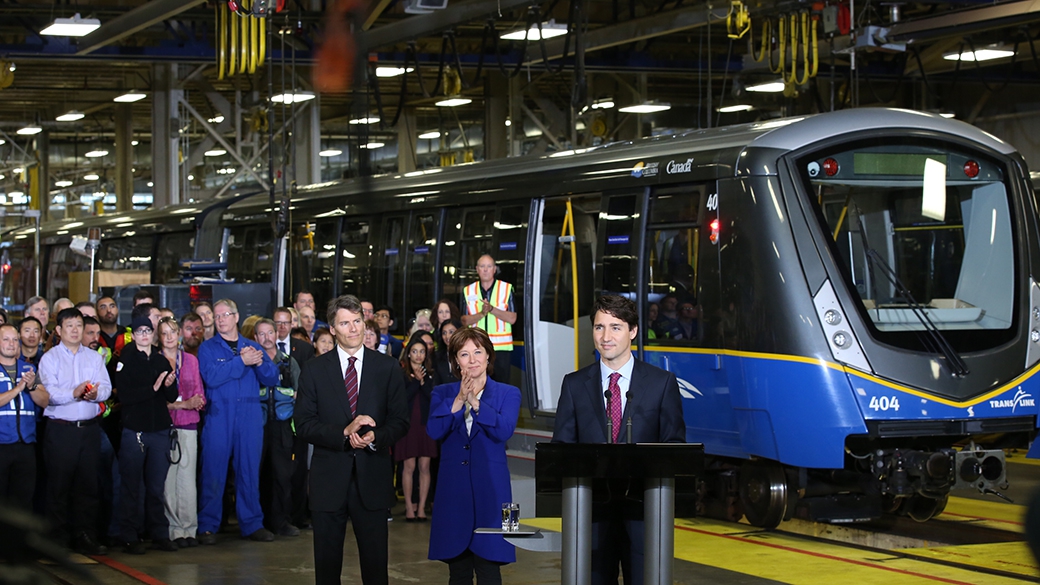
Prime Minister Justin Trudeau makes an announcement regarding transit funding in British Columbia.

Burnaby, British Columbia

16 June 2016

The Government of Canada remains committed to making significant investments in infrastructure that will improve our public transit systems, strengthen Canadian communities, and help grow the economy.

Today, the Prime Minister, Justin Trudeau, and Premier Christy Clark announced that an agreement has been reached that will result in more than $900 million being invested – by the Government of Canada, British Columbia, and municipalities – in public transit projects across the province.

The agreement made today will reduce congestion and commute times, so that Canadian families can spend less time on the road, and more time with their loved ones. The investments will be used to expand bus lanes, add new railcars to the SkyTrain, and deliver the fixes that our transit systems have needed for decades.

Investing in public transit creates good, well-paying jobs that can help the middle class grow and prosper today. When well-planned infrastructure makes it easier for middle class Canadians to get to work on time, bring their kids to soccer practice, or go to the grocery store, the entire economy benefits.

Quotes

“Canadians have asked us to reduce congestion and commute times in their cities. This investment in public transit will help the people of British Columbia get home to their loved ones faster. It will also help to grow the middle class by improving business flows in municipalities while reducing environmental damage.”
Rt. Hon. Justin Trudeau, Prime Minister of Canada

“British Columbia is leading Canada, and as our economy continues to grow, transit infrastructure needs to keep pace. This investment will help meet rising demand, ease congestion, lower our carbon footprint, and enhance our quality of life.”
Hon. Christy Clark, Premier of British Columbia

Quick Facts

  • This funding is part of the first phase of Investing in Canada, the Government of Canada’s historic $120-billion plan to support infrastructure across the country over the next 10 years.
  • Phase 1 of Investing in Canada will provide over $10 billion in immediate investments to support public transit systems, green infrastructure projects, and social infrastructure projects. Details on Phase 2 of Investing in Canada will be announced over the next year.
  • Phase 1 funding provided under the Public Transit Infrastructure Fund will be managed through agreements between the Government of Canada and provincial and territorial governments.
  • Under the agreement made today, the Government of Canada has made its funding retroactive to April 1, 2016, so projects can proceed without delay to help ensure a productive construction season this year.
  • The investment announced today – $460 million from the Government of Canada’s new Public Transit Infrastructure Fund, and $308 million from the Province of British Columbia – will help make sure that public transit is keeping pace with the rapid growth of British Columbia. Funding will modernize public transit systems – including the SkyTrain and SeaBus services, as well as the rapid transit and provincial bus systems – to help move people and commerce more efficiently through B.C. municipalities.

Associated Links

Source: Prime Minister announces new infrastructure agreement with British Columbia | Prime Minister of Canada

The Relative Productive Power of Hand and Machine Labour

fromthepast

From: The North American Review    Vol. 172, No. 534, May, 1901

  • RUSSELL SAGE ; JAMES J. HILL, PRESIDENT OF THE GREAT NORTHERN RAILWAY; CHARLES M. SCHWAB, PRESIDENT OF THE UNITED STATES STEEL CORPORATION; CHARLES R. FLINT, TREASURER OF THE UNITED STATES RUBBER CO.; F. B. THURBER, PRESIDENT OF THE UNITED STATES EXPORT ASSOCIATION; AND JAMES LOGAN, GENERAL MANAGER OF THE UNITED STATES ENVELOPE COMPANY.      URL: http://www.jstor.org/stable/25105160

The Hon. Carroll D. Wright, United States Commissioner of Labor, and one of our most conservative statisticians, recently published the result of his investigations into the relative productive power of hand and machine labor.

A thousand paper bags could formerly be made by hand in six hours and thirty minutes; they are now made in forty minutes with the aid of a machine. To rule ten reams of paper on both sides by hand required 4,800 hours; with a ruling machine, the work is done in two hours and thirty minutes of one man’s time.

In shelling corn by hand, sixty-six hours and forty minutes would be required to shell a quantity which can be handled by a machine in thirty-six minutes. A mowing machine cuts seven times as much grass per hour as one man can cut with a scythe.

These examples might be extended indefinitely; but a more forceful illustration will be found by considering the total horse-power applied to machines in this country and calculating how many men it would require to do the same work. For such calculations the census figures of 1890 must be used.

One horse-power is equivalent to the power of six men. Thus, if the work of 63,481 men in the flour mills of the United States is supplemented by the use of 752,365 horse-power, the power is equivalent to the work of 4,514,190 additional men. That is, it does seventy-two times as much work as the employees.

The ratio differs radically in different industries. Mr. Wright finds that the total horse-power used in the United States in 1890 was about 6,000,000, equivalent to the work of 36,000,000 men, while only 4,476,884 persons were employed, the two kinds of power having a ratio of 8 to 1.

A force of 36,000,000 men rep resents a population of 180,000,000, so that if the products of the manufacturing establishments were all made by hand, it would require a population of that size to do it, with none left for agriculture, trade, transportation, mining, forestry, the professions, or any other occupations.

A still more striking illustration is found in our transportation system. In 1890 there were over 30,000 locomotives in this country it would take 57,940,320 horses to do their work, or 347,425,920 men.

In countries like China, nearly all the work of transportation is actually done by man power, and no further explanation of the economic difference between America and Asia is required.

By the use of steam we are evoking aid from the heat stored up in our coal beds, equivalent to the working efficiency of the population of the whole earth, while the Chinaman lets his coal lie underground, packs his load on his back, and does his manufacturing largely by hand.

Mr. Mulhall, the British statistician, calculated in 1895 that the use of steam power had increased five-fold in the United States in thirty-five years, thus more than trebling the collective working power of the population.

He also remarks that the working energy of one American is more than double that of one European.

Thus the civilized world, with the United States leading, is yearly doing an increasing amount of useful work, while Asia does no more than it did a thousand years ago. This fact alone will explain the demand for the “open door,” and the growing world-domination of the machine-using nations.

Steam is our Genie of the Lamp, electricity our Slave of the Ring, and machinery an additional slave, which the imagination of the Arabian romancist did not picture.

In former times the men who possessed a thousand human slaves, and grew rich upon their labor, were but few; to-day the men who own the power of a thousand horses, embodied in mechanical slaves which speak all languages and serve all masters with equal fidelity, are almost too numerous for enumeration.

The inventors of the United States have created these slaves, and we are selling them to other nations at a rate which must soon impair the advantage we have here-tofore enjoyed, and level up and level down labor the world over.

This is the ground-swell of cause which the statesmen of the world have to adjust to effect. The captains of industry, who have been in contact with and have comprehended and grasped these controlling forces in this evolution of industry, have profited pecuniarily from it; but all they have got out of it is a living, somewhat more luxurious, perhaps, than that of the average citizen, but any surplus which they have not left to hospitals, churches and education has, in most cases, enervated and cursed their children. Many of them appreciate this, and we will have more Harvards and Yales and Cornells, and Johns Hopkins and Stanfords and Vanderbilts and Rockefellers and Carnegies and Morgans in the future.

The talk about an Emperor in this country, which the distinguished President of one of our great universities recently in dulged in, may be dismissed as a passing thought in a Lenten sermon.

The organization of industry has taken place so suddenly that the public has been startled, as a good horse will shy at an umbrella when it is opened suddenly in his face; but let the horse smell the umbrella and see that it is not dangerous and his alarm will subside. Thus will it be with the feeling of the public toward trusts. Their evil will be eliminated, their good will be developed, their usefulness to mankind demonstrated, and the bogy which the rivalries of sensational journalism and partisan politics have conjured up will fade into thin air.

The facts and the views herein stated are presented as an antidote to those of the alarmists, but with a full appreciation of the tides and currents of public sentiment, which affect the industries and welfare of our country. These are indicated in the following quotation from the circular of a conservative banking house in relation to the new steel trust:

“It will be cited in Congressional and Legislative halls as full of danger to American institutions through such unprecedented concentration of power in individual hands. It will revive the advocacy of Government ownership of railway lines and of more stringent “antitrust” legislation, and it cannot be denied that it brings up a very grave question before the American people as to the extent to which the laws of the land shall permit or support such tremendous centralization of power in the industrial world. We might add, also, that it is likely to occasion at the next session of Congress a very active movement for the abolition of duties on all products made by this consolidated company, and if the tariff is once brought up as a subject of serious discussion and amendment there is no telling where it will end. We all know that the agitation of tariff ^revision is detrimental to general business; for, while it is in progress, both importers and manufacturers restrict their operations until they know to a certainty what the result of the tinkering is to be. Of course, these facts are not going to affect the immediate market for the shares, but they must enter into the minds of the big holders and lead them, as the occasion offers, to part with their holdings to the general public, as far as the general public will be disposed to buy.”

If any legislation in regard to “trusts” is necessary, it is in the direction of publicity and reports, for the protection of investors. The practice of over-capitalization, or stock watering, is considered by many persons a great evil, but it is an injury rather to those who practice it than to the general public.

Real values are reflected in the market prices of securities. Bay State Gas is quoted at $1 per share, with a par value of one hundred dollars, while Standard Oil is quoted above $800. Capitalization is usually based upon earning power, and in this “good will” is often a factor. A newspaper with a plant worth $50,000 may earn $100, 000, net, per year. If a company was organized on this, what should its capital be? A railroad is projected, which, when built and with a large traffic developed, can pay dividends upon a capital which would seem very large in its inception, and yet carry for the public at low prices. Unless its projectors had had a prospect of a profit the railway would not have been built. So far as the interest of investors is concerned, they should have information, and they can then use their own judgment. There are frauds in all kinds of merchandise, and the doctrine of caveat emptor is of universal application.

Mr. Carnegie has said that a successful business was like a three-legged stool, standing on labor, capital and brains; or brains, labor and capital; or capital, brains and labor, that neither is first and all are inter-dependent. The United States is fortunate in having such a citizen as Andrew Carnegie and millions of others who, with opportunity, like him, are capable of “rising on stepping stones of their dead selves to higher things”; there can be no dissent from Mr. Carnegie’s kaleidoscopic conception. The combination of any two elements in the trinity can be pulled down by the dissent of the third. Each, therefore, must recognize the usefulness of the other and its share in the enormous benefits which Providence has conferred upon the human race in placing such resources of nature and such slaves as steam, electricity and machinery at their disposal to develop them.

F.B. Thurber.

Statement by the Prime Minister of Canada on National Public Service Week 2016 

Ottawa, Ontario
12 June 2016

The Prime Minister, Justin Trudeau, today issued the following statement for National Public Service Week 2016:

“This National Public Service Week, I invite Canadians to join me in celebrating our federal Public Service.

“Every day, public servants work hard to strengthen the middle class and improve the lives of all Canadians. Their commitment ensures that we receive the services we need, no matter the pressures they face or the challenges before them.

“The theme of National Public Service Week, ‘Proudly Serving Canadians,’ could not be more apt. Since last November, my team and I have seen the passion and dedication of Canada’s public servants in every task and project that they undertake. Whether helping resettle more than 25,000 Syrian refugees into Canada, or assisting the thousands of Canadians affected by the devastating wildfires in Fort McMurray, Canada’s public servants make a real difference – day in and day out – in the lives of Canadians and people around the world.

“Our public servants understand that to remain focused on the people we serve, we must work together to make openness and transparency key values of our institutions. They understand the need to renew and modernize so that together we can – effectively and efficiently – meet the needs of Canadians today and into the future.

“Now is also the time to build and promote a welcoming and healthy federal Public Service environment in which public servants can access the support they need in times of personal crisis. A healthy workplace is a proud workplace – a dynamic, engaging, and appealing one to young Canadians looking for an exciting career that helps them make a real difference in the lives of others.

“To public servants, I say thank you for all that you do to help us tackle the real challenges that we face as a country. You serve a vital role in our democracy, and are a source of pride and a model to other countries and governments. It is truly a privilege to work with you every single day.

“I look forward to the great things we will achieve together for all Canadians.”

Source: Statement by the Prime Minister of Canada on National Public Service Week 2016 | Prime Minister of Canada

Kuzma: Benning bullish on fifth overall draft pick, but Canucks GM will listen to trade offers

VANCOUVER, BC – JANUARY 28: Pierre-Luc Dubois #18 of Team Orr skates up ice with the puck during the CHL/NHL Top Prospects Game January 28, 2016 at Pacific Coliseum in Vancouver, British Columbia, Canada. Photograph by: Jeff Vinnick , Vancouver Sun

BY BEN KUZMA JUNE 10, 2016

There are at least three forwards and three defencemen who could command interest when the Vancouver Canucks select fifth in the National Hockey League draft on June 24 in Buffalo.

There could be just as many trade offers to consider because the phone is ringing, and general manager Jim Benning and his staff are preparing for what is expected to be an active period before Auston Matthews is picked first overall.

The Canucks know they can land a foundation player — centre/winger Pierre-Luc Dubois, left winger Matthew Tkachuk or puck-moving defenceman Olli Juolevi, depending on what the Edmonton Oilers do with the fourth pick — but they could also make their club better now and in the future by moving the selection and getting a proven and young top-six player.

That’s plenty to ponder.

“Teams have been calling and enquiring about the fifth pick,” Benning said Thursday from the Canucks’ amateur scouting meetings in Whistler.

“We want to be prepared for any scenario that could come up at the draft. But depending on who’s there when we pick, we know we’re getting a good player. We’re not looking to move the pick, but I wouldn’t be doing my job if teams call and make offers for the pick and we didn’t consider the offers.

“We’re doing our due diligence. If we can move down and get a top-six player and a second-round pick, we have to keep our options open. I’m not saying we’re going to do anything, but we need to be prepared for any situation that may come up. But at the end of the day, if we go in and pick at No. 5, I’m real confident that we’re getting a piece that will help us win and be part of our future for a long time.”

The Canucks interviewed 70 players at the recent draft combine. Benning came away with a heightened level of satisfaction in how prospects conducted themselves, how articulate they were and how they were better prepared than even the previous year.

———————————————————-

Ben Kuzma tells Jeff Paterson about his recent chat with Canucks GM Jim Benning about the coming NHL Entry Draft. Listen here.

———————————————————-

That’s crucial. Playing the game is one thing, but being mentally mature and understanding the team concept at the pro level is crucial for impressionable players who dominate the junior ranks.

“It made me feel that we’re going to get a good player and a solid person,” added Benning, who noted that Tkachuk was really impressive in his interview with the Canucks.

Dubois and Tkachuk are of obvious interest as future first-liners because the Canucks need to formulate a succession plan for the eventual departure of Henrik and Daniel Sedin. It’s why a centre like the 6-foot-6 Logan Brown may pique their interest and why defencemen Mikhail Sergachev and Jake Bean merit some consideration.

The delicate dance of being more competitive now and retooling on the fly is easier said than done. The Canucks were active in the last draft at Florida when they showed interest in trading for Milan Lucic and then tried to land a second-round pick in 2015.

They thought they had one from San Jose in a possible Kevin Bieksa deal, but he wasn’t moved until the following week to Anaheim for a second-round pick in 2016. That pick was moved to Pittsburgh in the Brandon Sutter trade. The Canucks also tried to get a second-rounder for Eddie Lack, who was moved to Carolina at the last draft for third-round pick in 2015 and seventh-round pick in 2016.

The Canucks have first and third-round picks this year, but not a coveted second-round pick. They have identified their top 60 players for this draft and it’s imperative that the sixth through 30 picks are figured out in order of preference in case the round turns into the trade show.

The amateur meetings focus Thursday was also about making sure they’re all on the same page with what to do in the later rounds — especially the fifth, sixth and seventh where they could not only add depth, but find a diamond in the rough. In the fifth round, the Canucks selected Ben Hutton in 2012, Frank Corrado in 2011 and Bieksa in 2001. Joe Cannata was a sixth-round pick in 2009 and Jannik Hansen a ninth-rounder in 2004.

OF NOTE — The Canucks will hold pro-scouting meetings next week in advance of the buyout window and the plan for nine unrestricted free agents in the organization — including Dan Hamhuis — and which of seven restricted free agents to qualify. The Canucks expect to announce their training-camp location within the next two weeks.

bkuzma@postmedia.com

twitter.com/@benkuzma

Source: Kuzma: Benning bullish on fifth overall draft pick, but Canucks GM will listen to trade offers