Canada’s Fiscal Sustainability Report 2016

28 June 2016

Get the report
Fiscal Sustainability Report 2016.pdf

Get the data
FSR 2016 – Figures.xlsx

Summary
Medium-term budget plans are insufficient to evaluate the long-term prospects for public debt under current fiscal policy. This report extends PBO’s medium-term analysis to assess the fiscal sustainability of Canada’s federal government, subnational governments and public pension plans.

Fiscal sustainability means that government debt does not grow continuously as a share of the economy. The goal is to identify if policy changes are required to avoid unsustainable public debt accumulation, after considering the economic and fiscal impacts of population ageing.

Government sector net debt over the long term
% of GDP
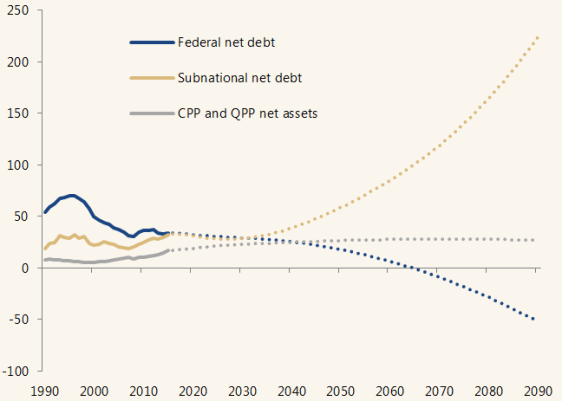
Sources:  Statistics Canada and Parliamentary Budget Officer.

Federal government

PBO’s 2015 Fiscal Sustainability Report concluded that the federal government had room to increase spending or reduce taxes. Measures in Budget 2016 have reduced this room. However, the government continues to have flexibility to expand policy while maintaining fiscal sustainability.

To maintain net debt at its current level of 33.7 per cent of gross domestic product (GDP) over the long term, PBO estimates that the federal government could permanently increase spending or reduce taxes by 0.9 per cent of GDP ($19.2 billion in current dollars). This is down from 1.4 per cent in last year’s assessment.

PBO’s federal sustainability assessment concludes:

  • Federal fiscal room has been reduced as a result of reversing the increase in the age of eligibility for the Old Age Security program. The higher long-run cost as a result of the change is expected to reduce federal fiscal room by 0.2 per cent of GDP.
  • Removing existing children’s benefits and introducing the Canada Child Benefit are expected to reduce fiscal room by 0.1 per cent of GDP. However, a complete picture of the impact is uncertain, as no details have been announced describing the indexation of benefits or eligibility thresholds beyond the medium term. Parliamentarians may wish to seek further clarification.
  • The impact of other Budget 2016 spending measures, including Phase 1 and Phase 2 of Canada’s New Infrastructure Plan, is 0.1 per cent of GDP.

Subnational governments

The outlook for subnational governments (that is, combined provincial, territorial, local and Aboriginal governments) is little changed from last year’s assessment. Permanent policy actions amounting to 1.5 per cent of GDP ($30.2 billion in current dollars) would be required to stabilize the subnational government net debt-to-GDP ratio at its current level (32.5 per cent) over the long term. The required fiscal consolidation has increased marginally from 1.4 per cent in last year’s assessment.

PBO’s subnational government sustainability assessment concludes:

  • The slight increase in the fiscal gap is the result of higher-than-projected program spending in 2015.
  • Health care spending outpaced nominal GDP growth in 2015. This, along with historical revisions to the national accounts, has raised PBO’s projection for excess cost growth.  Excess cost growth refers to the increase in health spending that cannot be accounted for by general inflation, real per capita income growth, population growth and ageing.
  • Although provinces cannot meet the challenges of population ageing under current policy, the required fiscal consolidation is not insurmountable if compared to previous consolidation episodes. Furthermore, the changes do not need to occur immediately. However, the longer they are delayed, the greater the adjustment that is required.

Canada Pension Plan and Quebec Pension Plan

The fiscal gap for the public pension sector represents the immediate and permanent change in contributions and/or expenses that returns the net asset-to-GDP ratio to its current level over the long term. PBO estimates that public pension plans are sustainable over the long term.

The long-term projection of the Canada Pension Plan (CPP) does not incorporate the agreement in principle signed by Canada’s Finance Ministers on 20 June 2016. PBO will assess the changes to the CPP when further details on implementation are released.

Total general government sector

The total general government sector in Canada (that is, the combined federal and subnational governments and public pension plans) is not fiscally sustainable without permanent increases in revenues or reductions of at least 0.6 percentage points of GDP.

Changes could be made at any level of government to eliminate the total government fiscal gap. However, ensuring the sustainability of each government sector on its own would require a consolidation at the subnational level and/or higher transfers from the federal government.

Related posts

  • 21 July 2015

    This report provides an assessment of the long-term sustainability of government finances for three government sub-sectors: the federal government; subnational governments consisting of provinces, territories, local, and aboriginal governments; and, the Canada and Quebec Pension Plans.    [PDF]

Source: Fiscal Sustainability Report 2016

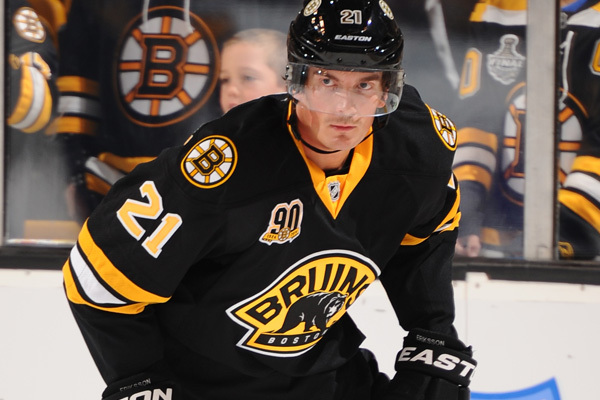
Vancouver Canucks Land Forward Loui Eriksson In Free Agent Signing To Boost Scoring Depth

VancouverCanucksCANUCKS BANTER     By Andrew Chernoff    July 1, 2016

600x400_110213_loui_eriksson_third_jersey

The Vancouver Canucks secured the services of unrestricted free agent left wing Loui Eriksson on Canada Day.

Eriksson was believed to be asking for a five- or six-year contract worth around $6 million per season going into free agency.

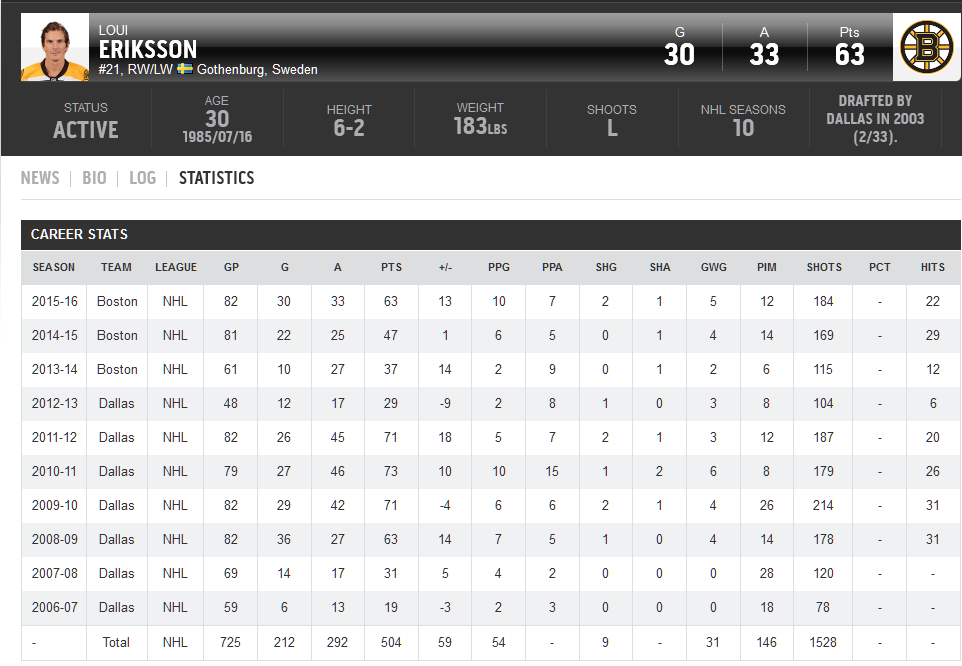
Eriksson, who turns 31 on July 17, has spent the last three seasons with the Boston Bruins.

He has scored more than 20 goals in every 82-game season since 2008. He’s coming off a 30-goal season.

Eriksson signed for 6-years for 6-million per season with the Canucks.

According to TSN.ca, Eriksson:

“Owns tremendous offensive instincts and a goal-scorer’s touch with an accurate shot. Is also good as a playmaker, thanks to excellent stickhandling ability. He’s also great defensively.”

Knocks against Eriksson, according to the TSN website:

“Could stand to add more bulk to his 6-2 frame in order to become a truly elite winger. Plays a somewhat passive game in all three zones, so he needs to keep the fire burning at all times.”

but is an excellent two-way winger.

According to the Canucks website:

“Loui Eriksson has been like the Alex Burrows of the Swedish National men’s Ice Hockey Team since winning World Championship gold with the Sedin twins back in 2013.

There’s a level of familiarity there. Eriksson will turn 31 before next season, but still has the speed and overall checking game to qualify as a high-end defensive winger. He’s also a credible second-line point producer and could conceivably hit 30 goals if given a regular shift with Vancouver’s top line.”

Eriksson was drafted by the Dallas Stars in the 2nd round (33rd overall) in 2003.

FireShot Screen Capture #318 - 'Statistics - TSN' - www_tsn_ca_nhl_player-bio_loui-eriksson_statistics

Sources: TSN.ca, canucks.nhl.com

Vancouver Canucks Take Candella, Stukel, Abols and McKenzie With Last Picks In 2016 NHL Draft

VancouverCanucksCANUCKS BANTER     By Andrew Chernoff    June 25, 2016

The Vancouver Canucks finished off the second and last day of the draft with picks in the 5th, 6th and 7th rounds, after choosing right wing William Lockwood of the USA U-18 team, with the 64th pick in the 3rd round of the 2016 NHL Draft.

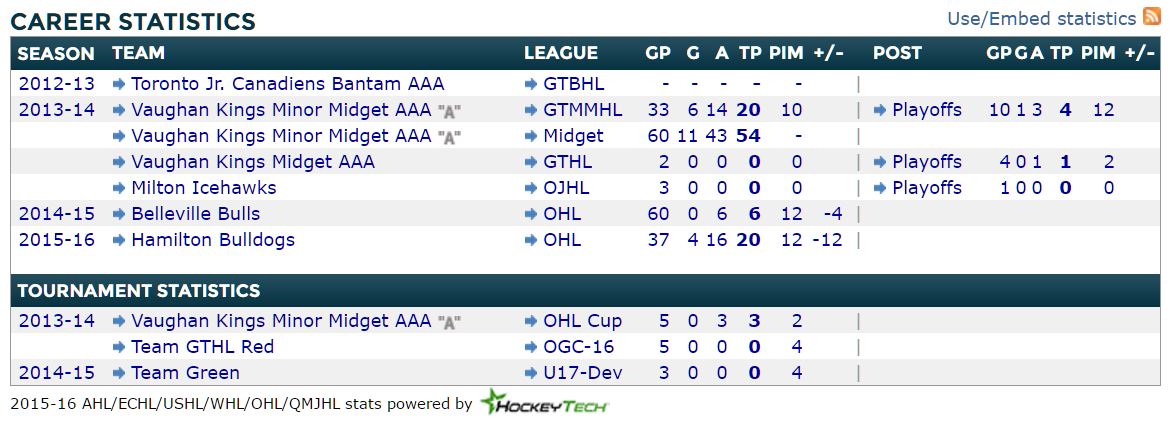
With their third pick of the 2016 NHL draft, Vancouver chose defenseman Cole Candella of the Hamilton Bulldogs in the Ontario Hockey League, with the 140th pick (5th round) in the 2016 NHL draft.

ColeCandella_BrandonTaylor

Capture

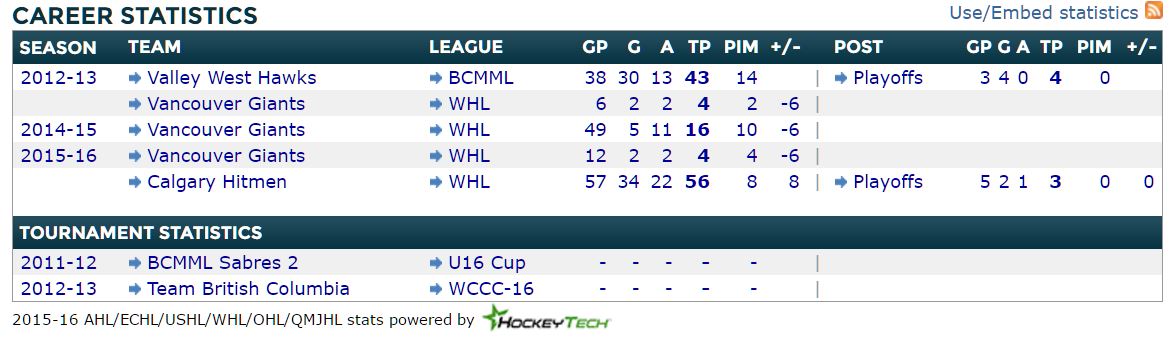
With their fourth pick of the 2016 NHL draft, Vancouver chose left wing Jakob Stukel of the Calgary Hitmen in the Western Hockey League, with the 154th pick (6th round) of the 2016 NHL draft.

Stukel_Goal_Nov27-730x487

Capture

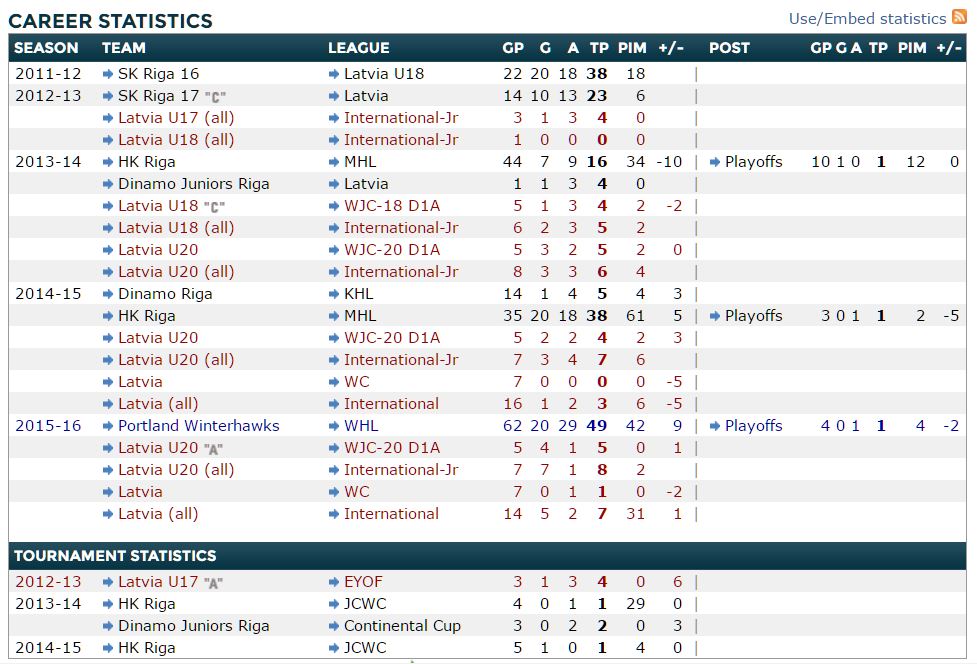
With their fifth pick of the 2016 NHL draft, Vancouver chose center Rodrigo Abols of the Portland Winter Hawks in the Western Hockey League, with the 184th pick (7th round) in the 2016 NHL draft.

abols-winterhawks-664x498

A gritty, hard-working forward with a large frame. An agile skater for his size and is starting to work explosiveness into his game. Smart with and without the puck, and exhibits strength at both ends of the ice. Not the most physical player, but that side of his game will come naturally as he develops more bullish instincts. Loves to battle and works hard to win puck possession on open ice, along the boards, and in the corners. All-in-all, a sizeable forward that has the raw tools it takes to become an effective producer as he elevates his game. (Curtis Joe, EP 2015)

Father: Artis Ābols

Capture

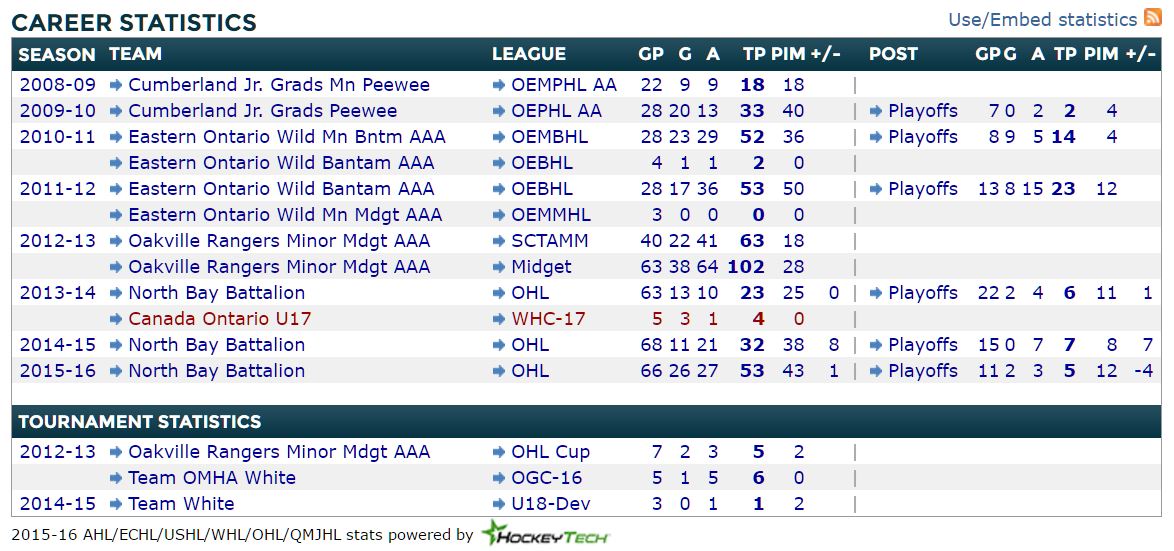
With their sixth and last pick of the 2016 NHL draft, Vancouver chose center Brett McKenzie of the North Bay Battalion in the Ontario Hockey League, with the 194th pick (7th round) of the 2016 NHL draft.

McKenzie_TW_CHL_0629-637x509

McKenzie can be described as a smart defensive forward who skates well and is excellent on the draw. He is not overly physical, but his overall awareness in all 3 zones is coveted. (Tyler Parchem, EP 2015)

Capture

Sources: NHL.com, Eliteprospects.com, Youtube

Vancouver Canucks Choose Right Wing William Lockwood of the USA U-18 Team With The 64rth Pick (3rd Round) In 2016 NHL Draft

VancouverCanucksCANUCKS BANTER     By Andrew Chernoff    June 25, 2016

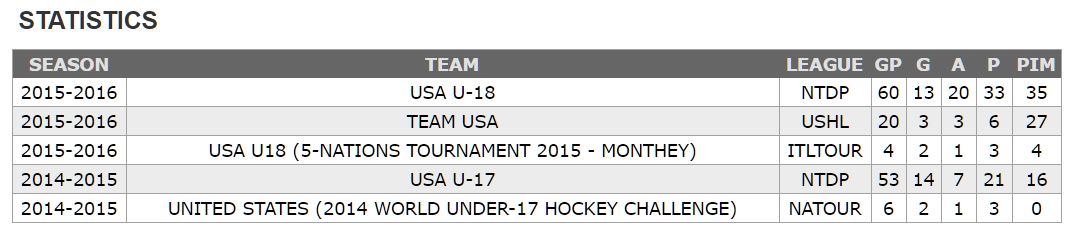
The Vancouver Canucks with their second pick of the 2016 NHL draft, chose right wing William Lockwood of the USA U-18 team, with the 64rth pick (3rd round) in the 2016 NHL draft.

Capture

Vancouver Canucks Choose Defenseman Olli Juolevi With 5th Pick In 2016 NHL Draft

VancouverCanucksCANUCKS BANTER     By Andrew Chernoff    June 24, 2016

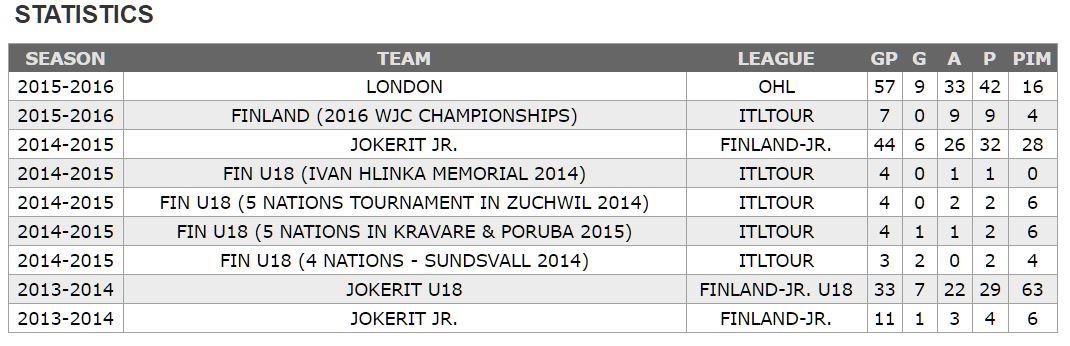
The Vancouver Canucks with their 5th pick of the 2016 NHL draft, chose Olli Juolevi of the London Knights of the Ontario Hockey League.

• In 2015-16, Juolevi finished third among Ontario Hockey League rookie defensemen with 9-33—42 in 57 games for the London Knights, earning OHL Second All-Rookie Team and OHL Third All-Star Team honors.

• In the playoffs, Juolevi registered 3-11—14 in 18 games to help the Knights capture the OHL championship. He added 0-7—7 in four games at the 2016 Memorial Cup – where he was named to the tournament All-Star Team – to help the undefeated Knights capture the title for the second time in franchise history.

• Juolevi was a key member of Finland’s gold medal-winning team at the 2016 World Junior Championship where he led all defensemen with nine assists (0-9—9 in 7 GP) and was named to the tournament All-Star Team.

• During 2014-15, Juolevi stocked his trophy case while playing with Jokerit’s junior squad (6-26—32 in 44 GP), where he was named the league’s Best Defenseman, Rookie of the Year and selected to the First All-Star Team.

• Juolevi compares his style of play to Oliver Ekman-Larsson of the Arizona Coyotes. His favorite NHL player is Nashville Predators captain Shea Weber.

Director of NHL Central Scouting Dan Marr:
“Juolevi is a smart, smooth skating, puck moving defenseman with excellent poise and composure. He displays elite hockey sense and instincts with and without the puck and plays in every situation.”

Capture

The 2016 NHL draft started according to plan with the Toronto Maple Leaf’s picking Auston Mathews, with the top pick; and the Winnipeg Jets choosing Patrik Laine, with the second overall pick.

The Columbus Blue Jackets had the third overall pick and pulled off the first surprise by choosing Pierre Luc-Debois.

The fourth pick of the 2016 NHL Draft, was set now to be anybody’s guess, as the the Edmonton Oilers, had a chance to choose the projected number three pick coming into the draft, Jesse Puljujarvi. And they did not disappoint, as they did do just that.

Source: NHL.com, http://canucks.nhl.com