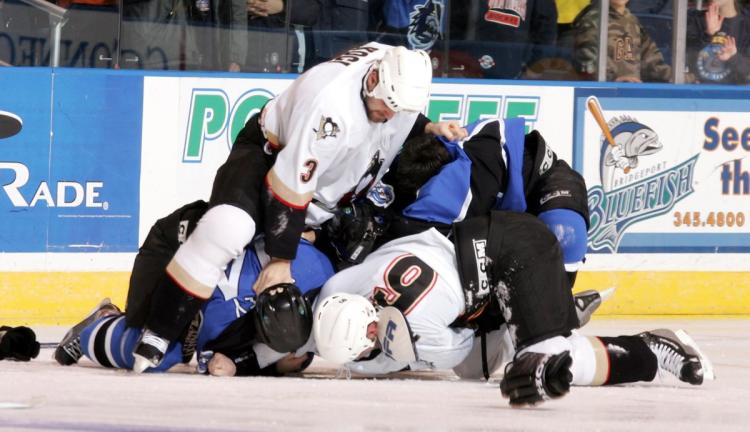
NHL shouldn’t wait on results of AHL experiment to end fighting 

The AHL is putting new rules in place to cut back on fights. (JIM MCISAAC/GETTY IMAGES)

Pat Leonard   NEW YORK DAILY NEWS  Friday, July 8, 2016

The American Hockey League, the NHL’s primarily U.S.-based feeder league, passed new rules at its most recent Board of Governors meeting to clamp down on fighting.

Players who fight before, at, or immediately following a face-off will be ejected with an automatic game misconduct. During the AHL regular season, players will be suspended one game apiece for their 10th fight of the season, all the way through their 13th bout, until a two-game suspension kicks in for fights 14 and up.

Everyone is already asking why NHL commissioner Gary Bettman continues to allow fighting at the sport’s highest level, why he chooses even to champion its existence rather than oppose its presence or, at the very least, say nothing at all.

But now there is another question, because the NHL typically monitors new measures applied in the AHL before considering adding them to its own rule book:

Why should the NHL need to wait to see the results of these new AHL rules before acting?

Bettman has plenty of reason to ban fighting from hockey entirely already. All of this tip-toeing around officially abolishing the practice just feels tired and futile.

In May, the NHL had its motion to dismiss a lawsuit from former playersdenied, in the face of accusations that the league failed to warn, inform and adequately care for them while glorifying violence that leads to head trauma.

In the face of this litigation — and despite improved science and increased knowledge about the debilitating effects of repeated head trauma, concussionsand the degenerative brain disease CTE — Bettman nevertheless told Sports Illustrated recently that fighting “has been a part of the game, it does act a thermostat in the game” and contended “your question presumes that it should be eliminated, and that isn’t necessarily the case.

“Fighting may help prevent other injuries,” Bettman added.

Why he keeps fighting for fighting, though, is beyond me.

First of all, banning fighting would not necessarily imply the NHL is guilty as charged in this lawsuit of infractions in the past – unless the league has something to hide, of course.

Secondly, Bettman’s continued comments on the subject — including his 2015 assertion that there is “no evidence” linking concussions and CTE — are ignorant and insensitive to the findings of new science and the identification of the brain disease in late NHL players such as former enforcer Bob Probert.

Third, fighting is increasingly irrelevant in today’s NHL already, even in the AHL compared to the old days.

The NHL’s more-recently adopted “instigator” rule often deters players (they’ve told me themselves) from taking any sort of retribution they may desire, since the penalty would be too costly to that game’s outcome.

Clubs are more reticent to encourage the violence, since every win and point matters even more in a league with so many teams in the playoff hunt due to the NHL’s cherished baby, its competitive balance. They can’t afford to sacrifice games just to settle a score with a hated rival.

And with the NHL’s salary cap so restrictive and the game of hockey so much faster, most teams can’t afford anymore to pay or play a player who is strictly an enforcer anyway. A sort of natural selection has weeded out this type of hockey breed from the highest level of the game.

So why not just stamp it out for good and eliminate unnecessary risk to players’ health?

The NHL was policed by the Broad Street Bullies back in the 1970s. I remember Philadelphia Phantoms AHL games at the Spectrum in the 1990s when they barely needed a puck on the ice there were so many brawls.

But as a CBC article pointed out recently, Rockford’s Michael Liambas led the AHL with fighting majors with 20 last season, while in the NHL only four players reached the 10-fight threshold: Colorado’s Cody McLeod (12), Vancouver’s Derek Dorsett (11), former Islander and new Maple Leaf Matt Martin (11) and Shark/Canadien Mike Brown (10).

Even Bettman said that “fighting is at the lowest level … in the history of the game.” The only problem is, he is using that as an argument for keeping fighting in hockey. On the contrary, that is one of the best reasons to say goodbye to the glove-dropping altogether.

Granted, the NHL’s ever-faster, ever-more physical high-speed collisions can be even more dangerous for players than some fights. But the time for parsing these details and statistics and defending fighting’s place in the game of hockey is over.

From an image standpoint, at least, the always-booed Bettman should at least understand how much better he and the NHL would look if he simply stepped up and banned fighting, announcing that in a sport so inherently high-risk there is no need to put these men in increased danger.

He seems determined, though, to make the fighting issue a hill he will die on — when what he should really do is, well, lock it out.

_____________________________________________

Pat Leonard

Pat Leonard is in his fifth season on the Rangers/NHL beat. He has worked at the Daily News since May 2010. Pat graduated from the University of Notre Dame in 2006.

Source: NHL shouldn’t wait on results of AHL experiment to end fighting – NY Daily News

Canucks sign Markstrom to three-year extension

VancouverCanucksCANUCKS BANTER     By Andrew Chernoff    July 8, 2016

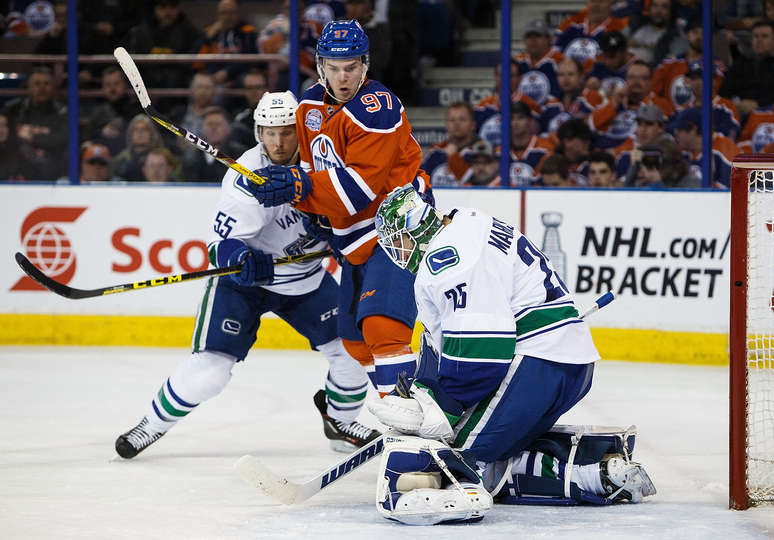
EDMONTON, AB – APRIL 6: Connor McDavid #97 of the Edmonton Oilers can’t get a shot past goaltender Jacob Markstrom #25 of the Vancouver Canucks on April 6, 2016 at Rexall Place in Edmonton, Alberta, Canada. The game is the final game the Oilers will play at Rexall Place before moving to Rogers Place next season. (Photo by Codie McLachlan/Getty Images)

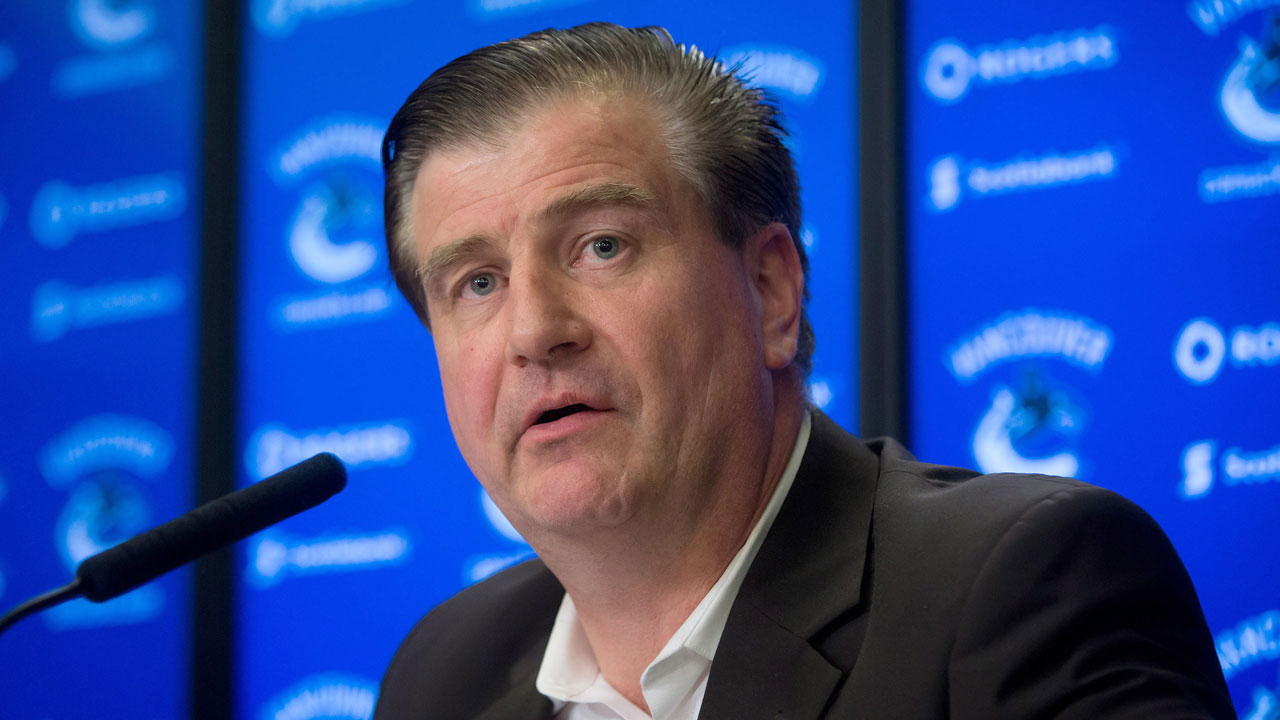
Vancouver, B.C. – Vancouver Canucks General Manager Jim Benning announced July 7 that the Canucks have signed goaltender Jacob Markstrom to a three-year contract extension. The contract will carry an annual average value of $3.67 million and will run through the end of the 2019.20 season.

“Jacob is a talented, competitive goaltender with size and a proven ability to make big saves at crucial moments in a game,” said Jim Benning. “He set career highs in several statistical categories last season and two years ago led the Comets to their first Calder Cup Final. He’s motivated and wants to help his team win. We’re excited to have Jacob competing in a Canucks uniform for years to come.”

Markström is a tall goaltender that has a lot advantage of being big and making himself look even bigger in net. He is a skilled goaltender with great mental strength as one of his major characteristics. He is cool, despite having a strong winner’s instinct. Plays the butterfly style with a decent glove and has fine positioning and agility in net. What has been noticeable, however, is that he sometimes goes down too early and has problems getting up on his feet fast enough after a save. He could also work some with his rebound control, but overall Markström has plenty of raw qualities that makes him a very interesting prospect. http://www.eliteprospects.com

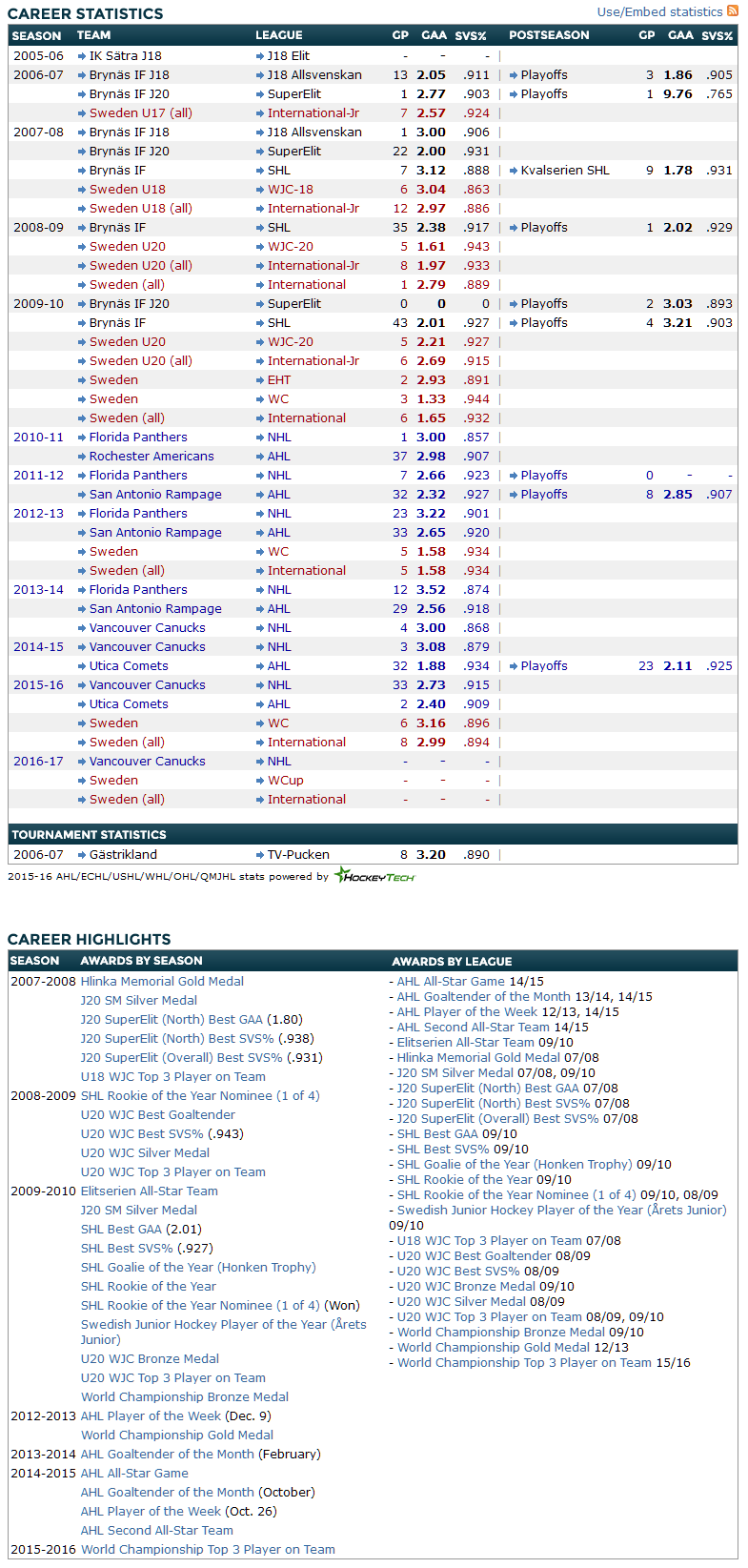
Appearing in his sixth NHL season in 2015.16, Markstrom established career highs for games played (33), starts (30), wins (13), shots against (988), saves (904) and minutes (1,848). The 26-year-old finished the season with a 2.73 goals against average, a .915 save percentage and set career-highs for most shots faced (48) and most saves made (47) in a single game on March 22, 2016 at Winnipeg. Markstrom also posted a record of 1-0-1 along with a 2.40 goals against average during a two game conditioning stint with the AHL Utica Comets to start the season. In 83 career NHL games split between Vancouver and Florida, the 6-6, 201-pound goaltender has a record of 26-42-9 along with a 3.00 goals against average and .904 save percentage.

On the international stage, the Gavle, Sweden native has represented his country in numerous tournaments including the IIHF World Championship in 2016, 2013 (gold) and 2010 (bronze) and at the IIHF World Junior Championship in 2010 (bronze) and 2009 (silver). He is also set to represent Team Sweden at the 2016 World Cup.

Markstrom was acquired by Vancouver from Florida alongside Shawn Matthias in exchange for Roberto Luongo and Steven Anthony on March 4, 2014. He was originally selected by Florida in the second round, 31st overall, at the 2008 NHL Entry Draft.

FireShot Screen Capture #319 - 'Eliteprospects_com - Jacob Markström' - www_eliteprospects_com_player_php_player=9787

Source: Canucks sign Markstrom to three-year extension

Vancouver Canucks GM Jim Benning Era Transaction Summary 

jim_benning

Trades:

-2014-15———–
Bonino, Sbisa, 1st (#24 – McCann), 3rd — Kesler, 3rd (#84 – Deven Sideroff)
Dorsett — 3rd (#85 – Keegan Iverson)
2nd — Garrison, 7th (204th – Jack Sadek), Costello
Vey — 2nd (#50 – Roland McKeown)
Acton — Lain
Pedan — Mallet, ’16 3rd
Clendening — Forsling
Conacher — Jeffrey
Baertschi — 2nd (#53 – Rasmus Andersson)

-2015-16———–
3rd (66th – Brisebois) and ’16 7th — Lack
7th (210th – Tate Olson) — McNally
Prust — Kassian, ’16 5th
’16 2nd — Bieksa
Sutter, ’16 3rd — Bonino, Clendening, ’16 2nd
Etem — Jensen, ’17 6th
Granlund — Shinkaruk
Larsen — ’17 5th
Futures — Fox

-2016-17———-
Gudbranson, ’16 5th — McCann, ’16 2nd, ’16 4th

Signings:

-2014-15-———
AHL – Biega, Jeffrey, O’Reilly, Sanguinetti, Andersson, Archibald, Cannata, Freisen, Zalewski
ELC – McCann, Virtanen, Subban, Stewart
Miller — 3 yrs, $6 mil per
Vrbata — 2 yrs, $5 mil per
Kassian — 2 yr, $1.75 per
Weber — 1yr, $850K
Tanev — 1yr, $2mil
Tanev — 5yr, $4.45 mil per
Vey — 1yr, $735K
Dorsett — 4yr, $2.65 mil per
Sbisa — 3 yr, $3.6 per
Kenins — 1yr, $600K
Sautner — 3 yr, $678K (ELC)
Hutton — 2 yr, $900K (ELC)

-2015-16————–
AHL – Fedun 1yr, $600K, Bachman 2yrs, $575K per, Jones 1yr, $600K, Grenier, 1yr, Witt
Baerstchi — 1yr, $900K
Vey — 1yr, $1 mil
Bartkowski — 1yr, $1.75 mil
Weber — 1yr, $1.5 mil
Markstrom — 2yrs, $1.55 per
Cracknell — 1 yr, $575K
Corrado — 1yr $600K
Clendening — 1yr $760K
Sutter — 5 yrs, $4.375 per
Brisebois — 3yr $734K (ELC)
Zalewski — 3 gm, $575K
Biega — 2 yrs, $750 per
Tryamkin — 2 yr, $925K (ELC)

2016-17—————-

AHL — Stecher — 2 yr, $925K (ELC), Demko — 3 yr, $925K (ELC), Garteig — 1 yr, $925K (ELC), Laplante — 3 yr, $837K (ELC), Nilsson — 1 yr, $575K (2-way), Chaput, Billens, Rendulic
Rodin — 1 yr, $950K
Granlund — 2 yr, $900K
Baertschi — 2 yr, $1.85 per
Etem — 1 yr, $775K
Eriksson — 6 yr, $6 mil
Larsen — 1 yr, $1.025 mil

Draft Class:

2014: Virtanen, McCann, Demko, Tryamkin, Forsling, Pettit, Stewart
2015: Boeser, Brisebois, Zhukenov, Neill, Gaudette, Jasek, Olson
2016: Juolevi, Lockwood, Candella, Stukel, Abols, McKenzie
2017: 1, 2, 3, 4 , , , 7
2018: 1, 2, 2, 3, 4, 5, 6, 7

14-15 turnover:

OUT:
Garrison, Kesler, Santorelli, Booth, Sestito, Dalpe, Schroeder, Welsh, Lain, Pelletier, Sauve, Ferriero, Mallet, Forsling
IN:
Vrbata, Miller, Bonino, Vey, Dorsett, Sbisa, McMillan, Baertschi, Sanguinetti, Pedan, Clendening, Conacher, Acton, Hamilton

15-16 turnover:

OUT:
Bieksa, Lack, Matthias, Richardson, Kassian, Bonino, Stanton, Clendening, Eriksson, Conacher, O’Reilly, Sanguinetti, McNally, McMillan, Defazio, Jensen, Corrado, Shinkaruk, Cracknell, Fox
IN:
Bartkowski, Prust, Sutter, Fedun, Bachman, Jones, Cracknell, Witt, Etem, Granlund, Larsen

16-17 Turnover:

OUT:
McCann, Higgins, Hamhuis, Kenins, Cannata, Weber, Vrbata, Vey, Blomstrand, Freisen, Fedun
IN:
Rodin, Stecher, Laplante, Gudbranson, Nilsson, Eriksson, Chaput, Billens, Rendulic

Source: Jim Benning Era Transaction Summary | Mod warning in OP – HFBoards

Hot, dry heat in Ontario

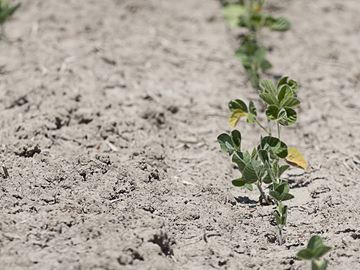
Amanda Moore/Staff Photo. Experts with the Ontario Ministry of Agriculture, Food and Rural Affairs estimate only 20 per cent of soybeans have an acceptable plant stands. Rain is needed in the next 10 days to ensure a decent yield for area growers.

Grimsby Lincoln News   Jul 04, 2016

By Amanda Moore

NIAGARA — With no end in sight to the dry, hot weather, farmers across the region are bracing themselves.

The situation is similar across the province, with Niagara, Haldimand and Eastern Ontario being the hardest hit, reads an online report from the Ontario Ministry of Agriculture, Food and Rural Affairs posted last week.

Agricorp, which provides risk management solutions for Ontario’s agri-food industry, has so far received 1,400 calls regarding damaged crops — 1,000 of which have been for poor soybean stands. About half of those calls were for dry soil conditions, with the remaining being for the opposite — extreme wet conditions in the Essex, Chatham, Kent area.

According to OMAFRA, only 20 per cent of soybean stands in Niagara and Haldimand have an acceptable plant stand due to the dry conditions.

Horst Bohner, soybean specialist for OMAFRA, said the lack of rain in much of Ontario puts this year’s soybean crop at risk. But it’s not all bad news. In Perth, where he is located, the soybean crop is fairing well, with most plants starting to flower. He said sporadic rainfall has kept the crop healthy there.

“That’s not the case for a lot of the Niagara region and Haldimand,” said Bohner. “It’s getting very late to try and get beans established now. There is significant acreage there with very poor plant stand which is a major concern at this stage.”

Typically, soybeans will begin the flowering stage this week but with many plants not having been established, Bohner said farmers are starting to get nervous. He said significant rainfall needs to happen, and soon.

“In a lot of fields, if we don’t get significant rain in the next 10 days, the likelihood of a good recovery is small,” he said, noting some fields in Niagara managed to catch a few showers and show potential for a good yield.

According to Environment Canada, the Hamilton area has received less than half the normal amount of rainfall this spring. In an average year, 165 millimetres of rain falls between May and June, this year there has been only 78 mm.

Bohner said Niagara’s corn crop faces a similar threat but there is more time for that crop to establish itself. However, if there is not significant rain by mid July, the chance of a good corn crop significantly lessens.

Four years ago, farmers faced a similar situation when dry weather early in the season threatened much of the soy and corn crop. Showers towards the end of July helped turn it around. That year was much better than 2001 when Mother Nature did not co-operate and the soybean crop was quite low across the province, said Bohner.

While the situation is not as dire for the many tender fruit growers in the region, growers of cherries, peaches, plums, apricots and other tender fruits are all hoping for some rain. Farmers have been irrigating around the clock to ensure their trees get enough water.

“We are irrigating a lot,” said Sarah Marshall, manager of the Ontario Tender Fruit Growers in Vineland. “Growers have been constantly irrigating over the past several weeks. We are definitely in a water deficit.

“We need some rain is what it boils down to.”

Marshall said through her discussions with OMAFRA, she learned this year’s precipitation levels for May and June are about 40 per cent of what they should be. She said that combined with a dry fall and winter have created a less than ideal situation for fruit growers.

However there is one benefit to a dry growing season.

“Dry weather does mean sweeter fruit generally,” she said, noting it also affects size. “We are at the stage now where fruit needs to pick up size. We are coming into harvest in three to four weeks and it could mean yield reduction, though we won’t know by how much until the end of the growing season.”

Cherries, which are just starting to make their way onto market stands and farmers’ market, are smaller than average but sweet, she said. One benefit to the lack of rain at this point in cherry season is minimal cracking in the skins of the fruit which is caused by rainfall during harvest.

The dry weather has certainly made fruit farming a more labour intensive process this year, Marshall said.

A dry season is easier to manage for the many grape growers in the area, but a balance of good moisture is key. Matthias Oppenlaender, chairman of the Grape Growers of Ontario, said he and fellow growers in the Niagara-on-the-Lake region are faring the lack of a storm due to access to water for irrigating. But many growers in Niagara aren’t so lucky and are holding out hope for rain. Just like with soybeans, grape growers need a good-sized drink for their crops in the next 10 days.

“If we don’t get any rain in July, it will be concerning for growers who cannot irrigate,” said Oppenlaender. “It’s a little too early for this. In August, we don’t mind if it slows down but we need rain in the 10 days. An inch or inch-and-a-half and then dry again would be perfect.”

Source: Hot, dry heat

24 NHL PLAYERS ELECT SALARY ARBITRATION

TORONTO (July 5, 2016) – 24 players have elected Salary Arbitration:

Arizona Coyotes
Michael Stone

Colorado Avalanche
Tyson Barrie
Mikhail Grigorenko

Detroit Red Wings
Jared Coreau
Danny DeKeyser

Minnesota Wild
Jordan Schroeder

Nashville Predators
Calle Jarnkrok
Petter Granberg

New York Rangers
Kevin Hayes
Chris Kreider
Dylan McIlrath
Jonathan Miller

New Jersey Devils
Kyle Palmieri

Ottawa Senators
Mike Hoffman

Philadelphia Flyers
Brandon Manning
Brayden Schenn
Jordan Weal

St. Louis Blues
Jaden Schwartz

Tampa Bay Lightning
Alex Killorn
Vladislav Namestnikov

Toronto Maple Leafs
Frank Corrado
Peter Holland
Martin Marincin

Washington Capitals
Marcus Johansson

The deadline for Club-Elected Salary Arbitration notification is July 6, 2016 at 5:00 p.m. EDT.

Salary Arbitration hearings will be held in Toronto from July 20 to August 4, 2016.

Source: 24 PLAYERS ELECT SALARY ARBITRATION