Andrew Phillip Chernoff

The Outer Limits To The Inner Depths

Major Nova Scotia rivers dry enough to ‘walk across without getting your feet wet’

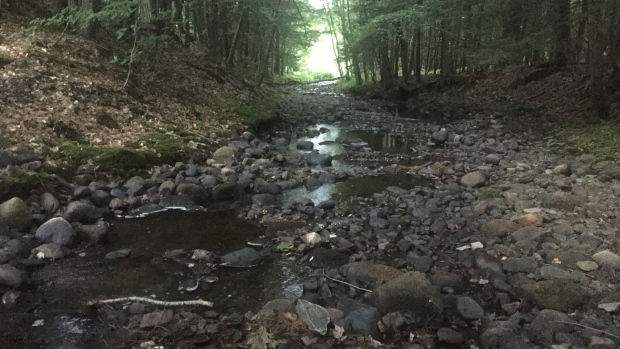
Cook’s Brook is normally an important spawning ground for salmon and trout (Stephanie vanKampen/CBC)

‘If things don’t turn around quickly, it’s going to have a lasting impact on the sport’

By Stephanie vanKampen

September 24, 2016

Nova Scotia’s severe drought has claimed another victim — the province’s recreational sport fishery is virtually non-existent, as rivers have dried up.

The head of the Nova Scotia Federation of Anglers and Hunters, Ian Avery, says the province’s 70,000 recreational fishers have nowhere to fish.

“When you go to any of the major rivers, you can literally walk across these rivers without getting your feet wet, whereas, normally you would be in knee-deep water,” said Avery.

1 in 100-year event

Avery said the drought could have a lasting impact on the brook trout and salmon fishery if rivers don’t get replenished soon.

“As the water levels drop, the temperature rises, of course, and that means a lack of oxygen for fish,” said Avery. “It’s been an anomaly this year to the point where it’s a one in 100-year event. This has never happened in Nova Scotia in quite a long time.”

Avery says the recreational sport fishery represents a $76-100 million industry in the province.

He says fishing clubs have a contingency plan to restock the rivers with small fish once water levels rise. But, he admits, that could take a while.

“If we don’t get the rain, the fish won’t be able to travel to their spawning grounds, which means less fish next year and the year after,” said Avery.

“It will have a detrimental effect on future fishing.”

On the LaHave River near Bridgewater, N.S., an area that is classified class 4-5 rapids in the spring, is now a trickle.
carroll-randall

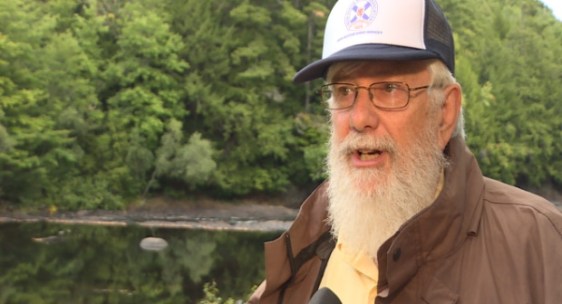
Carroll Randall, a registered fishing guide, says what is normally a beautiful paddle on the LaHave River, is now a hike. (Stephanie vanKampen/CBC)

Carroll Randall is a registered fishing guide, but he hasn’t had any customers this summer for trout or salmon due to the drought.

He says it is hurting the fishery, but the real victims are the fish.

“We could lose a whole generation of fish,” says Randall.  “The fish have to spawn, and if they can’t find a place to spawn, then all those eggs are lost, all those baby fish are lost, and it could mean some real trouble down the road.”

Rock piles

Rivers across the province are being described as “rock piles,” with historically low water levels, according to some guides.

Randall said the federal fisheries officers who have been monitoring fish numbers in the LaHave River have reported shockingly low numbers.

Randall said just 33 fish have passed through a fish way near Morgan’s Falls. In the past, hundreds have travelled the route.

He said even recent rains haven’t put a dent in the problem. Rivers need at least 200 millimetres of rain in order to save the fish.

Source: Major N.S. rivers dry enough to ‘walk across without getting your feet wet’

Europe nears trade deal with Canada 

European Commissioner for Trade Cecilia Malmstrom at the informal meeting of EU trade ministers in Bratislava, Slovakia | Jakub Gavlak/EPA

With CETA on track, the bloc keeps TTIP on life support.

By HANS VON DER BURCHARDS

September 23, 2016

BRATISLAVA — EU ministers have forged the political momentum required to seal their long-delayed trade deal with Canada but acknowledged that a more contentious pact with the U.S. will not be finalized this year.

At a meeting in Bratislava on Friday, the ministers drew up a plan to sign up to the Comprehensive Economic and Trade Agreement with Ottawa on October 18.

This sudden acceleration toward the diplomatic finish line was only possible after German Economy Minister Sigmar Gabriel earlier in the week secured overwhelming support for CETA at a convention of his often skeptical Social Democratic Party.

The SDP vote was followed by a similarly massive majority in the Bundestag.

Europe’s accord with Canada has become a defining test of whether Brussels is still able to steer the EU’s trade policy and the pact seemed in mortal danger while Germany’s commitment remained in question.

In Bratislava, Gabriel said he was now “very optimistic” that all 28 countries should be able to throw their weight behind the pact after months of tortuous diplomacy.

In addition to concerns in Germany, CETA’s advocates have needed to confront objections from Romania over visa reciprocity and Belgium’s Wallonia region about the rights of foreign investors to sue governments.

The most significant remaining hurdle, however, is Austria, where Social Democratic Chancellor Christian Kern has struck an increasingly hostile tone towards free trade.

Many diplomats, however, predicted that Vienna would ultimately sign on October 18, not least because of pressure from Berlin.

Source: Europe nears trade deal with Canada – POLITICO

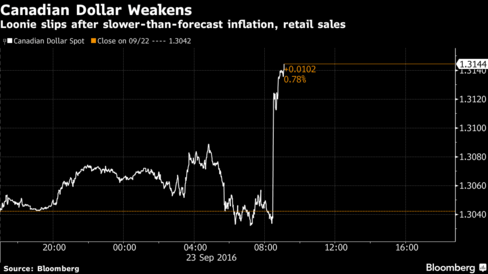
Loonie Weakens as Inflation Data Raise Chance for Bank Of Canada Rate Cut

By Maciej Onoszko

September 23, 2016

  • Currency is on track for a quarterly loss, its first in 2016
  • Probability of monetary easing this year rises to 18 percent

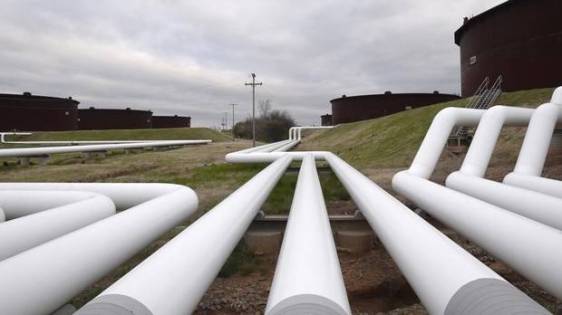
Oil sands surplus jamming up pipelines to U.S. 

Bloomberg News

Source: Oil sands surplus jamming up pipelines to U.S. – The Globe and Mail

S. Koreans shaken by their largest recorded earthquake

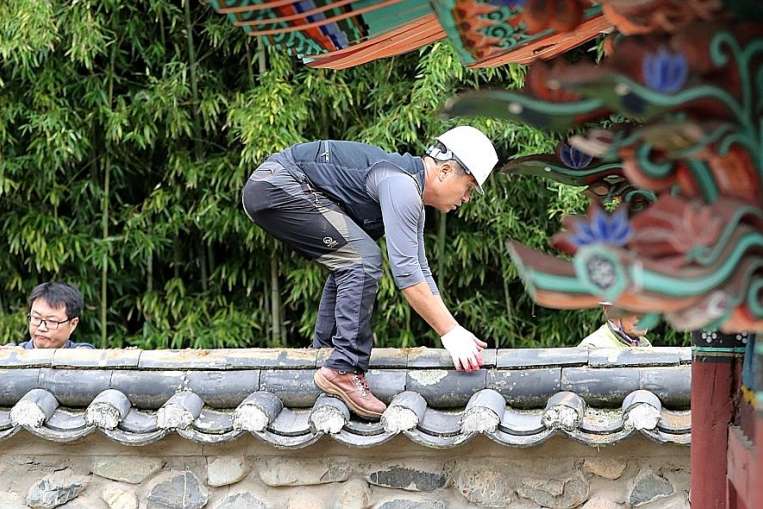
Workers from a cultural property repair agency replacing roof tiles at a traditional building in the city of Gyeongju, South Korea, on Sept 19 – a week after a 5.8-magnitude earthquake struck the historic city on Sept 12. Although it was the most powerful earthquake to have hit the Korean Peninsula since records began in 1978, it did not cause any major damage.PHOTO: EUROPEAN PRESSPHOTO AGENCY

More tremors felt in recent years; geologists warn of greater seismic movements to come

September 22, 2016

Chang May Choon     South Korea Correspondent In Seoul

Ms Lee Go Woon was having dinner with her family in the south-eastern port city of Busan when she felt the floor move, for about 30 seconds.

“I was quite surprised and didn’t know what to do because it was the first earthquake of my life,” said the assistant exhibition manager. “We never learnt how to deal with earthquakes because we always thought South Korea was safe from them.”

Ms Lee, 27, had two nights ago experienced an aftershock of South Korea’s biggest earthquake.

The 5.8-magnitude earthquake rocked most of the country on Sept 12, but did not cause any major damage. It was most strongly felt near the epicentre Gyeongju, a historical city in the south-eastern province of North Gyeongsang. Busan is 76km south-west of Gyeongju.

Fear is growing as aftershocks continue, and people are at a loss as to what to do. Some 400 aftershocks have been recorded, one of the latest being a magnitude 3.5 tremor that struck regions near Gyeongju around noon yesterday.

The Gyeongju earthquake is the most powerful to have hit the Korean Peninsula since records began in 1978. The last major seismic activity was a 5.3-magnitude earthquake that struck North Korea’s North Pyongan province in 1980.

SKOREA-QUAKE

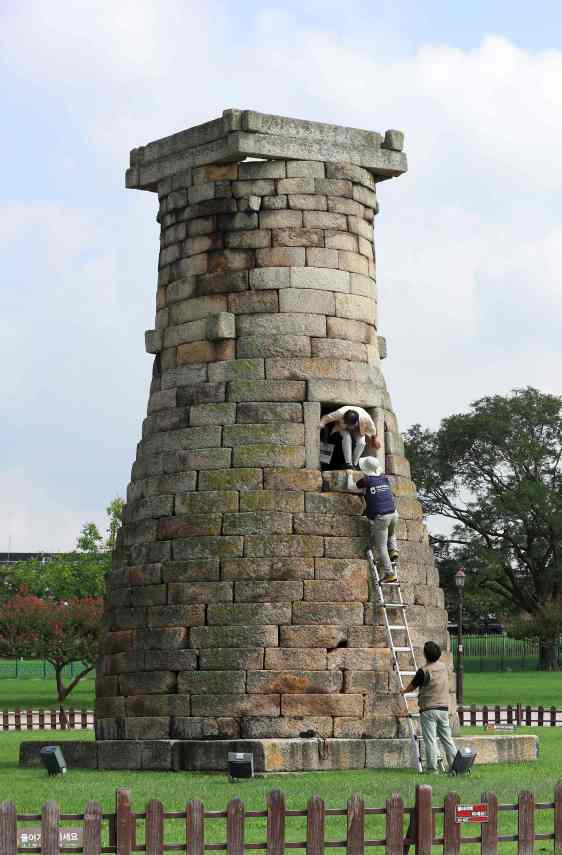
South Korean Cultural Heritage Administration officials inspect Cheomseongdae, an astronomical observatory of the 7th century, in Gyeongju on Sepber 13, 2016 after a powerful quake hit the southern part of South Korea. South Korea was clearing up on September 13 after being struck by its most powerful earthquake since records began. The 5.4 magnitude quake on late september 12 sent people scurrying from buildings, unused to the kind of seismic events that regularly shake neighbouring Japan. / AFP PHOTO / YONHAP / YONHAP####################YONHAP

South Korea has been relatively safe from major earthquakes, but geologists have expressed concern over the rising number of tremors felt in recent years and warned of bigger seismic movements to come.

The Korea Institute of Geoscience and Mineral Resources said last week that its studies show that a magnitude 6.5 quake could strike the Korean Peninsula in future. Some geologists predict that a quake with an even more powerful magnitude of 7.0 could strike the country.

Experts warned that powerful earthquakes could result in mass casualties as many buildings are not built to withstand them. The country is no stranger to gentle tremors of magnitude 2.0, but rarely experiences quakes of 5.0 or above.

To ease public anxiety, the government has held talks to discuss emergency quake-relief measures for the future. Yesterday, Prime Minister Hwang Kyo Ahn said they need to fix a budget to provide administrative support and allow the meteorological administration to send mobile alerts to the public effectively.

The Land Ministry announced on Tuesday more stringent control over earthquake-proof building designs starting next year, including additional safety evaluations for buildings 50 stories and taller.

Some experts noted that the Gyeongju earthquake was caused by activity in the Yangsan fault line in North Gyeongsang, while others said that recent earthquakes that shook Japan have shifted fault lines under the Korean Peninsula.

There are also rumours that the quake was triggered by North Korea’s latest nuclear test on Sept 9. But Dr Wang Yu, a research fellow at the Earth Observatory of Singapore, told The Straits Times it is “unlikely” that both events are related because the distance between them is vast.

Dr Wang said that aftershocks will “continue in the coming months to years”, but based on historical records, the chances of another damaging quake hitting Gyeongju is “relatively low”.

Some residents are not taking any chances. JoongAng Ilbo newspaper cited a Gyeongju resident who is making plans to move out of the city.

Another slept in her greenhouse because it was on flat land. The paper also quoted a father, in nearby Ulsan, who has been practising running down the stairs from his 19th-storey home with his six-month-old baby, as “it’s better than just sitting there stricken with fear”.

There are calls for the authorities to pay more attention to the safety of the country’s nuclear reactors, which are built to withstand earthquakes up to magnitude 7.0.

“We’re worried how long the aftershocks will last, and whether they are just teasers to a more severe earthquake,” Ms Lee said. “Koreans have been complacent about earthquakes so far, but now we need systemic control and manuals.”

Source: S. Koreans shaken by their largest recorded earthquake, East Asia News & Top Stories – The Straits Times