On Monday the Montreal Canadiens announced that they would be relocating their American Hockey League franchise from its current location in St. John’s, Newfoundland to Laval, Quebec, a suburb of Montreal. During the press conference in which the move was announced, Canadiens general manager Marc Bergevin listed the proximity of the NHL and AHL franchises as a chief reason for the move.
The Canadiens are far from the first team to do this. It’s another in a growing list of AHL-NHL partnerships that involves either sharing an arena or close proximity to each other. The benefits are clear: it would ease their ability to track the progress of their minor pro prospects as well as give feedback and instruction. Which begs the question: How long can the Canucks afford to keep their AHL franchise in Utica?
Jim Benning and the Canucks management team has been steadfast in their intention to leave their minor league affiliate in Utica, a town of a little over 60,000 people in upstate New York. This likely starts with loyalty: the Canucks have three seasons remaining on the six-year pact they made with Utica in the summer of 2013.
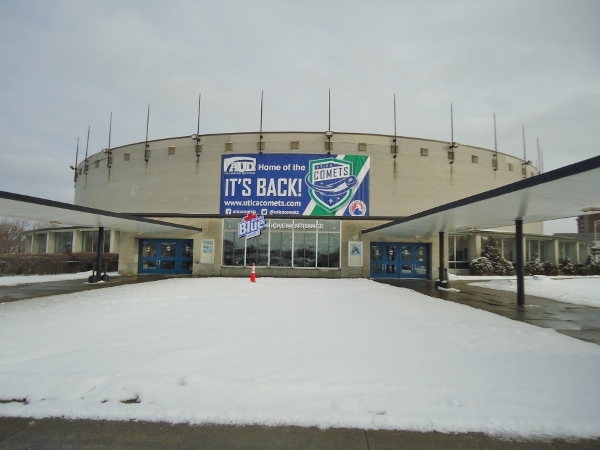
Beyond that, anyone who follows the Utica Comets knows that Vancouver has plenty more to like about the state of its farm team, starting with its fanbase. The city of Utica has completely embraced the Comets and has flocked to game after game providing what has been called a college-like atmosphere in the Utica Memorial Auditorium. They’re riding a sellout streak that dates back to the latter half of the 2014-15 season. Canucks management has also praised the facilities in Utica, suggesting that the workout and training areas that the prospects get to use are nearly NHL quality. Trevor Linden said this of their affiliation with Utica last summer:
“Our situation in Utica is special. It’s a great spot,” Linden said. “The one thing that we love is that we have six, seven teams within a two hour drive. The practice time and ability to rest between games is significant. The support they get in Utica, the guys love playing there. The dressing room the weight facility is NHL caliber. At this point we’re really happy there.”
That being said, Utica is still over 3,600 kilometres away from the city of Vancouver, and that is a path travelled quite frequently.
Every NHL team has its fair share of injuries, but the Canucks gruelling travel schedule has made them particularly susceptible to them – last season they were among the most affected teams in the league in terms of minutes lost (though their man games lost were closer to the middle of the pack).
It’s one of the main reasons that more and more teams are setting up affiliates in their own backyards. In the last two seasons, the AHL has seen a massive restructuring, as they added five teams in California – the first AHL teams on the west coast – belonging to the three California NHL organizations, as well as Calgary and Edmonton. San Jose formed the closest relationship with its affiliate: the NHL San Jose Sharks and the AHL’s San Jose Barracuda share the same arena.
This is not unusual: prior to the 2015-16 season, the Winnipeg Jets moved their affiliate, then located in Newfoundland, into their home arena, resurrecting the Manitoba Moose. The Toronto Maple Leafs’ AHL affiliate, the Marlies, also share a city with their parent club, though they play out of their own arena. Within the last month or so, the Arizona Coyotes moved their AHL club to Tucson, Arizona, causing the staff here at Canucks Army to reevaluate the situation.
The distance between Vancouver and Utica is not only something that NHL teams are moving on from, it’s the longest distance between an NHL city and its affiliate in the league – and it isn’t close. The 3,686 kilometres between the cities is more that one and a half times the next longest distance.
Vancouver and Utica are also the only pair that are three time zones apart (marked by a red bar), while only three others are even a single time zone apart (marked by yellow bars), with the other 26 pairs being in the same time zone.
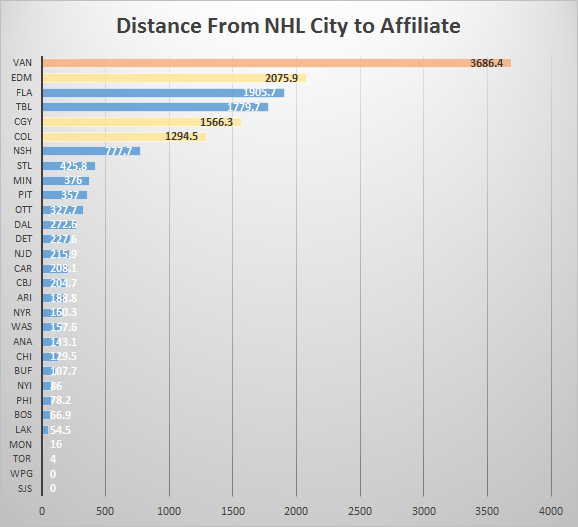
Source: Google Maps (Direct distance, not travel distance)
We’ve all heard about the effect an eastern road swing has on players, and many of us are personally familiar with the difficulties of working through different time zones. In their current situation, if the Canucks were on a homestand, or playing a series of games strictly in their division, any prospects that they call up from Utica would be forced to endure that feeling that Canucks players get when they have to go on a road trip through the Eastern time zone.
Canucks management has stated before that the Comets’ location in New York makes them convenient for call-ups while the team is out east, but the flaws in logic there are readily apparent. While the long eastern swings do seem to attract a disproportionate share of injuries, the Canucks are playing less than a dozen games a year within 500 kilometres of Utica.
Conversely, they play 41 games in Vancouver by default, another six to eight in California, and a dozen more in the next time zone over. The convenience of having call ups available in Vancouver vastly outweighs having them near the eastern metropolises.
The Canucks made 56 roster moves last year involving players going between the AHL and the NHL. We can see the distribution in the following graph, which charts the number of roster moves made within one day of a game, sorted by the time zone in which the game was played.
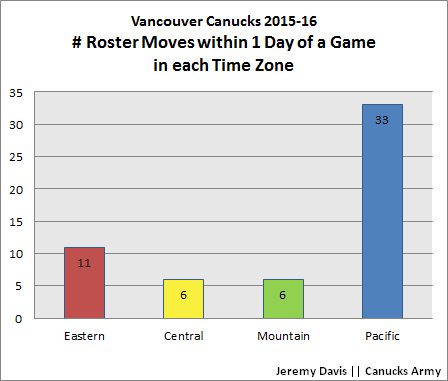
Source: Pro Sports Transactions
Lost in all of the chatter about the distance between NHL and AHL franchises is the fact that the Canucks signed an affiliation agreement with the Alaska Aces of the ECHL last month, after using the Kalamazoo Wings as their partner for the last several seasons. Alaska is a dreadful place for a franchise to be based out of at the best of times, given the travel to reach opponents, but having prospects going from Alaska to New York when transferring between the ECHL and AHL and then New York to British Columbia when transferring from the AHL to the NHL is just insanity; and it’s not like anyone ever gets called up from the ECHL to the NHL.
However, most call-ups from the AHL to the NHL result in another call up from the ECHL to the AHL to replace a missing player. Imagine if the Canucks had an AHL franchise somewhere in the lower mainland. A call up from the AHL to the NHL could be a drive across town, while the replacement player flies the 2,300 kilometres from Anchorage, Alaska (which is still admittedly inconvenient) to replace the call-up. Instead of that relatively painless process, the Canucks have to receive a Comet from 3,600 kilometres away, and then the Alaskan player has to travel a ridiculous 5,153 kilometres to Utica. That is, unless the Comets decide to just sign players to tryout contracts to avoid that hassle, which they will undoubtedly prefer to do, which also means that any prospects that find themselves relegated to the ECHL this year will have to work that much harder to get out of there.
POTENTIAL LANDING SPOTS
The Canucks have several different options if they wanted to relocate their subsidiary closer to home. Down the highway lies the Abbotsford Entertainment Center in the hometown of Jake Virtanen. The Center has been empty since the Abbotsford Heat vacated the arena following the 2013-14 season. Before moving their new purchased AHL franchise, the Peoria Rivermen, to Utica, the Canucks attempted to negotiate a deal with the city of Abbotsford that would involve the Canucks moving their franchise into the Abbotsford Entertainment Centre, and the Abbotsford Heat relocating to Utica instead.
That deal fell through, somehow. It would have been a major win for all parties – the Heat were running large deficits year after year, unable to fill the 7,000 seat arena with a bunch of Vancouver fans that had little interest in watching prospects of the Calgary Flames. Certainly a team full of Canucks prospects would have drawn bigger crowds, especially with Travis Green as the coach — the man could turn a dozen sacks of meat and potatoes into a competitive hockey club. Also among the reasons that the Abbotsford Heat struggled so mightily was the travel – of course, that was before the inclusion of five California teams. The return of the Manitoba Moose and a new team in Tucson, Arizona means there will be seven AHL teams within 2,200 kilometres of Abbotsford next season. Back when Heat were in town, Des Moines, Iowa was the closest city at 2,382 kilometres away.
Another option is the more recently vacated Pacific Coliseum. The home of the WHL’s Vancouver Giants for the past 15 seasons (who will play out of the Langley Events Center next season) and the former home of the Vancouver Canucks is certainly large enough to house an AHL team, though it could use a bit of a facelift. Finally, the farm team could share residence of Rogers Arena with the parent, as San Jose and Winnipeg are doing. Scheduling an extra 38 home games would certainly be tricky, but that’s what computer algorithms are for. The Canucks considered this option in 2013 as well, but due to AHL by-laws, they were not allowed to set up an AHL franchise that close to the Abbotsford. There are no such roadblocks at this point.
Update: Since I saw this in the comments, I thought I’d make a couple of additional suggestions that I forgot to get into the published article. While the AHL has established a western conference that includes five teams in California and one in Arizona, the north-south distant from Vancouver is still a bit of a pain. While I think having a team in the Lower Mainland is the ideal situation from the perspective of parent club interaction, there are other compromises that could be available. For instance, finding another market in California would allow travel between AHL and NHL that is shorter than the current set up and stays in the same time zone, as well as reducing day to day travel for the AHL club.
The California teams are currently playing a reduced schedule of 68 games instead of 76, with the standings sorted by points percentage rather than overall points. As more teams are added in the west (Tucson next season, and a hypothetical Vancouver affiliate would make seven teams in the Pacific/Mountain time zones), the need for this dismisses. As it is, the Western teams play an increased amount of games against each other. Between these two scheduling tweaks, the travel/game-to-rest ratio roughly equalizes to that of the Eastern conference.
Similarly, you could set up an AHL franchise in Portland, Oregon or Tacoma/Seattle, Washington, both of which could likely sustain NHL clubs let alone AHL clubs. The choice between B.C., Washington, Oregon and California gives the Canucks a lot of flexibility in terms of which type of distance they feel is more important, NHL to AHL travel, or AHL day to day travel. But in this case, all options are within the Pacific time zone and reduce the effect of time zone changes and cross continental travel for call ups.
I think it’s important to remember that while you do indeed want your AHL players to feel rested, it’s also extremely unfair for prospects like Brendan Gaunce and Alex Grenier to have to deal with jet lag while they’re on their first NHL call ups – stints that if they perform poorly in could affect the rest of their careers.
Any of these options would eliminate travel required for call-ups when the Canucks are playing at home, and lessen it in a lot of cases when they are playing on the road. All this is saying nothing of the benefit that minor pro prospects like Jordan Subban, Ashton Sautner and Curtis Valk could gain from being a stone’s throw away from the Canucks training staff when they return to AHL action this fall, not to mention new Comets like Thatcher Demko, Troy Stecher, and Carl Neill.
This Canucks management regime has been insistent that simply being around NHL players is beneficial to the development of young prospects, so being exposed to NHL players by sharing facilities would undoubtedly foster some extra development.
The Canucks’ loyalty to Utica is admirable. Surely they feel they owe the city that has grown to love their farm team to at least complete their current contract. However, there are benefits that are up for grabs as soon as the Canucks are able to move their farm team closer to home, if the Canucks could get out of the contract they made with Utica. Even if they were resigned to riding the current deal out, it makes no sense to extend it beyond its current expiration, especially as plenty of other teams in the NHL continue to take advantage of closer affiliates. I’ve been a huge fan of Utica to this point, but the distance between the cities is just too vast, and the benefits associated with a having an affiliate located within the greater Vancouver area are simply too good to turn down.


 Sources: Statistics Canada and Parliamentary Budget Officer.



 Andrew Phillip Chernoff