Q&A with Dr. Sylvie Trottier, Canadian researcher working on Zika vaccine

[A team of Canadian researchers is working diligently to develop a vaccine to combat the Zika virus/CBS]

A team of Canadian researchers is signing up volunteers to be part of the first human clinical trial of a vaccine to combat the Zika virus.

The Université Laval’s Infectious Disease Research Centre and Centre de recherche du CHU de Québec-Université Laval will be one of a trio of research centres to conduct the trial.

There is currently no treatment or vaccine for Zika, the virus that most recently emerged in South America. While most cases of Zika are relatively mild, the virus can cause microcephaly in infants born to infected mothers.

Yahoo Canada News spoke to Dr. Sylvie Trottier, director of the Laval faculty of medicine’s department of microbiology, infectious diseases and immunology, about the study.

Q: What does the trial involve?

The trial involves the first injection of the developing Zika vaccine. This vaccine has been through all the pre-clinical studies and now it is ready to be given to human beings for the first time.

This study is being conducted in Quebec City along with in two American centres.

Q: How long will it take?

The whole study will take about one year. We will give the vaccine to the volunteers and after we will observe the response in the immune system. This means there will be three shots of the vaccine. After that, it will be blood tests for quantification of the human response.

Q: So these are healthy people and you’re studying whether it has any adverse effects?

We want to see if there are any adverse effects and we want to see if there is immune response.

Q: How was the vaccine developed?

Researchers in Pennsylvania and Canada decided nine months ago that a Zika vaccine should be developed because of the pending outbreak of Zika in Brazil.

[Laval’s involvement is linked to the arrival of Dr. Gary Kobinger, a doctor of microbiology, professor in Université Laval’s Faculty of Medicine, researcher with Centre de recherche du CHU, director of Laval’s Infectious Disease Research Centre, and a global authority on vaccine research]

Q: That’s relatively quick?

Yes. This is a high-tech vaccine, a DNA vaccine.

[A DNA vaccine is a standard development technique in which genetic material is injected into a living host in order to prompt cells to produce an immunological response.]

This kind of vaccine is already in development for other viruses or microbes.

Q: So the team nine months ago foresaw the outbreak of the Zika virus?

In fact, the thing is that there were already two outbreaks in relatively small communities. In 2007, on Yap Island, Micronesia, 70 per cent of the people were infected.

The concern at that point was Guillain-Barre [an illness of the nervous system that can cause paralysis, and has been associated with Zika]. In the 2013 outbreak, the number of cases of Guillain-Barre was 20 times more than normal.

I don’t think anyone could have foreseen the onset of neurological defects in children. It could be more severe than we ever would have expected.

Q: Has this emerging problem of microcephaly made this vaccine more urgent?

Yes. These infants that are born with microcephaly have a lifelong disability and they will need a lot of care.

This is a human tragedy.

Q: This is an early stage of a human clinical trial. If everything goes as you hope, how long before a vaccine is available?

This is why we are working so hard now. But it is still hard to tell.

With the preliminary data, if we have good human immune response, this study can move quickly into Phase II, perhaps as early as the beginning of 2017.

Q: How many volunteers do you need?

We need 40 volunteers for the whole study. We want to proceed quickly to try and vaccinate them before the end of July or at the very beginning of August.

Q: What do you want Canadians to know about this study and Zika virus?

Even if, in Canada, we don’t have the mosquito that spreads this virus, this virus is transmitted sexually. In Canada now we have 161 cases and 160 of these cases involve travelers to affected countries. As there are more people, there will be more sexual transmission.

So it is not only a problem of South America or Central America. It is going to be a problem for us here, even if we don’t have transmission by the mosquito.

This interview has been edited and condensed.

Source: Q&A with Dr. Sylvie Trottier, Canadian researcher working on Zika vaccine

Paramount Pictures, Skydance and Bad Robot’s Star Trek Beyond spent over $69 million in British Columbia and created 3,925 jobs

CoAiyj_VMAAIWgt

VANCOUVER, BRITISH COLUMBIA – July 22, 2016 – Paramount Pictures, Skydance and Bad Robot’s Star Trek Beyond, out in theatres today, provided a significant boost to British Columbia’s economy.

New data released today shows that over the course of 78 days of filming, the production was responsible for over $69 million spent in British Columbia.

From the construction of the U.S.S. Enterprise at Vancouver Film Studios to filming at the beautiful Squamish Boulders, British Columbia continues to benefit from the economic boost of local productions like Star Trek Beyond.

Over $40 million was spent on local cast, crew, and extras hired for the period of filming. Some of the production’s other local expenditures include:

  • Over $17 million on rentals, including transportation, truck and car rentals;
  • More than $1.75 million on hotels and catering;
  • More than $1.6 million on hardware and lumber supplies; and
  • Almost $600 thousand on local wardrobe and dry cleaning services.

“The film and television industry is a creative and economic engine for British Columbia, benefiting local businesses, thousands of cast and crew, and communities across the province,” said Wendy Noss, President, Motion Picture Association-Canada.

“The data released today demonstrates the significant impact the industry continues to have both provincially and nationally.”

“Filming Star Trek Beyond in Vancouver and the surrounding areas provided us diverse filming locations and outstanding film studios, but beyond that we had access to amazing local cast and crew,” said Lee Rosenthal, President of Physical Production, Paramount Pictures.

“We are thankful for British Columbia’s hospitality and the numerous local businesses and vendors who were great to work with.”

“Vancouver Film Studios was thrilled to provide state of art production facilities for the filming of Star Trek Beyond,” said Peter Mitchell, President & Chief Operating Officer, Vancouver Film Studios and Board Member, Motion Picture Production Industry Association.

“With 12 purpose-built sound stages on 35 acres in the City of Vancouver and over $200 million invested, we have established our reputation as a leading film and television studio facility. British Columbia has become a key destination for film and television investment and we are excited to play our part in that success.”

“Congratulations to the more than 3,900 British Columbians who helped bring Star Trek Beyond to audiences around the world!” said Shirley Bond, Minister of Jobs, Tourism and Skills Training, and Minister Responsible for Labour.

“British Columbia has a talented workforce, world-class infrastructure, and stunning diverse filming locations and because of these advantages, B.C. has earned its reputation as one of North America’s busiest centres for screen entertainment production.”

Source: http://www.mpa-canada.org


‘Atomic Memory’ Device Uses Single Atoms to Store Information

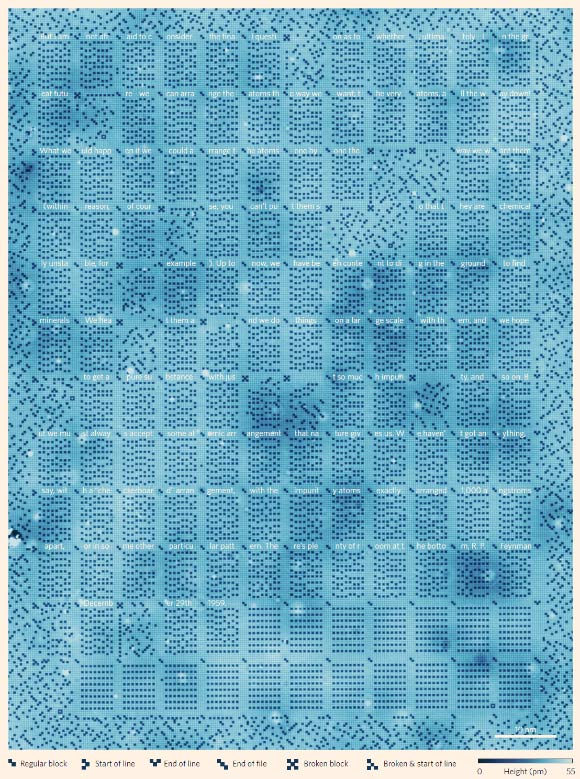
STM image (96 x 126 nm) of a 1,016-byte atomic memory, written to a passage from physicist Richard Feynman’s lecture ‘There’s plenty of room at the bottom.’ The various markers used are explained in the legend below the images. The memory consists of 127 functional blocks and 17 broken blocks. Image credit: F.E. Kalff et al.

An international group of researchers from Spain, Portugal and the Netherlands has demonstrated an atomic-scale memory device with a storage density of 502 Terabits per square inch (Tbpsi), outperforming state-of-the-art hard disk drives by three orders of magnitude.

July 19, 2016

“In theory, this storage density would allow all books ever created by humans to be written on a single post stamp,” said team leader Dr. Sander Otte, from the Kavli Institute of Nanoscience at the Delft University of Technology.

Dr. Otte and co-authors used a scanning tunneling microscope (STM), in which a sharp needle probes the atoms of a surface, one by one. With these probes scientists cannot only see the atoms but they can also use them to push the atoms around.

“You could compare it to a sliding puzzle. Every bit consists of two positions on a surface of copper atoms, and one chlorine atom that we can slide back and forth between these two positions,” Dr. Otte explained.

“If the chlorine atom is in the top position, there is a hole beneath it — we call this a 1.”

“If the hole is in the top position and the chlorine atom is therefore on the bottom, then the bit is a 0.”

“Because the chlorine atoms are surrounded by other chlorine atoms, except near the holes, they keep each other in place. That is why this method with holes is much more stable than methods with loose atoms and more suitable for data storage.”

The researchers organized their memory in blocks of 8 bytes (64 bits).

Each block has a marker, made of the same type of ‘holes’ as the raster of chlorine atoms.

These markers work like miniature QR codes that carry information about the precise location of the block on the copper layer.

The code will also indicate if a block is damaged, for instance due to some local contaminant or an error in the surface.

This allows the memory to be scaled up easily to very big sizes, even if the copper surface is not entirely perfect.

“In its current form the memory can operate only in very clean vacuum conditions and at liquid nitrogen temperature (77 degrees Kelvin), so the actual storage of data on an atomic scale is still some way off,” Dr. Otte said.

“But through this achievement we have certainly moved a big step closer.”

The team’s results were published this week in the journal Nature Nanotechnology.

_____

F.E. Kalff et al. A kilobyte rewritable atomic memory. Nature Nanotechnology, published online July 18, 2016; doi: 10.1038/nnano.2016.131

Source: ‘Atomic Memory’ Device Uses Single Atoms to Store Information | Nanotechnologies | Sci-News.com

Neuroscientists Release New Map of Human Cortex

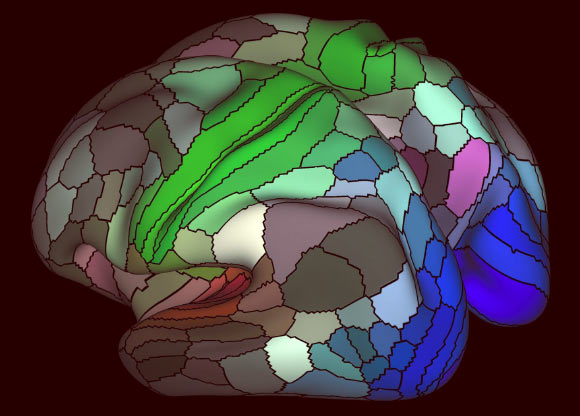
Matthew Glasser et al. discovered that our brain’s cortex is composed of 180 distinct areas per hemisphere. For example, the image above shows areas connected to the three main senses — hearing (red), touch (green), vision (blue) and opposing cognitive systems (light and dark). Image credit: Matthew Glasser / David Van Essen.

An international team of neuroscientists from the United States and Europe has mapped 180 distinct areas, including 97 that were previously unknown, in human brain cortex, or outer mantle.

The team, led by Washington University in St. Louis researchers Dr. David Van Essen and Dr. Matthew Glasser, has also developed software that automatically detects the ‘fingerprint’ of each of cortex areas in an individual’s brain scans.

“Using multi-modal magnetic resonance images from the Human Connectome Project (HCP) and an objective semi-automated neuroanatomical approach, we delineated 180 areas per hemisphere bounded by sharp changes in cortical architecture, function, connectivity, and/or topography in a precisely aligned group average of 210 healthy young adults,” the scientists said.

“We characterized 97 new areas and 83 areas previously reported using post-mortem microscopy or other specialized study-specific approaches.”

Earlier studies often used just one measure, such as examining postmortem tissue with a microscope. Uncertain delineation of cortex areas has sometimes led to shaky comparability of brain imaging findings.

“The situation is analogous to astronomy where ground-based telescopes produced relatively blurry images of the sky before the advent of adaptive optics and space telescopes,” Dr. Glasser said.

The team set out to banish this blurriness by using multiple, precisely aligned, magnetic resonance imaging (MRI) modalities to measure cortical architecture, activity, connectivity, and topography in a group of 210 healthy participants.

These measures – including cortex thickness, cortex myelin content, task and resting-state functional MRI (fMRI) – cross-validated each other.

The findings were, in turn, confirmed in an additional independent sample of 210 healthy participants.

Even though some cortex areas turned out to be atypically located in a small minority of subjects, the data-derived algorithms incorporated into the software were able to successfully map them.

While the study included fMRI scans of subjects performing tasks, the team determined that resting-state MRI techniques should suffice to map the areas in future studies using the tools they developed.

“Some areas may turn out to have further subdivisions or be subunits of other areas, in light of new data,” Dr. Van Essen said.

“The ability to discriminate individual differences in the location, size, and topology of cortical areas from differences in their activity or connectivity should facilitate understanding of how each property is related to behavior and genetic underpinnings,” Dr. Glasser added.

The team’s results were published online this week in the journal Nature.

_____

Matthew F. Glasser et al. A multi-modal parcellation of human cerebral cortex. Nature, published online July 20, 2016; doi: 10.1038/nature18933

Source: Neuroscientists Release New Map of Human Cortex | Neuroscience | Sci-News.com

CUPE takes supervisory battle to the next step | Canadian Union of Public Employees

July 22, 2016

CUPE has filed a notice of constitutional question in the cases of three employers who are attempting to unilaterally remove unionized supervisors out of the bargaining unit of their choosing.

The City of Moose Jaw, the Saskatoon Public Library, and Cypress Hills Abilities Centre are some of the first employers in the province to use new provisions under The Saskatchewan Employee Act (SEA) which allow employers to try to remove workers with supervisory duties from the bargaining unit. A fourth employer, the Regina Public Library, has applied to have similar employees removed from the bargaining unit claiming that they are managers.

“Working people have the right to belong to the union of their choosing. CUPE will fight any employer who moves forward with attempting to exclude supervisory members with every tool in our tool box, including legal avenues,” said Tom Graham, president of CUPE Saskatchewan. “Filing a notice of constitutional question is the first step in what could be a very lengthy and expensive legal battle.”

CUPE has serious concerns about the constitutionality of this legislation, as well as the impact the legislation is having on workers.

“This legislative change is causing a lot of stress and uncertainty for union members who have supervisory duties. People are worried about their job security. They are worried about what will happen to their benefits and wages if they get removed from their bargaining unit. They are worried about what their future holds,” added Graham.

CUPE believes that removing supervisors from the bargaining unit is completely unnecessary. Many major employers in the province have already signed irrevocable agreements to keep the status quo arrangement, including the Ministry of Health, SAHO, and the Government of Saskatchewan.

“Saskatchewan is now the only jurisdiction in Canada with this type of legislation. And I can see why,” said Graham. “This legislation is a solution in search of a problem. In my 37 years with CUPE, we have never had a problem with supervisors being in the same bargaining unit as the people they supervise that was not solved through application of the collective agreement.

“It is in both the union and the employer’s interests to maintain the integrity of the current bargaining unit, rather than create a separate bargaining unit within the local for supervisory employees. The status quo has worked and can continue to work.”

Source: CUPE takes supervisory battle to the next step | Canadian Union of Public Employees