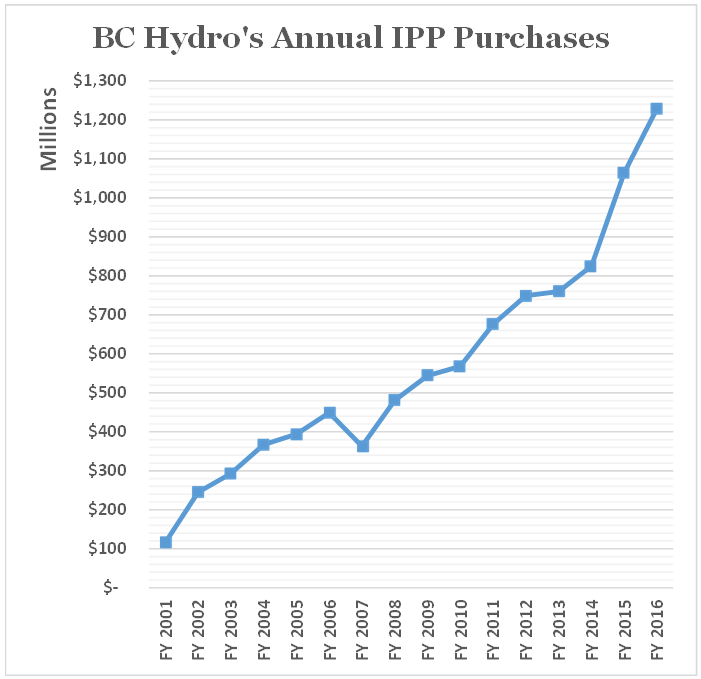
In the last five years, the delivery of cash to IPPs totaled $4.6 billion. If the established trend continues, the amount will be $8.3 billion in the next five years.
Amounts flowing to IPPs and the necessary write-off of more than $6 billion in deferred costs means in the next five years, consumers will pay rates 60% higher than they’ve paid in the last five years.
In addition, more than $10 billion dollars is committed to Site C and BC Hydro has been spending over $2 billion a year on capital expenditures. Without profitable new markets – none are anticipated – the 60% price rise for electricity could be 100% in the foreseeable future.
Wilderness Committee complains meetings poorly advertised and hard to get to
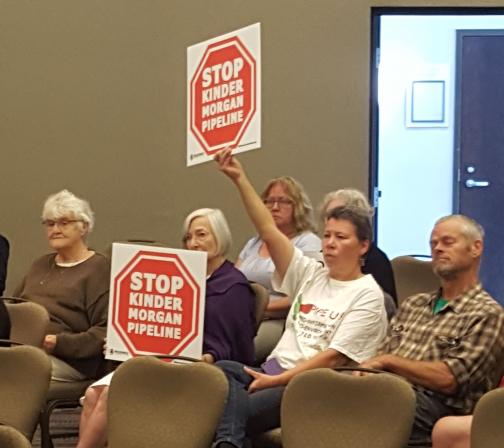
VANCOUVER, BC – A federal panel appointed to gauge opposition to the Kinder Morgan pipeline found widespread public opposition in Kamloops, Chilliwack, Abbotsford and Langley, according to Wilderness Committee climate campaigner Peter McCartney.
“All along the pipeline route we’ve heard from local residents and Indigenous people who fear for their health, their land and their water because a toxic tar sands spill could destroy their way of life,” said McCartney.
“At each stop, communities have also raked the panel over the coals for its lack of notice and accessibility.”
In Kamloops, Councillor Donovan Cavers expressed outrage that he only found out about the meeting through Facebook and Chief Judy Wilson of Neskonlith told the panel they had breached cultural protocol by not inviting Secwepemc leaders.
At Fraser Valley meetings leaders railed against the lack of notice and information.
“It’s a miracle we’ve seen the strong numbers we have at these meetings given how hard it has been for the public to find out about and get to them, often during working hours and in the middle of summer vacations,” said McCartney.
“It shows just how much this issue matters to the people, which is not surprising as they are the ones facing the risk.”
The public meetings on the proposed Kinder Morgan pipeline expansion take place against the backdrop of a catastrophic spill in Saskatchewan, which has shown residents’ worst pipeline fears can come true.
“All this time we’ve been saying there’s no way to clean up a tar sands spill and now we see that playing out in the North Saskatchewan River,” said McCartney.
“We cannot let this happen to the Fraser River or the Salish Sea. The stakes here are enormous.”
At each stop, opponents stressed the urgency of the climate crisis and the need to halt the expansion of the tar sands.
“That’s been the elephant in the room this whole time,” said McCartney.
“The reality is that we need to keep fossil fuels in the ground for a healthy global climate.”
For more information, please contact: Peter McCartney | Climate Campaigner, Wilderness Committee
778-239-1935, peter@wildernesscommittee.org
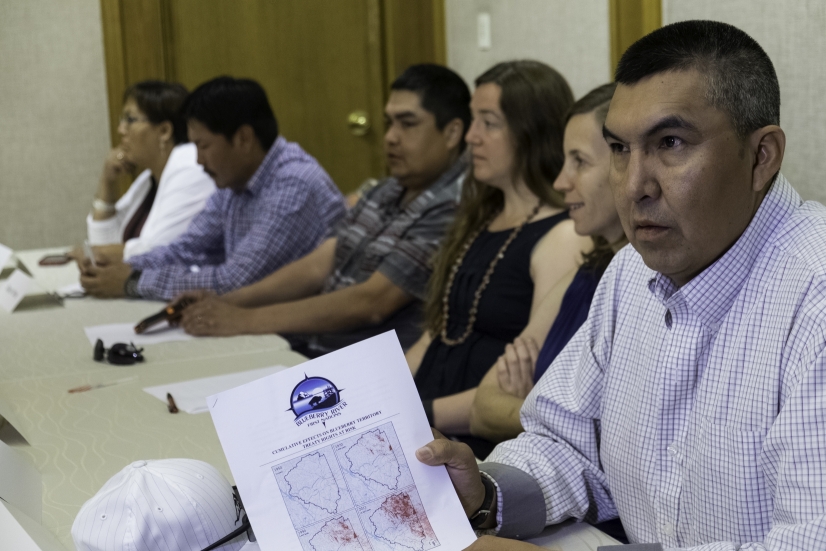
The B.C. government has significantly accelerated the rate and scale of industrial development in the Blueberry River First Nations’ traditional territory over the past four years despite knowledge of alarming impacts, says a major science report released today.
“Our very life, our way of existence, is being wiped out,” Blueberry River Chief Marvin Yahey told a Vancouver press conference. “It’s devastating. It’s really impacted my people, culturally but socially also. It puts a lot of stress on a community.”
The report, authored by Ecotrust Canada and based on B.C. government data, found that up to 84 per cent of the Blueberry River traditional territory in B.C.’s northeast has been negatively impacted by industrial activity.
Almost 75 per cent of the territory now lies within 250 metres of an industrial disturbance, and more than 80 per cent is within 500 metres.
“The industrial activity has really hammered our traditional territory,” Yahey said in an interview. “It affects our hunting, fishing, camping and teaching our children our way of life. The wildlife are vanishing. Our berry picking sites are being destroyed by pathways and pipelines.”
It paints a bleak picture of the total impacts of all industrial development in the nation’s traditional territory, which covers more than 38,000 square kilometers in the Peace region.
Since 2012, the B.C. government has authorized the construction of more than 2,600 oil and gas wells, 1,884 kilometres of petroleum access and permanent roads, 740 kilometres of petroleum development roads, 1,500 kilometres of new pipelines and 9,400 kilometres of seismic lines, according to the report. Approximately 290 forestry cutblocks were also harvested in Blueberry River traditional territory over the same time period.
The disturbance atlas found that almost 70 per cent of Blueberry traditional territory is now covered by active petroleum and natural gas tenures. There are 4,676 abandoned oil and gas wells in the territory.
Several proposed liquefied natural gas (LNG) lines could also extend into Blueberry River First Nations traditional territory, including Spectra Westcoast Connector, Coastal GasLink, North Montney Mainline and Prince Rupert Gas Transmission Project, the report said.
Blueberry River First Nations – Industrial Development Change Over Time
David Suzuki Foundation spokesperson Rachel Plotkin called the findings both an “ecological crisis and a crisis of social justice.”
In 1979, a sour gas leak forced Blueberry River members to flee from their original reserve on the banks of the Blueberry River, with only the clothes they were wearing.
“Everything we left behind was destroyed,” recounted Yahey. “Animals, pets, food, clothing.”
The nation was eventually moved to its current location just two kilometres away, 80 kilometres northwest of Fort St. John.
The ‘Little Kuwait’ of Northern B.C.
Yahey said people refer to the current reserve as “Little Kuwait” because of the flares from fracking that light it up at night. Community members have purchased sour gas monitors to ensure they will have time to evacuate if there is another sour gas leak and they have to haul in safe drinking water due to a drop in water levels they believe is caused by nearby fracking operations.
“We leave one area and go to another and it’s just as bad there today. We go to our hunting camps and [they’ve] been destroyed.”
The B.C. government ignored a September 2014 request from the Blueberry River First Nations for a cumulative impacts assessment and monitoring program that would guide decisions about land use and resource extraction, said Yahey.
“There has been no meaningful response.”
On the contrary, the chief said the province continues to approve major industrial undertakings, including the expansion of fracking operations and the $8.8 billion Site C dam.
In an e-mailed statement, John Rustad, Minister of Aboriginal Relations and Reconciliation, said the B.C. government is aware of the Blueberry River First Nations’ concerns regarding resource development in their traditional territory.
Rustad said the government has developed a cumulative effects framework that is being applied in northeast B.C. to improve natural resource decision-making, along with a “regional strategic environmental assessment project.” Blueberry River First Nations has been invited to join these initiatives, Rustad said.
“We also regulate all industries with rigorous environmental standards, and have programs in place to protect critical habitat for wildlife and water resources, and to ensure our air is clean,” said the minister’s statement.
Yahey said the government’s initiatives are not sufficient, and that there is “a hurry for B.C. to clear everything [and] wipe everything out without acknowledging our rights.”
In an effort to seek solutions, the Blueberry River First Nations used its own resources to develop a science-based Land Stewardship Framework. The framework, which Yahey calls a “path to yes”, identifies immediate action the provincial government can take to protect areas of importance to the Blueberry and to allow industrial development “without sacrificing ecological values.”
Critical Area Slated for Fracking
The Pink Mountain area, described by Chief Yahey as a “critical area” for Blueberry River First Nations traditional practices and an area the nation has been trying to protect, is one of many zones throughout Blueberry River territory that has been slated for shale gas drilling and fracking. Pink Mountain is currently the site of intense fracking operations by Progress Energy, a subsidiary of Malayasian-owned Petronas, one of the leading liquefied natural gas proponents in B.C.
Expansion of Pink Mountain fracking operations, leading to further landscape fragmentation, will occur if a proposed privately-built transmission line is built across Blueberry River territory to link the project with hydro facilities on the Peace River, including the Site C dam. In a controversial move, the B.C. government has excluded the proposed transmission line to Pink Mountain from independent review by the B.C. Utilities Commission.
Much of the development in the wildlife-rich Pink Mountain area is occurring in a region that, until very recently, had not been subject to the intense industrial development that characterizes the landscape further to the south in Blueberry River traditional territory.
The territory overlays the Montney basin, which contains the largest shale gas reserves in the province and some of the largest in the world. While much of the gas industry currently battles low prices, the Montney’s gas resources contains a high content of valuable liquids that allow companies to continue to extract the gas profitably.
The Blueberry River First Nations are not opposed to development but want to be included in plans, said Yahey. To that end, the chief described a lawsuit the nation launched against the province of B.C. in March 2015 as a “last hope.”
The ongoing lawsuit claims that the cumulative impacts from extensive industrial development, including Site C, violate Treaty 8, which the Blueberry River First Nations signed in 1900.
The claim asserts that Blueberry River members can no longer access uncontaminated land and resources capable of sustaining traditional patterns of economic activity and land use, as guaranteed by the treaty. These include hunting, eating moose, harvesting berries and medicinal plants and teaching children their language while on the land.
“Our backs are against the wall,” said Yahey. “We’ve tried all the time to come up with a solution. This was our only way to get them to the table to protect our way of life.”
The disturbance atlas also demonstrates that the Peace region has received a disproportionate share of the province’s industrial activity and lacks protected areas compared to other regions of B.C.
Less than one per cent of Blueberry River First Nations traditional territory is conserved in parks and protected areas, compared to 14 per cent province-wide.
While 60 per cent of B.C. is classified as intact forest landscape, less than 14 per cent remains in Blueberry territory. And almost one-half of the total area in B.C. reserved for pipelines through tenures falls in the Blueberry River traditional territory.
You know you’ve got the attention of the fossil fuel industry when the Financial Post’s Claudia Cattaneo pens a dismissive column about your efforts.
On Tuesday, Cattaneo — recently dubbed “everyone’s favorite oil and gas shill” by American Energy News — bestowed the honour on a new report about TransCanada’s proposed Energy East pipeline, published by the Natural Resources Defense Council and 13 other environmental organizations including 350.org, Greenpeace and the Sierra Club.
“Canadian [sic] are also right to wonder why a deep-pocketed U.S. group with an army of lawyers is meddling in an all-Canadian pipeline project,” she opined in her 820-word column, shortly after insinuating the Natural Resources Defense Council “needed to conquer and make money off a new dragon” following the presidential veto of the Keystone XL pipeline in 2015.
The idea that Energy East only concerns Canadians is a curious perspective. But it’s certainly not a unique one.
The Energy East project, requiring 1,500 kilometers of new pipeline and the conversion of 3,000 kilometers of existing natural gas infrastructure in order to transport up to 1.1 million barrels of dilbit per day, has been heralded by many as a quintessentially Canadian project, comparable to the Canadian Pacific Railway in scope and significance. Even Rick Mercer argued for its construction.
Unlike the Kinder Morgan’s proposed Trans-Mountain Expansion, however, there’s been a fair bit of obfuscation about what the desired market is for the transported product.
That’s a key problem for a big picture defence of the project.
Some have contended that Energy East will transport products for consumption in Eastern Canada, helping to foster energy security by breaking a reliance on imports from the Middle East. Such a reality would indeed seem like an “all-Canadian pipeline project” and justify Cattaneo’s confusion about why U.S. organizations are getting involved in the battle.
But as the Natural Resources Defense Council’s new 24-page report (ominously titled “Tar Sands in the Atlantic Ocean“) sketches out, the U.S. has many, many reasons for concern: threats to marine mammals, vulnerable ecosystems and progress on climate change, for starters.
“From the U.S. perspective, [Energy East] is a huge project that right now feels as if it’s being snuck in,” says Josh Axelrod, a Washington, D.C.- based policy analyst at the Natural Resources Defense Council and co-author of the report in an interview.
”We’re worried if it remains on the down-low that our regulators will basically find out about dilbit tankers the day something goes wrong and will not be prepared for it. We would like to, at the very least, have them prepared, if not express their disapproval of the idea.”
Tankers Could Move 328 Million Barrels of Oil Per Year in U.S. Water
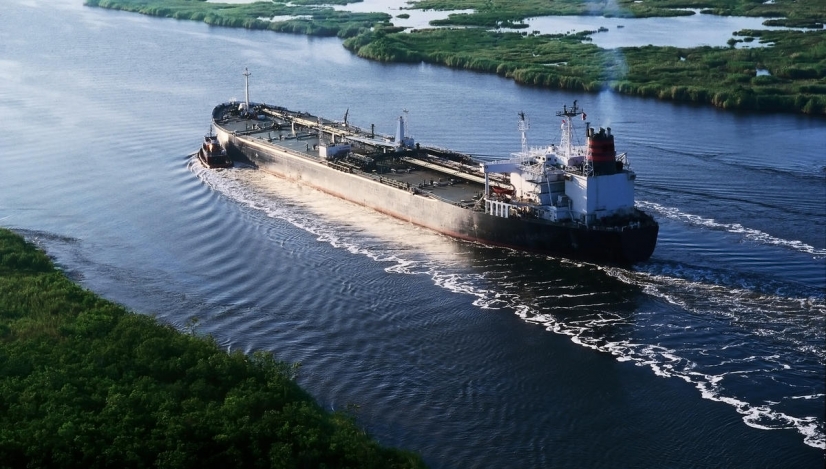
In TransCanada’s May 2016 consolidated application to Canada’s National Energy Board, the company estimated it would ship up to 281 tankers every year.
Axelrod says the proposed tanker configuration amounts to 900,000 barrels a day.
By the report’s estimates, tankers could move up to 328 million barrels of oil to refineries in New Jersey, Delaware, Louisiana and Texas: the U.S. Gulf Coast sports 25 refineries, 17 of which have a history of processing heavy oilsands crude.
Meanwhile, New Brunswick’s Irving refinery doesn’t have the capacity or even necessarily the desire to process dilbit (Axelrod adds the reversal of Enbridge’s Line 9B in September makes Energy East less useful to the Montreal refineries).
This matters a great deal. If TransCanada was intending to transport and sell dilbit to Canadian refineries for Canadian usage, it would indeed be odd for a report to call for a moratorium on tankers; Cattaneo strangely suggested in her column that the proposed ban is “a bit surprising given that oilsands tankers would be leaving from a Canadian port, making it harder to block by the U.S. administration.”
For at this point, the facts seem clear: tankers will be leaving a Canadian port and travelling through American waters with potentially catastrophic impacts in the case of a spill or accident.
Dilbit Spills Notoriously Difficult to Clean Up
The report points to two major incidents that have occurred in the past few years — the 2010 Enbridge spill in Michigan’s Kalamazoo River, and the 2013 ExxonMobil spill in Arkansas — as examples of the difficulties of containing and cleaning up a dilbit spill.
And that’s not even to speak of issues like ship strikes (when ships hit whales or other marine mammals), noise pollution or the accidental transportation of invasive species.
These are all issues that one would hope regulators would consider in their review of projects. But Axelrod says the National Energy Board (NEB) has “really flubbed this,” using a process that fails to consider cumulative impacts or acknowledge difficulties with cleaning up other dilbit spills.
“The NEB likes to make it seem like their processes are straightforward but they’ve really made it into a disaster,” he says. “There’s pro forma discussion of some of the impacts but a very limited scope.”
Energy East Exempted From Environmental Assessment Overhaul
There is still lots of time to correct such problems: the NEB’s consultation process will be continuing until 2018, while the very earliest Energy East could start transporting dilbit would be 2021.
But companies including TransCanada and Kinder Morgan have already been told by the federal government that “no project proponent will be asked to return to the starting line,” with the exception of the evaluation of their upstream greenhouse gas emissions.
“I hope it’s being used as a way to look at a project’s impacts on provincial and national climate goals and international commitments, and if that’s the case it could be a useful tool,” Axelrod says. “But it really misses a lot of the project’s climate impacts.”
And given the NEB will almost certainly approve the project — since 2012, the body has had to conduct environmental assessments and consultations, tasks that are far outside of its original mandate — that’s a problem the federal cabinet will have to confront.
But if Canada does end up approving Energy East — and, of course, depending on who’s elected as president of the United States — it may end up seeing a similar conclusion to what happened with the Keystone XL pipeline: pushed for by Canada and rejected by America due to potential impacts on environments and wildlife.
Maybe, by then, it will have all started to make sense for Cattaneo and her pals.
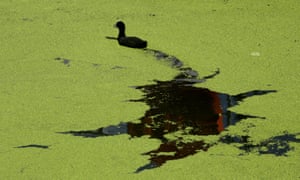
The hot weather has been a boost for plants, and especially weeds. The heat triggered an explosion of duckweed that has smothered many canals and ponds, especially in London, where some waterways have been choked with carpets of duckweed so dense they looked like garden lawns. In fact, the Canal & River Trust recently removed 70 tonnes of the weed from canals in London.
Duckweed is only a tiny plant with miniature round leaves that float, but it grows and multiplies so fast it can quickly smother fairly slow or stagnant waters, starving wildlife in the water of light and oxygen.
Despite its troublesome reputation, duckweed also has its virtues. As its name suggests, ducks feed on it, and it provides shelter for spawning common frogs and toads. It’s got a big appetite for mopping up pollution from metals, animal waste, sewage and much else. Duckweed can be turned into biofuel by converting its starch by fermentation into ethanol, currently widely made from maize.
But duckweed is much more economic to grow. It makes more starch per acre, doesn’t take up valuable land to grow on, doesn’t need pesticides and fertilizers, and is easy to harvest and process.
Perhaps duckweed’s crowning glory could be as a valuable high-protein food. There’s already a flourishing market for duckweed as a foodstuff for ducks and fish in Vietnam, and it’s eaten as a vegetable by people in other parts of south-east Asia. The plant can also be grown hydroponically in tanks of water and turned into a powdered food containing 68% protein.

 Andrew Phillip Chernoff