
Category Archives: Nanos Poll
Human rights trump jobs for Canadians in Saudi arms deal (Globe and Mail/Nanos Survey)

Human rights trump jobs by 2 to 1 in Saudi arms deal
According to a recent survey conducted by Nanos Research on behalf of the Globe and Mail, Canadians have an overall negative impression of the Government of Saudi Arabia and feel Canada should sell arms only to countries that respect human rights.
- Impression of the Government of Saudi Arabia – More than four fifths of Canadians say that they have either a negative (54%) or somewhat negative (33%) opinion of the Government of Saudi Arabia, while almost one in ten (9%) are undecided. Only five percent of Canadians say they have a somewhat positive (four percent) or positive opinion (one percent).
- Armament sales to Saudi Arabia – Nearly three fifths of Canadians (58%) say that it is more important to ensure that Canada only sells arms to countries that respect human rights than to create the 3,000 jobs needed to build the light armoured vehicles in Canada (30%) to sell to Saudi Arabia. Twelve percent of Canadians are unsure.
- Demographic differences – It should be noted that women (67%) are significantly more likely to say that Canada should only sell arm to countries that respect human rights than men (49%). Likelihood to agree with this statement also decreases with age, as two thirds (66%) of those aged 18 to 29 said that selling arms to countries who respect human rights was more important than the jobs created, while only half (50%) of those aged 60 plus said the same. No other significant differences can be noted.
The full survey results can be found by visiting our website
Methodology
Nanos conducted an RDD dual frame (land- and cell-lines) hybrid telephone and online random survey of 1,000 Canadians between January 30th and February 1st, 2016 as part of a Canadian omnibus survey.
Participants were randomly recruited by telephone using live agents and administered a survey online. The sample included both land- and cell-lines across Canada. The results were statistically checked and weighted by age and gender using the latest Census information and the sample is geographically stratified to be representative of Canada. The research was commissioned by the Globe and Mail.
The margin of accuracy for a random sample of 1,000 Canadians is 3.1 percentage points, plus or minus, 19 times out of 20.

Nik Nanos, FMRIA
Chairman
email: nnanos@nanosresearch.com
web: http://www.nanosresearch.com

Canadians support non-combat role – open to bringing 25,000 Syrian refugees (Globe and Mail/Nanos Survey)

Canadians support training local troops in Syria and accepting 25,000 refugees; split on sending Canadian troops to fight ISIS or providing only humanitarian aid
A majority of Canadians support sending non-combat personnel to Syria to train local troops, as well as the Trudeau Liberals’ pledge to bring 25,000 Syrian refugees into Canada. Contrary to current government plans, deploying Canadian fighter jets to support the international mission was also supported, although support has experienced a decline over the past year. Support was split among Canadians when considering sending in Canadian ground troops to fight ISIS directly, or providing only humanitarian aid.
- Training local troops only – The most popular choice for intervention in the Syrian conflict, according to Canadians, is to deploy non-combat military to train local troops in the region. Four fifths of Canadians (81%) either support or somewhat support the deployment of non-combat troops (54% support; 27% somewhat support), while 16% of Canadians either somewhat oppose or oppose the same idea (8% oppose; 8% somewhat oppose).
- Accepting 25,000 refugees – The majority of Canadians (65%) support or somewhat support the Trudeau liberal plan to bring in 25,000 refugees from Syria into Canada as promised by the Trudeau Liberals during the election (46% support; 19% somewhat support). Twelve percent say they would somewhat oppose this plan, and one fifth (22%) say they would oppose the plan.
- Deployment of fighter jets – Contrary to the Trudeau Liberal’s plan to stop Canadian air support in the international mission in Syria, a majority of Canadians (59%) continue to support or somewhat support the deployment of fighter jets in Syria. Thirty-eight percent support, and 21% somewhat support deploying the jets- down from those who supported (44%), and who somewhat supported (21%), deployment of jets a year ago. However, almost two fifth (38%) of Canadians somewhat opposed or opposed this plan (16% oppose; 22% somewhat oppose).
- Deployment of Canadian ground troops – Opinions on deploying ground troops to Syria were split among Canadians. Just under half of Canadians (49%) either oppose or somewhat oppose sending in ground troops to Syria to fight ISIS. Thirty-two percent said they oppose such a plan, and 17% said they somewhat oppose it,however, fewer Canadians oppose sending in troops now compared to 2014, where 40% of respondents said they opposed such a plan. Just under half of Canadians (47%) said they would support or somewhat support sending in ground troops (24% support; 23% somewhat support)
- Provide only humanitarian support – Opinions on providing only humanitarian aid to Syria were similarly split among Canadians. Just under half of Canadians (49%) either oppose or somewhat oppose providing only humanitarian support and offering no military involvement in Syria (32% oppose; 17% somewhat oppose), compared to 23% who said they would oppose and 14% who said they would somewhat oppose the same thing a year ago. Comparatively, just under half of Canadians (47%) would support or somewhat support providing only humanitarian aid. Twenty-five percent of participants said they would support, and 22% said they would somewhat support, this type of intervention. This is a decline from 2014 when 38% supported, and 21% somewhat supported, the same action.
The full survey results can be found by visiting our website
Methodology
Nanos conducted an RDD dual frame (land- and cell-lines) hybrid telephone and online random survey of 1,000 Canadians between November 21st and 24th, 2015 as part of a Canadian omnibus survey.
Participants were randomly recruited by telephone using live agents and administered a survey online. The sample included both land- and cell-lines across Canada. The results were statistically checked and weighted by age and gender using the latest Census information and the sample is geographically stratified to be representative of Canada. The research was commissioned by the Globe and Mail.
The margin of accuracy for a random sample of 1,000 Canadians is 3.1 percentage points, plus or minus, 19 times out of 20.
Canadians say climate change a threat to Canada’s economic future and that Canada’s reputation has taken a hit on the global stage – CTV
Canadians see climate change as a threat to Canada’s economic future; support moving forward with climate change targets
Canadians agree or somewhat agree that the science behind climate change is irrefutable, and that climate change presents a threat to our economic future. They do believe that our previous efforts on climate change have harmed our reputation internationally, and generally support or somewhat support job losses in the oil industry in order to move forward with meeting environmental targets. Canadians are generally willing to pay more for products to help meet those commitments.
- Climate’s threat to our economic future – Just under three quarters of Canadians (73%) either agree or somewhat agree that climate change represents a significant threat to our economic future (51% agree; 21% somewhat agree). Respondents in British Columbia were the most likely to agree or somewhat agree (82%). Just 16% either disagree or somewhat disagree (six percent disagree; 10% somewhat disagree) that climate change is a threat, while 10% said that they neither agree nor disagree that climate change is a threat.
- The science of climate change – Just over seven in ten Canadians (72%) believe that the science of climate change is irrefutable, with half saying they agree (50%) and a little over one fifth saying they somewhat agree (22%) with that statement. Comparatively, only 17% said they either disagree or slightly disagree with that statement (10% disagree; eight percent somewhat disagree). Eight percent said they neither agree nor disagree that the science of climate change is irrefutable. Canadians in Atlantic Canada were the most likely to say the agree or somewhat agree (82%) that the science behind climate change is irrefutable, and participants in the Prairies were the least likely to say they agree or somewhat agree (58%) with the same statement.
- Reputation damage from previous climate action – Just under seven in ten Canadians (69%) agree that Canada’s reputation on the global stage been hurt by our previous efforts on climate change (52% agree; 17% somewhat agree). Eighteen percent on Canadians either disagree or somewhat disagree that there was any reputation damage (11% disagree; seven percent somewhat disagree). Twelve percent said they neither agree nor disagree with that statement. Quebecers were most likely to agree or somewhat agree (81%) that Canada’s reputation had been damaged (61% agree; 20% somewhat agree), while those in the Prairies were the least likely to agree or somewhat agree (52%) to the same thing (35% agree; 17% somewhat agree).
- Paying more to meet climate commitments – Just over three fifths of Canadians (63%) are willing to pay more for certain products in order to help Canada meet its environmental commitments, with (37% agree; 26% somewhat agree). However, just under a quarter of respondents either disagree or somewhat disagree that they would be willing to pay more (15% disagree; nine percent somewhat disagree). Twelve percent of Canadians neither agree nor disagree that they would be willing to pay more for certain products. Canadians in Atlantic Canada were most likely to agree to pay more, with almost three quarters (74%) saying they would agree or somewhat agree to pay more, compared to only half (50%) of Canadians in the Prairies who would say the same thing.
- Moving forward with new targets – The majority of Canadians (66%) either support or somewhat support going forward with new climate change targets and processes even if the result is significant job loss in Canada’s oil patch (38% support; 28% somewhat support). Conversely, just under a third of Canadians (30%) would oppose or somewhat oppose the same thing (18% oppose; 12% somewhat oppose). Support for this plan is lowest among Canadians in the Prairies, where only 45% would agree or somewhat agree to move forward with new targets irrespective of job losses in the oil industry.
The full survey results can be found by visiting our website.
Methodology
Nanos conducted an RDD dual frame (land- and cell-lines) hybrid telephone and online random survey of 1,000 Canadians, 18 years of age or older, between November 21st and 24th, 2015 as part of an omnibus survey. Participants were randomly recruited by telephone using live agents and administered a survey online. The sample included both land- and cell-lines across Canada. The results were statistically checked and weighted by age and gender using the latest Census information and the sample is geographically stratified to be representative of Canada. Canadians without internet access or telephone lines were excluded by default.
Individuals randomly called using random digit dialling with a maximum of five call backs.
The margin of error for a random survey of 1,000 Canadians is ±3.1 percentage points, 19 times out of 20.
Note: Charts may not add up to 100 due to rounding.
Liberals hit record high in Nanos Party Power Index – Nanos Weekly Tracking (ending November 6, 2015)
The Nanos Party Power Index
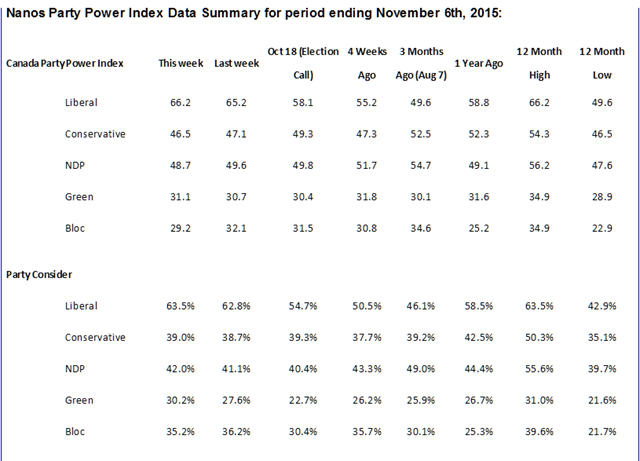
- Nanos Party Power Index – The Liberals have hit a new high in the Nanos Party Power Index and have registered the highest single score since the index began in 2013. The Index which is a composite of a series of questions including ballot preferences and impressions of the leaders, had the Liberals with 66.2 out of a possible 100 points followed by the NDP with 48.7 points, the Conservatives with 46.5 points, the Greens with 31.1 points and the BQ with 29.2 points (QC only).
- Accessible Voters – Liberal accessible voters hit a new high for any party. More than six of ten (63.5%) of Canadians would consider voting Liberal compared to 42.0% who would consider voting NDP, 39.0% who would consider voting Conservative, 30.2% who would consider voting Green and 35.2% of Quebecers who would consider voting for the BQ.
The team at Nanos in conjunction with Klipfolio have launched our new live political data portal where you run the numbers you want and can explore the trends and data you need. This is part of our campaign, not only to provide the most reliable data to Canadians but to let them use it as they wish. We were the first to do nightly tracking and now we are the first research organization to post live public opinion data for Canadians. Here’s the link to check it out
To view the detailed tracking visit our website.
Methodology
The views of 1,000 respondents are compiled into a party power brand index for each party that goes from 0 to 100, where 0 means that the party has no brand power and 100 means it has maximum brand power. A score above 50 is an indication of brand power for the party and its leader at this time.
The important factors in this weekly tracking include the direction of the brand strength or weakness and also the brand power of one federal party relative to another.
The data is based on random telephone interviews with 1,000 Canadians, using a four week rolling average of 250 respondents each week, 18 years of age and over. The random sample of 1,000 respondents may be weighted by age and gender using the latest census information for Canada, and the sample is geographically stratified to be representative of Canada.
The interviews are compiled into a four week rolling average of 1,000 interviews where each week, the oldest group of 250 interviews is dropped and a new group of 250 interviews is added. Note: the current wave of tracking is based on the final weekend of the election writ period ending October 18th as well as the three weeks ending November 6th. As we move forward the tracking will revert to a four-week rolling average of 1,000 Canadians (250 per week).
A random telephone survey of 1,000 Canadians is accurate 3.1 percentage points, plus or minus, 19 times out of 20.
All references or use of this data must cite “Nanos Party Power Index” as the source.
 Andrew Phillip Chernoff