
Cheap labour and the lessons of the Plaza Hotel strike

Robyn Benson By Robyn Benson on August 23, 2013   http://www.aec-cea.ca


plaza hotel strike.JPG

Who are those people pounding the pavement outside Toronto’s Plaza Hotel, whom the owner called “animals?” They are workers with little or no hope for the long-term, decently-paid jobs that many of us take for granted, living a precarious existence. If you want to know how many of them there are these days, take one Plaza Hotel and multiply by a very big number.

The low-wage workers at the Plaza are at least unionized. Largely due to their Steelworkers Union and to the Ontario Federation of Labour, the public is becoming more aware of the appalling working conditions there.

But this is just the tip of the cheap-labour iceberg.

I’ve posted before about the Temporary Foreign Workers program, a part of this new race to the bottom, in which the Harper government has been complicit. A victory or two have been won in that area, but there is much more to the problem than offshore workers entering Canada on a government program. In some ways, that was just a matter of domestic Canadian cheap labour being edged out of jobs by foreign cheaper labour.

Take the North American fast-food service industry, for example. It used to be that this was a good sector for young people to find a job for a while, and then move on. Now more adults than teens are asking if you want fries with that, and they’re in it for the long haul.

The new employees of this largely non-union sector are more experienced and better educated than formerly, but their wages and benefits don’t reflect that. Small wonder, as we have seen recently in Halifax with coffee-shop baristas, and in the US with employees of McDonald’s and other franchises, that these workers are beginning to look to unionization—and a substantial increase in the minimum wage—as a way of making their circumstances comparatively less precarious.

Would this make hamburgers, coffee and fried chicken too expensive? That’s always the scare-story put about by the anti-union types. But it’s not founded upon fact:

Several studies show that raising the minimum wage would have minimal effects on the industry as a whole. One letter signed by more than 100 economists and published by the University of Massachusetts said that raising the minimum wage to $10.50 would increase the price of a Big Mac by a nickel. Another study shows that doubling the salaries and benefits of all of McDonald’s employees would add 68 cents to each Big Mac.

Perhaps one of the more comical aspects of the corporate fightback was the spectacle of McDonald’s solemnly informing its low-wage employees how to budget. The bosses’ scheme works perfectly—if the minimum wage is doubled, and you can do without water, clothing, gas, heat and child care.

Are low wages the natural cost of working for a living wage in the service sector these days? Well, no:

Consider Costco and Wal-Mart’s Sam’s Club, which compete fiercely on low-price merchandise. Among warehouse retailers, Costco…is number one, accounting for about 50% of the market. Sam’s Club…is number two, with about 40% of the market.

…A 2005 New York Times article by Steven Greenhouse reported that at $17 an hour, Costco’s average pay is 72% higher than Sam’s Club’s ($9.86 an hour).

On the benefits side, 82% of Costco employees have health-insurance coverage, compared with less than half at Wal-Mart.

…In return for its generous wages and benefits, Costco gets one of the most loyal and productive workforces in all of retailing, and, probably not coincidentally, the lowest shrinkage (employee theft) figures in the industry….Costco’s stable, productive workforce more than offsets its higher costs.

A cheap labour strategy doesn’t work. It costs just about everybody. Costco knows this from experience, and has resisted calls to lower its wages and benefits.

So the push-back against impoverishing workers is not only a union concern, although we can certainly play a lead role in it. But we in the labour movement can’t do that by focusing too narrowly. We need to be part of a wider movement to defend the right to a living, dignified wage and secure employment for everyone. After all, it’s our whole society that is at stake here—and surely that makes it everybody’s fight.
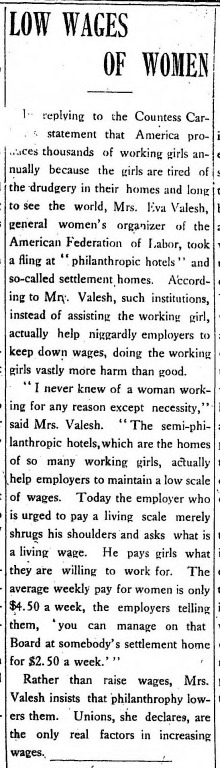
Unions…The Only Real Factors In Increasing Wages, So Says Mrs. Eva Valesh

NOTE: Women have been involved in the Labour Movement for untold generations, advocating proper working conditions, fair wages, and worker rights throughout Canada and the United States. One such woman was Mrs. Eva Valesh, general women’s organizer of the American Federation of Labour.

Mrs. Valesh knew then, what Unions and Canadians know today, Union wages lift the wages of all people and stimulate local, regional, provincial economies. Canada is a better country for the inclusion of Unions. Enjoy the article.

From: Boundary Creek Times, Greenwood, B.C., July 15, 1910

lowwagesofwomen

MP welcomes bill’s second chance

Bill C-377 To Revert To When  It Passed third reading In The House On Dec. 12 – Nullifying  Senators’ Amendments, Deliberations.

By Alex Browne – Peace Arch News    August 21, 2013 3:00 PM

https://i0.wp.com/media.bclocalnews.com/images/29576whiterockHiebert-Russ0411FC.jpg

South Surrey-White Rock-Cloverdale Conservative MP Russ Hiebert

Russ Hiebert, Conservative MP for South Surrey-White Rock-Cloverdale, says he’s pleased by Prime Minister Stephen Harper’s decision to prorogue – or suspend – Parliament until October.

For Hiebert, prorogation means the clock will be turned back to last December on his controversial private member’s bill, C-377, which would require labour unions to publish detailed financial information.

Harper has said prorogation is in anticipation of a throne speech putting forward a new agenda for the government at the midpoint of its mandate.

Following heated debate, the Senate sent C-377 back to the Commons in June, with extensive amendments reducing the scope and impact of the bill that Hiebert claimed, at the time, had “gutted” it.

Under prorogation, according to the Library of Parliament, the bill will revert to the way it was when it passed third reading in the House on Dec. 12 – essentially nullifying the Senators’ amendments and the deliberations leading to them.

The unamended bill will subsequently be resubmitted to the Senate, Hiebert noted in a statement issued Tuesday.

“As such, I am hopeful my colleagues in the Senate will give C-377 appropriate and timely consideration,” he said, adding that the restored bill will “once again reflect the wishes of the elected lower house of Parliament.”

Wednesday, Peace Arch News asked Hiebert if that means he expects the bill will receive a smoother ride the second time around.

“I’m always hopeful,” Hiebert said, adding that he’s making no predictions about how quickly the Senate will deal with the bill when it returns to the chamber.

“This does give me an opportunity to communicate with the small number of members of my caucus who had concerns about the bill. I’ll do my best to persuade them that the bill should pass as it stands.”

Hiebert acknowledged going back to square one with the Senate also raises the possibility the bill could face further Senate Banking Committee hearings before being debated by senators.

“That decision would have to rest with them,” he said. “My hope is that, because we have already had three weeks of testimony, that could be taken into consideration. But it’s completely in the hands of the senators.”

A total of 16 Tory senators joined their Liberal counterparts in approving the amendments to Hiebert’s bill in June.

Hiebert has argued that since unions receive tax deductions through union dues, their finances should be made public, and that the transparency he’s asking for is no greater than that currently required for charities.

Opponents, however, claim the legislation – as it stands – will cost unions millions of dollars, adding that the bill also ventures into dangerous  areas of unconstitutionality and invasion of privacy.

Conservative Senator Hugh Segal was among those who spoke out against the bill in June, saying it was poorly drafted and likely to be challenged.

“Whatever may have been its laudable transparency goals, (it is) really – through drafting sins of omission and commission – an expression of statutory contempt for the working men and women in our trade unions and for the trade unions themselves and their right under federal and provincial law to organize,” Segal said.

Conservative Senator Diane Bellemare, a former economics professor at the University of Quebec, was also critical of the legislation.

“Even with the proposed amendments, this bill remains an unbalanced bill that has no similarity to other transparency bills in France, the United Kingdom and Australia,” she said.

By the Numbers: Youth unemployment and underemployment in Canada, around the world || UFCW Canada – Canada’s Largest Private Sector Union

By the Numbers: Youth unemployment and underemployment in Canada, around the world || UFCW Canada – Canada’s Largest Private Sector Union.

CETA talks ‘re-launch’ in September: Council of Canadians to deliver petitions in Brussels

By Stuart Trew   August 22, 2013   http://rabble.ca

Council-of-Canadians's picture      Council of Canadians’ blog

CETA talks 're-launch' in September: Council of Canadians to deliver petitions in Brussels

Between September 17 and 19, the Council of Canadians will hand-deliver a CETA petition, signed by thousands of people in Canada, to Members of the European Parliament in Brussels. The petition focuses on the excessive (FIPA- or NAFTA-like) investor protections built into the proposed Canada-EU deal but it is more broadly designed to protest a deal that few people have heard of, even after four years of negotiations, and that a growing number oppose.

The timing of the petition delivery is especially important after news that the Harper government will “re-launch” the Canada-EU trade talks in early September, with the aim of wrapping up the negotiations before parallel EU-U.S. talks begin in October.

We need your help gathering signatures for the petition so it can have maximum effect in Europe and right here in Canada. There are two easy ways that you can help:

1. Circulate the petition to your friends and, if you’re a member of a union or other organization, to your colleagues as well. If you have a website, consider copying our web action image (top left) and use it on your site to link back to our petition page.

2. If you are holding or attending public events in the next two weeks, you could print off the letter and have people sign it right away. Hard-copy letters can be mailed to our offices at 170 Laurier Avenue West, Ste. 700, Ottawa, Ontario, K1P 5V5.

Council of Canadians Executive Director Garry Neil will travel to Brussels on September 17 to meet with Members of the European Parliament and trade justice allies, and will deliver the petitions at this point. So we would need to have all hard-copy petitions/letters at our head office by Monday, September 16. We will continue to accept online signatures to the petition up to September 17.

Thank you for your help and good luck!

For more information about the Canada-EU deal, visit Canadians.org/CETA

The Council of Canadians is Canada’s largest citizens’ organization, with members and chapters across the country. We work to protect Canadian independence by promoting progressive policies on fair trade, clean water, energy security, public health care, and other issues of social and economic concern to Canadians.