The best defence is a good offence: Lessons from Canadian labour history

By Mark Leier   September 3, 2013   http://rabble.ca

Workers in Saint John, NB on strike, Oct. 1976. (Photo: Frank & Ella Hatheway Labour Exhibit Centre)

Contemporary labour activists might find inspiration in the history of Labour Day. It isn’t a simple lesson of how to fight for a statutory holiday. It is a broader one about the nature of political struggle, reform and militancy.

The federal government created the holiday in 1894, and the labour movement deserves the credit for it. But Labour Day was not something labour specifically struggled for and won. The real significance of the holiday is in the broader struggle that pushed the government to make concessions and in a movement that dared to aim high.

The formal request for a holiday to celebrate labour came in 1889 in the report of the Royal Commission on the Relations of Labour and Capital. The commission produced five volumes of testimony and analysis and dozens of recommendations. These ranged from separate factory washrooms for men and women to arbitration boards to shorter hours to better regulation of railways and the oil industry. Among the recommendations was the suggestion “that one day in the year, to be known as Labour Day, be set apart as a holiday by the Government.”

None of the recommendations were taken up by the government of the day. Workers continued to celebrate Labour Day and May Day without the benefit of a statutory holiday, as they had for years. Five years and two prime ministers later, Labour Day was proclaimed, but it is not clear that the government had consulted the report of the Royal Commission. What is clear is that the government was responding to a wave of worker militancy, strikes and radicalism.

By 1886, when John A. Macdonald created the Royal Commission, workers had made the “labour question” the most important issue of the day. It was not an abstract question. It was impressed upon the minds of politicians and capitalists by workers across North America who used strikes and street protests with increasing frequency and militancy.

1872 saw the movement for the nine-hour workday culminate in a Toronto printers’ strike and several thousand workers marching in the streets in support. In the U.S., the railway strike of 1877 broke out in several states and mobilized tens of thousands of workers who engaged in running battles with police, state militia and federal troops in what became known as the Great Upheaval.

The 1880s saw even more strikes; 425 took place in Canada, double the number of the previous decade. Workers formed new unions, federations and councils; the Vancouver Trades and Labour Council, for example, was created in 1889 to provide a single, strong voice for the city’s workers.

Perhaps most worrisome to the authorities was the growth of the Knights of Labor, which organized not just the skilled trades, but all workers, including women. Pierre Berton’s grandfather, Phillips Thompson, was a Knight of Labor and in his book, The Politics of Labor, published in 1887, he warned “capitalism is a wrong, an usurpation, and a growing menace to popular freedom.”

In language that is echoed by the Occupy movement, Thompson pointed out that “the poverty of the many is caused by the unearned, and therefore stolen, wealth of the few.”

At the same time, workers engaged in political action, supporting those Liberals and Conservatives who supported labour and running their own candidates. In B.C., four “workingmen’s candidates” ran in the 1886 provincial election. One of the candidates was Samuel Myers, a miner and a Knight of Labor, who ran against the infamous coal baron Robert Dunsmuir. Myers lost the election and the following year would lose his life in a Nanaimo coal mine explosion that killed 147 workers.

This rising militancy pushed Macdonald to launch the investigation into the relations of labour and capital.

In his view, the “labour question” prompted by the Knights of Labor was as critical a political issue as Louis Riel, temperance, and Irish Home Rule.

By 1894, the creation of Labour Day was almost an afterthought, the belated recognition of the fact of the growing and increasingly radical labour movement across Canada and the U.S.

What is clear from this is that changes in the law, including holidays, come as a response to labour’s militancy, not as a reward for workers staying quiet. Labour influences the political agenda when it is active in the streets, the workplace and the ballot box, when it develops new tactics and forms of organization, and when it poses alternatives to “business as usual.”

It is not so clear that the union leadership has always grasped this lesson. It has usually been the radical edge of the labour movement that created new movements and organized new constituencies, from the Knights of Labor to the Industrial Workers of the World to the Communist Party and the early CCF, to the Canadian Association of Industrial, Mechanical and Allied Workers (CAIMAW) to the Service, Office and Retail Workers’ Union of Canada (SORWUC) and to contemporary rank and file activists.

But too often these dissident movements have been purged from the so-called main house of labour. Without that creative rebel energy, new ideas and new directions rarely emerge.

If strike activity is an indication of militancy, then Canadian labour has lost momentum.

In 1919, when the population of Canada was about 8.3 million, worker-days on strike totaled 3,401,843. In 2011, with a population of 33.4 million, worker-days on strike totaled only 1,966,587. More recently, Canadians spent 10.6 hours on the picket line in 1976; in 2011, that was down to a single hour.

During that same period, governments have made it harder for unions to organize, wages have stagnated, the minimum wage is worth less than it was 35 years ago, the working day has lengthened, social benefits have declined and employers have been successful in decertification drives across the country.

No one likes strikes, and 2013 is not 1976 or 1919. Nonetheless, one lesson from the history of Labour Day may be that the best defence is a good offence.

Mark Leier is a historian at Simon Fraser University. The second revised edition of his book, Rebel Life: The Life and Times of Robert Gosden, Revolution, Mystic, Labour Spy, will be published by New Star Books later this month. He will give a talk on the book at Simon Fraser University’s Harbour Centre on Sept. 19. For more details, click here.

This article was originally published by The Tyee, and is reprinted here with permission.

Following our extensive coverage of the founding convention of Unifor, this week we continue our coverage with a focus on the labour movement’s future. 

Photo: Frank & Ella Hatheway Labour Exhibit Centre

Editorial: Labor, Then and Now

By THE EDITORIAL BOARD   http://www.nytimes.com
August 31, 2013

On Thursday, the day after the 50th anniversary of the March on Washington, thousands of fast-food workers in 60 cities walked off their jobs, the latest in an escalating series of walkouts by low-wage workers demanding higher pay and the right to organize without retaliation.

The parallels, though inexact, are compelling. A half-century ago, the marchers called on Congress to increase the minimum wage from $1.15 an hour to $2 “so that men may live in dignity,” in the words of Bayard Rustin, one of the chief organizers of the march. Today, the fast-food workers also seek a raise, from the $9 an hour that most of them make to $15.00 an hour. That’s not much different from what the marchers wanted in 1963; adjusted for inflation, $2 then is $13.39 an hour today.

The strikers are targeting their employers — profitable companies like McDonald’s, Yum Brands (which includes Taco Bell, Pizza Hut and KFC) and Wendy’s. But Congress could help. Today’s minimum wage is a miserly $7.25 an hour — which is actually lower, adjusted for inflation, than it was 50 long years ago. Raising it would support the legitimate demands of the strikers and underscore the pressing needs of the country’s growing ranks of low-wage workers.

President Obama has noted, correctly, that increases in labor productivity have long failed to translate into higher wages for most Americans, even while income for the richest households has skyrocketed. His proposed remedies, however, leave much to be desired — a pathetic increase in the minimum wage, to $9 an hour by 2016, plus hopeful assertions that revolutions in energy, technology, manufacturing and health care will create good-paying jobs.

On its own, however, growth will not raise wages. What’s missing are policies to ensure that a large and growing share of rising labor productivity flows to workers in the form of wages and salaries, rather than to executives and shareholders. Start with an adequate minimum wage. Provide increased protections for workers to unionize, in order to strengthen their bargaining power. Provide protections for undocumented workers that would limit exploitation. Add to the mix regulations to prevent financial bubbles, thereby protecting jobs and wages from ruinous busts. Adopt expansionary fiscal and monetary policies in troubled times to sustain jobs and wages.

Low-wage workers would also benefit from executive-branch orders to ensure fair pay for employees of federal contractors. All workers need stronger enforcement of labor law so they are not routinely misclassified in ways that deny wages, overtime and benefits. They also need a tax system that is more progressive to shield wage earners from unduly burdensome tax increases or government cutbacks.

They need, in brief, pro-labor policies that have been overlooked for decades, with devastating results: from 1979 to 2012, typical workers saw wage increases of just 5 percent, despite productivity growth of nearly 75 percent, while wage gains for low-wage workers were flat or declined.

Recent experience has been even worse. In the decade from 2002 to 2012, wages have stagnated or declined for the entire bottom 70 percent of the wage ladder. The marchers had it right 50 years ago. The fast-food strikers have it right today. Washington has it wrong.

Time is right to relight fires of union activism, says labour leader

August 30, 2013                                              https://i0.wp.com/www.capebretonpost.com/images/logo/cbpost-header.png

Suzanne MacNeil                                                                                                                                                     Suzanne MacNeil

SYDNEY — There are some changes coming for the Canadian labour movement and the president of the Cape Breton District Labour Council said the time is right to relight the fires of union activism across the country.

“Many in labour today are looking towards building a stronger movement in knowing individual unions can’t go it alone anymore,” said Suzanne MacNeil.

In addition to strengthening alliances among union groups, MacNeil said it is equally important that all union members get more involved in their locals.

“Many (workers) just go to work in a bid to take care of their families and secure some kind of good life. Union activism is a lot of work, but we just can’t leave it to the keeners anymore,” she said.

This Labour Day weekend marks the launch of a national campaign by the Canadian Labour Congress to encourage more unionized workers to get involved along with improving the ties that bind unions together.

Ken Georgetti, Canadian Labour Congress president, said the campaign themed Together Fairness Works will be unveiled across the country and will highlight, among other things, the labour movement’s contributions to local communities.

“I do detect a real sense of urgency in the work we do,” said MacNeil.

She said while Cape Breton has been hit hard over the years with the loss of major union groups representing steelworkers and coal miners, there remains a commitment to protect worker rights.

“There has been a loss of morale here, but there is still a fire in the belly to protect workers and the collective bargaining process,” she said.

The national campaign’s objective of unifying the union voice and building a stronger union movement are already two key elements of the local council’s work in representing some 8,000 unionized workers in the Cape Breton Regional Municipality. The Strait Area Labour Council represents the interests of union workers in eastern Cape Breton.

A freelance writer by trade, MacNeil is a member of the Canadian Freelance Union and her position with the local labour council is voluntary.

She says that many workers’ rights are now under attack and the effects are being felt locally, especially with the recent qualification changes to employment insurance benefits.

MP Mark Eyking recently held a public meeting in Bay St. Lawrence where residents of the small fishing community have been tagged with a repayment bill of more than $170,000, while others have been denied benefits entirely.

She said governments usually have assumed the role of mediator between the unions and companies. MacNeil said that role has changed as governments are now directly attacking unions and rewarding bad faith bargaining by companies.

Some examples, said MacNeil, include the federal government ordering union groups back to work after they have exercised their right to strike. Ontario and British Columbia have imposed or frozen contracts for certain workers, including teachers.

There are an estimated 3.5 million Canadian workers now involved in unions and MacNeil said harnessing such power won’t be easy, but will produce tremendous benefits.

As for this year’s Labour Day celebrations, MacNeil said all unionized workers should prepare themselves to become more involved in their locals and extend a helping hand to other union and non-union groups.

“If the last couple of years are any indication, the fight for worker rights is far from over,” she said.

Membership to the Cape Breton council is open to unions affiliated with the Canadian Labour Congress. The local group mets the first Wednesday of every month at the Grand Lake Road fire hall beginning at 7 p.m. The meetings are held between September and June.

MacNeil said the local council’s projects include hosting the annual day of mourning for workers killed on the job, organizing Labour Day celebrations, hosting a labour school for union members and co-ordinating with other unions to help locals grow and develop.

“Workers’ Lot Can Be Better”—Labour Day Message From 1959 Relevant In 2013

From 1959, a Labour Day not so dissimilar to Labour Day 2013.

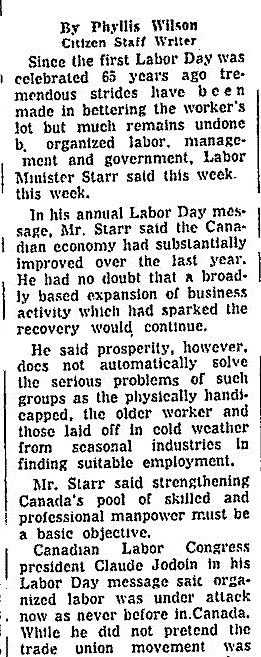
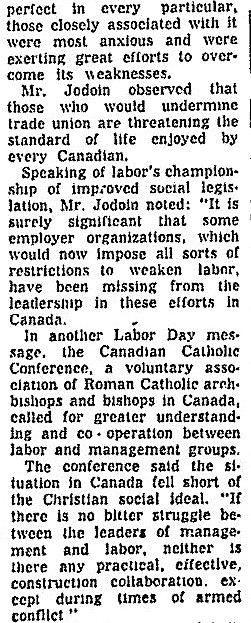
In 1959, Canada’s pool of skilled and professional manpower needed improvement; organized labour was under attack like never before in Canada; the union movement was exerting great effort to overcome its’ weaknesses; and those who were seeking to undermine the trade union movement, were threatening the standard of life enjoyed by every Canadian.

Labour’s spearheading of improved social legislation by 1959 were likewise under attack as is now in 2013. The writer observed then, what is the case now,

“It is surely significant that some employer organisations, which would now impose all sorts of restrictions to weaken labour, have been missing from the leadership in these efforts in Canada.”

I could not have said it better.

So from 1959, a Labour Day message. Enjoy.


From: The Ottawa Citizen, Ottawa, Ontario, September 5, 1959

Clip_3bClip_3cClip_2e

The True Meaning of Labour Day

Paul Moist Paul Moist

National President, Canadian Union of Public Employees

08/30/2013    http://www.huffingtonpost.ca

Labour Day is a time to celebrate the role of workers in the economy and address the real economic issues of our time.

Labour Day is about more than a well-deserved day off. It is a time to celebrate the important contributions working people make to our economy. It is also a good time to reflect on what is needed to improve the economic and social well-being for all workers.

Working people are the engine of the economy. The work we do, the services we provide and the money we spend drive the economy. But, in 2013 the economy is failing working people. Downward pressure on wages and government austerity programs are resulting in layoffs, contracting out, privatization of public services while families struggle to make ends meet. The rich are getting richer and the debt load of working people is increasing. It is no wonder our economy is experiencing such slow growth.

Economic recovery is being undermined by federal government actions over the last two years that erode workers wages, including: exploitation and fast-tracking approval for business to employ temporary foreign workers at wages below market rates; cuts to Employment Insurance and forcing workers to work at lower wages, continuous interference in the collective bargaining process on the side of employers, as well as attacks on unions and labour rights. These measures all need to be reversed and replaced by policies that support, rather than undercut real wage increases for workers.

At the same time, workers need a retirement security system in Canada to support our economy and provide economic security after a lifetime of work. It is a central economic problem today. Without adequate retirement incomes, we will pay with reduced living standards and an increase in seniors’ poverty. These outcomes, will, in turn, cost taxpayer money through programs like the federal Guaranteed Income Supplement and provincial and territorial income support and social assistance programs.

But, study after study shows that Canadians are not saving enough for retirement, and that this problem will only get worse as future generations retire. These troubling projections demonstrate the shortcomings of an increasingly individualized retirement income system. Working people are increasingly told their retirement security is their own problem. Save more for your own retirement at the same time your real wages are declining and debt level increasing?

The answer is clear. The economy needs a raise — disposable incomes need to rise to increase demand and create good jobs and economic growth. And we need to build an economy that sustains jobs with decent incomes for the next generation.

As we celebrate Labour Day this year, let’s really celebrate the contribution of working people by continuing to press for economic change to reverse growing income inequality. Press for economic change to drive the economy through higher wages and economic change to ensure all Canadians can retire in dignity.

Workers can count on the labour movement to do just that. We do that through collective bargaining and political action on behalf of all working people. And on this labour day, as national president of Canada’s largest union, I repeat my call to the government of Canada to convene a national pension summit where we can roll up our sleeves and address the affordability issues with defined benefit pension plans and re-tool the Canada Pension Plan so that it will continue to provide economic security for all Canadian retirees for generations to come.