Are Canadians “fickle, wing nuts”? Is Trudeau “unprepared, gaffe prone”? Former U.S. Senate Aide Says They Are

October 21, 2015   Andrew Phillip Chernoff  Just Saying….Just-saying

Trudeau Victory Bad For U.S., World At Large: Sean Kennedy

Sean Kennedy did not like the 2015 Federal Election result.

He  is all sad and crying tears for the nation of Canada, after years of having a man crush on Stephen Harper.

“The downfall of the Harper government is a defeat for a conservative admired by many on the right in U.S. politics,” according to Kennedy.

Who is Sean Kennedy?  Sean Kennedy is a writer based in Washington. Previously, he was a U.S. Senate aide, television producer and a fellow at public policy think tanks. He lived in Canada and observed the last federal election in Canada firsthand., according to CNN.

I think his head was in the cloud on some wacky-tobacco, and in reruns of his favourite Richard Nixon home movies, when he coined his dribble.

In his article for CNN, titled “Justin Trudeau victory in Canada is bad news for U.S. conservatives”, Kennedy let’ it all hang out, not flattered in the least about the Canadian election outcome;  sulking over the Harper conservatives loss  and his disdain for the Canadian voters for getting his man in Canada,  “…booted out of office after nine years of steadily manoeuvring the ship of state.”

Steadily manoeuvring Canada? Maybe, over Niagara Falls.

On how and why Canadians voted for Justin Trudeau and the Liberals in resounding fashion, Kennedy explains it this way:

The fickle Canadian voters were tired, though. Tired of the scandals and unforced errors that come with years of unchecked power (Canada’s parliamentary system is a unitary executive-legislative branch). Political appointees and friends of Harper’s couldn’t resist feeding at the taxpayers’ trough. Though the trail never led directly to Harper, the scandal only fed a public perception that the cool-to-a-fault, calculating (and yes, even Nixonian) Prime Minister was up to no good.

We fickle Canadians…..The majority of the Canadian electorate punted Harper to the sidelines, and did not vote for the  Lord and Saviour Stephen Harper. Canadians instead were:  patriotic, tried, responsible, true, pertinacious, tenacious, secure, staunchincorruptiblenationalistic, unalterable, sure.

Kennedy just can not understand it. His American peanut-sized brain just can’t put his head around it.

Harper was defeated by, “ the unprepared, gaffe-prone but well-coiffed son of a former prime minister, Justin Trudeau.” , Kennedy writes, probably after another puff of his wacky tobacco.

How is that possible?  How was it that the Harper punch bowl just did not have enough of that elixir to make us all Harperites and submissive to his voting will at the ballot box from coast-to-coast-to-coast?

After all, look what  what Harper and the Conservatives did for Canadians,eh:

Canada under Harper’s leadership was a conservative wonderland with balanced budgets, increasingly low taxes and a robust foreign policy aimed at taking on terrorists and bullies the world over.

Harper’s fate is all the more shocking when you consider how well Canada weathered the 2008-2009 financial crisis under his watch. He didn’t bail out anyone (except the U.S.-based auto industry), no financial institutions failed and the Canadian economy hummed along.

With sky-high oil prices and other resources reaching record highs, Canada got rich as other industrial powers paid top dollar (or top loonie, if you will) for the raw materials they needed to grow. As oil prices fell off a cliff, the Canadian economy slowed, even briefly dipping into recession this year. But Harper made the necessary cuts and kept taxes low. Amazingly, he balanced the budget ahead of schedule as the commodity markets nosedived.

When Harper introduced anti-terror legislation called C-51, or “Canada’s Patriot Act,” after prominent attacks inspired by radical Islam, the wing nuts of Canada’s left came out of the woodwork, painting the Prime Minister as a tyrant in the making.

Harper took a stand for an inclusive, but fully Westernized and assimilating Canada — banning the niqab, or face veil, from being worn at citizenship swearing-in ceremonies.

Canada is in for it now. Prepare for end times. The world will now turn its back on Canada.

According to Kennedy, Harper and the Conservatives,  were the authors and implementers of, “Canada’s Miracle”, which was:

….surviving the financial crisis, balancing budgets, slashing red tape and taxes while maintaining a healthy welfare state….

According to Kennedy, “The Conservative Party’s loss is to the detriment of its neighbours to the south and the world at large…”

Well, in the Great White North, in a country called Canada, on October 19, 2015, the Canadian voters took back Canada from Stephen Harper and the Conservatives.

Stay within your borders United States and Global community; or be prepared to suffer the consequences of challenging Canadian sovereignty, if you dare; upon which every disobedient nation  will be subjected to the unleashing of hundreds of thousands of hockey pucks.

My advice to Kennedy, the United States of America, and the rest of the Nations in the world, who have issue with democracy at its finest,  as demonstrated by the massive, historic, resounding landslide of Justin Trudeau and the federal Liberal Party: Most unlearned reviewer! fortunate would it be for your own sakes and ours, could you but fix your eyes upon the stifling smoke issuing from your own home, instead of keeping them busy with your spy-glasses in watching our  motions across in Canada.{Note: thanks be to Louisa Susanna Cheves McCord, and her book Political and Social Essays for assistance in the advice}

Just Saying…..

Trudeau Quickly To Be On International Stage…Just Saying…

Prime Minister Elect Justin Trudeau To Shape Canada’s Domestic And Foreign Policies In The Shadow Of His FatherJust-saying

October 20, 2015        Andrew Phillip Chernoff         Just Saying….

Justin Trudeau will have little time after his inauguration as Prime Minister to sit and gloat about his good fortune as he will quickly be on the international stage with:  the G20 Summit in Turkey, November 15-16; APEC Summit in Philippines, November 16-18; Commonwealth Heads of Government Summit in Malta, November 27-29; and, the UN Climate Change Conference, November 30-December 11.

But that is not all facing the new Prime Minister and Liberal government:

Both at home and abroad, Trudeau faces several pressing priorities and a raft of longer-term promises.

The immediate issues for the prime minister-designate include a major international conference on climate change, a military mission in the Middle East he has pledged to end and the still-churning refugee crisis enveloping Europe.

On the horizon domestically loom keystone promises from his party’s successful campaign: lower taxes for the middle class, the legalization of marijuana, and a slate of democratic reforms including a new electoral system to replace the venerable first-past-the-post regime under which he swept to power.

Trudeau will no doubt be riding an electoral high from the 184 seats the Liberals captured — a whopping 149-riding increase from the last election — but he will already be facing tough questions on how and when he will implement his plan. http://www.cfra.com/NationalCP/Article.aspx?id=483607

Justin Trudeau hopes to develop a positive legacy with respect to domestic, and foreign policy and international relations, as his father, Pierre Elliott Trudeau did.

Pierre Elliott Trudeau led Canada as Prime Minister for16 years and with his governing Liberal party, left Canadians the legacy of  a new Canadian Constitution and the Charter of Rights and Freedoms.

Justin Trudeau hopes to follow in his father’s footsteps as he attends upcoming, and further international events during the next four years, outlining Canada’s position on foreign and international affairs and events; putting his own stamp on Canadian domestic and foreign policy; and international relations.

And Justin Trudeau will have a lot to live up to.

Jeremy Kinsman, a retired Canadian career diplomat, who was the Canadian High Commissioner to the United Kingdom (2000–2002) and the Canadian Ambassador to the European Union (2002–2006), said of the late Prime Minister in his paper “Who is my Neighbour? Trudeau and Foreign Policy”, published in the London Journal Of Canadian Studies 18: 2002/2003:

Pierre Elliott Trudeau’s impact on Canada was enormous. His dual commitment to individual civil liberties and to building the Canadian nation resulted in a charter of rights enshrined inside a patriated constitution and a changed country. In foreign policy, where he dealt with a wider and changing world, not so amenable to shaping by any one middle power, his impact was less convincing. Moreover, a political leadership career spanning 16 years inevitably takes one down a long and winding road. Inconsistency-seekers can feast on a record that long—no matter what the vision.

Trudeau’s foreign policy was assembled from within a conceptual framework analogous to his view of Canada and Canadians that emphasized nation-building within a general vision on the great fault-lines of global relations: North-South and East-West. For all the twists in his foreign policies, Trudeau was remarkably consistent in his commitment to individual civil rights, and to the rights of individual states, to be free from arbitrary interference in their affairs, which necessarily involved something of a contradiction. At the time, the doctrine of humanitarian intervention had not yet been developed. Though Trudeau the anti-racist abhorred apartheid, and the assumptions governing the conduct of racist Rhodesia, Trudeau the international jurist was less confrontational on the issue of individual political freedoms within the socialist states of Eastern Europe. Whatever he thought of individual regimes, he endeavoured to work with them.

As for the North Atlantic Treaty Organization (NATO), Trudeau was his own man. Kinsman writes:

In 1968, NATO was a closed-doctrine shop. But maintaining a Canadian military almost uniquely for the purpose of fighting a land war in Western Europe made no sense to the new prime minister. Over 10,000 Canadian soldiers and 108 Canadian combat aircraft with dual reconnaissance/nuclear strike roles were stationed in an already prosperous Germany, along with heavy tanks and armour of no use to Canada in any other theatre. He didn’t buy the official advice that Canada’s alliance obligations or the state of the cold war removed any choice in the matter. His unilateral reductions in 1968–9 to Canadian forces in Europe created a stir in Washington and fed the notion that he was a ‘lefty’ who was soft on the challenges of the cold war. It was an impression that would dog him for the next twenty years.

Trudeau was never soft, but he did have enduring concerns about the need to reduce tension in the East-West standoff, especially over nuclear détente. He firmly believed in the need to move back from the danger of direct conflict—he knew NATO helped by being a clear deterrent but worried it locked Canada into a culture of anti-communist conservatism.

The Americans and others frequently found Trudeau infuriating because he questioned received wisdom. His decisions on nation-building and on internationalism were assertive, and inevitably his actions were felt in the immediate neighbourhood.

Canadian sovereignty and environmental protection in the Arctic, was high on Trudeau’s foreign policy, according to Kinsman, saying, “Trudeau made the north part of Canada’s idea of itself.”

During Trudeau’s first term in office, another issue at the core of Canadian ‘business’ that the United States saw as a threat was a product of Trudeau’s legal reasoning and his bent for ‘nation-building.’ That was the Canadian response to the planned voyage through the northwest passage in September 1969 of the United States super-tanker, Manhattan, which sought a way to bring newly discovered Alaskan energy to east coast markets. Ivan Head, Trudeau’s personal foreign policy adviser and intellectual companion during his first several years in office, has written comprehensively about this defining episode in Canadian foreign policy in which Canada asserted jurisdiction over its Arctic waters because its responsibility for protecting the fragile Arctic environment insisted upon it. In strategic terms, of course, the cold war rivalry between the USSR and the United States took concrete form most dramatically under the sea, especially under the polar icecap. Few prerogatives have been held as tenaciously by United States government lawyers as those favouring the maximum freedom of the sea for the United States navy. The possibility that Canada would draw straight baselines to enclose the northwest passage in Canadian internal waters and assert economic sovereignty over the waters by establishing an economic protection zone extending 100 miles offshore posed a dangerous challenge to the United States.

Trudeau made the north part of Canada’s idea of itself. His initiative to assert Canadian sovereignty in the Arctic for the purposes of environmental protection was a precursor to the drafting of a new law of the sea convention that would eventually codify the existence of coastal state responsibility for a 200-mile economic zone. The 1970 Arctic Waters Pollution Prevention Act anticipated a whole body of vital international law and of practice regarding the regulation of the transport by sea of bulk cargoes. If the Trudeau administration did nothing else that was new in foreign policy, this concrete and very real contribution to international law and to Canadian sovereignty would stand as a fine monument.

What will history say of “Prime Minister” Justin Trudeau with respect to foreign policy and international relations.? The diary is about to be written, and a book to follow after all is done and said.

“We need to keep working hard to show Canadians that we can have an open, optimistic and positive Canada, positive government, and that we can build a better Canada for everyone,” Trudeau said after the election victory.

Governments plan to gather in Paris in December for a global summit on climate change. That leaves the Liberals just weeks to come up with a national position based on the party’s promise to join with the provinces and territories to take action on climate change, put a price on carbon and reduce carbon pollution.

The Liberals have also committed to ending Canada’s combat mission in Iraq against rampaging radical militants — instead focusing Canada’s military contribution in the region on the training of local forces, while providing more humanitarian support and immediately welcoming 25,000 more refugees from Syria.

Trudeau has said that the first piece of legislation his government would put forward is one to lower taxes for the middle class and raise taxes for the wealthiest Canadians.

A Liberal government is also committed to revamping the recently enacted omnibus security bill, known as C-51, that gave Canada’s spy agency substantial new powers and angered civil libertarians.

Trudeau has also promised the largest new infrastructure investment in Canadian history. The plan would nearly double federal spending on public transit, affordable housing, recreational facilities and other items to almost $125 billion over the next decade.  http://www.cfra.com/NationalCP/Article.aspx?id=483607

It is clear that there are many domestic and international issues coming out of the starting gate that will give both Canadians and global leaders an indication just how “Prime Minister” Justin Trudeau will act compared to “Member of Parliament” Justin Trudeau.

Trudeau knows he is not just the Liberal leader, and Member of Parliament for Papineau, but that he speaks and acts for all Canadians both in Canada and abroad,  as Prime Minister.

“Many of you have worried that Canada has lost its compassionate and constructive voice in the world over the past 10 years,” Trudeau told a boisterous rally in Ottawa on October 20, 2015.

“Well, I have a simple message for you: on behalf of 35 million Canadians, we’re back.” http://www.cfra.com/NationalCP/Article.aspx?id=483607

As said in an earlier column, Trudeau and the Liberals now have to answer the bell of parliament and put action behind the hype, the rhetoric, the promises, and the bold statements of the election campaign.

May God be with him, and the shadow of his father be kind…..Just Saying….

G20 Leaders Summit 2015 Logo / The tenth annual G20 Leaders Summit, a platform which brings together the 20 developed countries of the world, will be held in Antalya between 15-16 November 2015. November 15-16, 2015        https://i0.wp.com/apec2015.ph/wp-content/uploads/2015/01/Screen-Shot-2015-01-08-at-4.03.43-PM.png November 16-18, 2015

https://encrypted-tbn3.gstatic.com/images?q=tbn:ANd9GcQmFu-kANcdYUaJ5VZOieNtGV4L6l0rsX5KSePVvrkVdJt-ROLHYQ  November 27-29, 2015  COP21/CMP11 logo  November 30-December 11, 2015

Justin Trudeau and His Liberals Take Canada With A Resounding Victory For The Ages….Just Saying….

SIGNED, SEALED AND DELIVERED!!!!

October 19, 2015         Andrew Phillip Chernoff     Just-sayingJust Saying….

Justin Trudeau and the Liberals started out in the Maritimes with a massive showing of red, and the momentum just carried them  westward, both in acquiring seats and  the popular vote.

Big defeat for the NDP.  A fitting outcome for Stephen Harper to end his political career. A crowning achievement for his legacy.

Every other party lost seats and popular vote to the Trudeau Liberal tsunami , which did not look back on the night.

Justin Trudeau joins his dad, Pierre Elliott Trudeau as the first father-son Prime Minister team in Canadian political history.

Just like his father, Justin Trudeau has managed during his political career to carve out his own political identity, communicating   it and shaping it eloquently in public and in social media to Canadians from coast-to-coast-to coast.

Canadians felt the best way to defeat Stephen Harper and his Conservatives, was to support Trudeau and the Liberals.

The message was signed, sealed and delivered.

Liberal strength was clear and decisive coming  primarily at the expense of the New Democrats more so than the Conservatives.

It did not take long for CBC to make its call for Justin Trudeau as the next Prime Minister of Canada, making that call at 6:40 pm Pacific Standard Time.

With the Liberals all but assured to become the federal party to lead Canada, the only question was majority or minority government.

Well, within three-quarters of an hour of calling Trudeau the next Prime Minister, CBC called a Liberal majority government, and the rest is history.

Trudeau and the Liberals now have to answer the bell of parliament and put action behind the hype, the rhetoric, the promises, and the bold statements of the election campaign.

The honour and privilege they have been given by Canadians, in taking Canada back from Harper and his Conservatives, for all Canadians, is fitting and caught the emotion and heart of Canadians……but was it all just political hype and propaganda carefully constructed and projected to get votes and become the government in Ottawa?.

One glaring image this historic night, were the Liberals and NDP changing positions with the 2015 election results compared to 2011, tarnishing the former NDP leader (Jack Layton) crowning achievement of the 2011 federal election: the seat total.

Canadians had four years to decide if the NDP and their leader Mulcair had what it took for the next step: the official government of Canada.

What is left for the NDP: to go backwards and take back what they had before the 2011 election—-regarding seats, they are already there with their seat total on the night; or, somehow salvage all that at one time promising defeated political talent, for the next election and rise like the figurative phoenix?

I guess time will tell.  If the federal NDP can dust themselves off, chose a more dynamic, engaging, charismatic leader that young and old alike can be moved and aroused by.  

Oh, wait…Justin Trudeau is already taken….Just Saying….

More to say in the coming days.


Federal Election 2015: Voting Records Are Made To Be Broken: LET’S DO IT!!!—Just Saying….

October 19, 2015          Andrew Phillip Chernoff                Just Saying….

Image result for federal election 2015 voteJust-saying

“Paradigm Shift” Needed In Ottawa

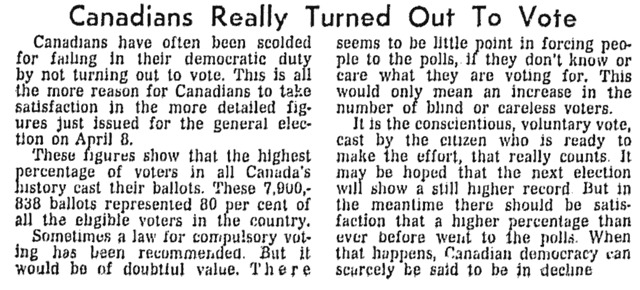
 On April 8, 1963, Canadians set a record unequaled or bettered since, with the highest percentage of voters in history when 80 per cent of all eligible voters in 1963 cast their ballots.

From: The Montreal Gazette – May 13, 1963:

canadalargestvote

Elections Canada reported on Oct. 14th, 2015:
According to the preliminary figures, some 3.6 million electors voted at the advance polls in this general election. This is a 71% increase from the 2,100,855 electors who voted in advance in the 2011 general election.

So far, Canadians from coast-to coast-to coast are going to the polls in record numbers.

Indeed, Canadian democracy can scarcely be said to be in decline it seems, as has been reported recently.

Let’s make this “paradigm shift” happen in Ottawa, David Herle, principal partner at The Gandalf Group, a Toronto-based research and consulting company, urges because Canadians need to feel connected to Parliament and Parliament needs to be seen as relevant to their lives, he outlined in the article, Democracy and the decline of Parliament,  published May 2, 2013.

“Only then can we begin to close the gap between voters and our political institutions with the goal of ultimately strengthening our democracy.”  Herle continued.

Star columnist Bob Hepburn who interviewed Herle for the article, started out by introducing his readers to Herle this way:

Since his days as Paul Martin’s campaign chairman ended, David Herle has given a lot of thought to the state of our democracy and the increasing disconnect between Parliament and Canadians.

And the more Herle studies the issue, the more the former prime minister’s strategist worries.

“There’s a growing gap that could have serious long-term implications for the health of our democracy” from voter turnout to policy formation, Herle says over coffee one recent afternoon in downtown Toronto.

“Voters look at Ottawa these days and feel the issues being debated up there have no impact on their daily lives,” he says.

“There’s also a serious decline in what people expect from government. As well, they’ve stopped looking to government for help and for the most part they don’t think it matters who is in power.”


Hepburn stated in the article that a poll in Fall 2012, “suggested barely 27 per cent of Canadians believe Ottawa is dealing with issues we really care about.”

Most people are worried about daily issues, such as their children’s education, looking after aging parents and getting decent health care. But other than writing cheques to the provinces, Ottawa has opted out of health care, education, transportation and other issues that affect our normal lives.

There are no bold new ideas emerging from Ottawa today that will engage Canadians and make them feel that what happens in Parliament really does play a role in their lives.

No longer is there serious talk in Ottawa of programs that would affect most Canadians directly, such as a national child care strategy, a national plan for big cities or an agreement for natives along the lines of the Kelowna Accord signed by Martin.

Instead, there is a narrow set of issues that Prime Minister Stephen Harper is pursuing and for the most part the opposition parties are adhering to them.

Because voters have stopped looking to Parliament for help, Ottawa has stopped responding to their needs, Herle believes.

Well, Canadians are engaged in this federal election.

The early voting poll results indicated that in resounding fashion.

Whether it is to solidify the Harper’s Conservatives hold on Canada, or to make a statement that change is on the way with an exclamation point; Canadians are alive and well, and have risen to affect what kind of Parliament will play a role in their lives.

The implications for democracy are huge in this federal election when so many Canadians have believed already it was not a waste of time to try to make a difference or to attempt at creating meaningful change through their democratic right to vote.

https://i0.wp.com/canadians.org/sites/default/files/publications/HowToVote-General.jpg

According to Hepburn, Herle is not alone in voicing similar concerns:

Conservative MP Michael Chong (Wellington-Halton Hills), writing in Policy Options magazine in 2010, predicted that “if Parliament is becoming increasingly irrelevant to Canadians and is not central to public debate in Canada, then public policy will be determined in an increasingly non-democratic fashion.”

Chong suggested that reforming question period, the insult-laden daily shouting match that is the only reference most Canadians have with politics, is a necessary first step to restoring Parliament’s relevance. He called for improved decorum, more time both for questions and answers and a requirement that ministers actually respond to questions directed at them.

Chong is correct about the possible consequences for democracy and the role of Parliament. That’s because if voters have given up on Parliament, it means they have lost faith in politicians to look after their interests.

To not exercise your  constitutional right to vote and support a democratic Canadian government, would as Herle suggests,  “provide the ruling party with enormous leeway to abuse parliamentary traditions and procedures.”

Let’s introduce fresh air into our parliament and federal government and take back what is ours as Canadians: our right to decide; thereby beginning to, as Hepburn writes, “… close the gap between voters and our political institutions with the goal of ultimately strengthening our democracy.”

Just Saying……..

…..What’s that??….Who won???…..Who won, what??……Ohhhhhh……

The 1963 federal election resulted in the defeat of the minority Progressive Conservative (Tory) government of Prime Minister John Diefenbaker

The Liberal Party of Lester Pearson ran on a platform promising that, if elected, they would begin their term with “60 Days of Decision” on questions such as introducing a new Canadian flag, reforming health care, and a public pension plan, along with other legislative reforms.

Despite winning 41% of the vote, which is usually sufficient for ensuring the election of a majority government, the Liberals fell five seats short of their target. The Liberals formed a minority government that was dependent on the support of the social democratic New Democratic Party (NDP) in order to pass legislation.

The social-democratic NDP had been formed in 1961 by a socialist party, the Co-operative Commonwealth Federation, and by the Canadian Labour Congress. The 1963 election was the second vote contested by the NDP. The party won slightly fewer votes, and two fewer seats, than they had received in the 1962 election. They were again disappointed by the failure of their new partnership with the labour movement to produce an electoral breakthrough, particularly in the province of Ontario, which has the largest population and the largest number of seats in the House of Commons.

Social Credit was unable to increase its representation in western Canada, and lost four of its Quebec seats – this despite gaining a slightly better share of the vote compared to 1962. Indeed, 1963 represented the highest share Social Credit would ever get. The continuing lop-sided result led to a split in the party when Thompson refused to step aside so that Caouette could become party leader. Caouette and his followers left the Social Credit Party to sit as a separate social credit caucus, the Ralliement des créditistes.=>https://en.wikipedia.org/wiki/Canadian_federal_election,_1963

Anybody see what I see…..I mean….does history really repeat itself???  Of course not….the 1963 Conservatives had a minority government….but a minority government is possible, is it not????? Who will it be….Check back on Tuesday, October 20, 2015.

The Advancement of Harperism In The Face of Glazed Eyes and Extreme Apathy….Just Saying….

By Andrew Philip Chernoff

Originally Published: August 5, 2013Just-saying

Is the disclosure of the Stephen Harper enemies list just further advancement of Harper’s agenda of Harperism in Canada such as was McCarthyism in the United States?

Headlines like, Harper leads a new McCarthyism in Canada; “Scary time” for Canada; Harper has now introduced McCarthyism to Canada; McCarthyism, Canadian Style have touted the similarity between so-called Harperism and McCarthyism.

Whatever the case one could make for similarities between Stephen Harper and McCarthy, others in Canada believe he has developed his own ism: Harperism that is distinct from McCarthy and more dangerous.

It’s could be called a Heinz 57 mismash of isms transformed into describing Harper’s political agenda and self serving ideology to leave a Supremacist legacy like no other Canadian Prime Minister ever has. Other leaders have tried that, like  Adolf Hitler in Germany.

No Canadian has done or ever dared to do what Stephen Harper has done, and will do, with the political mandate he has left before 2015.

Harperism has been defined as:

  • harperism |ˈhärpərˌizəm|
    noun
    1. the political philosophy that corruption is the highest good and proper aim of government.
    2. the pursuit of power; sensual self-indulgence.
    3. relentless political maneuvering. often informal; always slicker than a greased pig.
    derivatives
    harp•er•ist | noun & adjective
    harp•er•is•tic | adjective
    harp•er•is•ti•cal•ly | adverb
    harp•er•ian | adjective
  • “The January 2006 Federal election results in Canada unexpectedly yielded a minority Conservative Government. The ‘great moving right show’ is having yet another run. In Prime Minister Stephen Harper, Canada now has the most ideologically committed neoliberal in power since Margaret Thatcher. The five priorities Harper has announced – an accountability package; a cut in the GST; a market-based childcare system; a law and order agenda centred on sentencing; and a reduction in healthcare wait times through increased delivery flexibility – all reflect these commitments. These proposals are embedded in the overall strategic priority of aligning Canada even more tightly with the US through increased overseas military commitments and further economic integration. Canada’s move into southern Afghanistan and increased troop deployment is already sketching in the new terrain. The major boost military spending, tax cuts and marketized public services proposed in the first Harper Budget on May 2 filled in more details. This constitutes the initial agenda of Harperism. It could hardly be more pressing for the Left to take some stock of what the Harper government is and might become.” {Greg Albo, “Figuring Out Harper” (8 May 2006) zcommunications.org}
  • prime minister stephen harper conservative christian evangelical hypocrite
  • reference: http://www.urbandictionary.com/define.php?term=harperism

A further definition of Harperism has been advanced by Gregory Albo as:

  • …….a clear effort to unite all reactionary and conservative forces into a coherent governing force, most notably to bring into the fold right-wing nationalists in Quebec; deeper integration with the U.S. will be pursued, initially expanding Canada’s imperialist role in military operations in Afghanistan as a component of the war strategy of the American empire, and following this up with trade and security policies to form “Fortress North America”; neoliberalism will be pushed further into social policy with greater market provision in such areas as healthcare and daycare and in the remaking fiscal federalism; and there will be a discursive emphasis on traditional Canadian “values” as a bridge to social conservatism, religious fundamentalists of all faiths. and a “law and order” platform.  This is far from the neoliberalism-lite of the Chretien government by which Canada differentiated itself from the hard right developments in the U.S.

Another has defined harperism as:

  • Harperism
    noun (origin, Victoria,Canada) : A system of government marked by centralization of authority under a wannabe-dictator, stringent socioeconomic controls, suppression of the opposition through terror and censorship, and typically a policy of belligerent pro-Americanism and anti-environmentalism … all while selling their country out in the name of dirty oil.    http://homercat.blogspot.ca/2012/06/harpism.html

It could be argued as well, that Harper is just plain incompetent, and very good at it….and very good at incorporating it into Harperism.

In his blog Another Point of View, Mentarch outlines his eight principles of incompetence:

  • Zeroth Principle: Incompetence is driven by intellectual sloth.
    First Principle: Incompetence surrounds itself with incompetence.
    Second Principle: Incompetence is ethics-impaired.
    Third Principle: Incompetence abhors transparency and accountability.
    Fourth Principle: Incompetence does or says anything to defend itself.
    Fifth Principle: Incompetence always supports incompetence.
    Sixth Principle: Violence is the last refuge of incompetence.
    Seventh Principle: Incompetence is nothing but consistent with itself.

In defining the intellectual sloth, Mentarch says:

  • …..such a person refuses to accept any fact of reality which confronts, rattles, or even invalidates, the comfort of one’s “convictions”. To this effect, such a person will be arrogant, if not contemptuous, towards anything and anyone that confronts his/her ignorance generated by intellectual sloth“.
  • To this, I also added that one who is afflicted with intellectual sloth is often deluded by intellectual vanity and invariably becomes a slave of expediency. Furthermore, everything is about image and appearance, instead of substance. Truthiness, instead of truth. All of these characteristics underlie incompetence – whether as nations, as communities, as citizens, as blue-collar/white-collar workers, as parents, and/or as thinking, reasoning human beings. In short, intellectual sloth transforms any adult person who is guilty of it into an irresponsible and reactionary child or adolescent, who lives only in the “now” while remaining blind to “yesterday” and “tomorrow”. Such a person thus becomes incompetent – in dealing/composing with reality, or in at least trying to understand it.

Harperism has been likened to fascism and corporatism as well:

  • The 14 common traits of fascism, which the Harper government has pretty much covered:


PM ~ Harper Government

[x] Powerful and Continuing Nationalism

[x] Disdain for the Recognition of Human Rights

[x] Supremacy of the Military

[x] Rampant Sexism

[x] Controlled Mass Media

[x] Obsession with National Security

[x] Religion and Government are Intertwined

[x] Corporate Power is Protected

[x] Labor Power is Suppressed

[x] Disdain for Intellectuals and the Arts

[x] Obsession with Crime and Punishment

[x] Rampant Cronyism and Corruption

[x] Fraudulent Elections

And then we have comment from a progressive conservative who goes out of his way to describe harperism within the Canadian political spectrum in the blog article How To Know When You’re Talking to a Conservative.

Are Canadians really happy with Harperism? Do Canadians believe that if they ignore getting involved that Harperism will protect them as they exercise their apathy and allow others to control their destiny and fortune?

Will drowning their sorrows, escaping into their recreational drugs, losing themselves in their technology, satisfying their other addictions and selfish interests, make for their lives better? Make for a better Canada?

So, tell me….how’s it working for ya?….Living the dream life……giving others the power and authority to make decisions for you and your loved ones?….Your wishes coming true….no cares or worries with the Pied Pipers of “the one-percent” running things for ya?……Just saying….

I conclude with this last thought:

  • First they came for the Socialists, and I did not speak out–Because I was not a Socialist.
  • Then they came for the Trade Unionists, and I did not speak out–Because I was not a Trade Unionist.
  • Then they came for the Jews, and I did not speak out– Because I was not a Jew.
  • Then they came for me–and there was no one left to speak for me.”
    -Martin Niemöller

Does anyone see the similarities?

Once again again, the 99 per-cent of Canadians lose.

Take care…..keep smiling…may the force be with you….work safe…drive safe….be good to each other….live long and prosper…..just saying…..

Signed,

Me

COPYRIGHT ANDREW PHILLIP CHERNOFF 2013