C.D. Howe Institute Ignores Needs of Canada Post Users


http://www.cupw.ca    August 9, 2013

OTTAWA –The Canadian Union of Postal Workers is dismayed the C.D. Howe Institute’s e‑brief on postal reform offers only tired ideas for Canada Post that would result in service cutbacks.

Denis Lemelin, CUPW National President asks, “Why doesn’t it occur to this prominent private-sector-oriented think-tank that Canada Post should raise new revenue? Other postal administrations are bringing in expanded services, and staying viable by doing so. Why is the C.D. Howe Institute so short on innovation?”

Postal services globally are facing the same challenges. Postal operators in France, Italy, New Zealand and Brazil have responded by expanding into banking and financial services. PostFinance, Swiss Post’s postal banking and financial services arm, actually generated 71% of the company’s operating results in 2012.

The e-brief, “How Ottawa Can Deliver A Reformed Canada Post,” released August 8 by the C.D. Howe Institute, advocates an approach that likely leads to service cuts and government subsidization. It recommends contracting out, privatization, and tampering with the universal service obligation (USO) that ensures lettermail delivery to and from anywhere in the country for a single price.

“The C.D. Howe institute was making the same case for deregulation and privatization in 2007, while Canada Post was making profits” says Gayle Bossenberry, CUPW 1st National Vice‑President. “These are tired old ideas, not viable solutions for a valuable public service.

Furthermore, the public is clearly against this approach. Recent Strategic Communications poll results (May 2013) show that 71% of the general population opposes deregulating or privatizing postal services, even more so (88%) if it would mean the end of one-price-goes-anywhere service for the cost of a stamp. The C.D. Howe report does not value universal postal service, but the customers – the owners of Canada Post – clearly do.

The middle class: The battleground of all politicians

Monia MazighBy Monia Mazigh August 9, 2013 http://rabble.ca

Photo: Peter Klein/flickr

In the U.S., the “M” word has been on the lips of politicians from the left to the right of the political spectrum, albeit for different reasons. President Obama is not an exception. Indeed, he made the mention of the middle-class part of his electoral rhetoric immediately after the 2008 financial crisis and after hundreds of thousands of Americans lost their houses, their American dream.

Last February, in his State of the Union address, Obama declared it was “our generation’s task” to “reignite the true engine of America’s economic growth — a rising, thriving middle class.” A few days ago, on August 5, he spoke in a gathering and he again pondered the same message, to “secure a better bargain for the middle class.” Whether we agree with Obama’s plan to revive the middle class or not, one must admit that he has been quite explicit about it. It includes measures affecting child care, dependent care, college expenses and retirement savings.

Here in Canada, Justin Trudeau is on the footsteps of Mr. Obama and his talk is all about the middle class. The only difference is that we don’t have any idea how Justin Trudeau is going to tackle the middle-class issue. Is he going to continue to give free rides to corporations as both Liberal and Conservative governments did in the past, or will he be offering a real program with fiscal and economic measures specifically targeted to the fading middle class? (Even though a lot of words are being said about the new Liberal star candidate in Toronto Centre and how her book might make up the next platform for the Liberal Party campaign). Or is he only interested in the votes of this class and then will turn his back and continue to help the big corporations instead?

But in reality, do we still have a “real” middle class? Where does the political opportunism start and where does the economic reality end?

In the last two decades, generations of politicians watched the erosion and the crushing of the middle class. Some denounced the situation and stood by their principles but many nodded and acquiesced to all the economic and social measures making the poor poorer and the rich richer, effectively shrinking the middle class.

According to a report prepared by Canadian bureaucrats and presented to Finance Minister Jim Flaherty, and recently released by Postmedia, Canada’s middle class improved its average income only by seven per cent between 1976 and 2010. This is equivalent to 0.2 per cent per year. The median income of this class did not do better. From 2007 to 2011, it grew from $66,700 to $68,000, a mere 0.5 per cent per year.

This assessment is confirmed by another report that was prepared by TD Bank. The report documents the fact that low-wage and middle-wage jobs in Canada have been shrinking as a share of the economy as job growth focuses more and more on high-skilled, high-end jobs. Meanwhile, the spending by the middle class didn’t decrease. To the contrary, it continued to increase and the funding comes from the larger amount of debt Canadian families are contracting from the banks and other financial institutions, making the Canadian household one of the most indebted in the OECD countries with a debt-ratio of around 161 per cent for the first quarter of 2013. 

Mark Carney, the former governor of the Bank of Canada, never missed an opportunity to speak against the high amount of debt that is contracted by Canadians. The government never raised an eyebrow (until they changed the rules for mortgages). They barely reacted to the horrifying numbers of children who now live in poverty. Canada’s child poverty rate increased between the mid-1990s and the late 2000s. These are not only children born to single parents of low-income families but also to working parents who can’t make enough annual earnings to afford all the basic necessities for their families. The Conference Board of Canada reported that Canada scores a “C” grade and ranks 15th out of 17 peer countries. Moreover, more than one in seven Canadian children live in poverty.

Last July, the city of Detroit in the U.S., where the middle class was first formed by the autoworkers and later by public employers running city services, went bankrupt. The fall of the auto industry, the cuts to public funds, the fiscal structure of the American government and many other socio-economic factors took Detroit to the cliff; it was forced close shop. It is interesting nowadays to watch the Conservative government trying so hard to dismantle the unions in Canada and to slash thousands of jobs in the public sector. Yes, it would be both stretched out and simplistic to draw similarities between Detroit and the path Canada is following. Nevertheless, it is crucial to study the effects of recent public sector cuts and their impacts on the Canadian middle class, and the state of our economy in general.

The middle class today is like a beautiful woman, desired and solicited by everyone but insidiously feared and despised by all. The politicians are no exception.

Monia Mazigh was born and raised in Tunisia and immigrated to Canada in 1991. Mazigh was catapulted onto the public stage in 2002 when her husband, Maher Arar, was deported to Syria where he was tortured and held without charge for over a year. She campaigned tirelessly for his release. Mazigh holds a PhD in finance from McGill University. In 2008, she published a memoir, Hope and Despair, about her pursuit of justice, and in 2011, a novel in French, Miroirs et mirages.

Photo: Peter Klein/flickr

Stephen Harper and The Nightmare at 24 Sussex Drive

From:  http://montrealsimon.blogspot.ca/

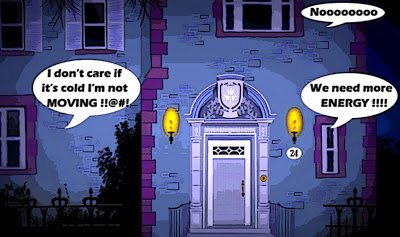
OMG. It’s another Con scandal AND a horror show at the same time. A Nightmare at 24 Sussex Drive.

The old mansion is crumbling, but Stephen Harper is refusing to move out !!!

With Prime Minister Stephen Harper declining to move his family out of 24 Sussex Drive, the National Capital Commission has been unable to perform substantial renovations to curb rising energy costs at the official residence.

He won’t leave the Big House, even though it’s costing taxpayers an arm and a leg to keep it at body temperature.

The NCC last year spent more than $69,000 on heat and hydro for the 145-year-old home, billing records obtained through the Access to Information Act show. That’s up about 20 per cent from the Harpers’ first year in the home, largely because of increased energy rates.

And even though it means the next Prime Minister will have to be the one to move out. Or wear a hard hat in the house, and a fur coat to bed.

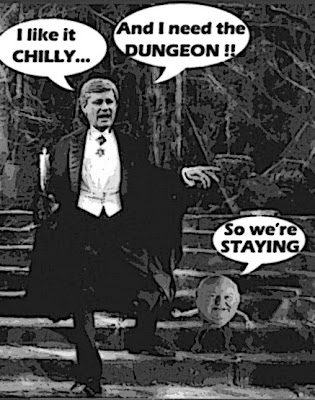
Or sleep in a box like he does…

Can you believe that eh? Is that a selfish energy hog vampire or WHAT?

And just at a time when he’s trying to convince Obama to approve the Keystone XL pipeline.

By posing as an environmentalist…

While blowing hot air out of every chimney and every ORIFICE.

Gawd. It’s so horrible, so embarrassing, so humiliating.

But then what what do we expect eh? When we live in the Banana Republic of Harperland where public servants have to use their OWN money to find out what the Con regime is plotting.

Officials at Parliament’s budget watchdog office say they are using their own money to file access to information requests in order to reduce government interference.

Interim Parliamentary Budget Officer Sonia L’Heureux recently said in a statement that a majority of departments and agencies are still withholding information on the impact of billions in federal spending cuts.

Because he would blind us while he kills our country.

Strangle our values like a python.

And force us to live in his own sinister darkness…

“This is a government which controls all information, all access to information, all material upon which a reasonable voter could make up his or her mind with factual information, and they just shut that down in favour of the massive Conservative propaganda machine.

Where ignorance is strength, madness rules, and hope goes to die.

Oh boy. I hope the day Stephen Harper is forced to move out of 24 Sussex Drive it’s live on TV eh?

Because it’s going to be the BEST moving day this country has ever seen.

And when he dares emerge from his dilapidated mansion in the fall, if the police haven’t taken him to live in THEIR Big House.

Let’s make sure he gets this message:

Monster, Monster, the sun is rising.

Steve, Steve, it’s time to LEAVE…

Opinion: Politicians must step up and make rail safety a top priority

By   William Brehl  | August 5, 2013  http://rabble.ca


Photo: flickr / mcwetboy


Transport Canada’s emergency safety directive issued following the Lac-Mégantic rail tragedy is welcome but more can be done.

For almost a decade we’ve been campaigning for better rail safety in Canada and the Harper government, to its credit (and that’s not easy for a union person like me to say), has returned some of the independent policing powers to Transport Canada after too much deregulation was granted by previous governments.

Still, the calamity of Lac-Mégantic occurred.

Obviously, more must be done to ensure safety, especially when tens of millions of Canadians live near main rail lines.

Transport Canada’s emergency directive is meant as a temporary fix while Ottawa drafts and passes into law new safety regulations.

The Transport Canada directive calls for limitations on leaving trains unattended and locomotives unlocked, minimum two-person crews when transporting dangerous materials, and clear direction on applying handbrakes to unattended locomotives with one or more cars attached.

As I said, it is a good start, but as someone who spent 20 years working on the track and the last 15 years representing 4,000 men and women who repair and maintain the track, there are three things that the temporary directive overlooked that I believe must be included in legislation.

Away from rail yards, no train should be left unattended for one minute, let alone one hour or more. Although the exact causes of Lac-Mégantic are still under investigation, the tragedy has already taught us this: Deadly and surprising things can happen when a locomotive is running and no one is around. Ending the practice of unattended locomotives will require better staff scheduling by managers.

Safety plans must be more transparent. Currently, federally regulated railways must file Safety Management Systems, or SMS, with Transport Canada. The SMS is intended to be a formal plan to build a culture of safety across the organization. SMS are not intended to be self-regulation, but in the everyday world, they are because a railway’s compliance is restricted to its own filings and infrequent surprise inspections from Transport Canada.

More Transport Canada safety inspectors are needed. Something is amiss when for every one Transport Canada rail inspector there are eight or nine air inspectors. Granted, when there is an air accident, it is usually a catastrophe with loss of life, but, as we’ve so tragically learned, calamity lurks on rail lines, too. The gap between the number of rail and air inspectors must be tightened.

Over the last 15 years or so, train derailments and accidents have been on the rise in Canada. In fact, there have been more than 10,000 of these incidents since 1999, according to transportation safety board statistics. Most are minor; some are major that force residential evacuations and some are catastrophic like Lac-Mégantic.

We cannot turn back the clock and bring back those innocent people in Lac-Mégantic. But we can look forward and create an environment of safety first.

Rail safety is something that must be maintained year in and year out, day in and day out. Wear and tear continually work its way on track and equipment. Short cuts to safety procedures must be avoided. Complacency as time passes since Lac-Mégantic must not occur.

Cynics might suggest that our decade-long safety campaign has to do with maintaining union jobs. But rail safety is not about jobs. It is about lives.

Millions of Canadians live close to rail lines and hundreds of millions of tonnes of dangerous commodities are shipped by rail through crowded urban areas every year. Our economy depends on rail traffic and our lives depend on it moving safely.

It is now time for every Member of Parliament, everywhere in Canada, regardless of party affiliation, to step up and do what is necessary to ensure that safety is given top priority. MPs need to look to their own constituencies, be aware of the possible dangers, and earn the trust their constituents have placed in them.

This fall when the House of Commons transport committee begins hearings it will be an important step toward ensuring no more tragedies like Lac-Mégantic happen again.

William Brehl is president of Teamsters Canada Rail Conference’s Maintenance of Way Employees Division, based in Ottawa, and a member of Transport Canada’s Advisory Council on Railway Safety.

Photo: flickr / mcwetboy