
SURETTE: Harper could still hang on, even after defacing Canada

http://thechronicleherald.ca     ralph Surette    May 16, 2014
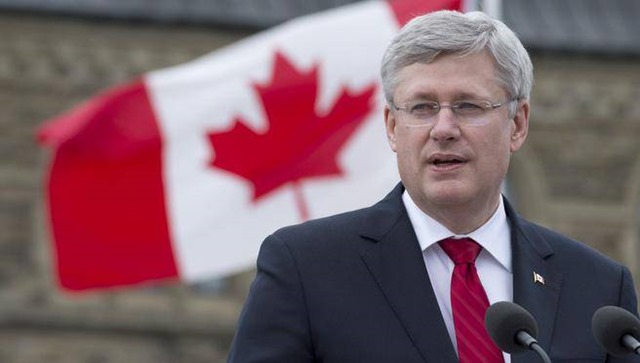
B97319909Z.120140516151800000GUH5J504.11           Three little-tent parties suit Stephen Harper just fine, because small, dirty and divided is his game, writes Ralph Surette. (ADRIAN WYLD / CP)

Watching Stephen Harper envenom not only the politics of the day but hammer at our deepest societal framework — the rule of law, democratic process — is to wonder what will be left of our self-respect as a nation if he wins the next election, thanks to a splintered electorate.

Once the light of the world on many fronts, Canada is now denounced regularly on environment, foreign aid and other things. Germany’s Bertelsmann Foundation, which rates governments every three years, has Canada slipping fast in “good government” ratings. Of the “high-quality governance structures” Canada once had in place, it said in its most recent report, “the actions of the Canadian government . . . have jeopardized this situation.”

Harper is a genius at totalitarian-style manipulation that feeds on the divisions that it has itself created, and at keeping the public confused. The fact that his party is still in the game at all according to the polls, despite one anti-democratic binge after another, attests to that.

Despite everything, he comes out with only a few light scratches over his scandalous attack on Supreme Court Chief Justice Beverley McLachlin on a trumped-up accusation.

This is not just a nasty spat. The Harperists have been attacking the courts from Day 1, and their problem is not with this or that judge — it is with the rule of law itself. The PMO’s reported fury at a string of setbacks suffered at the hands of the Supreme Court tells us ever more clearly that the Conservatives see the law as their plaything, to be bent to their purposes.

Harper is a clear-headed ideologue — all the more dangerous for that. Having bragged to the effect that “you won’t recognize Canada after I’m through with it,” his stated goal is to destroy the Liberal party and turn his own into the “natural governing party.”

The time for natural governing parties is probably over, but he can take some satisfaction in the reduced state of the Liberal party. The Harperists’ one telling argument is that Justin Trudeau “is not ready for prime time.” As regularly as Harper assaults democracy, Trudeau puts his foot in his mouth. And the recent signal given by its exclusion of pro-life candidates on the abortion issue is that the Liberal party is no longer a “big-tent” party. Three little-tent parties suit Harper fine, because small, dirty and divided is his game.

One would hope that by the time the next election rolls around in a year and a half, the game will be absolutely clear to the electorate. The idea of Harper in power another four years to rip up treaties, pervert the electoral process, pass manipulative omnibus bills, deepen the hold of oil and other resource companies over government, rig the tax system for partisan purposes, politicize the bureaucracy, plus attack environmentalists, scientists, civil society groups and parliamentary watchdogs, among others, should give us pause indeed.

Actually, many people get it now — the Harperists linger at some 20 per cent in the polls in Atlantic Canada and at 13 per cent in Quebec, raising the prospects of election night opening with fewer than a half dozen Conservative seats east of Ontario, and maybe none at all. The Prairies won’t budge much, despite some Conservative libertarians objecting to Harper’s iron grip, leaving Ontario and B.C. to decide. There, the Harperists are behind the Liberals, but not by much.

Harper’s argument there is that he’s going to heroically balance the budget and cut taxes. That is, he’s going to slash at everything, like services to veterans, and, especially, dump costs on the provinces. (Even the Parliamentary Budget Officer doesn’t know what exactly is being cut — that’s hidden in the last omnibus bill.)

With these savings, he’ll propose to cut taxes aimed at key voting groups in the money belts around Toronto and Vancouver that can be counted on to put self-interest above country.

If only Canadians saw what the outside sees. Once the light of the world on many fronts, Canada is now denounced regularly on environment, foreign aid and other things. Germany’s Bertelsmann Foundation, which rates governments every three years, has Canada slipping fast in “good government” ratings. Of the “high-quality governance structures” Canada once had in place, it said in its most recent report, “the actions of the Canadian government . . . have jeopardized this situation.”

Meanwhile, last November, with the media saturated with the Senate and Rob Ford scandals, Canadians heard nothing of the thrashing we got at the Warsaw Climate Change Conference, where several studies put us down with Saudi Arabia, which flares off oilfield gas, and a couple of others as one of the dirtiest nations on Earth per capita, thanks mostly to the tar sands.

Meanwhile, the opposition Liberals and NDP, which two-thirds of the electorate would like to see come together to put an end to Harper, instead are locked in their own frenzied combat, making it more likely that the Conservatives will slip through in those contested areas. And another Harper victory, even in a squeaky minority, would kill any chance that this country can retake its place as a positive force in the world.

Harper is a genius at totalitarian-style manipulation that feeds on the divisions that it has itself created, and at keeping the public confused. The fact that his party is still in the game at all according to the polls, despite one anti-democratic binge after another, attests to that.

About the Author

ralph Surette

Ralph Surette is a freelance journalist in Yarmouth County.

E-Mail: rsurette@herald.ca

Want to buy your way into Canada? New options revealed

By Majorie van Leijen    May 13 2014   https://www.zawya.com

Want to buy your way into Canada? New options revealed

Photo Credit:REUTERS/David McNew

New investment programme in Canada in the making

In February this year, the two investment programmes that existed were scrapped by the Canadian government, along with the backlog of thousands of applications. What had been the gateway to Canadian citizenship for the high net-worth-individuals for many years was suddenly a closed door.

However, it seems that the door will not remain shut, as several options have already been discussed. Most concrete were recent statements made by Chris Alexander, Minister of Immigration and Citizenship, to the Chinese media about the details of a new investment pilot scheme, which is set to be launched by the year-end.

According to news sources, the new programme would take the shape of a venture capital pilot, with a minimum investment amount that is more than twice as much as the previous amount, which was CAD800,000.

The investment would involve a privately managed at-risk venture capitalist investment, with a strong focus on start-up businesses, whereas the original programme offered a risk-free investment; the funds were eventually returned in full, interest free. The financing option that existed would no longer be part of the new pilot.

Further, the period of investment would probably exceed the previous investment period, which was a five-year period. However, language and residency requirements would most likely not be terribly stringent.

When the Immigrant Investment Programme (FIIP) and the Entrepreneur Programme were cancelled three months ago, the Citizenship and Immigration Canada (CIC) explained that in order to move forward with programmes that would more accurately capture the types of investors needed in Canada, CIC would instead eliminate the files currently in the backlog.

With that decision, 65,000 backlogged applications were returned. “By doing away with the current IIP and EN programmes, the government will pave the way for new pilot programmes that will actually meet Canada’s labour market and economic needs,” was the argument of the CIC.

However, not much was revealed about these programmes after that, claimed Sergio Marchi, former Minister of Citizenship & Immigration and Member of the global Council on Migration at the sidelines of the Citizenship by Investment & International Residence Summit, held in Dubai last month.

“Rather than refocusing and reinvigorating the programme, it was terminated without providing the public with a transparent economic analysis of the costs and benefits it brought to Canada,” he said.

Over the last 25 years, some 3,000 high net-worth-individuals have become residents annually, representing over CAD10 billion of investments, he points out. “These investments have been used to fund Canadian priorities, including support for SMEs and debt reduction.”

In general, the focus of the Canadian immigration policy has been more on the worker than on the investor. On average, immigrant investors comprised between 2-3 per cent of all immigrants who come into Canada each year, and a total of 130,000 investors have arrived in Canada over the past 25 years.

Ironically, the country was among the first to adopt an immigrant investment programmes, a concept which has been applied in many countries ever since. However, there is currently only the Start-Up Programme, which is an option for the entrepreneur to do business in Canada in return for permanent residency.

© Emirates 24|7 2014

Georgetti: The Tories Attack on the Middle Class Should Worry You

Ken GeorgettiKen Georgetti    President, Canadian Labour Congress

12/04/2013   http://www.huffingtonpost.ca

The Conservative government is engaged in a campaign to distract their supporters from a series of Senate scandals and cover ups. The Conservative fundraising machine believes that if it feeds its base a constant diet of someone to dislike, the donation cheques will keep rolling in. Workers and their unions are their current targets with a long list of legislation designed to keep their base happy.

The Conservative government’s recent volleys against workers and their unions will only serve to undercut the well-being and security of middle-class families in Canada if they succeed in pushing through their anti-union legislation. The Globe and Mail said as much in a recent series of articles on growing inequality in Canada — “declining unionization has contributed to wage inequality.”

Canada’s labour movement is not just about decent jobs, it’s about a better life for everyone. Unions have worked to protect good jobs, make workplaces safer, fought for paid vacation time, public health insurance and the Canada Pension Plan. When union members stand up for fairness everyone benefits — whether you belong to a union or not.

Canadians will see through the government’s attempts to divide people against one another. At one end of the legislative spectrum, the government uses giant omnibus bills to throw everything but the kitchen sink into one piece of legislation. The current budget bill runs to 308 pages and in the fine print it makes sudden and dramatic changes to the Canada Labour Code. One of those changes would place workers’ lives at risk by eroding their right to refuse dangerous work.

Other amendments to federal labour laws would erode workers’ constitutional right to bargain collectively by letting the government unilaterally, without negotiation, change the rules for bargaining with their employees. To add insult to injury, witnesses to the parliamentary committee studying the bill who would speak out against the changes were deliberately scheduled to testify after the deadline for the committee to make amendments passed.

What is the government really trying to fix here? We know that well over 99 per cent of all collectively bargained contracts in Canada result in an agreement rather than a strike or lockout. There was no consultation with any of the parties affected by this proposed legislation, and changing the rules without consultation and negotiation is simply heavy-handed and unfair. Given the Supreme Court of Canada will soon rule on very similar legislation introduced by the Saskatchewan government, the ideological cousins of this government, it’s also premature.

At the other end of the legislative spectrum, the Prime Minister’s Office (PMO) is offending parliamentary tradition by using its influence to introduce Private Member’s Bills and to force their passage. That is what happened with Bill C-377, an unconstitutional piece of legislation that will force labour organizations (but no one else) to undertake costly and time consuming reporting of even the most minute of financial transactions.

Bill C-377 was supposedly the initiative of backbench Conservative MP Russ Hiebert but we know that special interest groups met frequently with the PMO, including the Prime Minister’s Chief of Staff Nigel Wright, and the PMO exerted pressure in order for the bill to pass.

The senate found Bill C-377 to be so offensive that it was sent back to the House of Commons in June with numerous amendments. But then the Prime Minister shut down Parliament and Bill C-377 is now going to be sent to the senate all over again. Bill C-377 is ideologically-motivated and aimed at wasting union members’ money and it is not needed. Our members already have access to financial information about the unions to which they belong.

Bill C-525, another Private Member’s Bill put forward by a Conservative MP, would make it nearly impossible for workers in the federally-regulated sector to join a union. The bill would consider workers who don’t bother to vote in a certification vote as casting “no” ballots on having a union. That’s not democratic — giving those who don’t vote control over those who do. If those rules applied to electing MPs, Parliament would be empty. One set of rules for Conservatives and a different set for workers — that’s unfair.

Finally, the recent Conservative Party convention in Calgary passed a number of aggressively anti-worker resolutions. One of them would allow some workers to stop paying union dues but still receive all the benefits that the union negotiates – all at the expense of their coworkers who do pay their dues. Leave it to ethically-challenged Conservatives, counselling people that it’s okay to dine and dash at a restaurant while leaving others at your table to pay the bill. That’s unfair and it’s a recipe for conflict and disruption in the workplace.

This government puts its extreme ideology ahead of all other considerations, but Canadians see these bullying tactics for what they are. The CLC and its affiliates ran a television advertising campaign during October and November 2013. We talked directly to Canadians about the positive role that the labour movement plays in our society. The response to our campaign has been overwhelmingly positive from both union members and the public at large. That response and our polling shows that we are on the side of the vast majority of Canadians. They will support a labour movement that works in the interest of fairness for everyone.

Ken Georgetti is president of the 3.3 million member Canadian Labour Congress.

Andrew Coyne: There’s no spinning it — the Conservatives were spanked in Monday’s byelections

   Andrew Coyne  27/11/13  http://fullcomment.nationalpost.com

Does Stephen Harper realize that he needs to turn things around to win in 2015?   Adrian Wyld/The Canadian PressDoes Stephen Harper realize that he needs to turn things around to win in 2015?

If you were determined to be obtuse about it, you could look at the results of Monday’s byelections and say: nothing changed. The Tories held onto their two seats in the West, the Liberals held onto theirs in Ontario and Quebec. Move along folks, no story here.

Justin Trudeau would have come under less flak if he’d drawn a caricature depicting the Prophet Mohammed. Mr. Trudeau had the temerity to quote fallen NDP leader Jack Layton in his victory address, after the Liberals retained the Bourassa and Toronto Centre seats in Monday’s byelections.

Mr. Trudeau said that the NDP is “no longer the hopeful, optimistic party of Jack Layton … it is the Liberal Party that proved that hope is stronger than fear, that positive politics can, and should win out over negative.”

The invocation of Mr. Layton’s words, penned in a note to Canadians just before he died two years ago – “love is better than anger, hope is better than fear” – has incensed New Democrats, who have all but accused Mr. Trudeau of defaming the memory of their former leader.

You could do this, as I say, only if you took extravagant care to ignore everything else that happened that night: If you focused myopically on the top-line result in each riding, and paid no attention to the popular vote — the trend, the swing, across the nation and over time.

In private, I can assure you, no one in any of the parties does this. Only in the public realm do they say things like “a win’s a win” — which is what you say when a win looks a lot like a loss — and only the most programmed partisans actually mean it.

Only in the most literal sense is the Tories’ 391-vote margin in Brandon-Souris, one of the safest Conservative seats in the country, a “win.” Even the partisans found this hard to say with a straight face. Rather, they were obliged first to pretend that a Forum Research poll showing the Liberals ahead by 29 points the weekend before the election had some basis in reality, the better to conjure up a fantasy “comeback.”

To be sure, every party comes well-stocked with rationalizations on occasions like these, usually introduced by “when you consider” or some such phrase. As in: The Conservatives did pretty well, when you consider we’re in the throes of a massive national scandal. Or: the NDP collapse in Manitoba is understandable, when you consider the unpopularity of the province’s NDP government. It’s not cold, when you consider it’s February.

We would have done better, in other words, but for the fact that we did worse. Figures don’t lie, but losers can consider.

Related

But there’s just no spinning this one. The trends are too pronounced. Across all four ridings, the Tory vote was down 11 points versus the 2011 election, from 39% to 28%, almost exactly mirroring the national polls. The NDP, which might have been expected to gain the most from the Tories’ disfavour — when you consider how well Tom Mulcair has been performing in Parliament — instead dropped five points overall, while the Liberals surged 18 points.

If the drop in the Tory vote was the night’s main story, the rise in the Liberals’ was the other. In Provencher and Brandon-Souris, the Grits blew past the NDP to become the Tories’ main rivals, taking as many votes from the left as they did from the right. In Toronto Centre and Bourassa, they increased their margins of victory, even in the face of spirited challenges from the NDP. Conservative candidates in the East both lost their deposits, as NDP candidates did in the West. Only the Liberals were up across the board.

But the true significance of the result is captured, not by comparison to the last election, but set against the broad sweep of history. The 8.7% of the vote the Conservatives managed to hold onto in Toronto Centre — the riding of David Crombie and David MacDonald — is the party’s worst showing in any election in that riding since Confederation.

The Conservative candidate in Bourassa, likewise, took less than 5% of the vote. That is the second-worst showing for the Conservatives in that riding since 1968, when it was created. (Only 2000, when they split the vote with the Canadian Alliance, was worse.) By contrast, the Liberals’ 43% showing in Brandon-Souris was not only a 37% increase over 2011, it was their best ever.

NP Graphics

NP GraphicsClick to Enlarge

Nothing changed? Come on. We can argue about the reasons, we can debate what it portends, but on the night, there’s no getting away from it: The Conservatives were spanked. No doubt it would have been even worse for the Tories had they actually lost Brandon-Souris (“not unexpected, when you consider the Liberal candidate was the son of the riding’s long-time former Conservative MP”), but the results ought to prompt some deep reflection among the party’s leadership.

No, the Senate scandal is not likely to be at the top of most voters’ minds two years from now. But I rather doubt the Senate scandal, on its own, is what has driven one in four Tory voters to abandon the party: As I say, the polls have been showing the same thing for some time. It’s everything that went before it, and everything that’s happened since.

It’s the general impression that we are being governed by a gang of thugs — secretive, high-handed, unprincipled gusting to unethical, and openly contemptuous of such quaint notions as democratic accountability — an impression that grows more baked in each time the Prime Minister dodges a question in Parliament, or worse, sends in the clownish Paul Calandra to answer in his place.

At the same time, it’s clear the NDP have a lot of work to do to convince voters, not just of the Conservatives’ faults, but of their own virtues as their putative replacements. It must gall Mr. Mulcair, after all his weight and substance, to see the voters flock instead to the lighter-than-air Justin Trudeau. But he still has lots of time to turn things around.

For that matter, so does Stephen Harper. The difference is, Mr. Mulcair seems to realize he needs to.

Postmedia News